


This Grade 6 Ancient Civilizations lesson covers Ancient India, part of the unit “River valley civilizations.” First, read the full lesson with its primary sources, maps and key terms. Then practice with the worksheet, check yourself with the quiz and get ready with the test.
Imagine walking down a straight street in a city that is 4,500 years old. The street runs in a grid. The houses on either side are made of identical baked bricks, and each one has a bathroom connected to a covered drain that runs under the pavement. Nobody has left a king’s name or a story about wars on the walls. We cannot yet read the signs on the small stone seals that merchants used. Yet everything tells us that this was a carefully planned and organized society. The city is Mohenjo-daro, in what is now Pakistan, and it belonged to the first civilization of South Asia.
Guiding question: How did people in ancient India build their first civilizations, and which ideas and beliefs began there?
1. The land of the Indus and the Ganges
The Indian subcontinent is a large triangle of land that juts into the Indian Ocean. People call it a subcontinent because mountains cut it off from the rest of Asia, almost like a separate continent. To the north stand the Himalayas, the highest mountains on Earth. Water surrounds it to the east, west, and south. Two great river systems shaped early life: the Indus in the northwest, which flows through what is now Pakistan to the Arabian Sea, and the Ganges in the north, which flows east across a broad plain to the Bay of Bengal. Snow melting in the Himalayas feeds both rivers, and when they flooded, they left fertile soil on the plains.
Monsoon and climate
The climate depends on the monsoon, a seasonal wind. In summer the wind blows from the southwest and brings heavy rain; in winter it blows from the northeast and the land is dry. When the monsoon is strong, crops grow well; when it fails, there is drought and famine. In the south lies the Deccan Plateau, a dry highland, and in the northwest the Thar Desert. Farmers in the river valleys grew wheat and barley, and later rice in the wetter east; cotton was grown in India earlier than almost anywhere else.
Definition: subcontinent
A large landmass that is part of a continent but is separated from the rest by mountains or other barriers. India, Pakistan, and Bangladesh are in the South Asian subcontinent.
Definition: monsoon
A seasonal wind in South Asia that brings heavy rains in summer and dry weather in winter.
2. The Indus Valley civilization
Around 2600 BCE, towns along the Indus and nearby rivers grew into cities. Archaeologists call this the Indus Valley civilization, or the Harappan civilization, after Harappa. They first excavated that site in 1921, and they found Mohenjo-daro a year later. Since then, researchers have found more than a thousand settlements across an area bigger than ancient Egypt, from the Himalayan foothills to the Arabian Sea. The civilization lasted, at its height, from about 2600 to 1900 BCE.
Planned cities
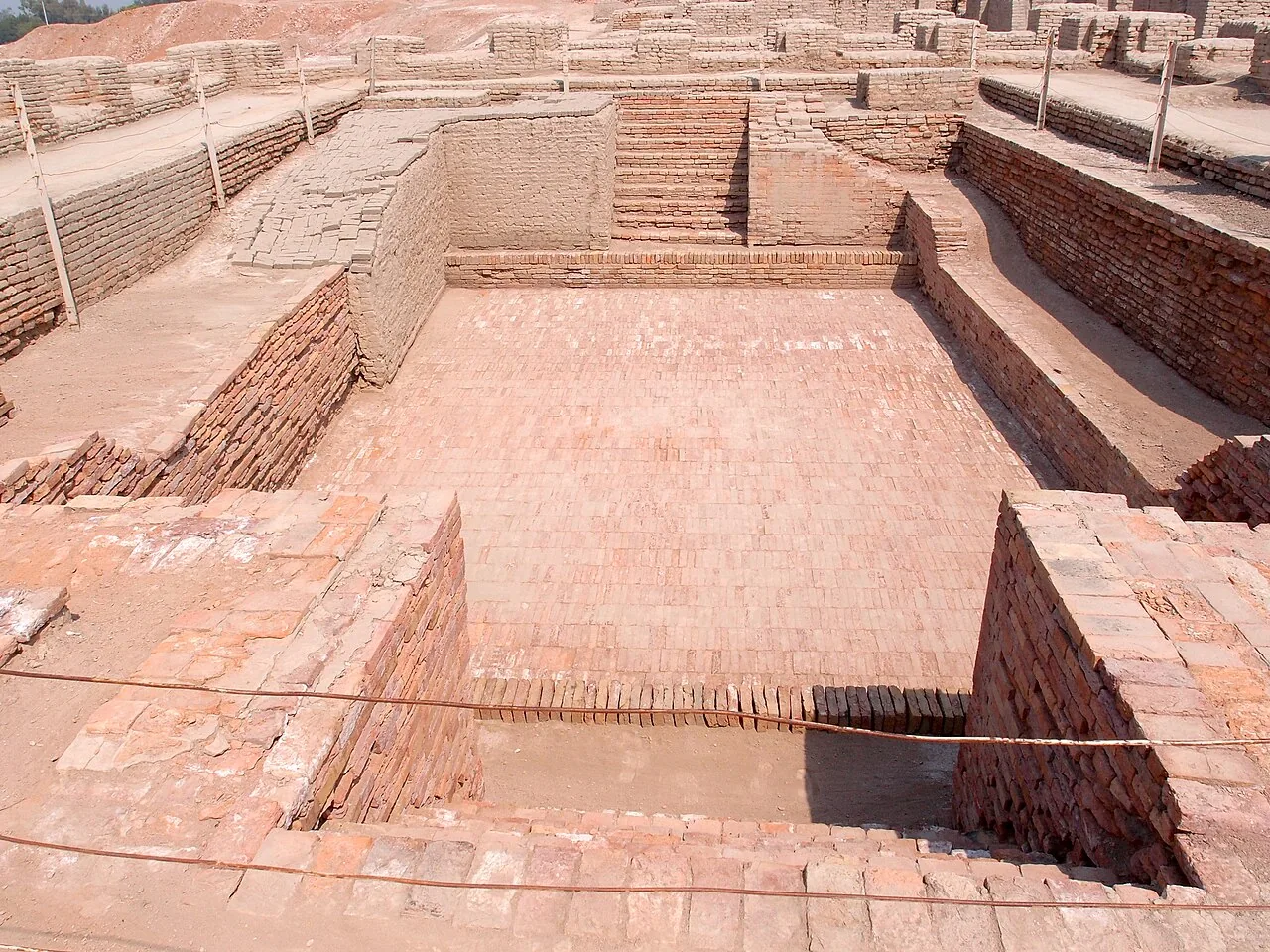
The cities were amazingly well planned. Streets ran north-south and east-west and crossed at right angles. Builders used baked bricks of standard sizes, in a ratio of about 4 to 2 to 1, in every city. Houses had wells and private bathrooms, and wastewater drained into covered sewers, and workers cleaned them through manholes. Many cities had a raised area, called a citadel, with large buildings. At Mohenjo-daro, the citadel holds the Great Bath, a brick-lined pool about 40 feet long and 8 feet deep, made watertight with tar. Archaeologists believe people used it for ritual washing, though no one is certain.
Trade and writing
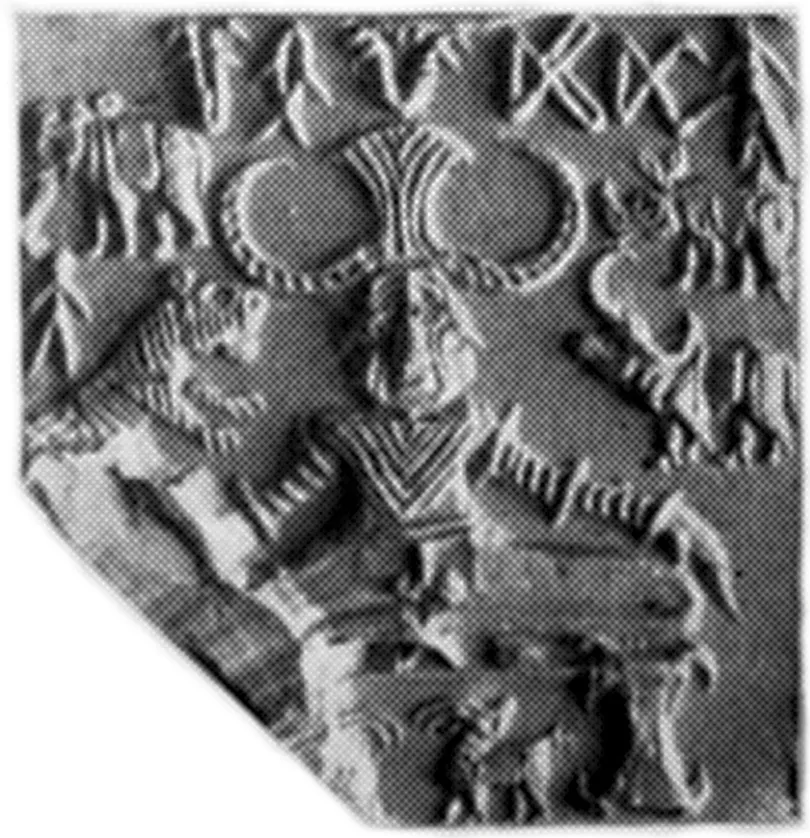
The people of the Indus traded far and wide. They used standard stone weights, made beads of carnelian, and exchanged goods with Mesopotamia, probably by sea across the Persian Gulf. Craftworkers made pottery, copper and bronze tools, and cotton cloth. They also made small stone seals, carved with animals and with lines of signs, to stamp clay tags on trade goods.
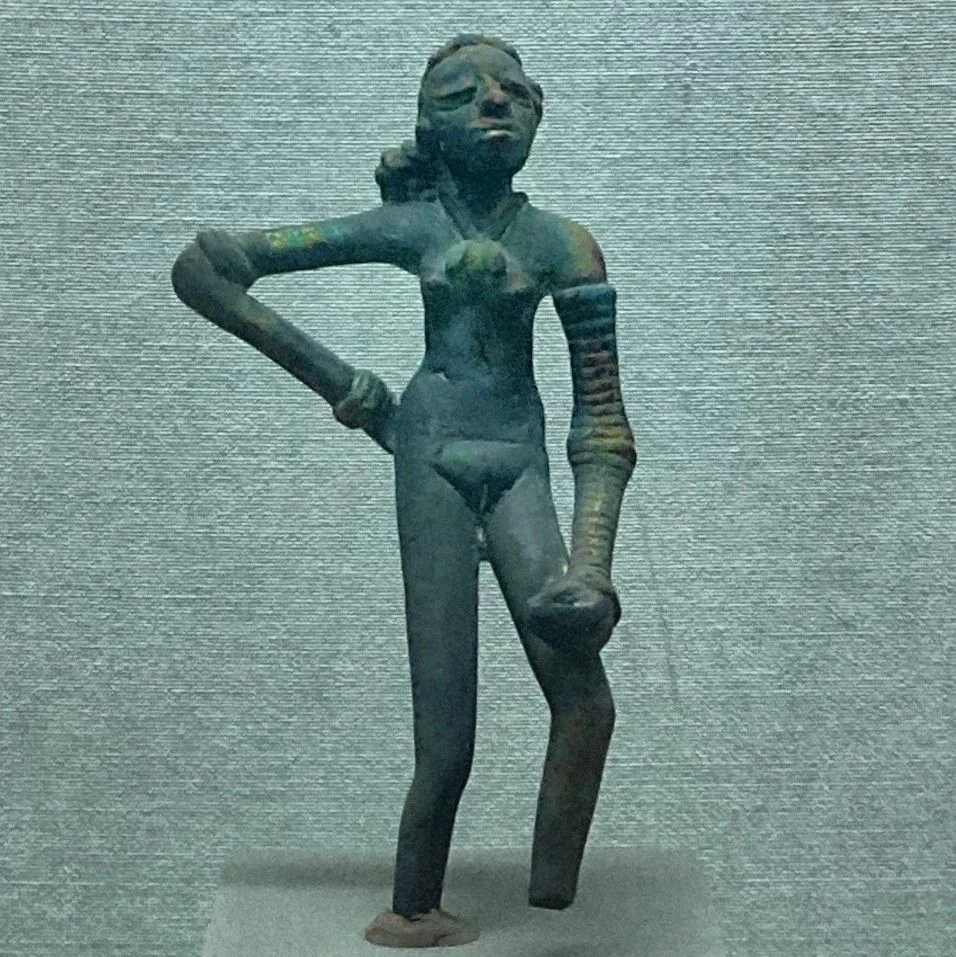
Scholars have found about 400 different signs, but no one has deciphered this script, so we do not know the language, the names of rulers, or the stories of these people. Without written records, archaeologists rely on objects: seals, statues, and the plans of the cities. The figure on one famous seal sits with crossed legs, wears a horned headdress, and is surrounded by animals; some scholars suggest that it is a god, but that remains a guess.
The decline of the cities
There are no clear signs of kings, large palaces, or armies, so historians debate how the cities were governed. After about 1900 BCE the cities declined. The causes are still debated. Some scientists think the climate became drier and that rivers shifted their courses; others point to floods and to the collapse of trade. People moved east toward the Ganges plain, and the cities were forgotten until the 1920s.
3. The Vedic age and the beginnings of Hinduism
After the Indus cities declined, new peoples settled in northern India. Many spoke Indo-Aryan languages, a family related to Greek, Latin, and English. Historians still debate how and when these languages spread to India. Historians call the period from about 1500 to 500 BCE the Vedic age, after the Vedas, collections of hymns and rituals in the old language Sanskrit. The oldest is the Rig Veda, with 1,028 hymns, which priests memorized and recited for many centuries before anyone wrote it down. The Vedas include hymns to gods such as Indra and Agni, and also big questions about how the world began. One of the most famous of them asks who really knows the answer.
Document 1 – The Hymn of Creation
Then was not non-existent nor existent: there was no realm of air, no sky beyond it. What covered in, and where? and what gave shelter? Was water there, unfathomed depth of water? […] Who verily knows and who can here declare it, whence it was born and whence comes this creation? The Gods are later than this world’s production. Who knows then whence it first came into being?
Source: Rig Veda, Book 10, hymn 129 (Nasadiya Sukta), Vedic period, about 1000 BCE (translation by Ralph T. H. Griffith, 1896).
*non-existent, existent: not existing, existing. *unfathomed: too deep to measure.
Commentary. The hymn imagines a time before anything existed, with no air, no sky, no death, and no day or night. It does not give a simple answer: the poet admits that even the gods came after creation and that perhaps nobody, not even the highest power, knows how it began. Historians value this text because it shows that thinkers in ancient India asked questions about the universe, not just prayers for rain and cattle.
Life in the Vedic age was centered on herding and farming, and later on small kingdoms. Society had four groups called varnas: priests (Brahmins), warriors and rulers (Kshatriyas), farmers and merchants (Vaishyas), and servants (Shudras). Over time, these groups split into hundreds of smaller groups called jatis, based on birth and job. Some people stood outside the system altogether. Together these divisions form the caste system. One late Rig Vedic hymn explains the four classes as parts of the body of a giant being whom the gods sacrificed at the beginning of the world.
Document 2 – The Hymn of the Primal Man
A thousand heads hath Puruṣa, a thousand eyes, a thousand feet. […] When they divided Puruṣa how many portions did they make? What do they call his mouth, his arms? What do they call his thighs and feet? The Brahman was his mouth, of both his arms was the Rājanya made. His thighs became the Vaiśya, from his feet the Śūdra was produced.
Source: Rig Veda, Book 10, hymn 90 (Purusha Sukta), late Vedic period, about 1000 BCE (translation by Ralph T. H. Griffith, 1896).
*Puruṣa: the “Primal Man,” whose sacrifice creates the world. *Brahman, Rājanya, Vaiśya, Śūdra: the four classes, or varnas, of Indian society: priests, warriors, farmers and merchants, and servants.
Commentary. The hymn describes society as a body: priests came from the mouth, warriors from the arms, farmers and merchants from the thighs, and servants from the feet. This image gave a religious explanation for social differences. A later law code, the Laws of Manu, gave each group its duties. Historians use such texts to learn what the priests who wrote them believed, not necessarily how every person lived. Many people have criticized the caste system for creating inequality, and modern India has laws against caste discrimination.
From the Vedic traditions, Hinduism grew over many centuries. It has no single founder and no single holy book. Its main ideas include dharma (duty and right conduct), karma (the idea that actions have consequences), and reincarnation, the belief that souls are reborn many times until they are freed. Later texts, the Upanishads, taught that the individual self is connected to a universal reality called Brahman.
4. New teachings: Buddhism and Jainism
By about 600 BCE, sixteen kingdoms and republics lay across the Ganges plain, and cities and trade were growing again. Some people questioned the power of priests and the cost of elaborate sacrifices. In this period, two new religious movements appeared, Jainism and Buddhism. Jain teachers, most notably Mahavira, taught ahimsa, or nonviolence toward all living things.
Buddhism began with Siddhartha Gautama, a prince of a small kingdom near Lumbini, in present-day Nepal. According to tradition, he lived from about 563 to 483 BCE, though many historians now date his life somewhat later. The stories say that he left his palace at 29 after seeing the suffering of sickness, old age, and death, studied with teachers, and practiced severe fasting. Finally, at about age 35, he meditated under a tree at Bodh Gaya and became the Buddha, the “awakened one.” He gave his first sermon in a deer park at Sarnath and taught for about forty-five years.
Document 3 – The Buddha’s first sermon: the middle path
There are two extremes, O Bhikkhus, which the man who has given up the world ought not to follow — the habitual practice, on the one hand of those things whose attraction depends upon the passions, and especially of sensuality […] and the habitual practice, on the other hand, of asceticism (or self-mortification), which is painful, unworthy, and unprofitable. There is a middle path, O Bhikkhus, avoiding these two extremes, discovered by the Tathāgata — a path which opens the eyes, and bestows understanding, which leads to peace of mind, to the higher wisdom, to full enlightenment, to Nirvāṇa!
Source: Dhamma-kakka-ppavattana Sutta, the first sermon of the Buddha at Sarnath, a Buddhist text preserved orally and written down centuries later (translation by T. W. Rhys Davids, 1881).
*Bhikkhus: Buddhist monks. *sensuality: pleasure of the senses. *asceticism: severe self-denial. *Tathāgata: a title the Buddha used for himself. *Nirvāṇa: the state of freedom from suffering.
Commentary. The Buddha rejects two extremes: a life of pleasure and a life of harsh self-denial. The “middle path” he describes leads to wisdom and to nirvana, freedom from suffering. Monks memorized this text and wrote it down several centuries after the Buddha’s death, so scholars treat it as an early Buddhist tradition, not a recording of his exact words. It teaches the Four Noble Truths: life involves suffering, suffering comes from craving, suffering can end, and the way to end it is the Eightfold Path of right views, conduct, and mental discipline.
The Buddha did not accept the authority of the Vedas or the caste system as a path to freedom, and he welcomed people of all classes into his community of monks. His message spread along trade routes, first within India and then to Sri Lanka, Central Asia, China, and Southeast Asia.
5. The Maurya Empire and Ashoka
In 326 BCE, Alexander the Great reached the Indus but turned back. A few years later, about 321 BCE, a young leader named Chandragupta Maurya seized the kingdom of Magadha, with its capital at Pataliputra, near modern Patna, and built the first empire to unite most of the subcontinent. A Greek ambassador, Megasthenes, visited his court and described a large army, a network of officials, and a splendid capital. His grandson Ashoka ruled from about 268 to 232 BCE.
Early in his reign, Ashoka was a conquering king. About 261 BCE he attacked Kalinga, a kingdom on the east coast. The war was terrible, and later he had a message carved into rock to tell his people what he felt.
Document 4 – Ashoka after the war in Kalinga
Kalinga was conquered by His Sacred and Gracious Majesty the King when he had been consecrated eight years. One hundred and fifty thousand persons were thence carried away captive, one hundred thousand were there slain, and many times that number died. Directly after the Kalinga had been annexed began His Sacred Majesty’s zealous protection of the Law of Piety, his love of that Law, and his inculcation of that Law. Thence arises the remorse of His Sacred Majesty for having conquered the Kalingas, because the conquest of a country previously unconquered involves the slaughter, death, and carrying away captive of the people. That is a matter of profound sorrow and regret to His Sacred Majesty.
Source: Ashoka, Rock Edict XIII (Shahbazgarhi version), about 260 BCE (translation by Vincent A. Smith, 1901).
*consecrated: crowned as king in a ceremony. *slain: killed. *the Law of Piety: dhamma, Ashoka’s code of moral conduct. *annexed: taken over.
Commentary. Ashoka admits that the war killed 100,000 people and took 150,000 captive, and he says he felt remorse. Historians point out that these numbers may be exaggerated, as kings often did, but the very fact that a ruler publicly regretted his conquest is rare. After Kalinga, Ashoka said he would follow dhamma, a moral code of kindness, tolerance, honesty, and respect for elders, teachers, and all religions. He also turned to Buddhism, though he said that all faiths should be respected.
Ashoka’s reforms
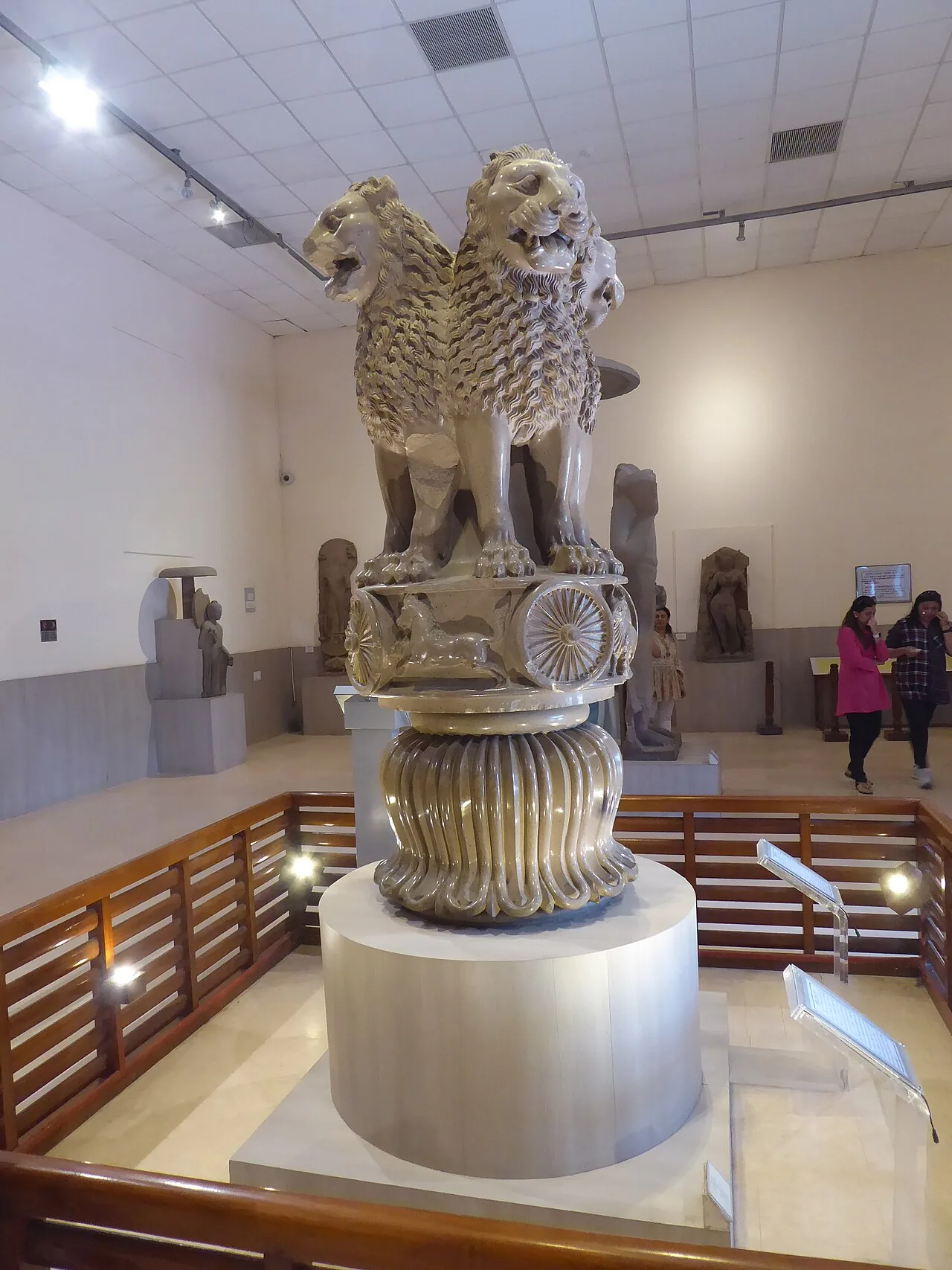
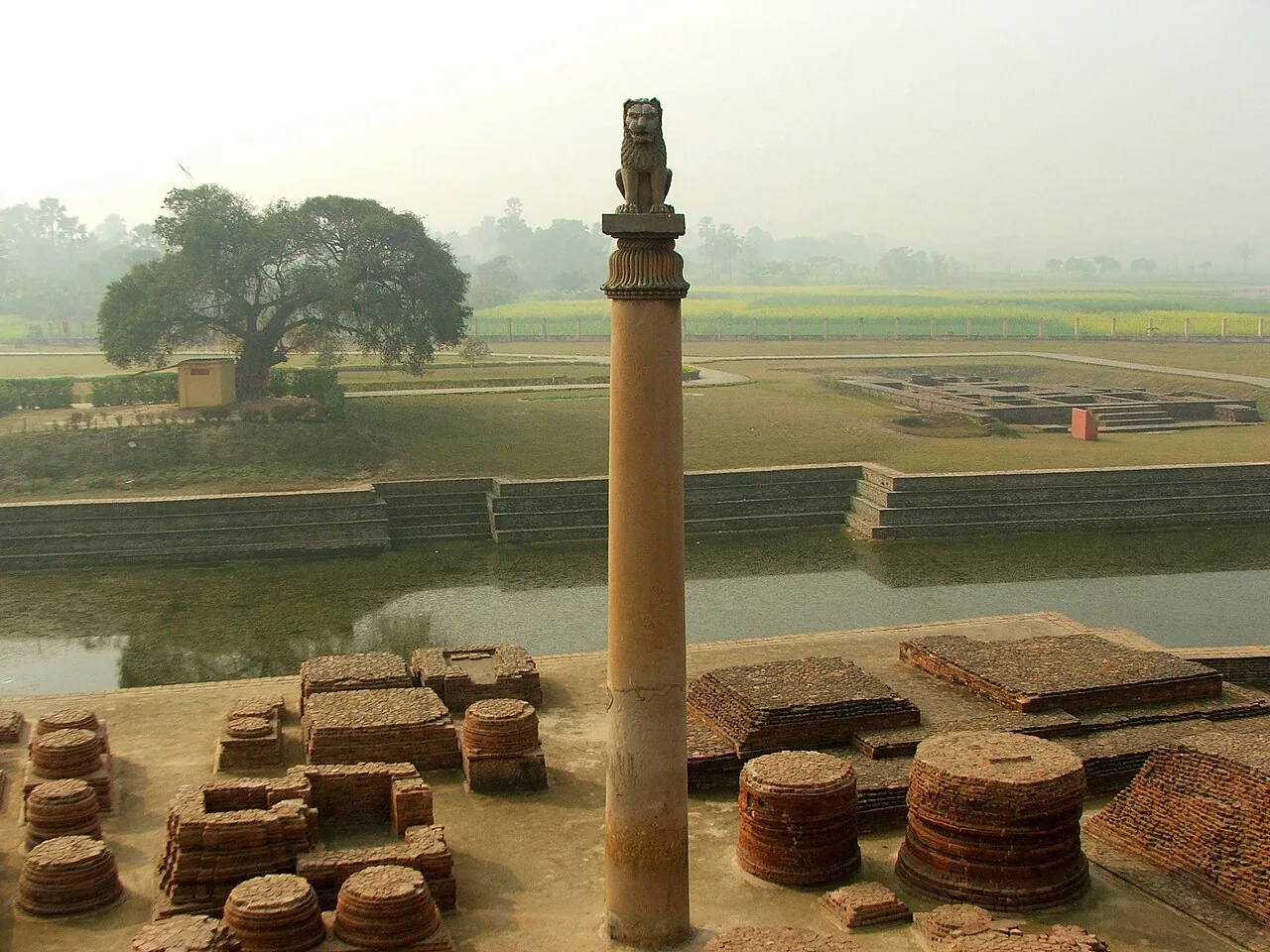
Ashoka had his edicts carved on rocks and on tall polished stone pillars in many parts of the empire, in local languages and in the Brahmi script, and some in Greek and Aramaic in the northwest. He ordered wells dug, trees planted along roads, rest houses built, and hospitals opened for people and animals, and he sent envoys and missionaries to other lands, including Sri Lanka. The Lion Capital of Ashoka, from a pillar at Sarnath, became the emblem of the Republic of India in 1950.
Definition: dhamma
In Ashoka’s edicts, a code of moral conduct based on nonviolence, tolerance, kindness, and respect for others. The Sanskrit form is dharma.
The Gupta age
After Ashoka’s death the empire weakened, and a general overthrew the last Maurya king about 185 BCE. Several kingdoms ruled northern India, and then, in 320 CE, Chandragupta I founded the Gupta dynasty. Under the Guptas (about 320 to 550 CE), art, literature, and science flourished. In addition, mathematicians developed the decimal system with a symbol for zero, which Arab scholars later carried to Europe. We know them today as Arabic numerals. The astronomer Aryabhata calculated the length of the year and suggested that Earth rotates, and the poet Kalidasa wrote plays that are still performed. This age is often called India’s “golden age.”
Legacy
Ancient India left a deep legacy: the idea of nonviolence, major religions and philosophies, numerals and mathematics, and a long tradition of art and literature. Its history also shows how a civilization can be studied without written records, as with the Indus cities, and how kings can use inscriptions to speak to their people.
- About 2600 BCE Cities such as Harappa and Mohenjo-daro appear in the Indus Valley.
- About 1900 BCE The Indus cities decline.
- About 1500-1000 BCE The hymns of the Rig Veda are composed and memorized.
- About 500 BCE The Buddha and Mahavira teach in the Ganges plain (traditional dates for the Buddha: 563-483 BCE).
- About 321 BCE Chandragupta Maurya founds the Maurya Empire.
- About 261 BCE Ashoka conquers Kalinga and then adopts dhamma.
- About 185 BCE The Maurya Empire ends.
- 320 CE Chandragupta I founds the Gupta dynasty.
Key takeaways
- The Himalayas, the Indus and Ganges rivers, and the monsoon shaped life in ancient India.
- The Indus Valley civilization (about 2600-1900 BCE) built planned cities such as Mohenjo-daro, with standard bricks, drains, and the Great Bath; its script is still undeciphered.
- In the Vedic age, the Rig Veda was composed, Sanskrit spread, and society was divided into four varnas.
- Hinduism grew from Vedic traditions; Buddhism and Jainism appeared about 500 BCE and taught paths to freedom from suffering.
- Chandragupta Maurya founded the first empire to unite most of India; after the war in Kalinga, Ashoka governed according to dhamma and carved his edicts on rocks and pillars.
- The Gupta age brought great advances, including the decimal system and the zero.

Quick review: flashcards
Tap a card to see the answer.