


This worksheet on Ancient China: the Shang and Zhou Dynasties belongs to the Grade 6 Ancient Civilizations course. Its questions use primary sources, maps and timelines, and they move from basic recall to short writing tasks. Before you start, review the lesson; afterward, try the true or false quiz.
Exercise 1 : Vocabulary of early China
Define each word, then use it in a sentence.
- loess
- dynasty
- oracle bones
- bronze
- Mandate of Heaven
- feudalism
- filial piety
Hint: use the definition boxes and the lesson.
Exercise 2 : A speech to the soldiers
Document 1 – King Tang explains why he will attack the last king of Xia
Now, ye multitudes, you are saying, “Our prince does not compassionate us, but (is calling us) away from our husbandry to attack and punish Hsia.” I have indeed heard (these) words of you all; (but) the sovereign of Hsia is guilty, and, as I fear God, I dare not but punish him. […] The king of Hsia in every way exhausts the strength of his people, and exercises oppression in the cities of Hsia. His multitudes are become entirely indifferent (to his service), and feel no bond of union (to him). They are saying, ‘When wilt thou, O sun, expire? We will all perish with thee.’
Source: Book of Documents (Shujing), “The Speech of Thang,” a speech attributed to the founder of the Shang dynasty, about 1600 BCE, put into writing many centuries later (translation by James Legge, 1879).
*ye: you (old English plural). *compassionate: feel sorry for. *husbandry: farming. *Hsia: the Xia dynasty, which came before the Shang. *God: Heaven or the high god. *sovereign: ruler.
- Present the document (nature, author, date, context).
- What do the people complain about?
- What reasons does the king give for attacking Xia?
- Explain how the king uses the idea of Heaven to justify the attack.
- The speech was written down many centuries later. How should a historian use it?
Hint: find what the king says the ruler of Xia does to his people.
Exercise 3 : Before the battle of Muye
Document 1 – King Wu speaks to his army before the Battle of Muye
The ancients have said, “The hen does not announce the morning. The crowing of a hen in the morning (indicates) the subversion of the family.” Now Shau, the king of Shang, follows only the words of his wife. In his blindness he has neglected the sacrifices which he ought to offer […]. They are only the vagabonds from all quarters, loaded with crimes, whom he honours and exalts, whom he employs and trusts, making them great officers and high nobles, so that they can tyrannize over the people, and exercise their villainies in the cities of Shang. Now, I, Fa, am simply executing respectfully the punishment appointed by Heaven.
Source: Book of Documents (Shujing), “The Speech at Mu,” a speech attributed to King Wu of Zhou before the battle of 1046 BCE, written down in the Zhou period (translation by James Legge, 1879).
*Shau: the last Shang king, usually called Di Xin or King Zhou (the same sound as the Zhou dynasty, but a different word). *Fa: the personal name of King Wu. *subversion: ruin. *vagabonds: wanderers without a home. *tyrannize: rule cruelly.
- Present the document.
- What reasons does King Wu give for attacking the Shang king?
- Whom does he say the Shang king trusts, and what do they do?
- What does King Wu say he is doing “respectfully”?
- Why would a general make a speech like this before a battle?
Exercise 4 : Heaven changes its decree
Document 1 – A Zhou statesman explains the Mandate of Heaven
Oh! God (dwelling in) the great heavens has changed his decree respecting his great son and the great dynasty of Yin. Our king has received that decree. Unbounded is the happiness connected with it, and unbounded is the anxiety:—Oh! how can he be other than reverent? When Heaven rejected and made an end of the decree in favour of the great dynasty of Yin, there were many of its former wise kings in heaven. The king, however, who had succeeded to them, the last of his race […] proceeded in such a way as at last to keep the wise in obscurity and the vicious in office. The poor people in such a case, carrying their children and leading their wives, made their moan to Heaven.
Source: Book of Documents (Shujing), “The Announcement of the Duke of Shao,” early Western Zhou, about 1040 BCE (translation by James Legge, 1879).
*decree: command or appointment (the Mandate). *Yin: another name for the Shang dynasty. *reverent: respectful. *obscurity: being unknown or ignored. *vicious: wicked.
- Present the document.
- According to the text, what did Heaven do to the Yin dynasty?
- What mistakes did the last Yin king make?
- What did the poor people do, and what did Heaven do in response?
- Explain the meaning of the Mandate of Heaven in your own words.
Exercise 5 : Heaven's favor can be lost
Document 1 – The Duke of Zhou warns that Heaven’s favor can be lost
Prince Shih, Heaven, unpitying, sent down ruin on Yin. Yin has lost its appointment (to the throne), which our House of Kau has received. […] The favour of Heaven is not easily preserved; Heaven is difficult to be depended on. Men lose its favouring appointment, because they cannot pursue and carry out the reverence and brilliant virtue of their forefathers.
Source: Book of Documents (Shujing), “The Prince Shih,” a speech attributed to the Duke of Zhou, early Western Zhou, about 1040 BCE (translation by James Legge, 1879).
*unpitying: without mercy. *Kau: Legge’s spelling of Zhou. *appointment: here, the Mandate of Heaven. *virtue: good character. *forefathers: ancestors.
- Present the document (nature, speaker, date).
- What happened to the Yin dynasty, according to the Duke of Zhou?
- What warning does he give the new rulers?
- Why would he warn his own family about the Mandate of Heaven?
- How does the idea in this text limit a king’s power?
Exercise 6 : Laws or virtue?
Document 1 – Confucius on government by laws and by virtue
If the people be led by laws, and uniformity sought to be given them by punishments, they will try to avoid the punishment, but have no sense of shame. If they be led by virtue, and uniformity sought to be given them by the rules of propriety, they will have the sense of shame, and moreover will become good.
Source: Confucius, Analects, Book II, chapter 3, about 500 BCE (translation by James Legge, 19th century).
*uniformity: making everyone behave the same way. *propriety: proper behavior. *virtue: moral goodness.
- Present the document (nature, author, date).
- What happens, according to Confucius, when people are led by laws and punishments?
- What happens when they are led by virtue and good manners?
- Explain what Confucius thinks a ruler must do to improve his people.
- Do you agree with Confucius? Give one reason.
Exercise 7 : What does a government need?
Document 1 – Confucius on what a government needs
Tsze-kung asked about government. The Master said, “The requisites of government are that there be sufficiency of food, sufficiency of military equipment, and the confidence of the people in their ruler.” Tsze-kung said, “If it cannot be helped, and one of these must be dispensed with, which of the three should be foregone first?” “The military equipment,” said the Master. Tsze-kung again asked, “If it cannot be helped, and one of the remaining two must be dispensed with, which of them should be foregone?” The Master answered, “Part with the food. From of old, death has been the lot of all men; but if the people have no faith in their rulers, there is no standing for the state.”
Source: Confucius, Analects, Book XII, chapter 7, about 500 BCE (translation by James Legge, 19th century).
*Tsze-kung: a student of Confucius (Zigong). *The Master: Confucius. *requisites: requirements. *dispensed with: given up. *foregone: given up.
- Present the document.
- List the three requisites of government that Confucius names.
- Which does he say can be given up first? Which last?
- Explain why Confucius says trust matters more than food.
- What does this teach us about Confucius’ view of a ruler’s responsibility?
Exercise 8 : Two kings, two justifications
Document 1 – King Tang explains why he will attack the last king of Xia
Now, ye multitudes, you are saying, “Our prince does not compassionate us, but (is calling us) away from our husbandry to attack and punish Hsia.” I have indeed heard (these) words of you all; (but) the sovereign of Hsia is guilty, and, as I fear God, I dare not but punish him. […] The king of Hsia in every way exhausts the strength of his people, and exercises oppression in the cities of Hsia. His multitudes are become entirely indifferent (to his service), and feel no bond of union (to him). They are saying, ‘When wilt thou, O sun, expire? We will all perish with thee.’
Source: Book of Documents (Shujing), “The Speech of Thang,” a speech attributed to the founder of the Shang dynasty, about 1600 BCE, put into writing many centuries later (translation by James Legge, 1879).
*ye: you (old English plural). *compassionate: feel sorry for. *husbandry: farming. *Hsia: the Xia dynasty, which came before the Shang. *God: Heaven or the high god. *sovereign: ruler.
Document 2 – King Wu speaks to his army before the Battle of Muye
The ancients have said, “The hen does not announce the morning. The crowing of a hen in the morning (indicates) the subversion of the family.” Now Shau, the king of Shang, follows only the words of his wife. In his blindness he has neglected the sacrifices which he ought to offer […]. They are only the vagabonds from all quarters, loaded with crimes, whom he honours and exalts, whom he employs and trusts, making them great officers and high nobles, so that they can tyrannize over the people, and exercise their villainies in the cities of Shang. Now, I, Fa, am simply executing respectfully the punishment appointed by Heaven.
Source: Book of Documents (Shujing), “The Speech at Mu,” a speech attributed to King Wu of Zhou before the battle of 1046 BCE, written down in the Zhou period (translation by James Legge, 1879).
*Shau: the last Shang king, usually called Di Xin or King Zhou (the same sound as the Zhou dynasty, but a different word). *Fa: the personal name of King Wu. *subversion: ruin. *vagabonds: wanderers without a home. *tyrannize: rule cruelly.
- Present each document.
- Which dynasty did each speaker overthrow?
- What accusation does each speaker make against the ruler he will attack?
- Compare how each uses the idea of Heaven.
- What does the similarity suggest about how the Chinese told the story of dynasty changes?
Exercise 9 : Heaven and virtue
Document 1 – The Duke of Zhou warns that Heaven’s favor can be lost
Prince Shih, Heaven, unpitying, sent down ruin on Yin. Yin has lost its appointment (to the throne), which our House of Kau has received. […] The favour of Heaven is not easily preserved; Heaven is difficult to be depended on. Men lose its favouring appointment, because they cannot pursue and carry out the reverence and brilliant virtue of their forefathers.
Source: Book of Documents (Shujing), “The Prince Shih,” a speech attributed to the Duke of Zhou, early Western Zhou, about 1040 BCE (translation by James Legge, 1879).
*unpitying: without mercy. *Kau: Legge’s spelling of Zhou. *appointment: here, the Mandate of Heaven. *virtue: good character. *forefathers: ancestors.
Document 2 – Confucius on government by laws and by virtue
If the people be led by laws, and uniformity sought to be given them by punishments, they will try to avoid the punishment, but have no sense of shame. If they be led by virtue, and uniformity sought to be given them by the rules of propriety, they will have the sense of shame, and moreover will become good.
Source: Confucius, Analects, Book II, chapter 3, about 500 BCE (translation by James Legge, 19th century).
*uniformity: making everyone behave the same way. *propriety: proper behavior. *virtue: moral goodness.
- Present each document.
- What does Document 1 say people must do to keep Heaven’s favor?
- What does Document 2 say a ruler should rely on?
- Compare the two documents: what idea do they share?
- How might a ruler who accepted both texts behave?
Exercise 10 : An oracle bone
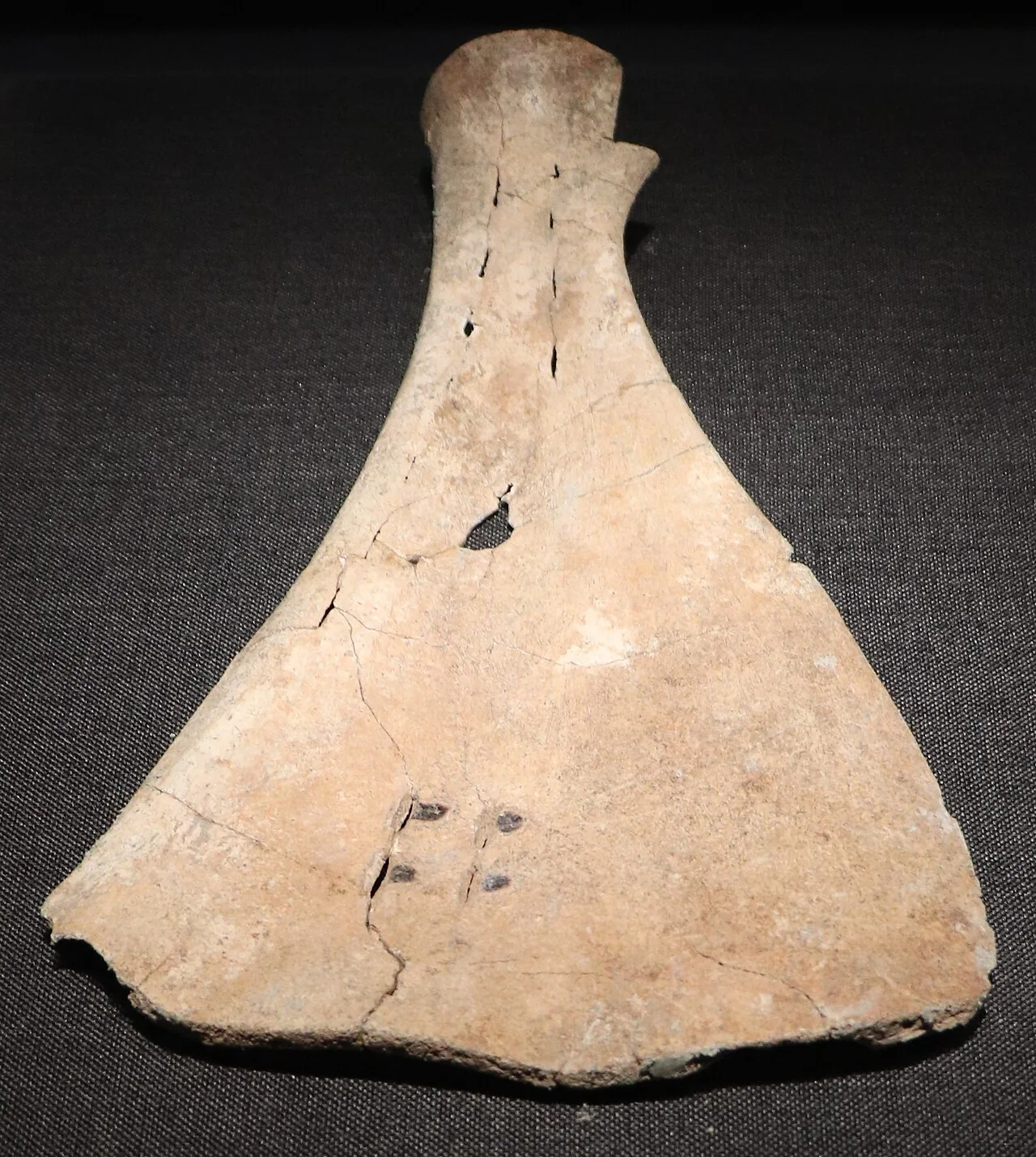
- Present the document (nature, date, place).
- Describe the object. What do you see on its surface?
- How was an oracle bone used, according to the lesson?
- Why are oracle bones important to historians?
- Why is this one harder to read than a long inscription?
Exercise 11 : The Houmuwu ding
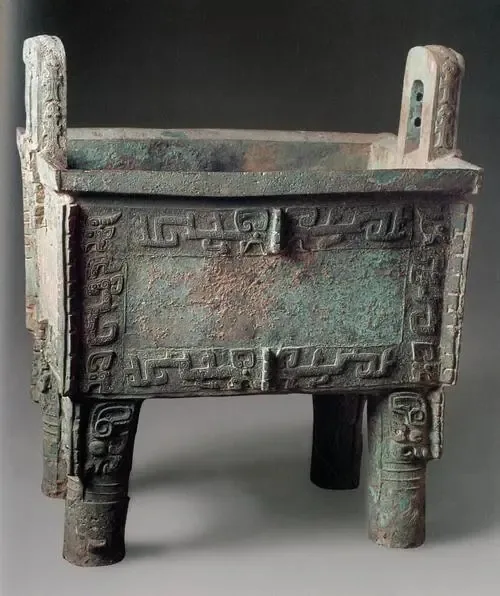
- Present the document.
- Describe the shape and decoration of the vessel.
- What does its size tell you about Shang power and wealth?
- What did the Shang put in vessels like this?
- How does this object show that the Shang worked with metal differently from the Egyptians or the Sumerians?
Exercise 12 : A chariot burial
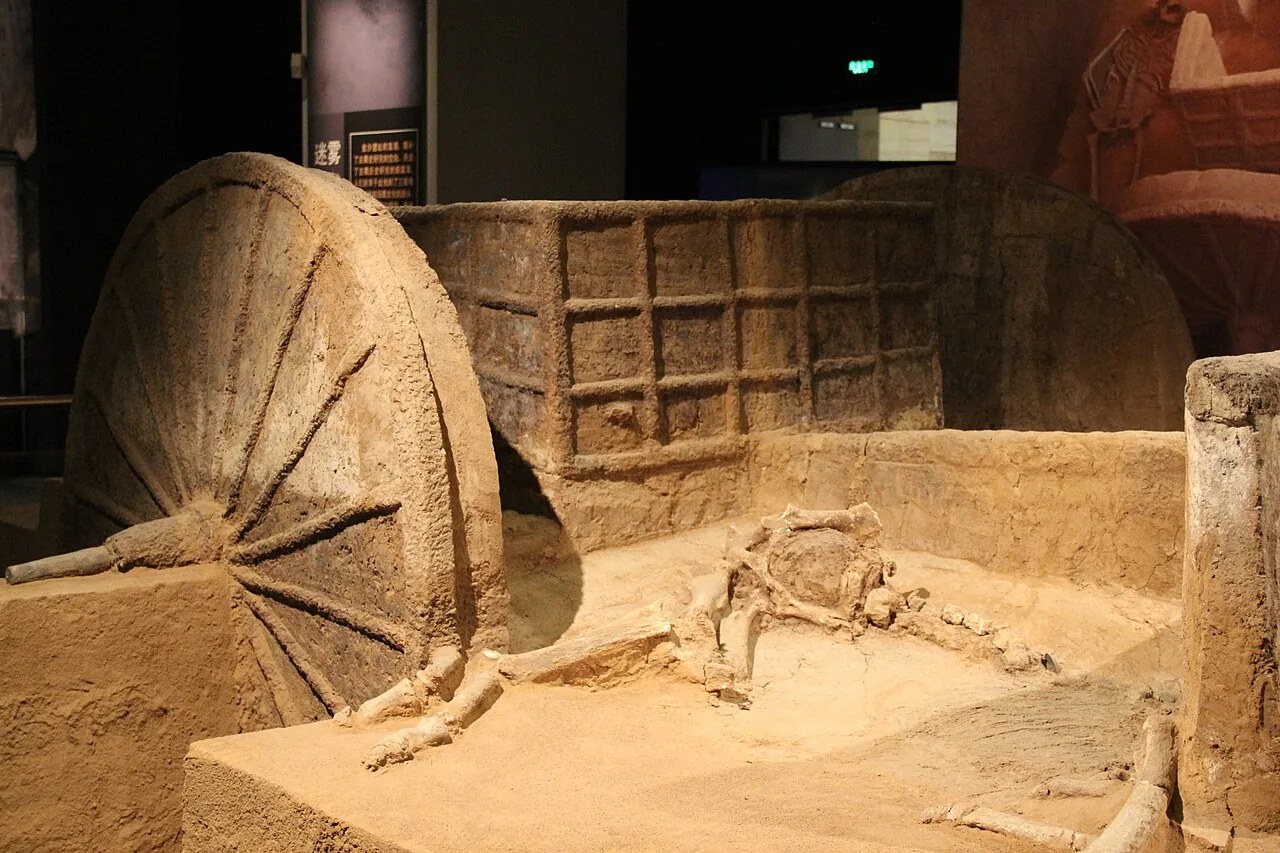
- Present the document.
- Describe what the excavation shows: the wheels, the body of the chariot, and any bones.
- What does the burial tell you about the role of chariots in Shang society?
- Why were chariots and horses buried with important people?
- What kinds of questions could archaeologists ask about this find?
Exercise 13 : A Zhou bronze inscription
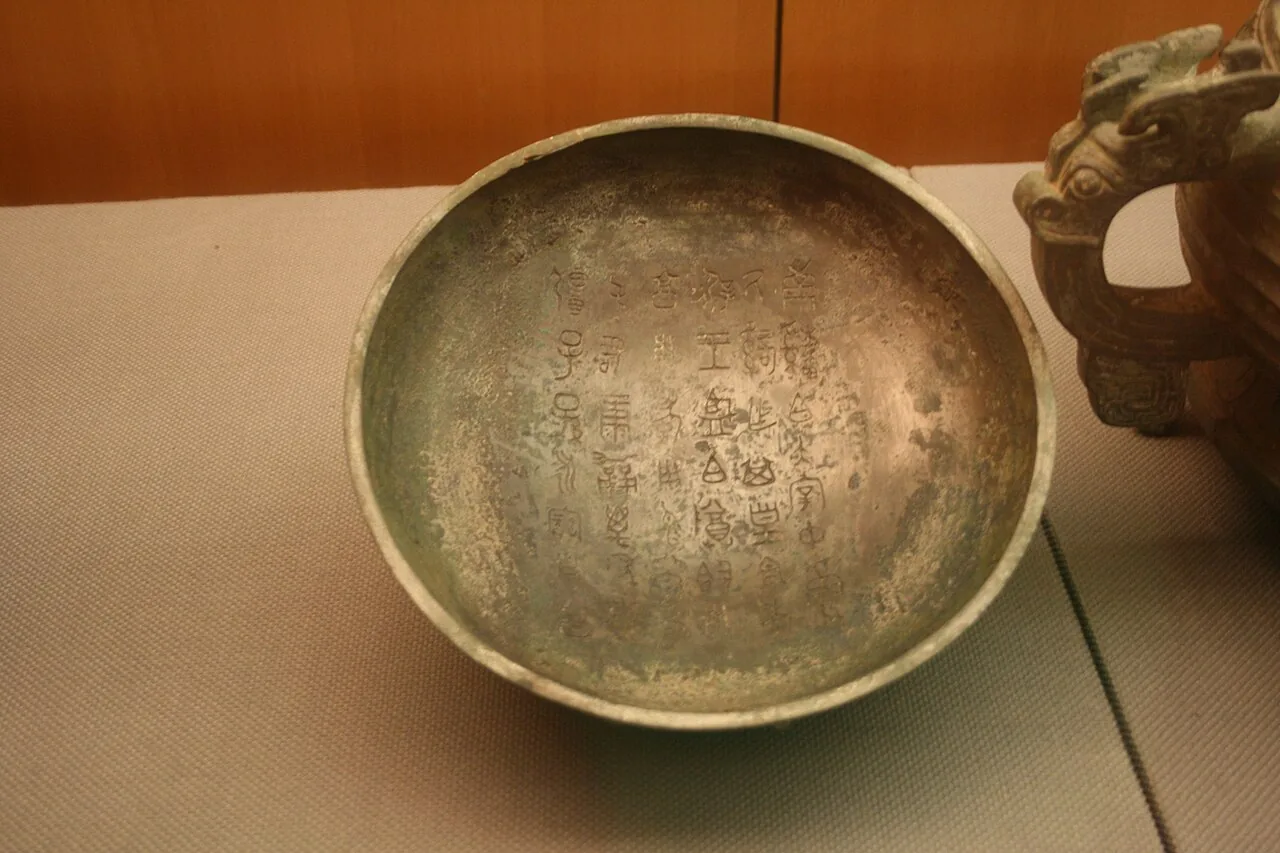
- Present the document.
- Describe the object and where the writing appears.
- What kind of information do inscriptions like this record?
- How is Zhou bronze writing different from Shang oracle bone writing?
- Why are such inscriptions useful to historians?
Exercise 14 : A royal consort's cup
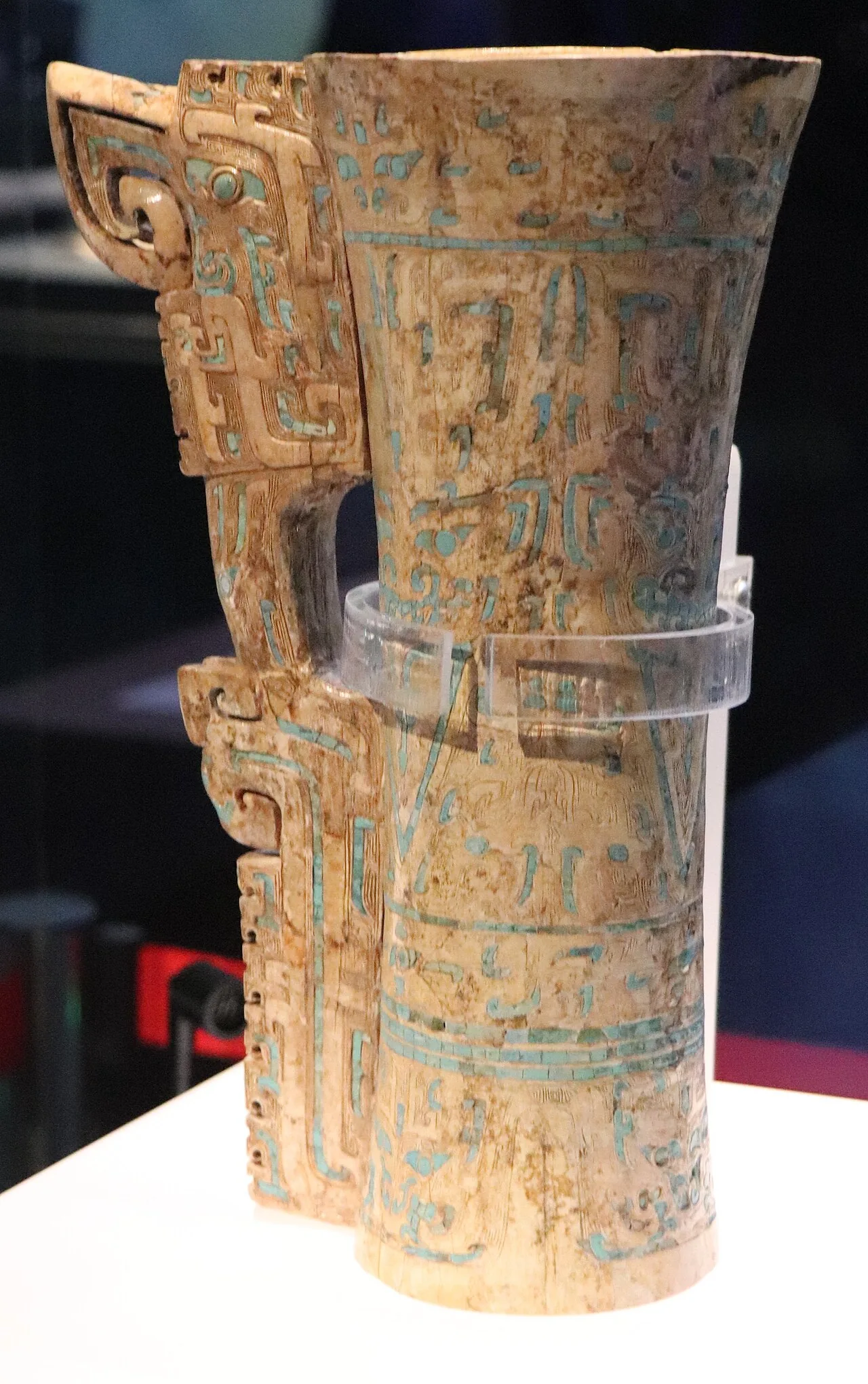
- Present the document.
- Describe the cup: its shape and decoration.
- What does the tomb of Fu Hao tell us about the role of women in the Shang court?
- What does the quality of the work show about Shang craftworkers?
- Why was a tomb that had not been robbed so valuable to archaeologists?
Exercise 15 : Dynasties by the numbers
Document 1 – Early Chinese dynasties
| Period | Dates (approximate) | Capital or center |
|---|---|---|
| Xia (traditional, evidence debated) | about 2070-1600 BCE | unknown |
| Shang | about 1600-1046 BCE | Anyang (Yin), later |
| Western Zhou | 1046-771 BCE | Haojing |
| Eastern Zhou | 770-256 BCE | Luoyi |
Source: dates as commonly given in reference works such as The Cambridge History of Ancient China (1999); the earliest dates are uncertain. Table prepared for this unit.
- For how many years did the Shang dynasty rule?
- For how many years did the Zhou rule altogether (Western and Eastern)?
- Which period was longer, the Western Zhou or the Eastern Zhou? By how many years?
- Why are some dates marked “approximate” or “traditional”?
Exercise 16 : Locate early Chinese sites
- Name the two great rivers on the map.
- Which numbered site was the Western Zhou capital and which was the Eastern Zhou capital?
- In which direction did the Zhou capital move in 770 BCE?
- Explain how the Yellow River helped and harmed early farmers.
Exercise 17 : Complete the map of China
- Name the cities A to D using this list: Haojing, Luoyi, Anyang, Zhengzhou.
- Which city lies farthest north? Which lies farthest west?
- Which sea lies east of the Yellow River’s mouth?
- Explain how geography helped to keep China isolated from other early civilizations.
Hint: find the Wei River valley for the Zhou homeland.
Exercise 18 : Order the events
Put these events in order from the oldest to the most recent.
- Confucius is born.
- The Zhou capital moves east to Luoyi.
- King Wu defeats the Shang at Muye.
- Fu Hao is buried at Anyang.
- Qin unites China.
- The Shang dynasty begins.
Exercise 19 : How long between events?
Calculate each time span. Remember that BCE years count down toward zero.
- From the start of the Shang (1600 BCE) to the battle of Muye (1046 BCE).
- From the battle of Muye (1046 BCE) to the move to Luoyi (770 BCE).
- From the birth of Confucius (551 BCE) to his death (479 BCE).
- From the end of the Zhou (256 BCE) to 2026: how many years? Is that longer or shorter than the Shang dynasty?
Exercise 20 : Guided research: oracle bones
Find out how oracle bones were discovered and read. Use at least two reliable sites, such as the British Museum, the Metropolitan Museum of Art, Britannica, or Asian Art Museum websites. Suggested keywords: oracle bones Shang dynasty museum, Anyang Yinxu UNESCO, oracle bone divination Metropolitan Museum.
- When and how were oracle bones noticed by scholars?
- Where were most of them found?
- What did the Shang diviners do with the bones?
- Which websites did you use, and why do you trust them?
Hint: compare what the two sources say; if they differ, note it.
Exercise 21 : CER paragraph: The Mandate of Heaven
Write a Claim, Evidence, Reasoning paragraph that answers: Did the Mandate of Heaven limit the power of Chinese rulers?
- Claim: state your position.
- Evidence: use at least two details from the documents or the lesson.
- Reasoning: explain how the evidence supports your claim.
Hint: think about what the Zhou said would happen to a cruel ruler.
Exercise 22 : SAQ: Shang and Zhou
Answer in complete sentences.
- Identify two ways the Shang used writing or bronze in religion.
- Explain one reason why the Zhou needed the idea of the Mandate of Heaven.
- Explain one cause of the decline of Zhou power after 771 BCE.
Exercise 23 : True or false? Justify
Decide whether each statement is true or false, and justify your answer.
- Oracle bones are the earliest known Chinese writing.
- The Zhou dynasty came before the Shang dynasty.
- Confucius taught that rulers should lead by moral example.
- The Yellow River is called yellow because of the loess it carries.
Exercise 24 : Causes and consequences: why the Shang fell
Complete the chain and explain each link.
- Cause: the last Shang king is accused of cruelty and bad government. Effect: ______.
- Effect on the Zhou: ______.
- Effect on how the Zhou explained their rule: ______.
- Later consequence for Chinese history: ______.


Quick review: flashcards
Tap a card to see the answer.