


This Grade 6 Ancient Civilizations lesson covers The Ancient Hebrews and the Origins of Judaism, part of the unit “The classical world.” First, read the full lesson with its primary sources, maps and key terms. Then practice with the worksheet, check yourself with the quiz and get ready with the test.
In 1896 the archaeologist Flinders Petrie was digging near Thebes in Egypt when his team found a huge slab of black granite. Its surface was covered with hieroglyphs describing a military victory won by the pharaoh Merneptah about 1208 BCE. In a list of defeated peoples in Canaan, the carvers had cut one name that no one had seen in an Egyptian record before: Israel. That single word is the oldest mention of Israel outside the Bible.
It shows that by the late 1200s BCE a people called Israel lived in Canaan, a small country at the eastern end of the Mediterranean. This small people never ruled a large empire, yet its beliefs, laws, and stories became the foundation of Judaism and left a deep mark on the histories of Christianity and Islam.
Guiding question: How did the ancient Hebrews develop a belief in one God and a body of laws that shaped Judaism, and how did conquest, exile, and Roman rule change their history?
1. Canaan, the Hebrews, and how we know about them
Canaan was the land between the Mediterranean Sea and the Jordan River. It was not rich in rivers or farmland like Egypt or Mesopotamia, but its position was valuable. The main roads that joined Egypt to Mesopotamia ran through it, so traders, armies, and ideas passed through constantly. Strong neighbors, first Egypt and later Assyria, Babylon, Persia, Greece, and Rome, repeatedly tried to control it. The ancient Hebrews, who were also called Israelites and later Judeans or Jews, lived in this crossroads and were often overrun by larger powers.
Definition: Hebrew Bible
The collection of sacred writings of Judaism. Jews also call it the Tanakh. It has three parts: the Torah (the first five books), the Prophets, and the Writings. Historians use it as a source, but because it was written and edited over many centuries, they compare it with other evidence.
Our main source for early Hebrew history is the Hebrew Bible. Historians treat it as they treat other ancient texts: it contains traditions, laws, poems, and histories written down long after some of the events it describes. Where other evidence exists, such as the Merneptah Stele, Assyrian and Babylonian records, and archaeology, scholars compare it with the Bible. Sometimes they agree. Sometimes they do not, and historians debate what to conclude. In this unit we study what the Hebrews themselves believed and remembered, and we also look at what outside sources can confirm.
2. From Abraham to the kingdom
According to the Book of Genesis, the story of the Hebrews begins with a man named Abraham, who left the city of Ur in Mesopotamia and traveled to Canaan. The Bible says that God made a promise to him. In return for his faithfulness, Abraham would have many descendants and a land for them. This promise is called a covenant, a binding agreement between God and a people.
Document 1 – The call of Abraham
Now the LORD had said unto Abram, Get thee out of thy country, and from thy kindred, and from thy father’s house, unto a land that I will shew thee: And I will make of thee a great nation, and I will bless thee, and make thy name great; and thou shalt be a blessing: And I will bless them that bless thee, and curse him that curseth thee: and in thee shall all families of the earth be blessed.
Source: Hebrew Bible, Genesis 12:1-3, King James Version (1611). The story is set in the early second millennium BCE, but Genesis was written down much later.
*shew: show. *kindred: relatives. *curse him that curseth thee: harm whoever harms you.
Commentary. This text is the starting point of the Hebrew tradition. It contains three ideas that would last: a special relationship with God, a promised land, and the hope that the family would become “a great nation.” The last line shows that the author thought of the blessing as reaching all peoples. A historian cannot prove from this passage that Abraham lived, but it tells us what later generations believed about their origins.
Moses and the Exodus
The Bible then follows Abraham’s son Isaac and grandson Jacob, who was also called Israel. Jacob had twelve sons, whose families became the twelve tribes of Israel. A famine drove the family to Egypt, where, the Bible says, their descendants were enslaved. The central event of the Hebrew Bible is the Exodus, the escape from Egypt led by Moses. At Mount Sinai, the Bible says, God gave Moses laws, including the Ten Commandments, and the people renewed the covenant.
Jews still remember the Exodus each spring at the festival of Passover. No Egyptian record mentions Moses or the Exodus, so historians are divided. Some think a small group of escaped slaves joined other peoples in Canaan; others think the story grew out of several memories. All agree that it became the core story of Hebrew identity.
Judges and kings
By about 1200 BCE the tribes were settling in the hill country of Canaan. For some time they had no king. Leaders called judges led them in times of war. Pressure from the Philistines, a people who lived on the coast and had iron weapons, persuaded the tribes to unite under a king.
The Bible names Saul as the first king, followed about 1000 BCE by David, who made Jerusalem his capital, and by his son Solomon, who according to tradition built the first Temple in Jerusalem about 960 BCE. The Temple was the center of worship, where priests offered sacrifices. These kings are known mostly from the Bible; outside evidence for them is limited, and scholars debate how large their kingdom was.
After Solomon died, about 930 BCE, the kingdom split in two. The northern kingdom kept the name Israel and its capital was Samaria. The southern kingdom was called Judah, with Jerusalem as its capital. The word Jew comes from Judah, because after the northern kingdom disappeared, the people of Judah became the main carriers of the tradition.
3. Conquest and exile
The two kingdoms were small, and larger empires crushed them. In 722 BCE the army of Assyria captured Samaria and ended the kingdom of Israel. Many Israelites were deported to other parts of the Assyrian empire and mixed with other peoples. In 701 BCE the Assyrian king Sennacherib attacked Judah. His army destroyed the city of Lachish, and a stone relief in his palace at Nineveh shows the siege. Jerusalem was also threatened. King Hezekiah of Judah had prepared by digging a tunnel to bring spring water inside the walls. A workers’ inscription found in the tunnel in 1880 describes how two teams of diggers met in the rock. Jerusalem did not fall at that time.
The next blow came from Babylon. In 586 BCE the Babylonian king Nebuchadnezzar II captured Jerusalem, burned the Temple, and carried thousands of Judeans, especially the leaders and skilled workers, to Babylon. This period is called the Babylonian Exile. It was a crisis: the people had lost their king, their land, and their Temple, where sacrifices could be offered. Psalm 137 captures their grief.
Definition: Exile
The forced removal of a people from its homeland. The Babylonian Exile (586-539 BCE) forced many Judeans to live in Babylonia without their Temple.
Life in exile
In exile, the Judeans adapted. They gathered to read and discuss their sacred writings, and many scholars think that this period was when the Torah and other books were collected and edited into much of the form we know. Because they could not offer sacrifices at the Temple, they stressed prayer, the study of the law, and the observance of the Sabbath, the weekly day of rest. The prophets, who spoke in the name of God, taught that the disaster had come because the people had broken the covenant, but they also promised a return.
The return came when Persia conquered Babylon. In 539 BCE Cyrus the Great took the city and, according to the Book of Ezra and to the Cyrus Cylinder, allowed exiled peoples to go home and rebuild their temples. Many Judeans returned to Jerusalem, and the Second Temple was finished about 516 BCE. Not everyone returned, however. Large Jewish communities stayed in Babylonia, and others settled in Egypt and elsewhere. The word for this scattering is Diaspora, which means “dispersion.”
Definition: Diaspora
The dispersion of Jews outside their homeland. From the Babylonian Exile onward, Jewish communities lived in many lands of the Near East, the Mediterranean, and later Europe.
4. Beliefs, laws, and the spread of Judaism
What made the Hebrews different from their neighbors was their belief in one God. Most peoples of the ancient Near East worshiped many gods. Egyptians, Babylonians, and Canaanites each had gods of the sun, storms, and fertility. The Hebrew tradition taught that there is only one God, creator of the world, who cares how people treat one another. This belief is called monotheism. Historians discuss when it developed. Many think it grew gradually and was firmly established by the time of the Exile. The prayer called the Shema, “Hear, O Israel: the Lord our God is one,” sums it up.
Definition: Monotheism
The belief in a single God. Judaism is one of the oldest monotheistic religions.
Laws and prophets
The covenant also meant rules. The Torah, the first five books of the Hebrew Bible, contains laws on worship, family life, food, business, and justice. The best known are the Ten Commandments, which forbid worshiping other gods and also forbid murder, theft, adultery, and false witness. Among ancient law codes, such as the Code of Hammurabi, the Hebrew laws are notable for connecting justice with God’s will, and for repeated commands to protect the weak: the widow, the orphan, and the foreigner. The Bible reminds the people that they themselves “were strangers in the land of Egypt.”
A line of prophets carried this message to the kings. Amos, Isaiah, Micah, and Jeremiah lived between the 8th and 6th centuries BCE. They did not mainly predict the future; they criticized injustice and religious show. The prophet Amos said that God cared more about justice than about festivals. Their teachings on justice and peace, such as “they shall beat their swords into plowshares,” are still quoted today.
Foreign rule and revolt
After the Exile, the Jews were ruled by outsiders: Persians, then Greeks after Alexander the Great (332 BCE), and then Romans. When a Greek king, Antiochus IV, tried to force Greek religion on the Jews in 167 BCE, the Maccabees led a revolt and recaptured the Temple in 164 BCE, an event celebrated at Hanukkah. In 63 BCE the Roman general Pompey captured Jerusalem. Later, Rome appointed Herod the Great as king, and he rebuilt the Temple on a grand scale.
Tensions with Rome led to a great revolt in 66 CE. In 70 CE Roman troops under Titus took Jerusalem and destroyed the Second Temple. A relief on the Arch of Titus in Rome, built to honor him, shows soldiers carrying the Temple menorah in a victory parade. After another revolt, led by Simon Bar Kokhba (132-135 CE), the emperor Hadrian forbade Jews to live in Jerusalem. Many Jews now lived outside Judea. Without the Temple, the center of religious life moved to the synagogue, a place of prayer and study, and to the teaching of rabbis. Their discussions of the law were written down in the Mishnah about 200 CE and, later, in the Talmud.
Document 2 – The Arch of Titus
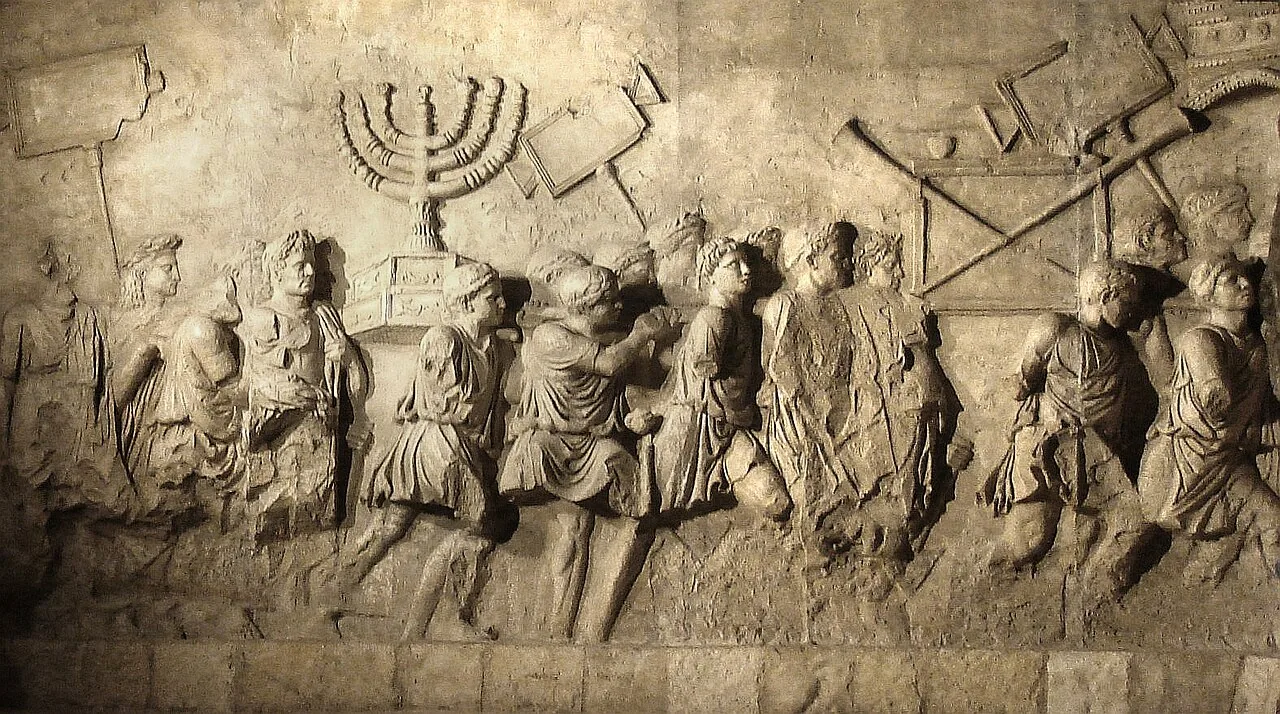
Source: Wikimedia Commons; Arch of Titus, Forum Romanum, Rome, about 81 CE.
Commentary. This relief is a Roman view of the destruction of Jerusalem. On the left, soldiers carry the seven-branched menorah, a golden lampstand from the Temple; on the right, other objects such as trumpets are carried on poles. The Romans carved it to praise their victory, but it also preserves proof of what the Temple held. The menorah later became a symbol of Judaism. The relief shows how history depends on who tells it: here the winners tell it.
A religion without a state
Judaism survived without a state, a king, or a Temple. Its laws, its texts, and its communities held it together over centuries of dispersion. Christianity grew out of the Jewish world of the first century CE, and Islam later honored many of the same prophets; for this reason the Hebrew tradition is part of the background of three world religions. These later traditions each developed on their own.
- About 1208 BCE The Merneptah Stele names “Israel” in Canaan.
- About 1000 BCE David makes Jerusalem the capital (traditional date).
- About 960 BCE Solomon builds the first Temple (traditional date).
- About 930 BCE The kingdom splits into Israel and Judah.
- 722 BCE Assyria captures Samaria; the kingdom of Israel ends.
- 586 BCE Babylon destroys Jerusalem and the Temple; the Exile begins.
- 539 BCE Cyrus of Persia takes Babylon; exiles may return.
- About 516 BCE The Second Temple is finished.
- 164 BCE The Maccabees recapture the Temple.
- 70 CE Romans destroy the Second Temple.
- 135 CE Bar Kokhba revolt ends; Jews are banned from Jerusalem.
Key takeaways
- The Hebrews lived in Canaan, a crossroads between Egypt and Mesopotamia; the Merneptah Stele (about 1208 BCE) is the oldest outside record of Israel.
- According to the Bible, God made a covenant with Abraham and renewed it through Moses at Sinai; the Ten Commandments are part of the Torah.
- After about 930 BCE the kingdom split into Israel and Judah; Assyria ended Israel in 722 BCE and Babylon destroyed Jerusalem and its Temple in 586 BCE.
- The Exile led to the Diaspora, and strengthened prayer, study of the law, and the collection of the Hebrew Bible.
- Monotheism, ethical law, and the message of the prophets are the heart of Judaism; after the Romans destroyed the Second Temple in 70 CE, the synagogue and the rabbis became central.

Quick review: flashcards
Tap a card to see the answer.