


This Grade 6 Ancient Civilizations lesson covers Ancient Greece, part of the unit “The classical world.” First, read the full lesson with its primary sources, maps and key terms. Then practice with the worksheet, check yourself with the quiz and get ready with the test.
In September of 490 BCE, an army of about ten thousand Athenians and their Plataean allies stood on a plain near the village of Marathon and looked at a Persian force that outnumbered them and had come to conquer Greece. Persia ruled the largest empire the world had yet seen. Athens was one small city. When the Greeks charged, they won. Ten years later, at sea, they won again. These victories happened because Greek cities were willing to fight for their freedom, and that freedom was one of the unusual ideas of the ancient Greeks: that citizens should have a voice in their own government.
Guiding question: How did geography and different ideas about government shape Greek city-states such as Athens and Sparta, and what did Greek culture leave to the world?
1. Mountains, seas, and city-states
Greece is a land of mountains and sea. Mountains divide the mainland into small valleys and plains, and thousands of islands lie in the Aegean and Ionian Seas. Because travel by land was hard and travel by sea was easier, Greek people developed small, independent communities near the coast and became skilled sailors and traders. The soil was thin and good farmland was scarce, so Greeks grew olives and grapes, raised sheep and goats, and bought grain from other lands.
Greek civilization had earlier roots. The Minoans of Crete (about 2000-1450 BCE) built palaces such as Knossos, and the Mycenaeans of the mainland (about 1600-1100 BCE) built fortresses and traded across the sea. After the Mycenaean world collapsed, Greece passed through a poorer period with little writing. By about 800 BCE Greeks had borrowed an alphabet from the Phoenicians and added vowels, and new cities were growing. The poems of Homer, the Iliad and the Odyssey, were composed in these years and became the shared stories of all Greeks. According to tradition the first Olympic Games were held in 776 BCE in honor of Zeus.
Definition: Polis (city-state)
A Greek city and the land around it, governed independently. A polis usually had a fortified hill called an acropolis and a marketplace and meeting place called the agora. Its citizens thought of the polis as their community.
Independent city-states
The Greeks never formed one country. They lived in hundreds of independent city-states, each with its own laws, army, and gods. They shared a language, religion, and festivals such as the Olympic Games, and they called themselves Hellenes, but cities often fought each other. Between about 750 and 500 BCE, growing populations and the search for land and trade sent Greeks overseas to found colonies. Syracuse in Sicily, Massalia (Marseille) in France, Byzantium on the Bosphorus, and Cyrene in North Africa all began as Greek colonies.
2. Athens and Sparta: two ways to govern
Kings ruled early Greek cities, and then small groups of wealthy landowners took over, a system called oligarchy, which means “rule by the few.” Many cities also fell under the control of tyrants, who seized power by force and often had the support of ordinary people. Two cities, Athens and Sparta, became the most important and chose very different paths.
Definition: Democracy
A government in which the people rule. The word comes from the Greek demos (the people) and kratos (power). In Athens citizens voted directly on laws and decisions instead of choosing representatives.
Wealthy aristocrats ruled Athens in the 7th century BCE. Creditors could force poor farmers who could not repay debts into slavery, and the city was close to civil war. In 594 BCE the Athenians gave a leader named Solon the power to fix the crisis. He canceled many debts and also ended the practice of enslaving Athenians for debt. Later, in 508-507 BCE, Cleisthenes reorganized the citizens into new groups, created a Council of 500 chosen from all over Attica, and gave the Assembly of citizens real power. For this reason, historians often call him the founder of Athenian democracy.
Document 1 – Pericles describes Athenian government
Our constitution does not copy the laws of neighbouring states; we are rather a pattern to others than imitators ourselves. Its administration favours the many instead of the few; this is why it is called a democracy. If we look to the laws, they afford equal justice to all in their private differences; if no social standing, advancement in public life falls to reputation for capacity, class considerations not being allowed to interfere with merit; nor again does poverty bar the way, if a man is able to serve the state, he is not hindered by the obscurity of his condition.
Source: Thucydides, History of the Peloponnesian War, Book II, chapter 37, about 400 BCE; the speech was given by Pericles in the winter of 431-430 BCE (translation by Richard Crawley, 1874).
*constitution: the system of government. *democracy: rule by the people. *obscurity of his condition: being unknown or poor.
Commentary. Pericles was the leading Athenian statesman. He gave this speech at a public funeral for soldiers killed in the first year of the war with Sparta. He says that power is in the hands of “the many instead of the few,” that the law gives “equal justice to all,” and that a poor man can serve the state. Remember that Thucydides wrote the speech himself, from memory and from what he thought was appropriate, so it presents an ideal. It also reflects only part of the truth: in Athens only free adult men born to Athenian parents were citizens. Women, enslaved people, and foreigners could not vote.
How Athenian democracy worked
Democracy in Athens was direct. Any citizen could speak and vote in the Assembly, which met on a hill called the Pnyx and decided on laws, war, and taxes. In addition, juries drawn by lot decided court cases, and Athenians picked many officials by lot, not by election. Citizens were also paid for serving, which allowed poorer men to take part. To protect the city from tyrants, the citizens could vote to send a powerful man into exile for ten years, a process called ostracism, because the votes were scratched on pieces of broken pottery called ostraka.
Sparta
Sparta was a very different society. It lay in the southern Peloponnese, and it conquered its neighbors in Laconia and Messenia and forced them to farm for the Spartans as helots, people who were not free and had to give up half of their crops. Because the helots greatly outnumbered the Spartans and sometimes rebelled, Sparta organized its whole society for war.
Sparta had two kings, a council of elders, and five officials called ephors, but real power stayed with a small group of full citizens, so Sparta was an oligarchy. Boys were taken from their families at age seven to begin the agoge, a harsh training that taught obedience, endurance, and fighting. However, Spartan women had more freedom and property than women in Athens, but their main duty was to raise strong sons.
Definition: Phalanx
A battle formation of heavily armed foot soldiers called hoplites, standing shoulder to shoulder with overlapping shields and long spears. It required discipline, because each soldier depended on the man next to him.
The soldiers of Greek cities fought in this way. Sparta had the best army in Greece, while Athens, with its harbor at Piraeus, became strongest at sea, with warships called triremes rowed by about 170 men on three levels.
3. War with Persia and the Golden Age of Athens
Persia ruled the Greek cities of Ionia, on the coast of Asia Minor. In 499 BCE they rebelled, and Athens sent some help. The Persian king Darius I wanted revenge. In 490 BCE his army landed at Marathon, and the Athenians, led by the general Miltiades, defeated it. The next Persian king, Xerxes, returned in 480 BCE with a huge army and fleet.
A small Greek force, including 300 Spartans under King Leonidas, delayed the Persians at the pass of Thermopylae, and the Spartans and their allies died fighting. Meanwhile, the Athenian leader Themistocles had persuaded the city to build a fleet of triremes. In the narrow waters at Salamis, the Greek ships destroyed much of the Persian fleet. In 479 BCE the Greeks won the land battle at Plataea, and the invasion was over.
Document 2 – Miltiades appeals to the commander before Marathon
With thee it rests, Callimachus, either to bring Athens to slavery, or, by securing her freedom, to leave behind thee to all future generations a memory beyond even Harmodius and Aristogeiton. For never since the time that the Athenians became a people were they in so great a danger as now. If they bow their necks beneath the yoke of the Medes, the woes which they will have to suffer when given into the power of Hippias are already determined on; if, on the other hand, they fight and overcome, Athens may rise to be the very first city in Greece.
Source: Herodotus, Histories, Book VI, about 430 BCE; speech of Miltiades to the polemarch Callimachus before the battle of Marathon, 490 BCE (translation by George Rawlinson, 1858-60).
*Harmodius and Aristogeiton: two Athenians honored as heroes for killing a tyrant’s brother. *Hippias: the former tyrant of Athens, who had joined the Persians. *Medes: a name the Greeks often used for the Persians.
Commentary. Herodotus, called the “father of history,” wrote about the Persian Wars a generation later. His speeches are not exact quotations, but they show what Greeks believed about the war: they thought they were fighting to remain free and not to be ruled by a tyrant like Hippias. The Athenian generals were divided, and the polemarch Callimachus cast the deciding vote to fight.
After the war Athens led an alliance of Greek cities, the Delian League, to keep Persia away. Over time Athens used the League’s money and ships to build an empire of its own. Under the leadership of Pericles, from about 460 until his death in 429 BCE, Athens entered its Golden Age. The Athenians rebuilt the Acropolis, which the Persians had burned, and constructed the Parthenon, a great marble temple to Athena, between 447 and 432 BCE. They watched tragedies by Sophocles and Euripides and comedies by Aristophanes in huge open-air theaters.
Philosophers asked questions about the world and how to live: Socrates taught by questioning, his student Plato wrote about justice and the ideal state, and Plato’s student Aristotle studied everything from biology to government. Herodotus and Thucydides wrote history as a search for causes, and Hippocrates taught that diseases have natural causes.
Document 3 – The Parthenon
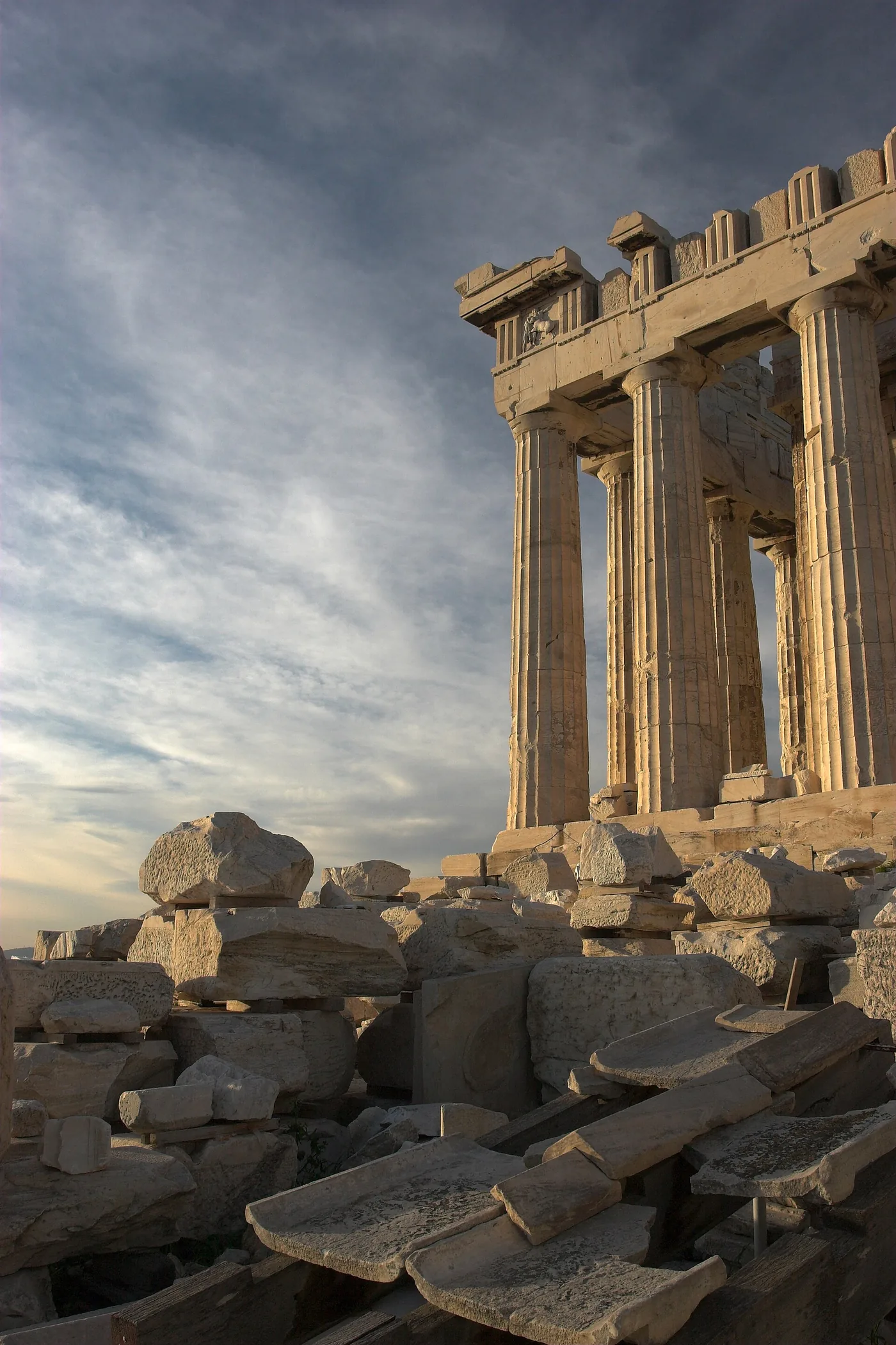
Source: Wikimedia Commons; the Parthenon, Acropolis of Athens, 447-432 BCE.
Commentary. The Parthenon expresses Greek ideals in stone: balance, proportion, and human scale. It is built in the Doric style, with plain, sturdy columns, and carved sculptures once filled the upper parts. The building also shows Athenian power. It was paid for in part with money from the Delian League, and many allies resented that.
Athens’s power frightened Sparta and its allies. In 431 BCE the Peloponnesian War began. Then a plague struck crowded Athens in 430 BCE, and Pericles died of it in 429 BCE. After almost thirty years of fighting, and with money from Persia for a Spartan fleet, Sparta forced Athens to surrender in 404 BCE. Thus the war weakened all the Greek cities.
4. The end of the city-states and the Greek legacy
Weakened by war, the city-states could not defend themselves against the kingdom of Macedonia, to the north. King Philip II defeated Athens and Thebes at Chaeronea in 338 BCE and brought Greece under his control. His son Alexander the Great, who was taught by Aristotle, led a Greek-Macedonian army that conquered Persia and reached India. Alexander died in 323 BCE, and his generals divided his empire. The following era is called the Hellenistic period, because Greek language and culture spread across Egypt and western Asia. In addition, new centers, such as Alexandria in Egypt, became great places for science and learning. In 146 BCE Rome conquered Greece, but Roman leaders admired Greek culture and carried it forward.
Definition: Philosophy
A Greek word that means “love of wisdom.” Greek philosophers used reason to study nature, ethics, and politics, instead of relying only on traditional stories.
The Greek legacy
The Greek heritage is large. Our word democracy is Greek, and the idea that citizens can take part in government has been rediscovered again and again; the framers of the American Constitution knew the Greek examples, though they chose representation over direct voting. Greek writers also created drama and history. Greek mathematicians such as Euclid built geometry, and Greek architecture, with its columns and symmetry, is copied in many government buildings, banks, and museums in the United States. The Olympic Games were revived in 1896. At the same time, we should not forget the limits of Greek society: slavery was common, and women could not vote.
- 776 BCE Traditional date of the first Olympic Games.
- 594 BCE Solon cancels debts and reforms Athens.
- 508-507 BCE Cleisthenes creates the democratic system of Athens.
- 490 BCE Athenians defeat the Persians at Marathon.
- 480 BCE Thermopylae and the naval battle of Salamis.
- 479 BCE The Greeks win the battle of Plataea.
- 447-432 BCE The Parthenon is built on the Acropolis.
- 431-404 BCE The Peloponnesian War; Sparta defeats Athens.
- 338 BCE Philip II of Macedonia wins at Chaeronea.
- 336-323 BCE Alexander the Great rules and conquers Persia.
- 146 BCE Rome conquers Greece.
Key takeaways
- Mountains and sea divided Greece into independent city-states (poleis) that shared a language, religion, and festivals but often fought each other.
- Athens developed a direct democracy for free adult male citizens (Solon in 594 BCE, Cleisthenes in 508-507 BCE); Sparta was a military oligarchy that relied on enslaved helots.
- The Greeks defeated Persia at Marathon (490 BCE), Salamis (480 BCE), and Plataea (479 BCE).
- Under Pericles, Athens built the Parthenon and produced drama, philosophy, and history; the Peloponnesian War (431-404 BCE) ended with Sparta defeating Athens.
- Macedonia and then Rome conquered Greece, but Greek ideas about democracy, philosophy, science, and art spread widely and are still influential.

Quick review: flashcards
Tap a card to see the answer.