


This Grade 6 Ancient Civilizations lesson covers Ancient Rome: from Republic to Empire, part of the unit “The classical world.” First, read the full lesson with its primary sources, maps and key terms. Then practice with the worksheet, check yourself with the quiz and get ready with the test.
On March 15, 44 BCE, a group of about sixty Roman senators gathered in a hall near the Theater of Pompey. Their target was Julius Caesar, the most powerful man in Rome, who had become dictator for life only a few weeks before. They stabbed him to death. The conspirators believed they were saving the Republic from a man who wanted to be king. Instead, they started another round of civil wars, and the Republic that they wanted to protect disappeared within fifteen years. Emperors would rule Rome for the next five hundred years.
Guiding question: How did Rome grow from a small city into the ruler of the Mediterranean, and why did the Republic give way to rule by emperors?
1. The Roman Republic
Rome began as a small town on the Tiber River in central Italy. The site was good: the hills were easy to defend, the river was close to the sea but far enough inland for safety, and the town lay on a crossing used by traders. Romans told a legend that a she-wolf nursed the twin brothers Romulus and Remus, and that Romulus then founded the city in 753 BCE. Historians treat this as a legend, but they know that by about 600 BCE Rome was a real city, ruled by kings who came from the Etruscans, a people living to the north.
According to Roman tradition, in 509 BCE the Romans drove out the last king, Tarquin the Proud, and set up a republic. The Latin words res publica mean “the public thing,” a state that belongs to its citizens. Rome swore never to have a king again, and for centuries the word “king” was hated.
Definition: Republic
A government in which citizens and the officials they choose hold power, not a hereditary king. In the Roman Republic, elected officials, the Senate, and assemblies of citizens shared power.
How the Republic worked
The Roman Republic had several parts. Two consuls, elected each year, led the government and the army. The Senate, a council of about 300 former officials, advised the consuls and controlled money and foreign policy. Assemblies of citizens voted on laws and chose officials. The Greek historian Polybius, who lived in Rome in the 2nd century BCE, admired this arrangement and called it a mixed constitution that balanced one-man power (the consuls), rule by the few (the Senate), and rule by the many (the people). As a result, each part could check the others.
The early Republic was not equal. Wealthy families called patricians held most offices and sat in the Senate, while ordinary citizens, the plebeians, had little voice but did much of the fighting. In 494 BCE, according to tradition, the plebeians went on strike by leaving the city, an event historians call the secession of the plebs, and refused to serve in the army.
As a result, the patricians had to compromise. The plebeians gained officials of their own, the tribunes, who could veto actions that harmed ordinary people. About 450 BCE the Romans wrote the laws on bronze tablets, the Twelve Tables, and displayed them in the Forum so that everyone could know them. Over the next two centuries plebeians won the right to hold every office, including consul.
Document 1 – The fable of the belly
In the days when all the parts of the human body were not as now agreeing together, but each member took its own course and spoke its own speech, the other members, indignant at seeing that everything acquired by their care and labour and ministry went to the belly, whilst it, undisturbed in the middle of them, did nothing but enjoy the pleasures provided for it, entered into a conspiracy; the hands were not to bring food to the mouth, the mouth was not to accept it when offered, the teeth were not to masticate it. [ 10 ] Whilst, in their resentment, they were anxious to coerce the belly by starving it, the members themselves wasted away, and the whole body was reduced to the last stage of exhaustion.
Source: Livy, History of Rome, Book II, chapter 32, written in the late 1st century BCE, about the plebeian secession of 494 BCE (translation by Canon Roberts, 1912).
*plebs: the common people of Rome. *conspiracy: a secret plan. *masticate: chew.
Commentary. Livy wrote centuries after these events, so he may have been repeating a legend. The story shows how Romans of his time understood the struggle between patricians and plebeians. Menenius Agrippa, a senator, tells the angry plebeians that the members of a body must work together: the belly seems to do nothing, but in fact it feeds all the parts. The message is that rich and poor need each other. Note whose point of view the story tells: a senator persuades the plebeians to return, and the fable aims to preserve the existing order.
Document 2 – The Roman Forum
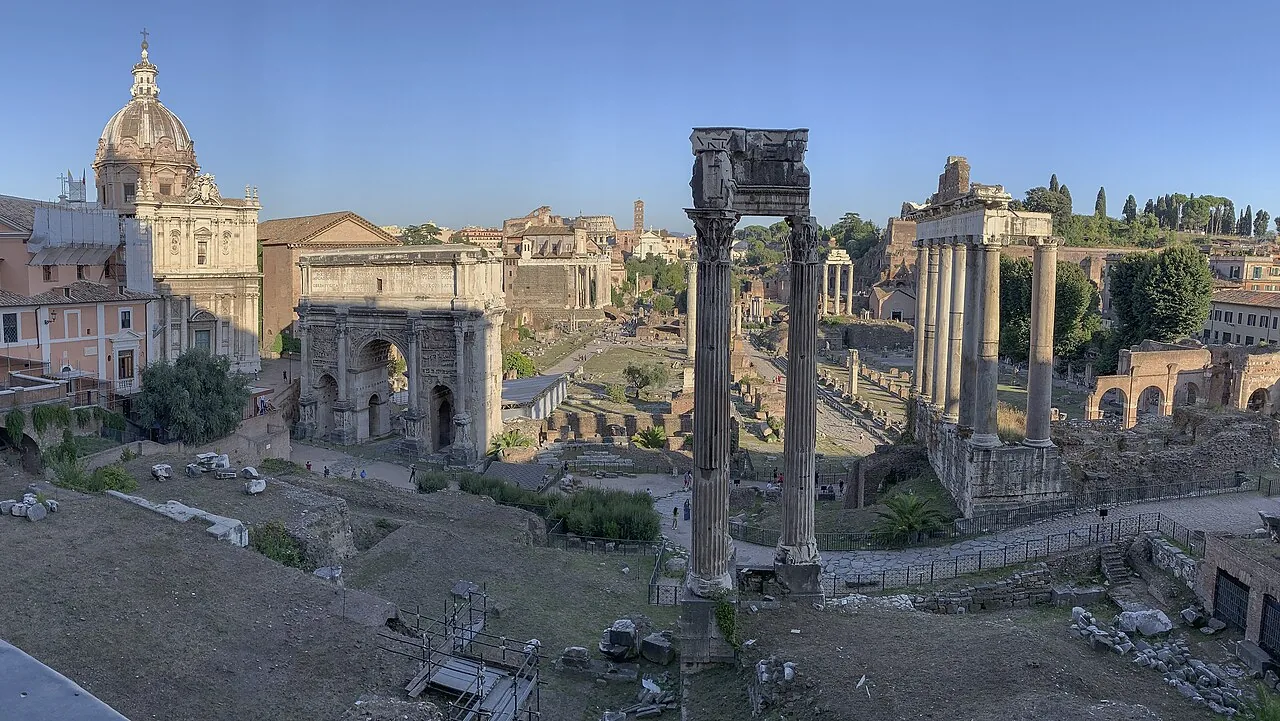
Source: Wikimedia Commons; the Roman Forum, Rome.
Commentary. The Forum was the heart of Roman public life: the Senate met in a building beside it, citizens voted and heard speeches, judges held courts, and people worshiped at its temples. Most of what we see today dates from the Empire, but the place was already the center of the Republic. Few cities have kept their political center in the same place for so long.
2. Conquest of the Mediterranean
Rome’s army was its greatest strength. Citizens served as soldiers in legions, units of several thousand heavily armed infantry, trained to fight in flexible groups. Rome treated defeated Italian cities well: they kept local government but had to supply soldiers, and some received Roman citizenship. By 264 BCE Rome controlled most of the Italian peninsula, and its manpower was enormous.
Definition: Legion
The main unit of the Roman army, made up of several thousand infantry. A legion included soldiers, engineers, and officers, and it could build roads, camps, and bridges as well as fight.
Rome against Carthage
Across the sea lay Carthage, a rich city in North Africa founded by Phoenicians, with a powerful navy. Rome and Carthage fought three wars called the Punic Wars (Punic comes from the Latin word for Phoenician). In the First Punic War (264-241 BCE), Rome built a fleet and won control of Sicily.
In the Second Punic War (218-201 BCE), the Carthaginian general Hannibal led an army with elephants across the Alps into Italy and destroyed a Roman army at Cannae in 216 BCE, one of the worst defeats in Roman history. Rome refused to surrender. The general Scipio took the war to Africa and defeated Hannibal at Zama in 202 BCE. In the Third Punic War (149-146 BCE) Rome besieged and destroyed Carthage. In the same year, 146 BCE, Rome also destroyed Corinth and took control of Greece.
Rome now ruled territories outside Italy, called provinces, each governed by a Roman official and required to pay taxes. Eventually the Romans ruled Spain, Gaul (modern France), Greece, Asia Minor, Egypt, and North Africa. The wealth that poured in changed Rome. Rich men bought up land and worked it with thousands of enslaved prisoners of war, while small farmers who had served for years in the army returned to find their farms ruined. Many of them moved to Rome and became poor and unemployed.
3. Civil wars and the end of the Republic
Reformers tried to address these problems. Tiberius Gracchus, a tribune elected in 133 BCE, proposed to give public land to poor citizens. However, many senators opposed him, and a mob of senators and their supporters killed him. His brother Gaius met a similar end in 121 BCE. Thus the deaths showed that political disagreements in Rome could now lead to violence. The general Marius opened the army to poor volunteers in 107 BCE, which gave landless men a career. But these soldiers depended on their generals for pay and land, and so they became loyal to their generals, not to the Republic.
Document 3 – A reformer speaks for the soldiers
“The wild beasts that roam over Italy,” he would say, “have every one of them a cave or lair to lurk in; but the men who fight and die for Italy enjoy the common air and light, indeed, but nothing else; houseless and homeless they wander about with their wives and children. And it is with lying lips that their imperators exhort the soldiers in their battles to defend sepulchres and shrines from the enemy; for not a man of them has an hereditary altar, not one of all these many Romans an ancestral tomb, but they fight and die to support others in wealth and luxury, and though they are styled masters of the world, they have not a single clod of earth that is their own.”
Source: Plutarch, Life of Tiberius Gracchus, chapter 9, about 100 CE, reporting a speech of 133 BCE (translation by Bernadotte Perrin, Loeb Classical Library, 1921).
*imperators: generals. *sepulchres: tombs. *hereditary altar: a family altar passed down from ancestors. *clod: lump of earth.
Commentary. Plutarch wrote more than two centuries after Tiberius died, so these words are what Plutarch’s sources said he spoke. They show what many Romans believed about the problem: the soldiers who conquered the world had no land at home. Tiberius’s words are an example of political speech that aimed to win the support of the poor.
For the next ninety years powerful generals competed for control. First, Sulla marched his army on Rome in 88 BCE and later made himself dictator. In 73 BCE a gladiator named Spartacus led a slave revolt that Rome crushed in 71 BCE. Then, around 60 BCE, three men, Pompey, Crassus, and Julius Caesar, formed a private alliance to dominate Rome.
Caesar won fame and a loyal army by conquering Gaul in 58-50 BCE. When the Senate ordered him to give up his army, he led it across the Rubicon River, the border of Italy, in January 49 BCE and began a civil war. He defeated Pompey, became dictator, and introduced reforms, including the Julian calendar that is the basis of our own. On March 15, 44 BCE, the conspirators killed him.
More civil wars followed. Caesar’s adopted heir, Octavian, and Caesar’s friend Mark Antony defeated Caesar’s killers, then fought each other. Antony allied himself with Cleopatra, queen of Egypt, and Octavian defeated their fleet at Actium in 31 BCE. As a result, Egypt became a Roman province. In 27 BCE the Senate gave Octavian the title Augustus, meaning “revered one,” and the Republic became in practice an empire.
Document 4 – Augustus describes what he did
In my sixth and seventh consulships, when I had extinguished the flames of civil war, after receiving by universal consent the absolute control of affairs, I transferred the republic from my own control to the will of the senate and the Roman people. For this service on my part I was given the title of Augustus by decree of the senate, and the doorposts of my house were covered with laurels by public act, and a civic crown was fixed above my door, and a golden shield was placed in the Curia Julia whose inscription testified that the senate and the Roman people gave me this in recognition of my valour, my clemency, my justice, and my piety. After that time I took precedence of all in rank, but of power I possessed no more than those who were my colleagues in any magistracy.
Source: Augustus, Res Gestae Divi Augusti (Deeds of the Divine Augustus), chapter 34, written shortly before his death in 14 CE (translation by Frederick W. Shipley, Loeb Classical Library, 1924).
*consulships: terms as consul. *Curia Julia: the Senate house. *clemency: mercy.
Commentary. Augustus wrote his own account of his achievements, which workers carved on bronze pillars outside his tomb and copied on temples in the provinces. He says that he “transferred the republic” to the Senate and the people and that he had no more power than his colleagues. Historians point out the contrast with what he did. He kept control of the army and the provinces where the troops had their bases, and he held many of the powers of the old offices at the same time. In effect, he was the ruler of Rome, while carefully avoiding the hated title of king.
4. The Roman Empire and the Pax Romana
Augustus ruled until 14 CE and gave Rome what it had lacked: peace and order. Later emperors followed his example. The first two centuries of the empire, from 27 BCE to about 180 CE, are called the Pax Romana, the “Roman Peace.” It was not completely peaceful: there were wars on the frontiers and revolts, and the army was always at the ready. But within the Mediterranean world, trade and travel were safer than they had ever been. The empire reached its greatest size under Trajan, who ruled from 98 to 117 CE. Estimates for the empire’s population range from about 50 to 70 million.
Definition: Pax Romana
Latin for “Roman Peace.” It refers to about two centuries (27 BCE to about 180 CE) of relative peace and stability inside the Roman Empire, which allowed trade and the spread of Roman culture.
Roman achievements
The Romans were builders and organizers. They constructed paved roads so that the army and traders could travel across the empire, and aqueducts to carry fresh water to cities. They developed concrete and used the arch to build bridges, theaters, and large domed buildings such as the Pantheon. For example, the Colosseum in Rome held about 50,000 spectators for gladiator fights and animal hunts. Roman law, with ideas such as “innocent until proven guilty,” and the Latin language, from which French, Spanish, Italian, and Portuguese developed, are still part of the modern world. Citizens enjoyed legal rights, and in 212 CE the emperor Caracalla gave citizenship to almost all free people in the empire.
Inequality in the empire
Roman society was also unequal and often cruel. Slavery was widespread, and enslaved people worked in mines, farms, and households. Many of the people who lived in Rome were poor and depended on free grain supplied by the state. Emperors kept them calm with entertainment, such as chariot races and the games in the Colosseum. Women had few political rights. The emperors held enormous power, and a bad emperor could be a disaster. Yet the system that Augustus created lasted for centuries and linked together many peoples from Britain to Egypt.
- 753 BCE Traditional date for the founding of Rome.
- 509 BCE Traditional date for the start of the Republic.
- About 450 BCE The Twelve Tables, Rome’s first written laws.
- 264-241 BCE First Punic War: Rome wins Sicily.
- 218-201 BCE Second Punic War: Hannibal in Italy; Scipio wins at Zama.
- 146 BCE Rome destroys Carthage and Corinth.
- 133 BCE Mobs kill Tiberius Gracchus.
- 49 BCE Caesar crosses the Rubicon.
- 44 BCE Conspirators assassinate Caesar.
- 31 BCE Octavian defeats Antony and Cleopatra at Actium.
- 27 BCE Octavian receives the title Augustus.
- 80 CE The Colosseum opens.
- 117 CE The empire reaches its greatest extent under Trajan.
Key takeaways
- Rome began as a city-state on the Tiber and, by tradition, became a republic in 509 BCE, with consuls, a Senate, and assemblies; the plebeians won rights through the tribunes and the Twelve Tables.
- Rome conquered Italy and then the Mediterranean, defeating Carthage in the Punic Wars (264-146 BCE); the conquered lands became provinces.
- Conquest brought wealth, slavery, and the loss of small farms, and it created armies that were loyal to generals; this led to the civil wars of Sulla, Pompey, and Caesar.
- After Caesar’s murder (44 BCE) and the victory at Actium (31 BCE), Octavian became Augustus (27 BCE) and the Republic gave way to an empire.
- The Pax Romana (27 BCE to about 180 CE) brought peace, trade, roads, law, and Latin, but also slavery and rule by emperors.

Quick review: flashcards
Tap a card to see the answer.