


This Grade 6 Ancient Civilizations test covers Ancient Rome: from Republic to Empire. Like a classroom assessment, it includes documents to analyze, knowledge questions and a short writing task. To prepare, review the lesson first, then practice with the worksheet.
Time : 50 min
The test has three parts: knowledge (32 points), documents (48 points), and a written argument (20 points). Answer in complete sentences and cite the documents.
Document 1 – The Roman Empire about 117 CE
Schematic map prepared for this unit; borders approximate.
Document 2 – Augustus of Prima Porta
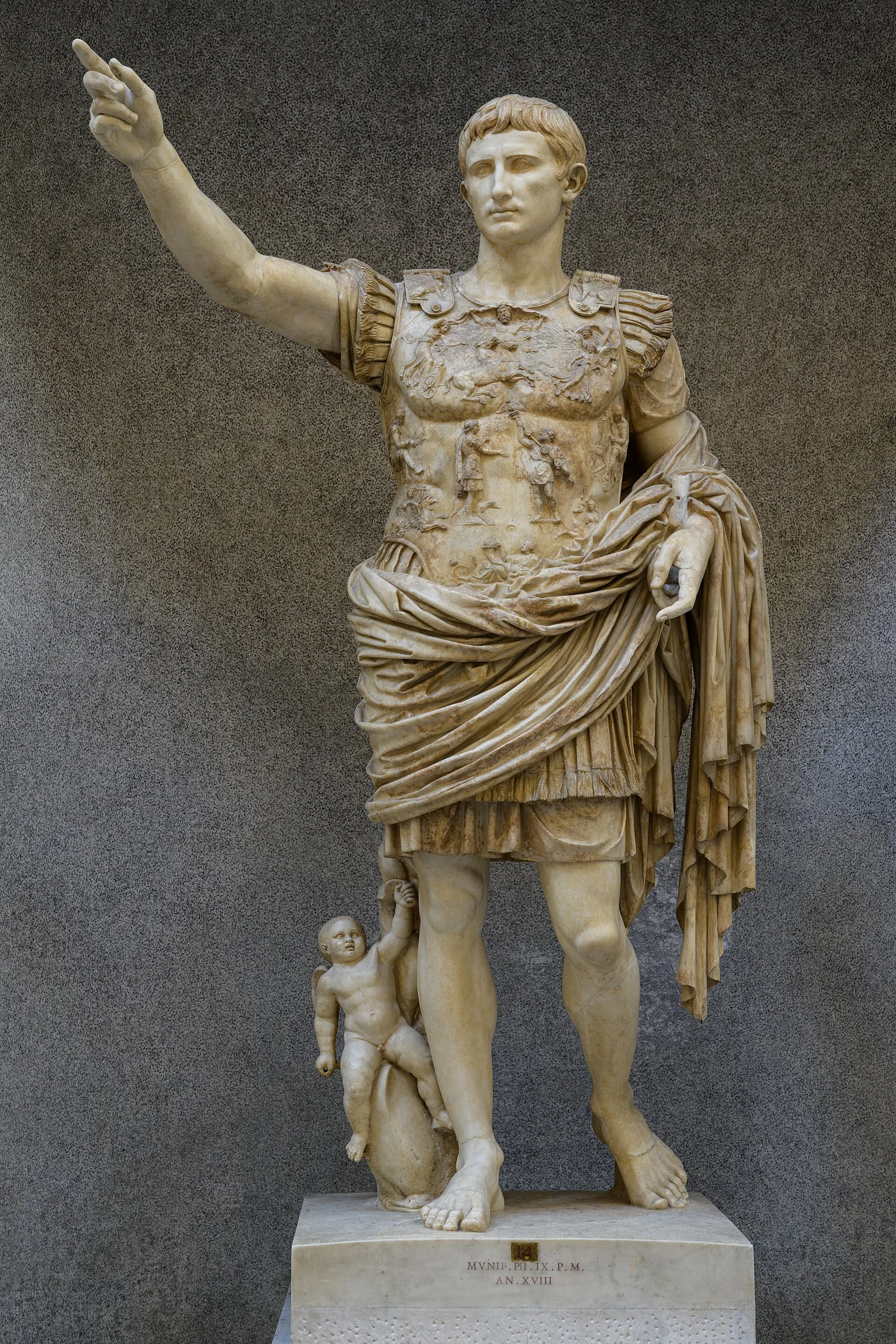
Wikimedia Commons, Vatican Museums, Rome.
Document 3 – Caesar at the Rubicon
Then, overtaking his cohorts at the river Rubicon, which was the boundary of his province, he paused for a while, and realising what a step he was taking, he turned to those about him and said: “Even yet we may draw back; but once cross yon little bridge, and the whole issue is with the sword.” […] Take we the course which the signs of the gods and the false dealing of our foes point out. The die is cast,” said he.
*cohorts: groups of soldiers. *the die is cast: the decision cannot be reversed.
Suetonius, Life of Julius Caesar, chapters 31-32, about 120 CE (translation by J. C. Rolfe, Loeb Classical Library, 1914).
Document 4 – The Punic Wars
| War | Dates | Famous event | Result |
|---|---|---|---|
| First Punic War | 264-241 BCE | Rome builds a fleet | Rome wins Sicily |
| Second Punic War | 218-201 BCE | Hannibal crosses the Alps; Cannae (216); Zama (202) | Rome wins; Carthage loses its empire |
| Third Punic War | 149-146 BCE | Siege of Carthage | Rome destroys Carthage |
Dates as given in standard reference works such as The Oxford Classical Dictionary; table prepared for this unit.
Questions
- Part 1 – Knowledge. Define republic, consul, and province. (12 pts)
- Part 1. Document 1: name the sea at the center of the empire, locate Rome and Carthage, and name two provinces shown on the map. (12 pts)
- Part 1. Explain why the Punic Wars were important for Rome. (8 pts)
- Part 2 – Documents. Document 2: present the document, describe what you see, and explain what it shows about how Augustus wanted to be seen. (14 pts)
- Part 2. Document 3: present the document, explain what Caesar means by “the die is cast,” and say why crossing the Rubicon began a civil war. (14 pts)
- Part 2. Document 4: calculate how long each of the three Punic Wars lasted, and how many years passed from the start of the first to the end of the third. (10 pts)
- Part 2. Using Documents 2 and 3 and the lesson, explain how Rome changed from a republic ruled by elected officials into an empire ruled by one man. (10 pts)
- Part 3 – Written argument. Was the Pax Romana a good thing for the people of the empire? Write a paragraph or two with a claim, at least two pieces of evidence from the documents or the lesson, and your reasoning. (20 pts)


Quick review: flashcards
Tap a card to see the answer.