


This worksheet on Ancient Greece belongs to the Grade 6 Ancient Civilizations course. Its questions use primary sources, maps and timelines, and they move from basic recall to short writing tasks. Before you start, review the lesson; afterward, try the true or false quiz.
Exercise 1 : Vocabulary of ancient Greece
Define each word, then use it in a sentence.
- polis
- democracy
- oligarchy
- helot
- phalanx
- ostracism
- philosophy
Hint: use the definition boxes and the lesson.
Exercise 2 : Miltiades before Marathon
Document 1 – Miltiades speaks to Callimachus
With thee it rests, Callimachus, either to bring Athens to slavery, or, by securing her freedom, to leave behind thee to all future generations a memory beyond even Harmodius and Aristogeiton. For never since the time that the Athenians became a people were they in so great a danger as now. If they bow their necks beneath the yoke of the Medes, the woes which they will have to suffer when given into the power of Hippias are already determined on; if, on the other hand, they fight and overcome, Athens may rise to be the very first city in Greece.
Source: Herodotus, Histories, Book VI (translation by George Rawlinson, 1858-60).
*polemarch: a high military officer of Athens. *Hippias: the former tyrant of Athens, then with the Persians. *Medes: the Persians.
- Present the document (nature, author, date, context).
- What does Miltiades say that Callimachus can do for Athens?
- What will happen to Athens, according to Miltiades, if the Athenians bow to the Persians?
- How are the ten generals divided?
- Explain why Herodotus’s speeches cannot be taken as exact quotations. How can a historian still use them?
Exercise 3 : Debts in early Athens
Document 2 – The poor in Athens before Solon
Not only was the constitution at this time oligarchical in every respect, but the poorer classes, men, women, and children, were the serfs of the rich. They were known as Pelatae and also as Hectemori, because they cultivated the lands of the rich at the rent thus indicated. The whole country was in the hands of a few persons, and if the tenants failed to pay their rent they were liable to be haled into slavery, and their children with them. All loans secured upon the debtor’s person, a custom which prevailed until the time of Solon, who was the first to appear as the champion of the people.
Source: Aristotle (or a student), The Athenian Constitution, chapter 2, 4th century BCE (translation by Frederic G. Kenyon, 1891).
*oligarchical: ruled by a few. *serfs: people forced to work for a landowner. *Solon: Athenian lawgiver of 594 BCE.
- Present the document.
- How did the poor of Athens live before Solon?
- What happened to a tenant who did not pay his rent?
- Which custom lasted until Solon?
- Explain how this situation could lead to rebellion and why a leader like Solon was needed.
Exercise 4 : Man is a political animal
Document 3 – Aristotle on the polis
Hence it is evident that the state is a creation of nature, and that man is by nature a political animal. […] Now, that man is more of a political animal than bees or any other gregarious animals is evident. Nature, as we often say, makes nothing in vain, and man is the only animal whom she has endowed with the gift of speech. And whereas mere voice is but an indication of pleasure or pain, and is therefore found in other animals (for their nature attains to the perception of pleasure and pain and the intimation of them to one another, and no further), the power of speech is intended to set forth the expedient and inexpedient, and therefore likewise the just and the unjust.
Source: Aristotle, Politics, Book I, chapter 2, about 350 BCE (translation by Benjamin Jowett, 1885).
*creation of nature: something that grows naturally. *Homer: the poet of the Iliad. *expedient: useful. *inexpedient: harmful.
- Present the document.
- What does Aristotle say about the city (the polis) and about human beings?
- Why does he say that human beings are more political than bees?
- What does he think speech is for?
- Explain in your own words what he means by “political animal.”
Exercise 5 : The education of Spartan boys
Document 4 – The training of the young Spartans
as soon as they were seven years old they were to be enrolled in certain companies and classes, where they all lived under the same order and discipline, doing their exercises and taking their play together. Of these, he who showed the most conduct and courage was made captain; they had their eyes always upon him, obeyed his orders, and underwent patiently whatsoever punishment he inflicted; so that the whole course of their education was one continued exercise of a ready and perfect obedience. The old men, too, were spectators of their performances, and often raised quarrels and disputes among them, to have a good opportunity of finding out their different characters, and of seeing which would be valiant, which a coward, when they should come to more dangerous encounters.
Source: Plutarch, Life of Lycurgus, about 100 CE, describing Spartan education (translation by John Dryden, revised by Arthur Hugh Clough, 1859).
*enrolled: entered on a list. *valiant: brave. *unguents: oils or ointments.
- Present the document. Plutarch lived many centuries after the time of Lycurgus. What problem does this create?
- At what age did Spartan boys begin training, and how did they live?
- How was a leader chosen among them?
- What did the boys learn, and what did they not learn much of?
- Explain why Sparta trained its boys this way.
Exercise 6 : The open city
Document 5 – Pericles compares Athens with its enemies
We throw open our city to the world, and never by alien acts exclude foreigners from any opportunity of learning or observing, although the eyes of an enemy may occasionally profit by our liberality; trusting less in system and policy than to the native spirit of our citizens; while in education, where our rivals from their very cradles by a painful discipline seek after manliness, at Athens we live exactly as we please, and yet are just as ready to encounter every legitimate danger. In proof of this it may be noticed that the Lacedaemonians do not invade our country alone, but bring with them all their confederates; while we Athenians advance unsupported into the territory of a neighbour, and fighting upon a foreign soil usually vanquish with ease men who are defending their homes.
Source: Thucydides, History of the Peloponnesian War, Book II, chapter 39, speech of Pericles, winter 431-430 BCE (translation by Richard Crawley, 1874).
*alien acts: actions against foreigners. *Lacedaemonians: the Spartans. *confederates: allies. *vanquish: defeat.
- Present the document.
- What does Pericles say about foreigners in Athens?
- How does he say Athens differs from its rivals in the education of the young?
- What does he say about how Athenians and Spartans make war?
- Whose point of view is shown, and why must a historian read this carefully?
Exercise 7 : The duty of the citizen
Document 6 – Pericles on public affairs
Our public men have, besides politics, their private affairs to attend to, and our ordinary citizens, though occupied with the pursuits of industry, are still fair judges of public matters; for, unlike any other nation, regarding him who takes no part in these duties not as unambitious but as useless, we Athenians are able to judge at all events if we cannot originate, and, instead of looking on discussion as a stumbling-block in the way of action, we think it an indispensable preliminary to any wise action at all.
Source: Thucydides, History of the Peloponnesian War, Book II, chapter 40, speech of Pericles (translation by Richard Crawley, 1874).
*unambitious: not wanting power. *originate: start new ideas. *indispensable preliminary: something absolutely needed first.
- Present the document.
- What do ordinary Athenians do, besides their work?
- How does Athens treat a man who takes no part in public life?
- What does Pericles say about discussion before action?
- Does this passage describe all people who lived in Athens? Explain.
Exercise 8 : Training the young: Sparta and Athens
Document 1A – Sparta
as soon as they were seven years old they were to be enrolled in certain companies and classes, where they all lived under the same order and discipline, doing their exercises and taking their play together. Of these, he who showed the most conduct and courage was made captain; they had their eyes always upon him, obeyed his orders, and underwent patiently whatsoever punishment he inflicted; so that the whole course of their education was one continued exercise of a ready and perfect obedience. The old men, too, were spectators of their performances, and often raised quarrels and disputes among them, to have a good opportunity of finding out their different characters, and of seeing which would be valiant, which a coward, when they should come to more dangerous encounters.
Source: Plutarch, Life of Lycurgus (translation by Dryden and Clough).
Document 1B – Athens
We throw open our city to the world, and never by alien acts exclude foreigners from any opportunity of learning or observing, although the eyes of an enemy may occasionally profit by our liberality; trusting less in system and policy than to the native spirit of our citizens; while in education, where our rivals from their very cradles by a painful discipline seek after manliness, at Athens we live exactly as we please, and yet are just as ready to encounter every legitimate danger. In proof of this it may be noticed that the Lacedaemonians do not invade our country alone, but bring with them all their confederates; while we Athenians advance unsupported into the territory of a neighbour, and fighting upon a foreign soil usually vanquish with ease men who are defending their homes.
Source: Thucydides, Book II, speech of Pericles (translation by Crawley, 1874).
- Present each document and say who the author is.
- How does each document describe the way young people were prepared for war?
- What does each document say about freedom?
- Why is it risky to treat both texts as neutral descriptions?
- Which city would you rather have lived in as a young man, and why? Use evidence.
Exercise 9 : Before and after: Athenian government
Document 2A – Athens before Solon
Not only was the constitution at this time oligarchical in every respect, but the poorer classes, men, women, and children, were the serfs of the rich. They were known as Pelatae and also as Hectemori, because they cultivated the lands of the rich at the rent thus indicated. The whole country was in the hands of a few persons, and if the tenants failed to pay their rent they were liable to be haled into slavery, and their children with them. All loans secured upon the debtor’s person, a custom which prevailed until the time of Solon, who was the first to appear as the champion of the people.
Source: Aristotle (or his school), The Athenian Constitution, chapter 2 (translation by Frederic G. Kenyon, 1891).
Document 2B – Athens in the age of Pericles
Our constitution does not copy the laws of neighbouring states; we are rather a pattern to others than imitators ourselves. Its administration favours the many instead of the few; this is why it is called a democracy. If we look to the laws, they afford equal justice to all in their private differences; if no social standing, advancement in public life falls to reputation for capacity, class considerations not being allowed to interfere with merit; nor again does poverty bar the way, if a man is able to serve the state, he is not hindered by the obscurity of his condition.
Source: Thucydides, Book II, chapter 37 (translation by Richard Crawley, 1874).
- Present each document.
- Who held power in Athens in Document 2A, and who in Document 2B?
- What changes for the poor between the two documents?
- Which reforms in the lesson help to explain the change?
- What limits does the democracy of Document 2B still have?
Exercise 10 : An ostracon
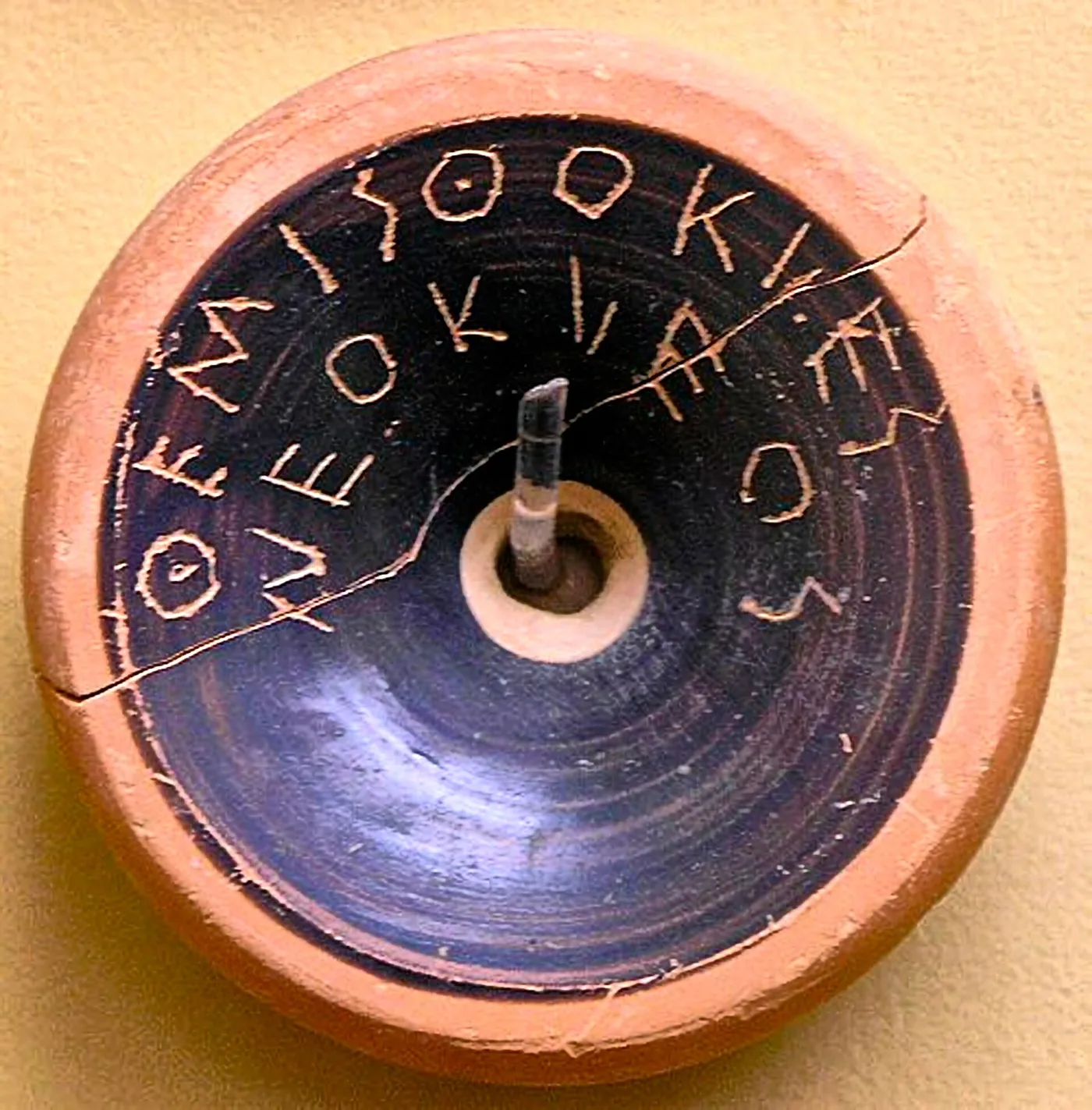
- Present the document (nature, date, place).
- Describe the object. What is written on it?
- How did an ostracism work? Use the lesson.
- Why do historians value ostraka as sources?
- Why might Athenians have voted against Themistocles, the hero of Salamis?
Exercise 11 : Pericles
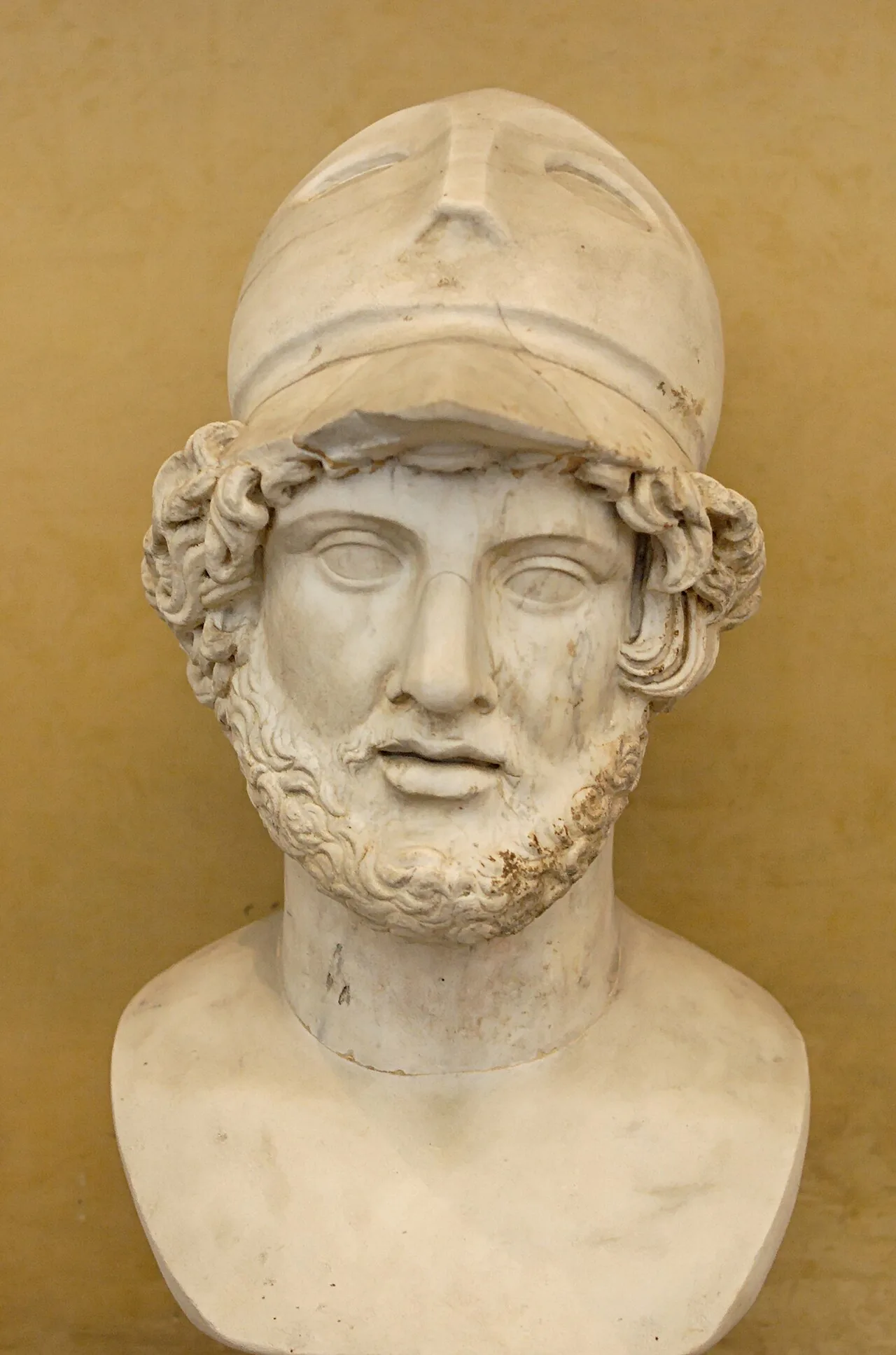
- Present the document (nature, date, place).
- Describe the portrait. What is he wearing, and what does the helmet tell us?
- Why is the original usually dated to Pericles’s lifetime, though this is a Roman copy?
- What role did Pericles play in Athens?
- How does this idealized portrait fit with Thucydides’s description of Pericles as a leader?
Exercise 12 : Hoplites in battle
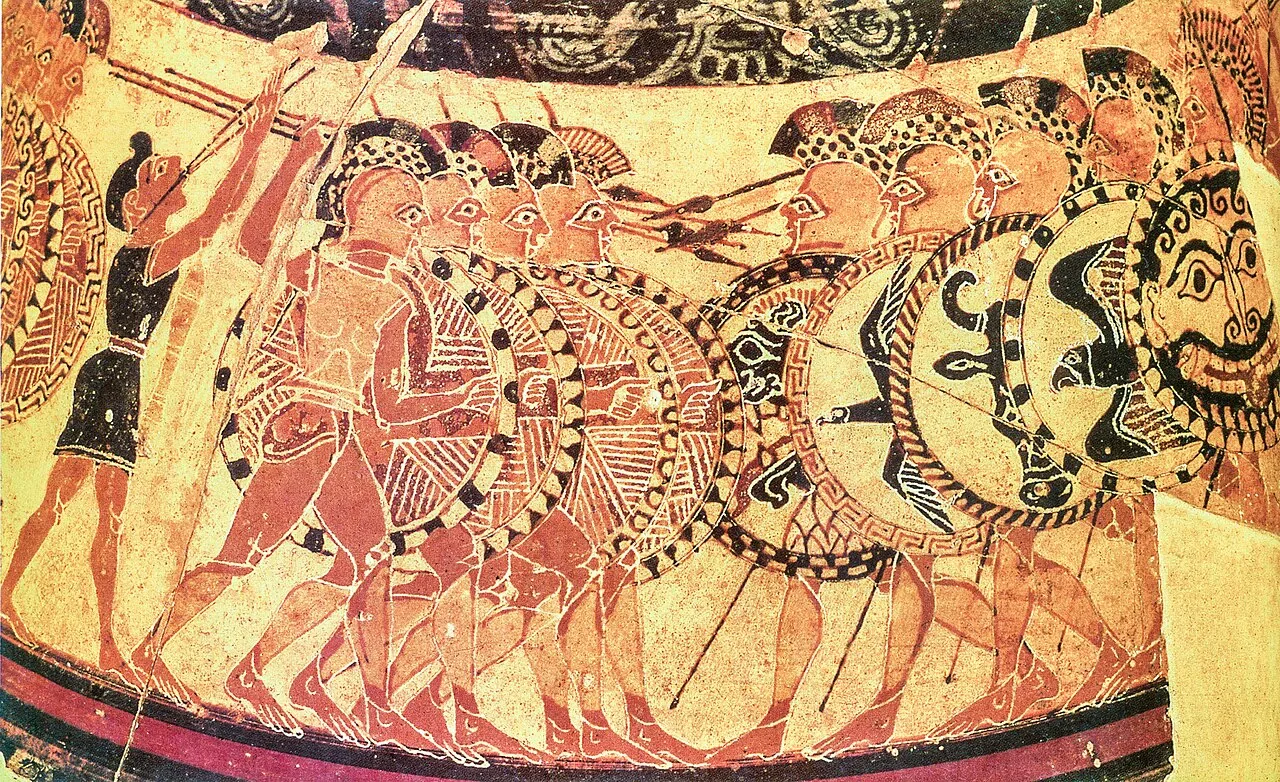
- Present the document (nature, date, place).
- Describe what you see. How are the soldiers arranged?
- What equipment can you identify?
- Why was fighting in a phalanx dangerous for a single soldier and strong for a city?
- What can a painted jug tell us that a written text cannot?
Exercise 13 : A prize for the games
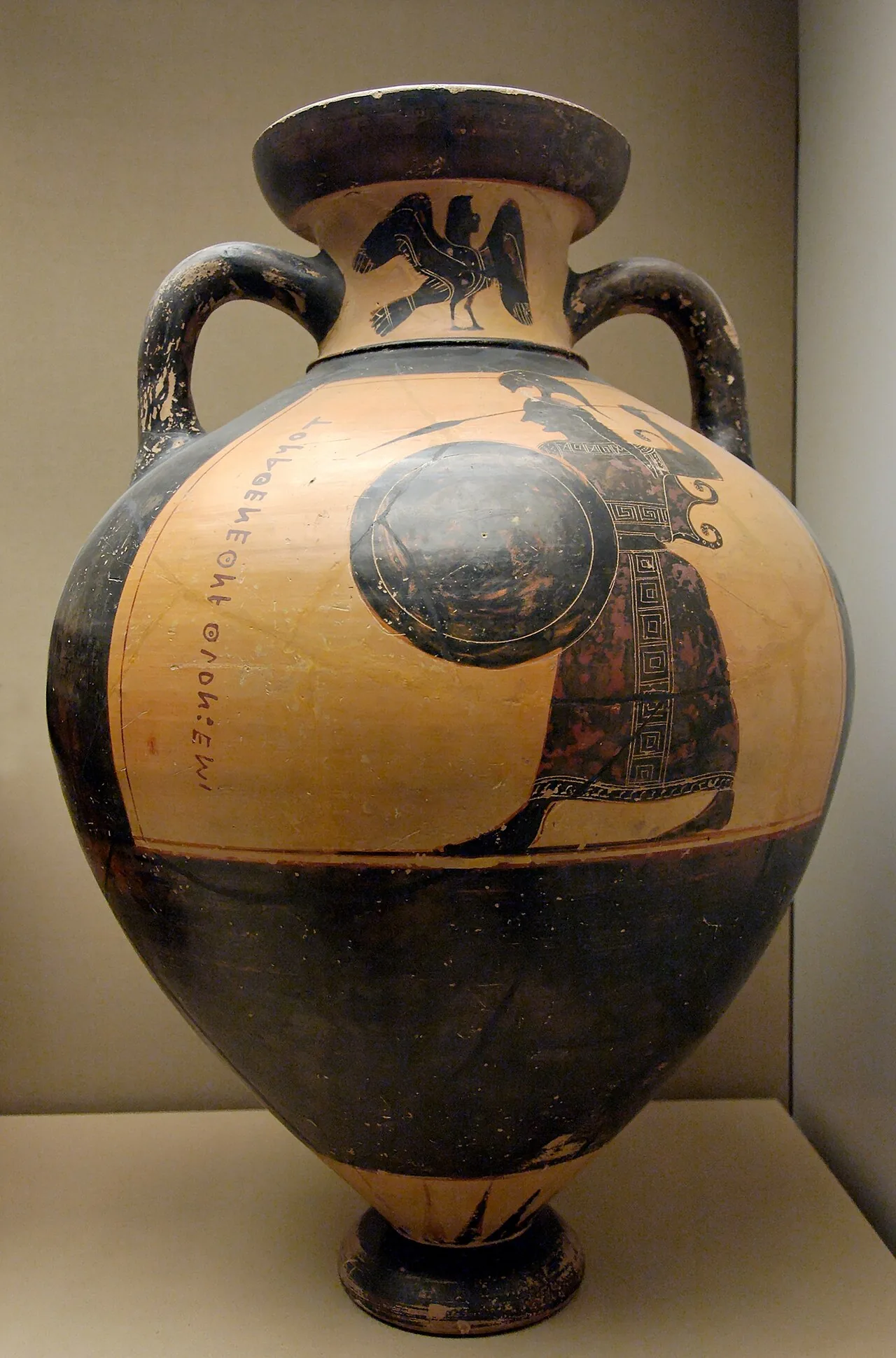
- Present the document (nature, date, place).
- Describe the shape and decoration of the vase.
- What was a vase like this used for?
- Why do the Athenians put Athena on such an object?
- What does the vase tell us about Greek festivals and trade in olive oil?
Exercise 14 : The Porch of the Caryatids
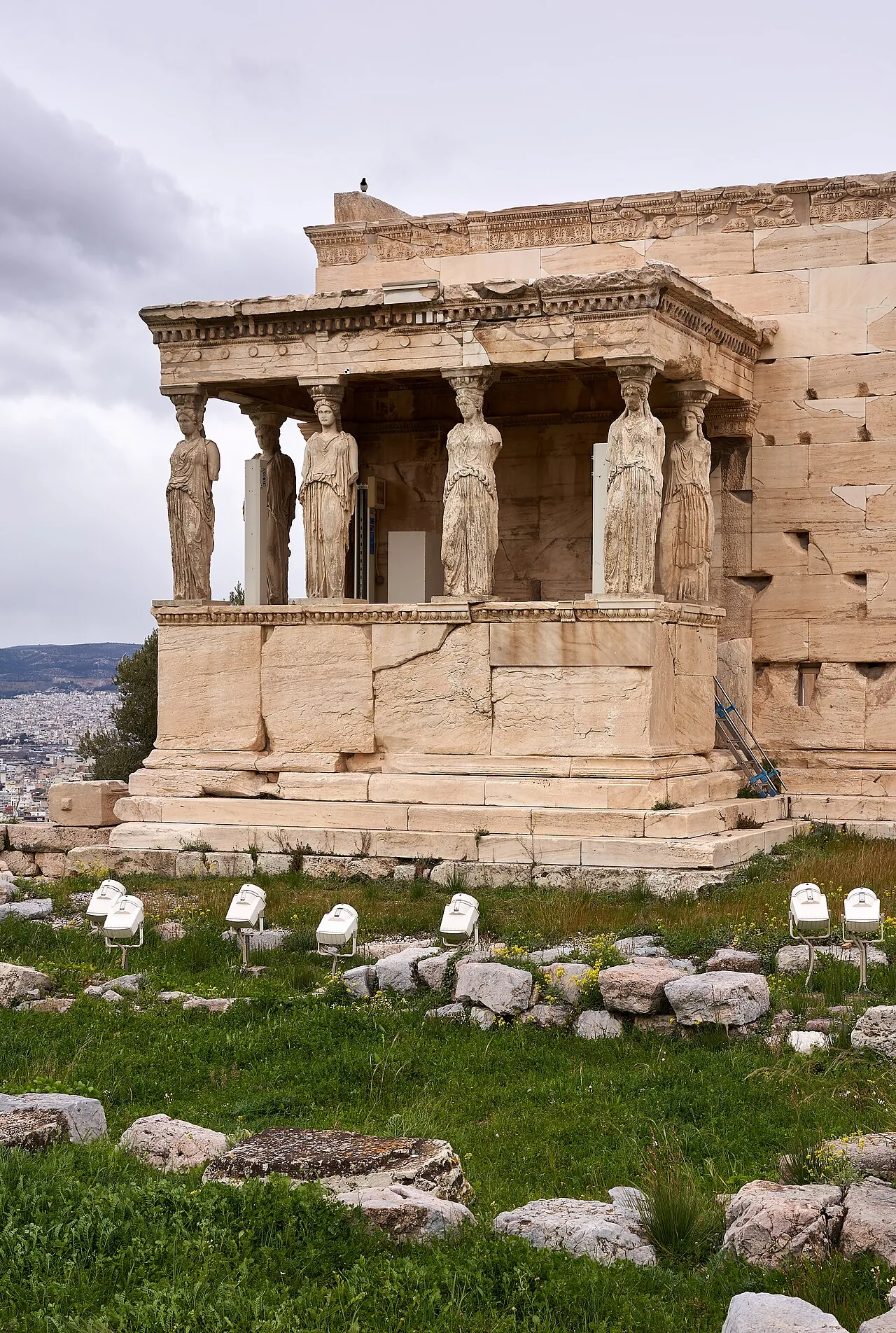
- Present the document (nature, date, place).
- Describe what you see. What replaces the ordinary columns?
- What does this show about Greek architects?
- Compare it with the Parthenon in Document 3 of the lesson: what is similar, and what is different?
- Why was the Acropolis rebuilt in the Age of Pericles?
Exercise 15 : The Persian Wars by the numbers
Document 1 – The main battles of the Persian Wars
| Battle | Year | Main Greek leader | Result |
|---|---|---|---|
| Marathon | 490 BCE | Miltiades (Athens) | Greek victory |
| Thermopylae | 480 BCE | Leonidas (Sparta) | Persian victory; Greek force destroyed |
| Salamis | 480 BCE | Themistocles (Athens) | Greek naval victory |
| Plataea | 479 BCE | Pausanias (Sparta) | Greek victory |
Source: Dates and leaders as given in standard reference works such as The Oxford Classical Dictionary; table prepared for this unit.
- How many years passed between Marathon and Salamis?
- Which city provided the leader for two of the four battles?
- Which battles were fought at sea, and which on land?
- Which battle was a Persian victory, and why do Greeks still remember it?
Exercise 16 : Locate Greek sites
- Match the numbers to these names: Athens, Corinth, Delphi, Marathon, Miletus, Olympia, Sparta, Thebes, Thermopylae.
- Which sites are on the Peloponnese?
- Which sea lies between Greece and Asia Minor?
- Explain how the geography shown on the map explains why Greece was divided into many city-states.
Hint: Athens lies in the region of Attica, on the east side of the mainland.
Exercise 17 : The Greek colonies
- Match the numbers to these names: Athens, Byzantium, Cumae, Cyrene, Massalia, Miletus, Naucratis, Syracuse, Taras.
- Which two colonies are in Italy and Sicily?
- Which colony lies in Africa? Which lies near the Black Sea?
- Why did Greeks found colonies? Give two reasons.
Exercise 18 : Order the events
Put these events in order from the oldest to the most recent.
- The Parthenon is completed.
- Cleisthenes reforms Athens.
- Rome conquers Greece.
- Athenians defeat the Persians at Marathon.
- Solon cancels debts.
- Alexander the Great dies.
- Sparta defeats Athens.
Exercise 19 : How long between events?
Calculate each time span. Remember that BCE years count down toward zero.
- From Solon (594 BCE) to Cleisthenes (508 BCE).
- From the beginning of the Peloponnesian War (431 BCE) to its end (404 BCE).
- From the battle of Chaeronea (338 BCE) to the death of Alexander (323 BCE).
- From the Parthenon’s completion (432 BCE) to 2026: about how many years?
Exercise 20 : Guided research: the Parthenon
Find out how the Parthenon was built and what has happened to it. Use at least two reliable sites, such as the Acropolis Museum, the Metropolitan Museum of Art (Heilbrunn Timeline), the British Museum, or Britannica. Suggested keywords: Parthenon Acropolis Museum, Parthenon Pericles Pheidias, Parthenon sculptures history.
- Who ordered and designed it? When was it built?
- What was it used for?
- What happened to it in later centuries?
- Which websites did you use, and why do you trust them?
Hint: compare two sources; if they differ, note it.
Exercise 21 : CER paragraph: Athenian democracy
Write a Claim, Evidence, Reasoning paragraph that answers: Was Athens a democracy for everyone who lived there?
- Claim: state your position.
- Evidence: use at least two details from the documents or the lesson.
- Reasoning: explain how the evidence supports your claim.
Hint: think about who could vote and who could not.
Exercise 22 : SAQ: the Persian Wars
Answer in complete sentences.
- Identify two Greek victories in the Persian Wars.
- Explain one reason why the Greeks were able to defeat the larger Persian force.
- Explain one effect of the Persian Wars on Athens.
Exercise 23 : True or false? Justify
Decide whether each statement is true or false, and justify your answer.
- Greece was one country with one government.
- In Athens, all adult residents could vote in the Assembly.
- Sparta relied on helots to do the farming.
- The Peloponnesian War was won by Athens.
Exercise 24 : Causes and consequences: from Persian Wars to Peloponnesian War
Complete the chain and explain each link.
- Cause: the Greeks defeat Persia in 490-479 BCE. Effect: ______.
- Effect on Athens’s power: ______.
- Effect on Sparta and its allies: ______.
- Later consequence for Greece: ______.


Quick review: flashcards
Tap a card to see the answer.