



This AP World History: Modern lesson covers AP World Unit 1: The Global Tapestry, part of the unit “AP World units.” First, read the full lesson with its primary sources, maps and key terms. Then practice with the worksheet, check yourself with the quiz and get ready with the test.
In 1325 a group of wandering people settled on a marshy island in a lake in central Mexico. They began to build a city. Within two centuries Tenochtitlan was one of the largest cities in the world. In the same year, a young Moroccan scholar named Ibn Battuta left Tangier on a pilgrimage to Mecca. He did not return for almost thirty years, and by then he had crossed Africa, Arabia, India, and perhaps China. A year earlier, the ruler of Mali, Mansa Musa, had reached Cairo on his own pilgrimage.
He carried so much gold that, according to later accounts, the price of gold in Egypt fell for years. These three stories happened on three continents, to people who did not know each other. Yet they belong to one period, and AP World History begins with it. These are the years from about 1200 to 1450, the world before the oceanic voyages of the late 1400s. Regions developed their own states, beliefs, and economies, and many of them were already more connected than their rulers realized.
Guiding question: How did states in different regions of the world build and justify their power between 1200 and 1450? What did religion, trade, and technology contribute to the way they were organized?
AP framing. This unit follows the College Board’s first period. The historical thinking skills practiced here are developments and processes (what changed and why), sourcing and situation (who wrote a document, when, and for whom), and comparison. The unit’s themes are the development and interaction of cultures, state-building and expansion, and economic systems. As you read, keep asking two questions: what does each state have in common with the others, and what makes it distinct?
1. East Asia: Song China and its neighbors
A commercial and technological society
The Song dynasty (960-1279) ruled the richest and most inventive society of its time. In 1127 northern invaders, the Jurchen, captured the Song capital at Kaifeng. The dynasty moved south and continued as the Southern Song, with its capital at Hangzhou. The loss of the north did not weaken the economy. Farmers in the Yangzi valley planted Champa rice, a fast-ripening variety brought from Southeast Asia in the early 1000s.
It let them harvest two crops a year and feed a growing population. Cities grew along rivers and the Grand Canal. Merchants used paper money and credit, printing spread books widely, and Chinese craftsmen used the magnetic compass, gunpowder weapons, and large ocean-going ships. Marco Polo came to China under the Mongols and wrote about it after 1295. He described the Southern Song capital in terms that astonished his Italian readers (see the source exercises).
Definition: Neo-Confucianism
a revival of Confucian thought in Song China, led by thinkers such as Zhu Xi (1130-1200). It blended Confucian ethics with ideas about the universe taken from Buddhism and Daoism. It stressed self-cultivation, family duty, and loyalty to the ruler, and it shaped the civil service examinations for centuries.
The government of Song China was run by officials chosen through civil service examinations based on the Confucian classics. The exams were open to most free men, though only families with the money to educate their sons could take advantage of them. Women’s legal and social position was limited, and the elite custom of foot binding spread during the Song period. Neo-Confucian ideas gave this order a moral foundation: a good society rested on proper relationships between ruler and subject, father and son, husband and wife.
Neighbors and tribute
China’s neighbors borrowed from it without simply copying it. Korea’s Goryeo kingdom (918-1392) adopted Confucian institutions and Chinese-style examinations, but also supported Buddhism and developed its own printing with movable metal type. Native dynasties ruled Vietnam after its independence from China in the 900s. The country used Chinese writing and administration, yet defended itself against Chinese and Mongol armies. Japan had stopped sending official embassies to China.
After 1185 the Kamakura shogunate, a military government of warrior lords called samurai, held real power while the emperor reigned in Kyoto. China’s rulers expected foreign states to send tribute, gifts and formal acts of respect, in exchange for permission to trade and for the emperor’s protection. The system made China the center of an East Asian order, although in practice trade and diplomacy were much more flexible than the theory suggests.
2. Dar al-Islam: a world of belief and commerce
The term Dar al-Islam (“the house of Islam”) refers to the lands where Muslims lived under Muslim rule and where Islamic law and learning shaped public life. By 1200 it stretched from Spain and Morocco to Central Asia and northern India. Political unity had long since broken down. The Abbasid caliphs in Baghdad kept their religious prestige but lost real power to military dynasties, among them the Seljuk Turks, who took Baghdad in 1055.
In 1250 a dynasty of soldiers of slave origin, the Mamluks, seized power in Egypt. In 1258 the Mongols sacked Baghdad and ended the Abbasid caliphate, an event treated in Unit 2. Yet culture and trade held the Dar al-Islam together. Arabic was the language of religion and scholarship, and Muslim merchants spoke a shared legal language. Every year pilgrims from all regions met at Mecca for the hajj.
Definition: Dar al-Islam
the lands in which Islam was the dominant religion and shaped law, education, and public life, from Spain to Southeast Asia. It was a cultural and commercial network, not a single state.
Learning and travel
Scholars of the Islamic world preserved Greek, Persian, and Indian knowledge and added to it. Ibn Sina (Avicenna) wrote a medical encyclopedia used in Europe for centuries. Ibn Rushd (Averroes) of Cordoba wrote commentaries on Aristotle. Al-Idrisi, working for the Norman king of Sicily, produced a world map in 1154. Schools called madrasas trained judges and teachers, and Sufi brotherhoods spread a mystical form of Islam that made it welcome in villages, in the steppe, and among merchants.
Ibn Battuta, born in Tangier in 1304, trained as a judge and used his learning as a passport. From 1325 to 1354 he traveled to Egypt, Mecca, Iraq, East Africa, India, the Maldives, and Southeast Asia, and probably to China, finding Muslim scholars and rulers almost everywhere. In 1355 he dictated his Rihla (“Journey”) to a scholar of the court of Morocco. It is both a travel account and a record of how a Muslim network worked.
Document 1 – A traveler in West Africa
They are seldom unjust, and have a greater abhorrence of injustice than any other people. Their sultan shows no mercy to anyone who is guilty of the least act of it. There is complete security in their country. Neither traveller nor inhabitant in it has anything to fear from robbers or men of violence. They do not confiscate the property of any white man who dies in their country, even if it be uncounted wealth. On the contrary, they give it into the charge of some trustworthy person among the whites, until the rightful heir takes possession of it.
Source: Ibn Battuta, Rihla (Travels), account of his stay in the empire of Mali, 1352-1353, as dictated in 1355; translated by H. A. R. Gibb, Ibn Battuta: Travels in Asia and Africa, 1325-1354 (London, 1929); Fordham Medieval Sourcebook.
*Whites: Ibn Battuta word for light-skinned visitors from North Africa and Arabia.
Commentary. Ibn Battuta visited the court of Mansa Sulayman of Mali in 1352-1353. He was a Muslim judge from North Africa writing for a Muslim audience, which explains his interest in prayer, Quran schools, and justice. He praises the safety of Mali as a mark of good government. However, he also complains about local customs that he finds un-Islamic, such as the dress of women. His account must therefore not be read as simple praise. As an outside observer who stayed only a few months, he is better on court life than on the daily life of villagers. Still, it is the best eyewitness description of the Mali empire that survives.
3. South and Southeast Asia
In India, Turkic armies from Afghanistan conquered the plains of the north around 1200. The result was the Delhi Sultanate (1206-1526), ruled by a succession of dynasties, some of slave origin. The sultans were Muslim, but most of their subjects were Hindu. Rulers had to decide how far to impose Islamic law and how far to cooperate with local elites.
They taxed peasants, built mosques and forts (the Qutb Minar in Delhi was begun about 1199), and invited Persian poets, scholars, and administrators to their courts. In the south, the Hindu kings of Vijayanagara (founded in 1336) built a rich empire based on agriculture and trade. They defended Hindu temples and culture against northern sultans. Devotional movements within Hinduism and Islam, such as bhakti and Sufism, spread religious ideas through poetry sung in local languages.
Southeast Asia was a crossroads of the sea routes between India and China. The Khmer kings of Cambodia built Angkor Wat in the early 1100s, a temple city dedicated to the Hindu god Vishnu; later Khmer rulers turned to Buddhism. On Sumatra, the maritime kingdom of Srivijaya had long controlled the Strait of Malacca by granting protection to ships. In Java the kingdom of Majapahit (founded in 1293) took its place. Muslim merchants from India and Arabia settled in port cities, and over the centuries the religion spread along the coasts. Rulers often adopted ideas from Indian religion and then reshaped them to justify their own authority.
4. The Americas: complex states without the wheel or the horse
No contact existed between the Americas and the Eastern Hemisphere in this period (apart from short Viking visits). However, American societies had developed cities, agriculture, calendars, and states of their own. In Mesoamerica, the Maya city-states of the southern lowlands had declined around 800 to 900, but cities such as Chichen Itza in Yucatan continued to flourish. In the central valley of Mexico, a people who called themselves the Mexica founded Tenochtitlan in 1325 on an island in Lake Texcoco.
Outsiders call them the Aztecs. Then, in 1428, Tenochtitlan joined with Texcoco and Tlacopan in the Triple Alliance. Over the next decades this alliance conquered much of central Mexico. The conquered peoples paid tribute in cotton cloth, food, feathers, and precious stones, and had to supply captives for religious ceremonies, which made many of them willing to rebel when the Spaniards arrived in 1519. Farmers fed the city’s population by building chinampas, artificial garden plots of mud and vegetation in the shallow lake.
Document 2 – Founding a city
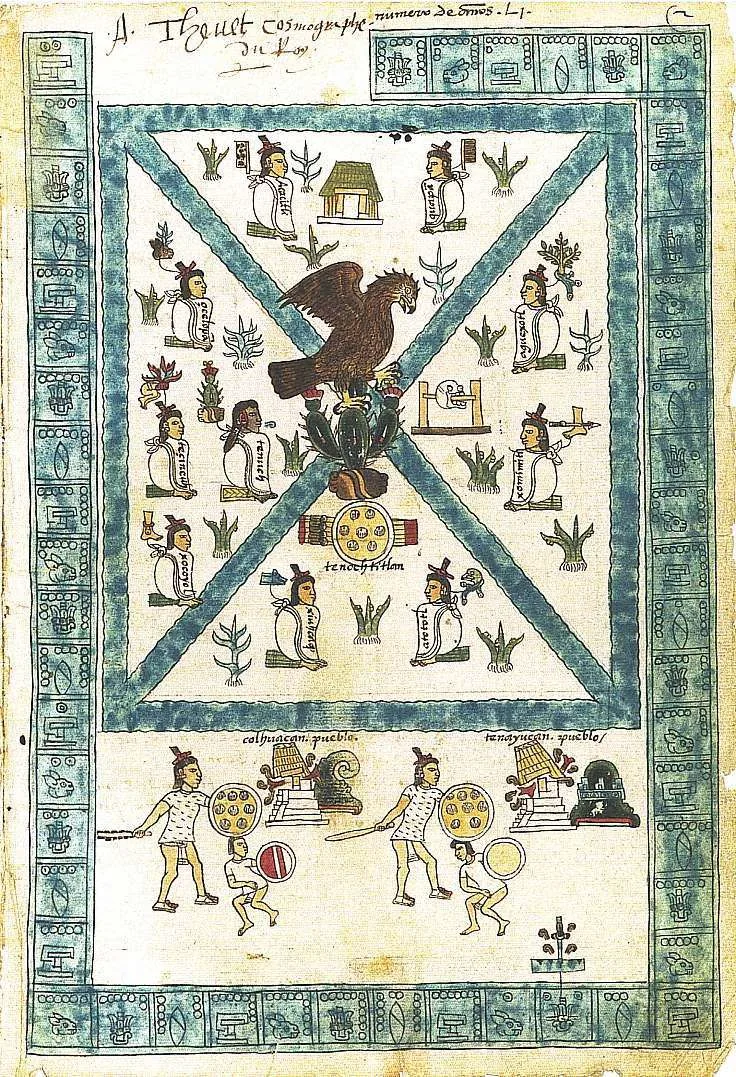
Commentary. The Codex Mendoza was painted by Aztec scribes in the 1540s, after the Spanish conquest, on the order of the Spanish viceroy, who meant to send it to Charles V. It follows pre-Conquest traditions of picture writing, but it was made for a Spanish audience, which accounts for the Spanish explanations written beside the pictures. The page shows the Mexica story of the foundation of their capital: a sign sent by the gods, an eagle on a prickly pear cactus, told the wandering people where to settle. The canals divide the city into four parts.
Definition: Tribute
a payment of goods, labor, or loyalty made by a weaker or conquered people to a stronger state. The Aztec Empire collected tribute from conquered cities; Chinese emperors received tribute missions from foreign rulers.
The Inca
In the Andes, the Inca built the largest empire in the Americas. From their capital at Cuzco, the ruler Pachacuti began a rapid expansion in about 1438, and within a century the empire, which the Inca called Tawantinsuyu (“the four parts together”), reached from what is now Ecuador to central Chile. They had no written language and no money, but they ran their empire with a system of labor service, the mit’a, in which each community owed the state a share of work on roads, terraces, storehouses, and military service.
Knotted cords called quipu recorded numbers, and relay runners carried messages along thousands of miles of stone-paved roads. Terraced fields and storehouses at different altitudes let Andean farmers grow potatoes and maize and store the surplus. Royal estates such as Machu Picchu show Inca skill in fitting stone walls without mortar.
5. Africa: gold, salt, and the Swahili coast
West Africa’s savanna, the Sahel, was linked to North Africa by caravans that crossed the Sahara. Camels carried salt and copper south and gold north. The empire of Mali, founded about 1235 by Sundiata Keita after he defeated the Sosso king, took control of the gold fields and the trade routes. Its most famous ruler, Mansa Musa, made the hajj to Mecca in 1324-1325 with a vast entourage.
He gave away so much gold in Cairo that, according to Arab writers, its value fell for years. Mansa Musa returned with scholars and architects, and Timbuktu and Djenne became centers of trade and Islamic learning. Mali’s rulers were Muslim, but they were also kings in the older African tradition, and many of their subjects kept local beliefs. The Catalan Atlas of about 1375 shows Mansa Musa holding a gold nugget, which proves that Europeans knew of his wealth.
Document 3 – Mali seen from Europe
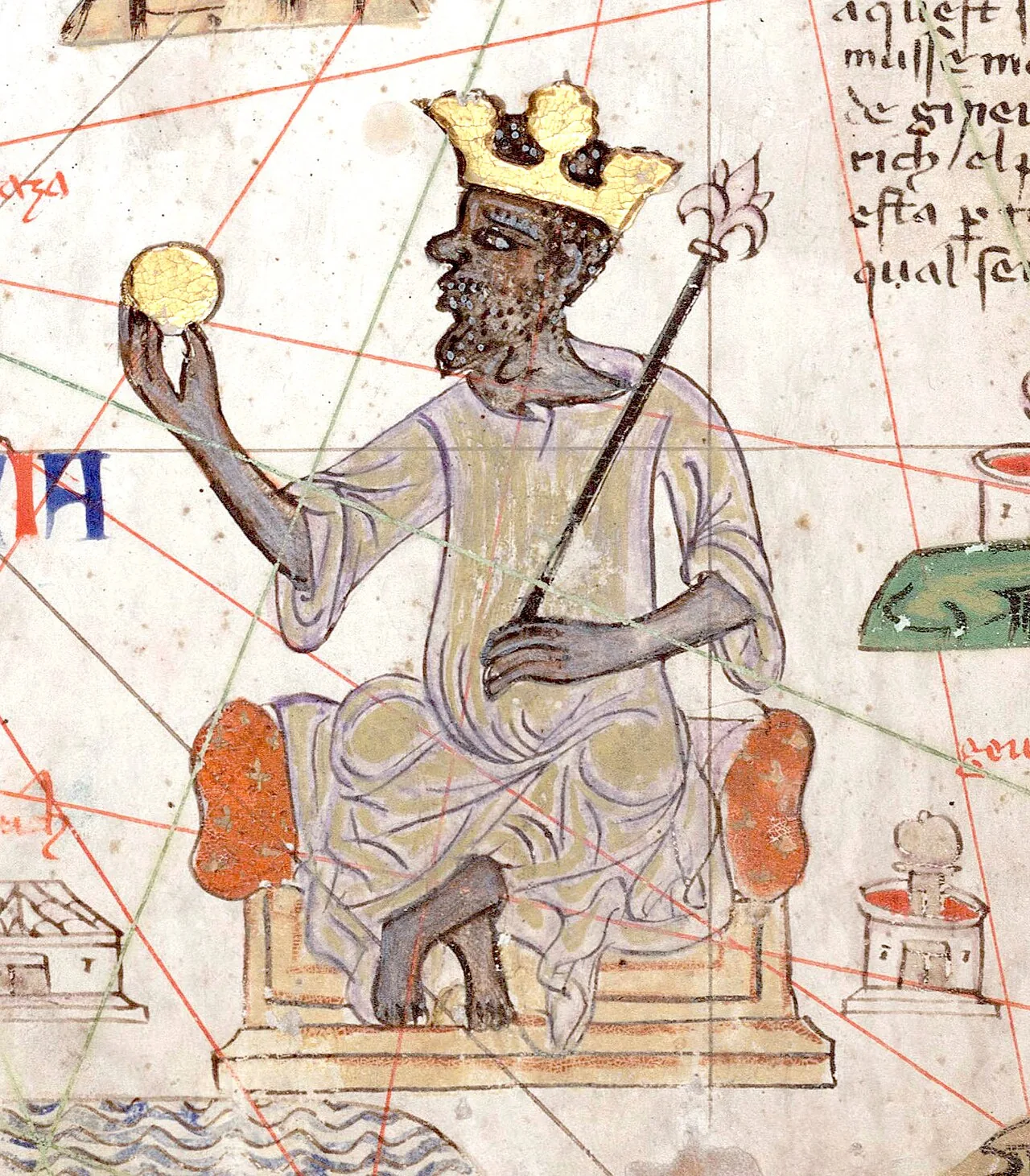
Commentary. The Catalan Atlas was made in Majorca for the king of Aragon, to show merchants and rulers what was known about the world, including the trade routes across the Sahara. Its caption names him Musa Mali, ruler of the people of Guinea, and calls him the richest and noblest king of the land because of the gold found there. The painter had never seen him: the image is an idea of an African king dressed in European royal style, with crown and scepter. It is valuable as evidence of what a Mediterranean audience knew about Mali, and of how the gold trade gave West Africa a place on European maps.
On the East African coast, Swahili city-states such as Mogadishu, Mombasa, and Kilwa grew rich on the Indian Ocean trade. Their people spoke Swahili, a Bantu language with many Arabic words, and many were Muslim. They exported gold from the inland kingdom of Great Zimbabwe, ivory, and enslaved people, and imported Indian cloth and Chinese porcelain. Further north, the Christian kingdom of Ethiopia, under the Zagwe kings, carved churches out of rock at Lalibela about 1200.
6. Europe: a decentralized and Christian world
After the fall of the Roman Empire in the west, Europe was divided into many small political units. In the Middle Ages, power rested on feudalism, a system of obligations between lords and vassals, and on manorialism, in which peasants, many of them serfs bound to the land, worked the fields of the lord. The Roman Catholic Church was the one institution common to all of Latin Christendom. Popes claimed authority over kings, monks preserved books, and the Church ran schools that became the first universities, at Bologna, Paris, and Oxford. Scholars such as Thomas Aquinas (c. 1225-1274) tried to reconcile faith with the reasoning of Aristotle, whose works reached Europe largely through Arabic translations.
European kings slowly built stronger states. In England, the barons forced King John to accept Magna Carta at Runnymede in June 1215. It did not create democracy; it protected the rights of nobles and the Church against arbitrary taxes. But its promise that the king himself was bound by law later became a symbol of limited government. The Crusades, launched in 1095 when Pope Urban II called Christians to recover Jerusalem, brought Europeans into contact with the Islamic world and with Byzantium, and increased the demand for Eastern goods. The Fourth Crusade turned against Constantinople and sacked it in 1204, which weakened the Byzantine Empire.
Document 4 – A charter of liberties
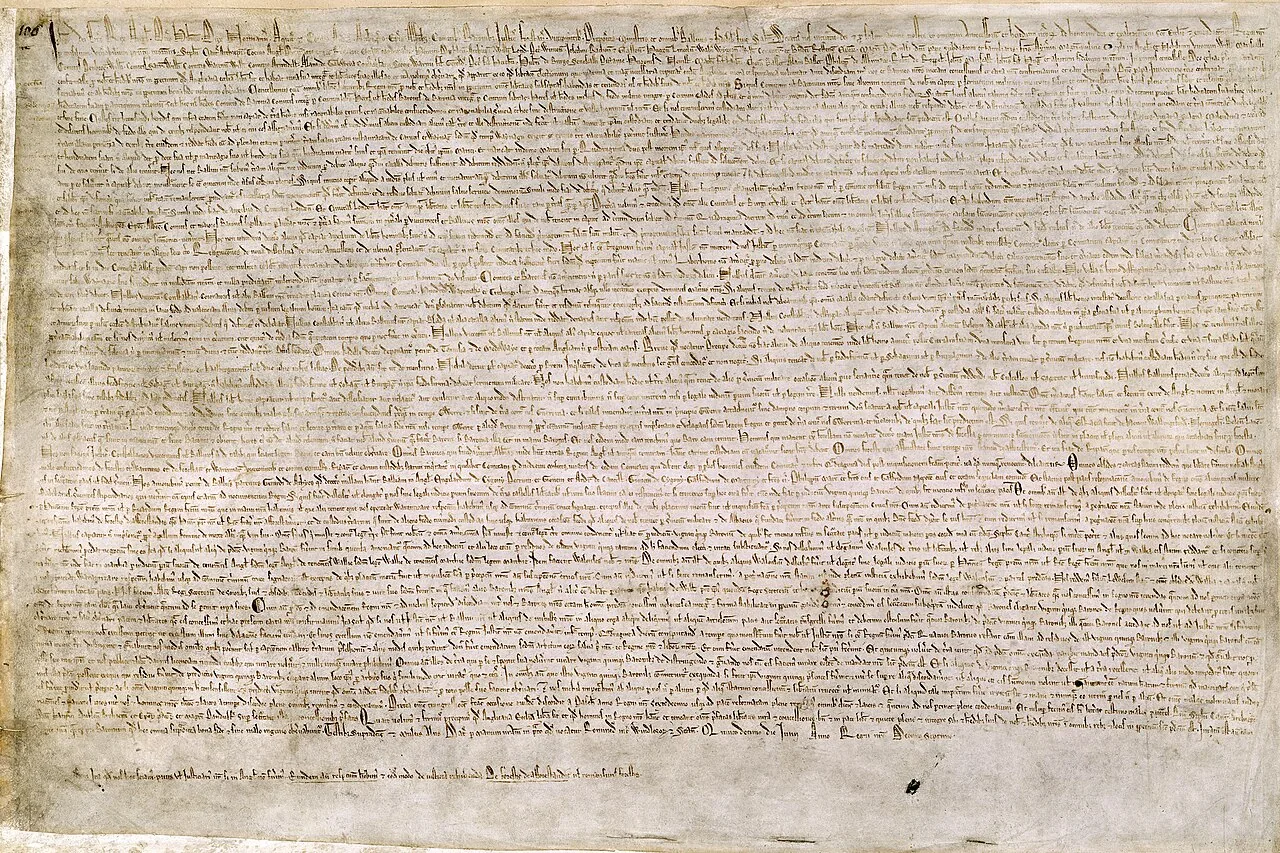
39. No freemen shall be taken or imprisoned or disseised or exiled or in any way destroyed, nor will we go upon him nor send upon him, except by the lawful judgment of his peers or by the law of the land. 40. To no one will we sell, to no one will we refuse or delay, right or justice.
Source: Magna Carta, clauses 39 and 40, issued by King John of England at Runnymede, June 1215; Avalon Project, Yale Law School.
Commentary. Clauses 39 and 40 are the best-known parts of Magna Carta. Their language is general: “no freeman” shall be punished except by lawful judgment of peers or the law of the land, and justice will not be sold or delayed. In 1215 “freemen” meant a minority; most English peasants were unfree. King John asked the pope to cancel the charter within weeks, and civil war followed. The document matters because later generations reread it as a statement of principle.
7. Comparing states and building the big picture
Between 1200 and 1450 the states described above used a few shared methods to hold power. Rulers needed resources, which came from taxes on farmers, tribute from conquered peoples, and tolls on trade. They needed administrators, whether Chinese scholar-officials, Muslim judges, Inca labor officials, or European clergy.
And they needed legitimacy, a reason why people should obey: the Mandate of Heaven and Confucian order in China, the blessing of God in Christian and Muslim states, descent from the sun in the Inca case, the favor of the god Huitzilopochtli among the Mexica. Religion served as a tool of rulers in every region, but it was also a force with its own aims, as when Sufi preachers or Buddhist monks spread beliefs independently of kings.
Trade and technology
Trade also linked these societies. The Indian Ocean connected East Africa, Arabia, India, and China; caravans connected West Africa to the Mediterranean; the Silk Roads, revived by the Mongols, connected China to the Middle East and Europe (Unit 2). The Americas stood apart, but within them, long-distance trade moved obsidian, cacao, cotton, and gold.
Technology moved with trade: Chinese compasses, paper, and gunpowder reached the Islamic world and Europe in these centuries, while Arabic numerals and Greek texts, transmitted through Muslim scholars, reached Europe. For AP, the key habit is to compare: for example, to ask how Mali and the Delhi Sultanate each combined Islam with older local traditions, or how the Inca mit’a and European manorialism each tied ordinary people’s labor to the state or to a lord.
- c. 960-1279 Song dynasty rules China (Southern Song from 1127)
- 1206 Delhi Sultanate begins
- 1215 Magna Carta issued by King John
- c. 1235 Sundiata founds the empire of Mali
- 1258 Mongols sack Baghdad
- 1271-1368 Yuan dynasty in China
- 1324-1325 Mansa Musa of Mali makes the hajj
- 1325 Tenochtitlan founded; Ibn Battuta leaves Tangier
- c. 1438 Pachacuti begins Inca expansion
Key takeaways
- Between 1200 and 1450, Song China, the Dar al-Islam, the Delhi Sultanate, Mali, the Aztec Triple Alliance, and the Inca all built states. Their rulers drew on taxes, tribute, labor service, and religion to hold power.
- Neo-Confucianism, Islam, Hinduism, Buddhism, and Christianity each shaped law, education, and politics, and rulers often combined a world religion with local traditions.
- Trade connected many regions: the Sahara caravan routes, the Indian Ocean, and the Silk Roads. The Americas were separate from the Eastern Hemisphere.
- Technology and ideas moved along trade routes: Chinese inventions reached the Islamic world and Europe; Muslim scholars preserved and added to Greek and Indian learning.
- AP skill: compare states by their resources, administrators, and legitimacy, and read travelers’ accounts as sources with a point of view.

Quick review: flashcards
Tap a card to see the answer.