


This worksheet on AP World Unit 1: The Global Tapestry belongs to the AP World History: Modern course. Its questions use primary sources, maps and timelines, and they move from basic recall to short writing tasks. Before you start, review the lesson; afterward, try the true or false quiz.
Exercise 1 : Key terms
Match each term with the best definition: (a) Neo-Confucianism, (b) Dar al-Islam, (c) feudalism, (d) chinampas, (e) mit’a, (f) tribute.
- Artificial garden plots built in a shallow lake by Aztec farmers.
- Labor service owed by Inca communities to the state.
- Lands where Islam shaped law and public life.
- A system of obligations between lords and vassals in medieval Europe.
- Payments or gifts from a weaker state to a stronger one.
- Song revival of Confucian thought, blended with Buddhist and Daoist ideas.
Exercise 2 : A judge in West Africa
Read Document A.
They are seldom unjust, and have a greater abhorrence of injustice than any other people. Their sultan shows no mercy to anyone who is guilty of the least act of it. There is complete security in their country. Neither traveller nor inhabitant in it has anything to fear from robbers or men of violence. They do not confiscate the property of any white man who dies in their country, even if it be uncounted wealth. On the contrary, they give it into the charge of some trustworthy person among the whites, until the rightful heir takes possession of it.
Source: Ibn Battuta, Rihla (Travels), account of his stay in the empire of Mali, 1352-1353, as dictated in 1355; translated by H. A. R. Gibb, Ibn Battuta: Travels in Asia and Africa, 1325-1354 (London, 1929); Fordham Medieval Sourcebook.
*Whites: Ibn Battuta uses the word for light-skinned visitors from North Africa and Arabia.
- Present the document (author, date, place, audience).
- List three features of Mali that Ibn Battuta praises.
- Why did he, as a Muslim judge, care about these features?
- Identify one limit of the document as evidence.
Hint: Think about what a visitor from Morocco would and would not notice in a few months.
Exercise 3 : Hangzhou through European eyes
Read Document B.
And let no man marvel that there are so many bridges, for you see the whole city stands as it were in the water and surrounded by water, so that a great many bridges are required to give free passage about it. […] The document aforesaid also stated that the number and wealth of the merchants, and the amount of goods that passed through their hands, was so enormous that no man could form a just estimate thereof.
Source: Marco Polo, The Travels of Marco Polo, book 2, on the city of Kinsay (Hangzhou), written about 1298; translated by Henry Yule, revised by Henri Cordier (3rd ed., 1903); Project Gutenberg.
*Kinsay: Marco Polo’s name for Hangzhou.
- Present the document. Why must a historian be careful about numbers in this text?
- What does the passage show about the economy of the city?
- Which details suggest the wealth of the merchants and masters?
- Compare the picture of Hangzhou with the Qingming scroll shown in the image exercise below, if you have studied it.
Exercise 4 : Law above the king?
Read Documents C and D.
39. No freemen shall be taken or imprisoned or disseised or exiled or in any way destroyed, nor will we go upon him nor send upon him, except by the lawful judgment of his peers or by the law of the land. 40. To no one will we sell, to no one will we refuse or delay, right or justice.
Source: Magna Carta, clauses 39 and 40, issued by King John of England at Runnymede, June 1215; Avalon Project, Yale Law School.
They are seldom unjust, and have a greater abhorrence of injustice than any other people. Their sultan shows no mercy to anyone who is guilty of the least act of it. There is complete security in their country. Neither traveller nor inhabitant in it has anything to fear from robbers or men of violence. They do not confiscate the property of any white man who dies in their country, even if it be uncounted wealth. On the contrary, they give it into the charge of some trustworthy person among the whites, until the rightful heir takes possession of it.
Source: Ibn Battuta, Rihla (Travels), account of his stay in the empire of Mali, 1352-1353, as dictated in 1355; translated by H. A. R. Gibb, Ibn Battuta: Travels in Asia and Africa, 1325-1354 (London, 1929); Fordham Medieval Sourcebook.
*Whites: light-skinned North African and Arab visitors.
- Present each document (author or issuer, date, place).
- Identify the principle of justice in each text.
- Compare how each document connects justice to the ruler.
- Explain why one document protects specific groups and the other describes a custom.
Exercise 5 : Mapping Afro-Eurasia
Use Map 1 in the lesson and the numbered map below.
- Name the places numbered 1 to 6: Hangzhou, Cairo, Timbuktu, Delhi, Paris, Kilwa.
- Which two are linked by the Indian Ocean trade?
- Which two are linked by the trans-Saharan trade?
- Which of these places was a center of a Muslim sultanate?
Exercise 6 : Two American empires
Use the map of the Americas.
- Name the capital of each empire.
- Which empire lay in the Andes mountains?
- Name one method each used to organize and feed its population.
- Why can historians say there was no contact between these empires and the Eastern Hemisphere before 1492?
Exercise 7 : Mansa Musa and the gold trade
Look at Document E.
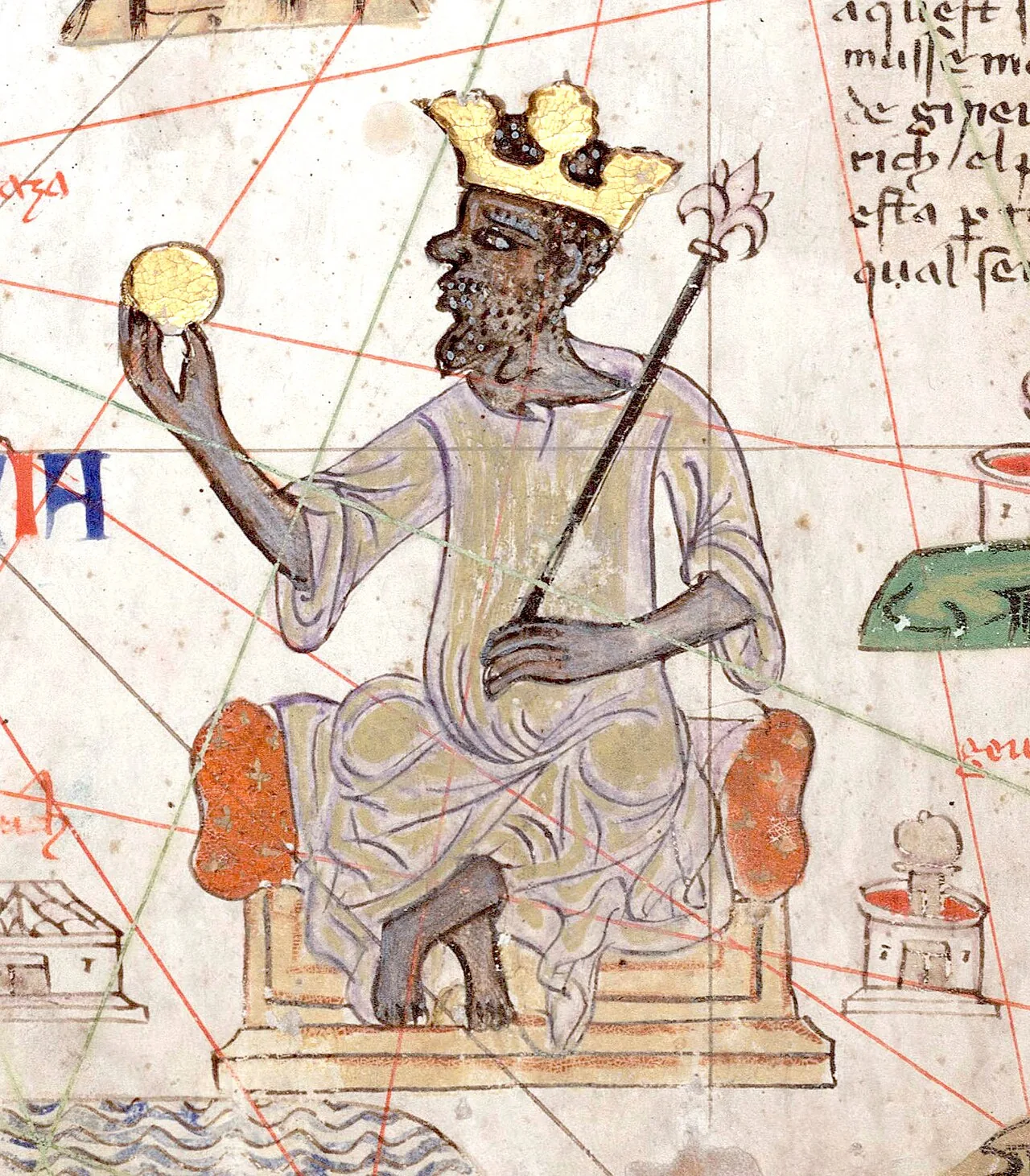
- Present the image (type, date, where made, for whom).
- Describe the figure and what he holds.
- What does the image suggest about European knowledge of West Africa?
- Why is this image a poor source for how Mansa Musa really looked, but a good source for something else?
Exercise 8 : The founding of Tenochtitlan
Look at Document F.
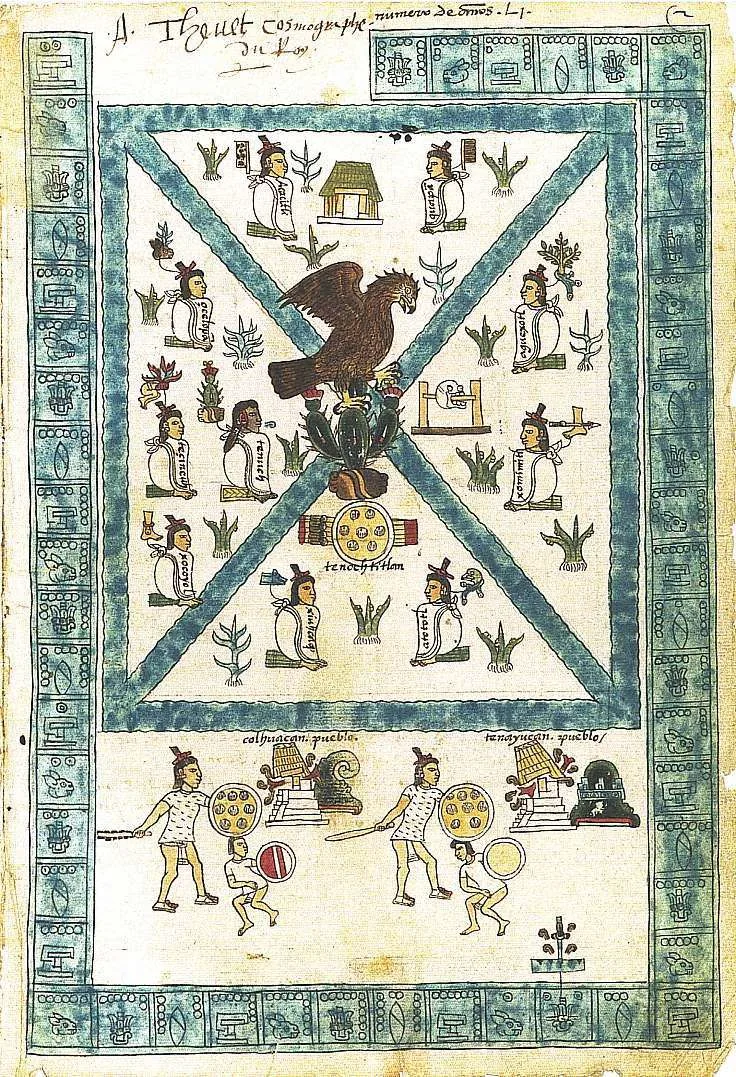
- Present the document. Who made the Codex Mendoza, and for whom?
- Identify the central symbol and what it means.
- How does the layout represent the city?
- What does this document tell us about how the Mexica explained and justified their rule?
Exercise 9 : Charter and image
Look at Documents G (text) and H (image).
39. No freemen shall be taken or imprisoned or disseised or exiled or in any way destroyed, nor will we go upon him nor send upon him, except by the lawful judgment of his peers or by the law of the land. 40. To no one will we sell, to no one will we refuse or delay, right or justice.
Source: Magna Carta, clauses 39 and 40, issued by King John of England at Runnymede, June 1215; Avalon Project, Yale Law School.
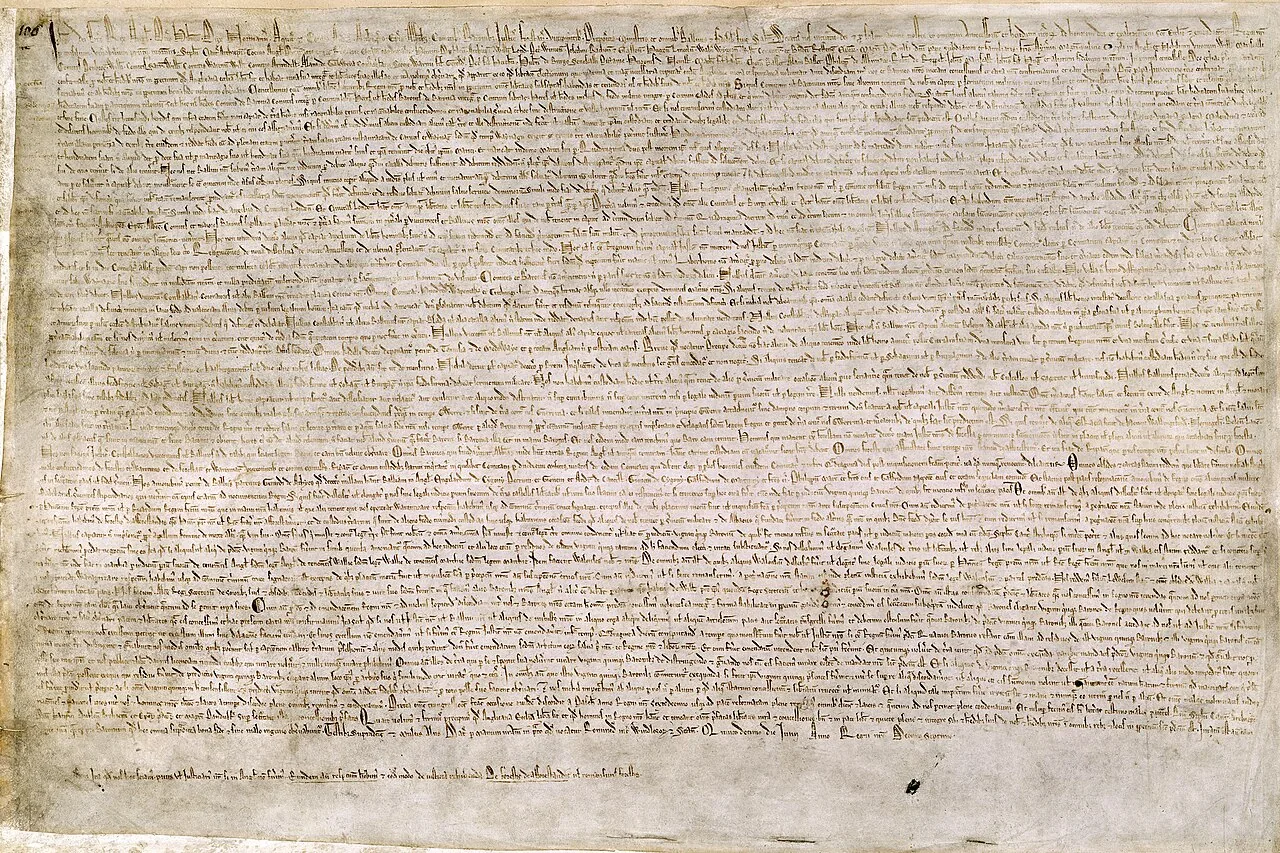
- Present the text and describe the image.
- How does the physical form of the image affect your idea of how the charter was used?
- Why is this text more important for later history than for 1215?
Exercise 10 : Entering Tenochtitlan
Read Document I.
The next morning we reached the broad high road of Iztapalapan, whence we for the first time beheld the numbers of towns and villages built in the lake, and the still greater number of large townships on the mainland, with the level causeway which ran in a straight line into Mexico. Our astonishment was indeed raised to the highest pitch, and we could not help remarking to each other, that all these buildings resembled the fairy castles we read of in Amadis de Gaul; so high, majestic, and splendid did the temples, towers, and houses of the town, all built of massive stone and lime, rise up out of the midst of the lake. Indeed, many of our men believed what they saw was a mere dream.
Source: Bernal Diaz del Castillo, Memoirs (the True History of the Conquest of New Spain), written decades after 1519, describing the Spaniards approaching Tenochtitlan (Mexico) in November 1519; translated by John Ingram Lockhart (1844); Project Gutenberg.
*Amadis de Gaul: a Spanish romance of chivalry; *causeway: a raised road across water.
- Present the document. How long after the events was it written?
- What did the Spaniards compare the city to? Why?
- What does the passage suggest about the size and organization of the city?
- Explain one way the writer’s purpose may shape the account.
Exercise 11 : A conquistador and a painter
Compare Document I (text) with the map of Tenochtitlan from 1524.
The next morning we reached the broad high road of Iztapalapan, whence we for the first time beheld the numbers of towns and villages built in the lake, and the still greater number of large townships on the mainland, with the level causeway which ran in a straight line into Mexico. Our astonishment was indeed raised to the highest pitch, and we could not help remarking to each other, that all these buildings resembled the fairy castles we read of in Amadis de Gaul; so high, majestic, and splendid did the temples, towers, and houses of the town, all built of massive stone and lime, rise up out of the midst of the lake. Indeed, many of our men believed what they saw was a mere dream.
Source: Bernal Diaz del Castillo, Memoirs (the True History of the Conquest of New Spain), written decades after 1519, describing the Spaniards approaching Tenochtitlan (Mexico) in November 1519; translated by John Ingram Lockhart (1844); Project Gutenberg.
*Amadis de Gaul: a Spanish romance of chivalry.
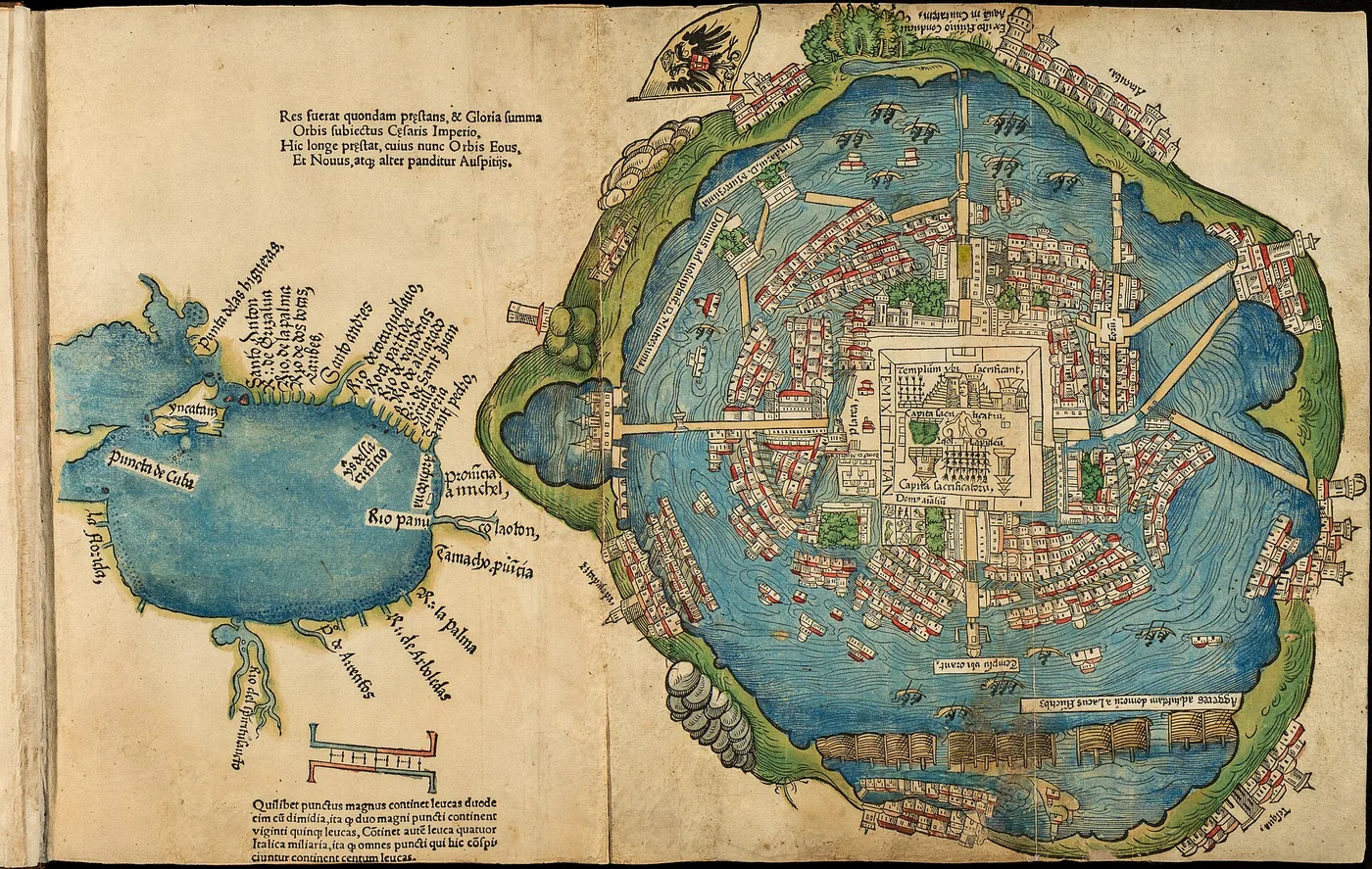
- Present each document.
- Which features of the text can you find in the map?
- What can the map not show that the text does?
- Why did Europeans print maps like this one in the 1520s?
Exercise 12 : The Swahili coast
Read Document J.
Kulwa, which is a large town on the coast. The majority of its inhabitants are Zanj, jet-black in colour, and with tattoo marks on their faces. I was told by a merchant that the town of Sufala lies a fortnight’s journey [south] from Kulwa and that gold dust is brought to Sufala from Yufi in the country of the Limis, which is a month’s journey distant from it. Kulwa is a very fine and substantially built town, and all its buildings are of wood. Its inhabitants are constantly engaged in military expeditions, for their country is contiguous to the heathen Zanj. The sultan at the time of my visit was Abu’l-Muzaffar Hasan, who was noted for his gifts and generosity.
Source: Ibn Battuta, Rihla, description of Mombasa and Kilwa (Kulwa) on the East African coast, about 1331; translated by H. A. R. Gibb (1929); Fordham Medieval Sourcebook.
*Zanj: the Arabic name for the people of the East African coast; *sultan: ruler.
- Present the document.
- Identify two pieces of evidence that Kilwa was part of a trade network.
- What does the sultan’s behavior suggest about the values of the ruling class?
- Which religious practice appears in the text?
Exercise 13 : Two Swahili ports
Compare Documents K and J.
Maqdasha [Mogadishu], which is an enormous town. Its inhabitants are merchants and have many camels, of which they slaughter hundreds every day [for food]. When a vessel reaches the port, it is met by sumbuqs, which are small boats, in each of which are a number of young men, each carrying a covered dish containing food. He presents this to one of the merchants on the ship saying “This is my guest,” and all the others do the same. Each merchant on disembarking goes only to the house of the young man who is his host, except those who have made frequent journeys to the town and know its people well; these live where they please.
Source: Ibn Battuta, Rihla, description of Mogadishu (Maqdasha), about 1331; translated by H. A. R. Gibb (1929); Fordham Medieval Sourcebook.
*Sumbuqs: small boats; *qadi: judge; *wazir: minister.
Kulwa, which is a large town on the coast. The majority of its inhabitants are Zanj, jet-black in colour, and with tattoo marks on their faces. I was told by a merchant that the town of Sufala lies a fortnight’s journey [south] from Kulwa and that gold dust is brought to Sufala from Yufi in the country of the Limis, which is a month’s journey distant from it. Kulwa is a very fine and substantially built town, and all its buildings are of wood. Its inhabitants are constantly engaged in military expeditions, for their country is contiguous to the heathen Zanj. The sultan at the time of my visit was Abu’l-Muzaffar Hasan, who was noted for his gifts and generosity.
Source: Ibn Battuta, Rihla, description of Mombasa and Kilwa (Kulwa) on the East African coast, about 1331; translated by H. A. R. Gibb (1929); Fordham Medieval Sourcebook.
*Zanj: Arabic name for the people of the East African coast.
- Present both documents.
- Compare what each tells us about trade and hospitality.
- Identify one difference between the two towns.
Exercise 14 : Machu Picchu
Look at the photograph.
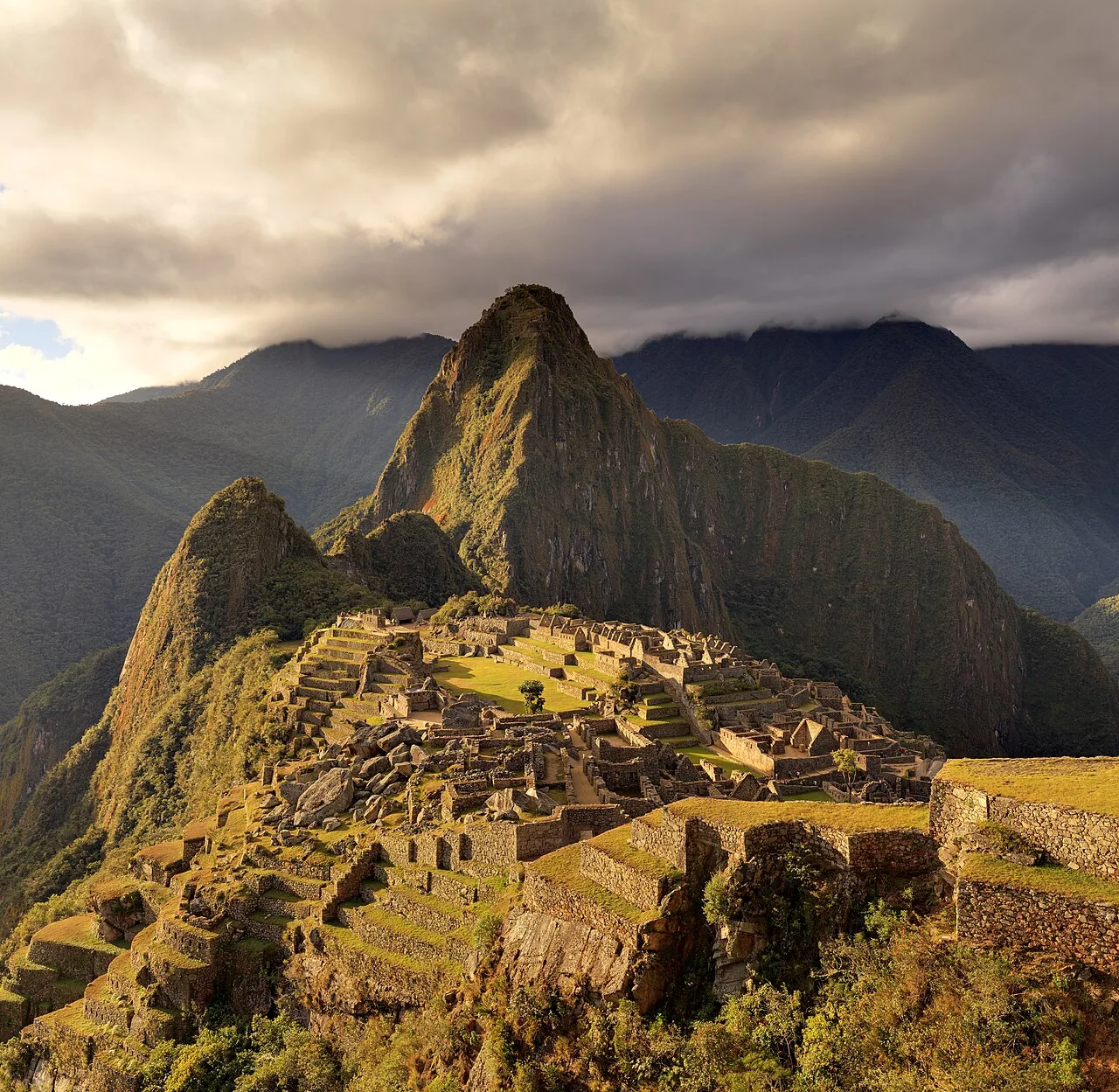
- Describe what you see.
- Which features show that the Inca organized large amounts of labor?
- How did the mit’a help build sites like this?
- What can this image not tell you about Inca society?
Exercise 15 : Ordering the centuries
Put these events in chronological order: Magna Carta; the Mongols sack Baghdad; Mansa Musa’s hajj; the Triple Alliance is formed; the Delhi Sultanate begins; Pachacuti begins to expand the Inca state.
- Give the date of each event.
- Which two events took place within a decade of each other?
- Which event came first and which last?
Exercise 16 : Periodization
AP World History Unit 1 covers about 1200 to 1450. Choose two events that could be used to justify starting the period in 1200 and one event that could justify ending it around 1450.
Exercise 17 : Guided research: Timbuktu
Investigate the role of Timbuktu in West African history.
- Keywords: Timbuktu manuscripts, Sankore, Mali Empire, Mansa Musa Cairo.
- Reliable sites: a university or museum site on Timbuktu manuscripts; the British Museum; the Library of Congress; Encyclopaedia Britannica. Check the date and the author of each page.
- Fill in: when was Timbuktu founded? Which empire controlled it in 1325? What goods were traded there? What kind of texts are in its libraries? Which source did you use for each answer?
Exercise 18 : Short answer: continuity and change
Answer parts A, B, and C (about three to four sentences in all).
- A. Identify one way in which Neo-Confucianism shaped the government of Song China.
- B. Identify one way in which the Delhi Sultanate’s rulers adapted to a Hindu-majority population.
- C. Explain one similarity between how two different states used religion to justify their rule.
Exercise 19 : Stimulus-based multiple choice
Use the passage from Ibn Battuta (Document A) to answer the questions.
They are seldom unjust, and have a greater abhorrence of injustice than any other people. Their sultan shows no mercy to anyone who is guilty of the least act of it. There is complete security in their country. Neither traveller nor inhabitant in it has anything to fear from robbers or men of violence. They do not confiscate the property of any white man who dies in their country, even if it be uncounted wealth. On the contrary, they give it into the charge of some trustworthy person among the whites, until the rightful heir takes possession of it.
Source: Ibn Battuta, Rihla (Travels), account of his stay in the empire of Mali, 1352-1353, as dictated in 1355; translated by H. A. R. Gibb, Ibn Battuta: Travels in Asia and Africa, 1325-1354 (London, 1929); Fordham Medieval Sourcebook.
*Whites: light-skinned North African and Arab visitors.
- 1. The author’s emphasis on prayer and Quran study best reflects (A) his concern as a Muslim scholar; (B) the Mali emperor’s plan for conquest; (C) a decline of trade; (D) his criticism of the sultan.
- 2. The security in the country most likely helped (A) Mali’s long-distance trade; (B) its conquest of Europe; (C) the spread of Buddhism; (D) the development of paper money.
- 3. A historian would find the document most useful for studying (A) the court and towns of Mali in the 1350s; (B) the daily lives of all villagers; (C) the earliest history of Ghana; (D) how Mali gold was mined.
Exercise 20 : Cause and effect: Mali's wealth
Explain how Mali’s control of the gold trade affected (a) its rulers’ power, (b) its connections with other regions, and (c) its place in Muslim and European knowledge of Africa.
Exercise 21 : True or false? Justify
Decide whether each statement is true or false and justify it in one sentence.
- The Inca had a written alphabet.
- Magna Carta created democracy in England.
- Mansa Musa’s hajj showed Mali’s wealth to the Muslim world.
- The Song government chose officials through examinations.
Exercise 22 : LEQ: comparison
Prompt (AP style): Evaluate the extent to which religion was the most important way that rulers legitimized their power in the period 1200-1450. Write a thesis and plan two body paragraphs, using at least two regions.
Hint: A strong thesis takes a position and names a reason, for example: religion was important, but taxes and administration mattered as much.


Quick review: flashcards
Tap a card to see the answer.