


This worksheet on AP World Unit 2: Networks of Exchange belongs to the AP World History: Modern course. Its questions use primary sources, maps and timelines, and they move from basic recall to short writing tasks. Before you start, review the lesson; afterward, try the true or false quiz.
Exercise 1 : Key terms
Match each term with its definition: (a) Pax Mongolica, (b) yam, (c) monsoon, (d) dhow, (e) caravanserai, (f) bubonic plague.
- A seasonal wind that allows sailing across the Indian Ocean in alternating directions.
- The Mongol relay system of stations for messengers.
- A disease spread by fleas on rats that killed millions after 1347.
- A ship with a triangular sail used in the Indian Ocean.
- A roadside inn for merchants.
- The period of safe travel under Mongol rule.
Exercise 2 : A friar in the Mongol capital
Read Document A.
Of the city of Caracarum you must know that, exclusive of the palace of the Chan, it is not as big as the village of Saint Denis, and the monastery of Saint Denis is ten times larger than the palace […] There are there twelve idol temples of different nations, two mahummeries [mosques] in which is cried the law of Machomet, and one church of Christians in the extreme end of the city. The city is surrounded by a mud wall and has four gates.
Source: William of Rubruck, Itinerarium, report to King Louis IX of France on his journey to the Mongol court, 1253-1255; translated by W. W. Rockhill (Hakluyt Society, 1900); University of Washington Silk Road Seattle site.
*Chan: khan; *Saracens: medieval Europeans’ word for Muslims; *mahummeries: mosques.
- Present the document (author, date, purpose).
- What does Rubruck compare Karakorum to, and why?
- List the religions and peoples he mentions.
- What does the passage suggest about the Mongols’ attitude to religion and trade?
Exercise 3 : Paper money
Read Document B.
And the Kaan causes every year to be made such a vast quantity of this money, which costs him nothing, that it must equal in amount all the treasure in the world. With these pieces of paper, made as I have described, he causes all payments on his own account to be made; and he makes them to pass current universally over all his kingdoms and provinces and territories, and whithersoever his power and sovereignty extends. And nobody, however important he may think himself, dares to refuse them on pain of death.
Source: Marco Polo, The Travels of Marco Polo, book 2, on the paper money of the Great Khan, written about 1298; translated by Henry Yule and Henri Cordier (1903); Project Gutenberg.
*Kaan: khan; *bezant: a Mediterranean gold coin.
- Present the document.
- How did the khan make the paper accepted as money?
- What does the text suggest about the Mongol state’s power?
- Why might Polo’s statement that the money “costs him nothing” be misleading?
Exercise 4 : Two Europeans in the Mongol world
Compare Documents A and B.
Of the city of Caracarum you must know that, exclusive of the palace of the Chan, it is not as big as the village of Saint Denis, and the monastery of Saint Denis is ten times larger than the palace […] There are there twelve idol temples of different nations, two mahummeries [mosques] in which is cried the law of Machomet, and one church of Christians in the extreme end of the city. The city is surrounded by a mud wall and has four gates.
Source: William of Rubruck, Itinerarium, report to King Louis IX of France on his journey to the Mongol court, 1253-1255; translated by W. W. Rockhill (Hakluyt Society, 1900); University of Washington Silk Road Seattle site.
*Chan: khan; *Saracens: Muslims.
And the Kaan causes every year to be made such a vast quantity of this money, which costs him nothing, that it must equal in amount all the treasure in the world. With these pieces of paper, made as I have described, he causes all payments on his own account to be made; and he makes them to pass current universally over all his kingdoms and provinces and territories, and whithersoever his power and sovereignty extends. And nobody, however important he may think himself, dares to refuse them on pain of death.
Source: Marco Polo, The Travels of Marco Polo, book 2, on the paper money of the Great Khan, written about 1298; translated by Henry Yule and Henri Cordier (1903); Project Gutenberg.
*Kaan: khan.
- Present each author and his purpose.
- What does each admire or report with surprise?
- Identify a difference in what they emphasize.
- Explain why historians use both accounts.
Exercise 5 : Cities on the networks
Use the numbered map and Map 1 in the lesson.
- Name the cities numbered 1 to 8: Changan, Samarkand, Baghdad, Guangzhou, Calicut, Kilwa, Timbuktu, Constantinople.
- Which cities belong to the Silk Roads?
- Which belong to the Indian Ocean network?
- Which city marks the southern end of the trans-Saharan route?
Exercise 6 : Mapping the plague
Study the map of the Black Death.
- Where does the route begin?
- Name three ports along the route.
- What does the map suggest about how the disease traveled?
- Why is the map a simplification?
Exercise 7 : Khubilai Khan
Look at Document C.
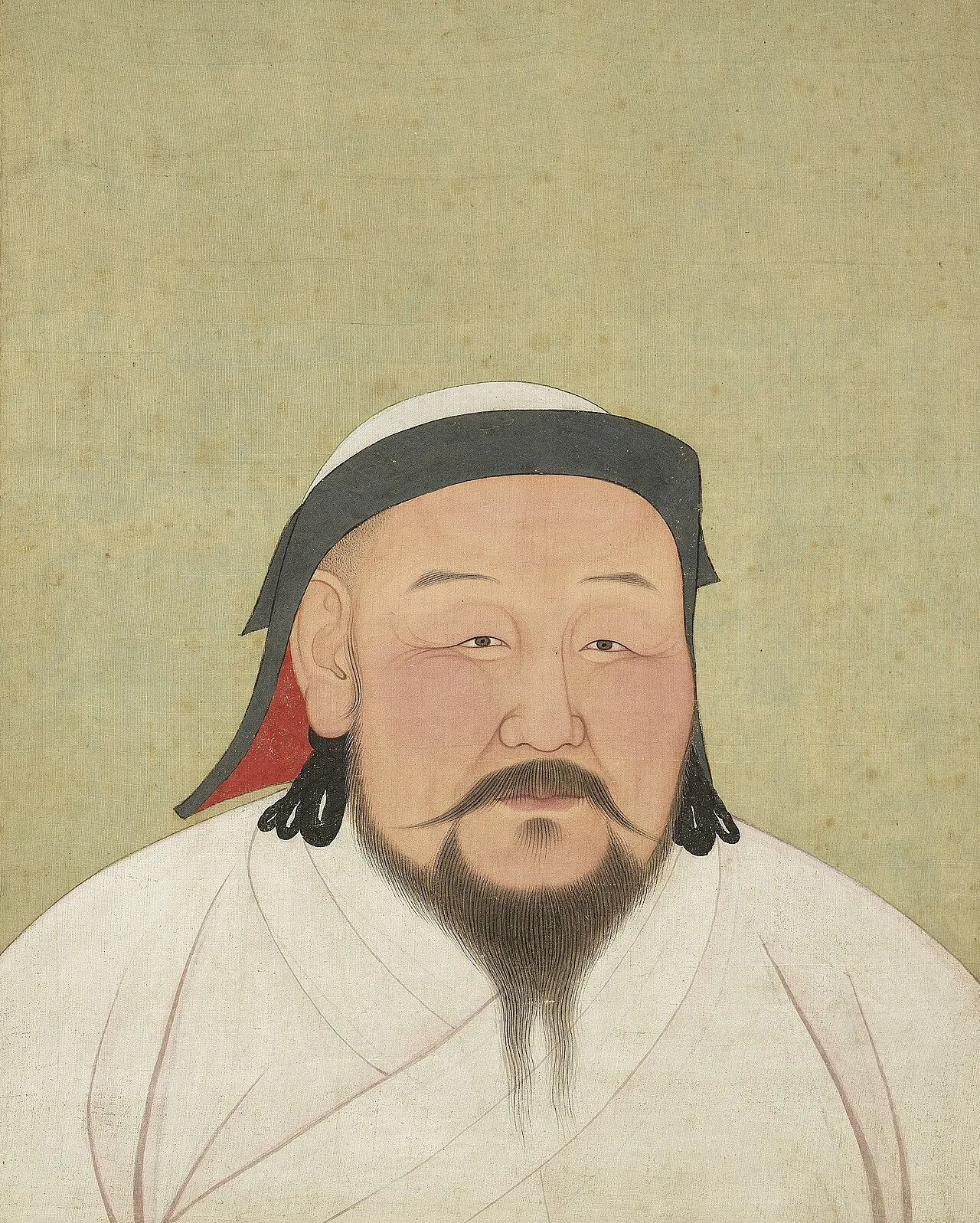
- Present the image.
- Describe the clothing and the posture of the figure.
- What message about the emperor does the portrait send?
- Why might a portrait of a Mongol ruler painted for a Chinese court differ from one made by the Mongols?
Exercise 8 : A Mongol siege
Look at Document D.
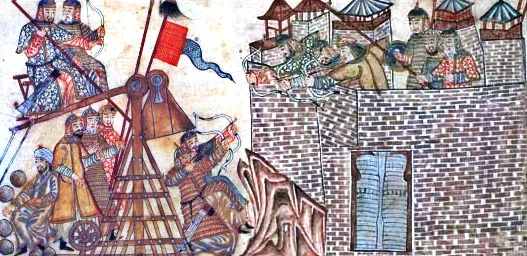
- Present the image (type, date, source).
- Identify the weapons and techniques that you see.
- Why did the Mongols use engineers from conquered peoples?
- What can the picture not tell you about the effects of such sieges?
Exercise 9 : Burying the dead
Look at Document E.
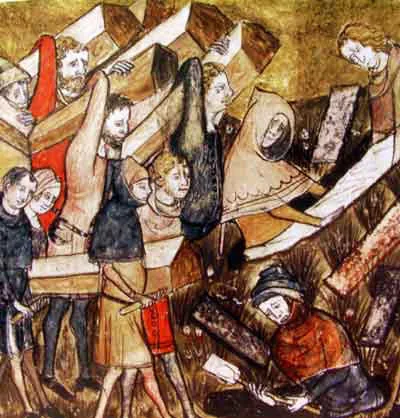
- Present the image.
- Describe what the people are doing.
- What does the image suggest about the scale of the epidemic?
- What is one limit of the image as evidence?
Exercise 10 : Florence in 1348
Read Document F.
thousand three hundred and forty-eight, when into the notable city of Florence, fair over every other of Italy, there came the death-dealing pestilence, which, through the operation of the heavenly bodies or of our own iniquitous dealings, being sent down upon mankind for our correction by the just wrath of God, had some years before appeared in the parts of the East and after having bereft these latter of an innumerable number of inhabitants, extending without cease from one place to another, had now unhappily spread towards the West.
Source: Giovanni Boccaccio, The Decameron, introduction to the first day, written about 1349-1353, on the plague in Florence in 1348; translated by John Payne (1886); Project Gutenberg.
*Pestilence: epidemic disease; *plague-boils: swellings on the body.
- Present the document.
- What explanations does Boccaccio give for the plague?
- Which symptoms does he describe?
- Why must a historian be cautious in using the text?
Exercise 11 : Text and image on the plague
Compare Document F (text) and Document E (image).
thousand three hundred and forty-eight, when into the notable city of Florence, fair over every other of Italy, there came the death-dealing pestilence, which, through the operation of the heavenly bodies or of our own iniquitous dealings, being sent down upon mankind for our correction by the just wrath of God, had some years before appeared in the parts of the East and after having bereft these latter of an innumerable number of inhabitants, extending without cease from one place to another, had now unhappily spread towards the West.
Source: Giovanni Boccaccio, The Decameron, introduction to the first day, written about 1349-1353, on the plague in Florence in 1348; translated by John Payne (1886); Project Gutenberg.
*Pestilence: epidemic disease.
- Present each.
- What does each show about the plague’s effect on society?
- Which gives more information about causes, and which about burial?
Exercise 12 : Mogadishu
Read Document G.
Maqdasha [Mogadishu], which is an enormous town. Its inhabitants are merchants and have many camels, of which they slaughter hundreds every day [for food]. When a vessel reaches the port, it is met by sumbuqs, which are small boats, in each of which are a number of young men, each carrying a covered dish containing food. He presents this to one of the merchants on the ship saying “This is my guest,” and all the others do the same. Each merchant on disembarking goes only to the house of the young man who is his host, except those who have made frequent journeys to the town and know its people well; these live where they please.
Source: Ibn Battuta, Rihla, description of Mogadishu (Maqdasha), about 1331; translated by H. A. R. Gibb (1929); Fordham Medieval Sourcebook.
*Sumbuqs: small boats; *qadi: judge; *wazir: minister.
- Present the document.
- Describe how merchants were received.
- How did this system benefit both visitors and residents?
- What does it show about Mogadishu’s religion and institutions?
Exercise 13 : Trust on the routes
Compare how trust was created in two networks: Document G (Mogadishu) and Document H (Mali).
Maqdasha [Mogadishu], which is an enormous town. Its inhabitants are merchants and have many camels, of which they slaughter hundreds every day [for food]. When a vessel reaches the port, it is met by sumbuqs, which are small boats, in each of which are a number of young men, each carrying a covered dish containing food. He presents this to one of the merchants on the ship saying “This is my guest,” and all the others do the same. Each merchant on disembarking goes only to the house of the young man who is his host, except those who have made frequent journeys to the town and know its people well; these live where they please.
Source: Ibn Battuta, Rihla, description of Mogadishu (Maqdasha), about 1331; translated by H. A. R. Gibb (1929); Fordham Medieval Sourcebook.
*Sumbuqs: small boats; *qadi: judge.
They are seldom unjust, and have a greater abhorrence of injustice than any other people. Their sultan shows no mercy to anyone who is guilty of the least act of it. There is complete security in their country. Neither traveller nor inhabitant in it has anything to fear from robbers or men of violence. They do not confiscate the property of any white man who dies in their country, even if it be uncounted wealth. On the contrary, they give it into the charge of some trustworthy person among the whites, until the rightful heir takes possession of it.
Source: Ibn Battuta, Rihla (Travels), account of his stay in the empire of Mali, 1352-1353, as dictated in 1355; translated by H. A. R. Gibb, Ibn Battuta: Travels in Asia and Africa, 1325-1354 (London, 1929); Fordham Medieval Sourcebook.
*Whites: light-skinned North African and Arab visitors.
- Present both.
- Identify the way each place protected visiting merchants or travelers.
- Explain one difference.
Exercise 14 : A world map for merchants
Look at Document I.
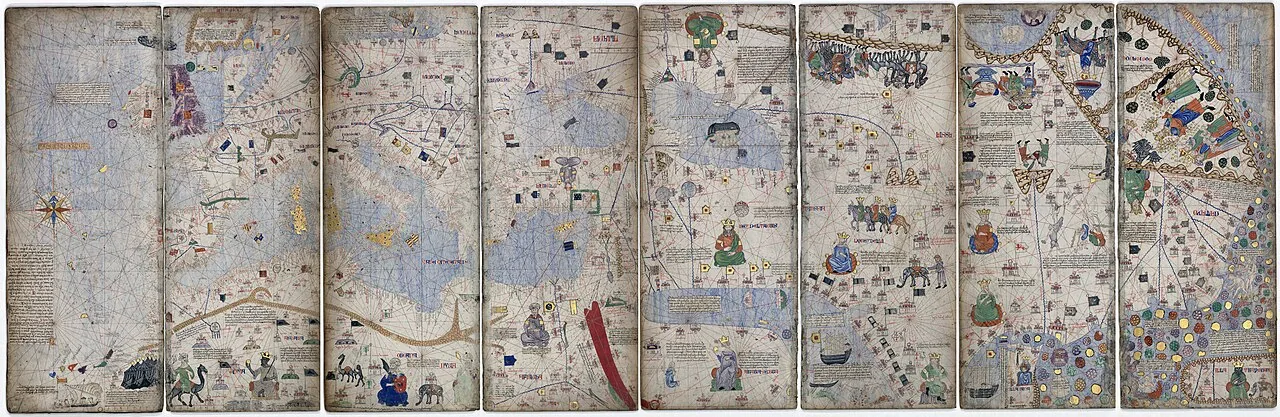
- Present the document.
- Which regions shown connect to the three networks of the lesson?
- What does the atlas show about what Europeans knew in 1375?
- Why is it a useful source for historians of trade?
Exercise 15 : Ordering events
Put these in order: Mongols sack Baghdad; Genghis Khan proclaimed; Black Death reaches Messina; Ming dynasty founded; Khubilai proclaims the Yuan; Zheng He’s first voyage.
- Give dates.
- Which came before the plague and which after?
- How many years between the sack of Baghdad and the Yuan?
Exercise 16 : Cause chains
Arrange the following in a chain of cause and effect: plague kills many workers; wages rise; landlords try to limit wages; peasants revolt; serfdom weakens. Then give dates for two of these steps.
Exercise 17 : Guided research: Zheng He
Investigate the voyages of Zheng He.
- Keywords: Zheng He voyages, treasure fleet, Ming dynasty, Yongle emperor, Malindi giraffe.
- Reliable sites: the British Museum, the Metropolitan Museum of Art, Encyclopaedia Britannica, a university history page. Check who wrote each page.
- Fill in: dates of the first and last voyages; regions visited; the goods taken and brought back; why the voyages ended; your sources.
Exercise 18 : Short answer: the Mongols
Answer A, B, and C.
- A. Identify one way the Mongols made Eurasian trade safer.
- B. Explain one effect of the Pax Mongolica on cultural exchange.
- C. Explain one way in which the Mongol conquests also disrupted society.
Exercise 19 : Stimulus-based multiple choice
Use Document F (Boccaccio) to answer the questions.
thousand three hundred and forty-eight, when into the notable city of Florence, fair over every other of Italy, there came the death-dealing pestilence, which, through the operation of the heavenly bodies or of our own iniquitous dealings, being sent down upon mankind for our correction by the just wrath of God, had some years before appeared in the parts of the East and after having bereft these latter of an innumerable number of inhabitants, extending without cease from one place to another, had now unhappily spread towards the West.
Source: Giovanni Boccaccio, The Decameron, introduction to the first day, written about 1349-1353, on the plague in Florence in 1348; translated by John Payne (1886); Project Gutenberg.
*Pestilence: epidemic disease.
- 1. The passage states that the plague had earlier appeared (A) in the East; (B) in Africa only; (C) in the Americas; (D) in Scandinavia.
- 2. The passage best supports the view that medieval people (A) understood germs; (B) explained plague by religion and the stars; (C) ignored it; (D) blamed trade.
- 3. Which later development is most directly connected? (A) the Statute of Labourers; (B) the discovery of America; (C) Magna Carta; (D) the Crusades.
Exercise 20 : Cause and effect: the plague
Explain how the Black Death was a result of the networks of exchange and how it changed them.
Exercise 21 : True or false? Justify
Decide whether each statement is true or false and justify it.
- The Mongols always destroyed the religions of conquered peoples.
- The monsoon winds made Indian Ocean sailing predictable.
- Zheng He’s voyages continued for more than a century.
- Mansa Musa’s pilgrimage took place before the Black Death.
Exercise 22 : LEQ: comparison
Prompt (AP style): Compare the causes and effects of the Silk Roads and the Indian Ocean trade between 1200 and 1450. Write a thesis and outline two body paragraphs.
Hint: A comparison thesis needs both a similarity and a difference.


Quick review: flashcards
Tap a card to see the answer.