


This AP World History: Modern test covers AP World Unit 2: Networks of Exchange. Like a classroom assessment, it includes documents to analyze, knowledge questions and a short writing task. To prepare, review the lesson first, then practice with the worksheet.
Time : 90 min
AP style. Part A: documents and short answers (70 points). Part B: LEQ (30 points).
Document 1 – Marco Polo on paper money (about 1298)
And the Kaan causes every year to be made such a vast quantity of this money, which costs him nothing, that it must equal in amount all the treasure in the world. With these pieces of paper, made as I have described, he causes all payments on his own account to be made; and he makes them to pass current universally over all his kingdoms and provinces and territories, and whithersoever his power and sovereignty extends. And nobody, however important he may think himself, dares to refuse them on pain of death.
Source: Marco Polo, The Travels of Marco Polo, book 2, on the paper money of the Great Khan, written about 1298; translated by Henry Yule and Henri Cordier (1903); Project Gutenberg.
*Kaan: khan; *bezant: a Mediterranean gold coin.
Marco Polo, Travels, translation of Yule and Cordier
Document 2 – Boccaccio on the plague in Florence (1348)
thousand three hundred and forty-eight, when into the notable city of Florence, fair over every other of Italy, there came the death-dealing pestilence, which, through the operation of the heavenly bodies or of our own iniquitous dealings, being sent down upon mankind for our correction by the just wrath of God, had some years before appeared in the parts of the East and after having bereft these latter of an innumerable number of inhabitants, extending without cease from one place to another, had now unhappily spread towards the West.
Source: Giovanni Boccaccio, The Decameron, introduction to the first day, written about 1349-1353, on the plague in Florence in 1348; translated by John Payne (1886); Project Gutenberg.
*Pestilence: epidemic disease; *plague-boils: swellings.
Boccaccio, Decameron, translation of John Payne
Document 3 – Burying plague victims at Tournai
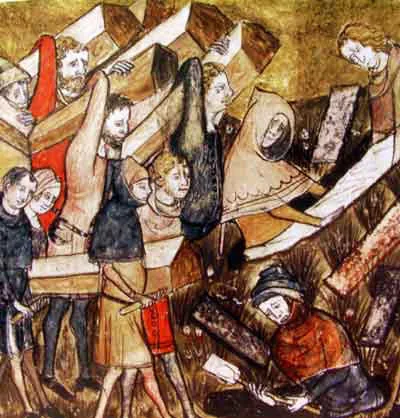
Miniature, about 1353, Wikimedia Commons
Document 4 – The spread of the Black Death, 1346-1350
Map prepared from Natural Earth data
Questions
- 1. (Document 1) Identify one way the Mongol state supported its paper money. (6 points) (6 pts)
- 2. (Document 1) Explain how Polo’s occupation could shape his description. (10 points) (10 pts)
- 3. (Document 2) Identify one cause of the plague named by Boccaccio and one symptom. (8 points) (8 pts)
- 4. (Documents 2 and 3) Compare what the text and the image tell us about the effects of the plague on society. (12 points) (12 pts)
- 5. (Document 4) Explain how the pattern of the plague’s spread reflects the networks of exchange. (10 points) (10 pts)
- 6. SAQ. (a) Identify one technology that made Indian Ocean trade possible. (b) Explain one effect of the plague on labor in Europe. (c) Explain one way the Pax Mongolica encouraged cultural exchange. (12 points) (12 pts)
- 7. DBQ-style synthesis. Using Documents 1 to 4 and your own knowledge, evaluate the extent to which Eurasian connections brought benefits rather than harm in the period 1200-1450. (12 points) (12 pts)
- 8. LEQ. Evaluate the extent to which the Mongol Empire transformed Afro-Eurasian trade between 1200 and 1450. (30 points) (30 pts)


Quick review: flashcards
Tap a card to see the answer.