


This AP World History: Modern lesson covers AP World Unit 2: Networks of Exchange, part of the unit “AP World units.” First, read the full lesson with its primary sources, maps and key terms. Then practice with the worksheet, check yourself with the quiz and get ready with the test.
In 1253 a Flemish friar named William of Rubruck set out from Constantinople with a few companions to find the Mongol Great Khan. He wanted to convert the Mongols to Christianity and to see whether they could be allies against Muslim rulers. Over about two years he traveled across the steppe, was hosted in tents, argued about religion at the khan’s court. Finally, he reached Karakorum, the Mongol capital. There he found a camp rather than a great city.
He also found a French goldsmith, a woman from Lorraine, and priests of many faiths. The world he describes was one where an Italian, a Persian, a Chinese, and a Muslim from Morocco could all travel and meet. This unit studies how and why that was so. Between 1200 and 1450 the Mongol conquests, the Indian Ocean monsoon trade, and the Saharan caravan routes tied together the Eastern Hemisphere more tightly than before. The same links carried goods, religions, inventions, and, in the 1340s, a deadly disease.
Guiding question: How did the Mongol Empire, the Indian Ocean, and the trans-Saharan trade routes connect Afro-Eurasia between 1200 and 1450, and what were the benefits and costs of those connections?
AP framing. This unit covers College Board Unit 2, “Networks of Exchange.” The AP skills emphasized are causation (why networks grew and what they caused) and sourcing (how a traveler’s origin and purpose shape what he sees). Themes: cultural developments and interactions; humans and the environment; economic systems.
1. The Mongol Empire and the Silk Roads
From the steppe to Eurasia
Before 1200 the Mongols were a collection of pastoral nomadic clans on the steppe north of China. In 1206 a chieftain named Temujin was proclaimed Genghis Khan, “universal ruler,” at a gathering of tribal leaders. He organized his warriors in units of ten, hundred, and thousand, rewarded loyalty and talent instead of birth. He also issued laws, called the yasa. His mounted archers were fast, disciplined, and skilled at using spies, terror, and engineers from conquered peoples.
Between 1206 and his death in 1227 he conquered northern China and the Central Asian empire of Khwarazm. This campaign devastated cities such as Bukhara, Samarkand, and Merv, with great loss of life. His successors continued the conquests. In 1237-1240 the Mongols, under his grandson Batu, overran Kievan Rus and captured Kiev. Then, in 1241, they raided Poland and Hungary before news of a succession crisis made them turn back. In 1258 his grandson Hulagu sacked Baghdad and ended the Abbasid caliphate.
Four khanates and the Yuan dynasty
The empire soon divided into four khanates: the Golden Horde in Russia, the Ilkhanate in Persia and Iraq, the Chagatai Khanate in Central Asia, and the Yuan dynasty in China. Genghis’s grandson Khubilai Khan (Kublai) became Great Khan in 1260 and proclaimed the Yuan dynasty in 1271. In 1279 he completed the conquest of Song China.
He moved the capital to Beijing (Khanbaliq), repaired the Grand Canal, issued paper money. He also employed foreigners, among them Persian financiers and, for a time, the Venetian merchant Marco Polo. His fleets failed to conquer Japan in 1274 and 1281, partly because of storms. A later expedition to Java was a failure as well. In 1368 rebels led by Zhu Yuanzhang overthrew the Yuan and founded the Ming dynasty.
Document 1 – A friar at Karakorum
Of the city of Caracarum you must know that, exclusive of the palace of the Chan, it is not as big as the village of Saint Denis, and the monastery of Saint Denis is ten times larger than the palace […] There are there twelve idol temples of different nations, two mahummeries [mosques] in which is cried the law of Machomet, and one church of Christians in the extreme end of the city. The city is surrounded by a mud wall and has four gates.
Source: William of Rubruck, Itinerarium, report to King Louis IX of France on his journey to the Mongol court, 1253-1255; translated by W. W. Rockhill (Hakluyt Society, 1900); University of Washington Silk Road Seattle site.
*Chan: khan; *Saracens: the medieval European word for Muslims; *Cathayans: people of northern China; *mahummeries: mosques.
Commentary. William of Rubruck was a Franciscan sent by King Louis IX of France, in 1253, to the Mongol court. His report to the king is blunt and curious. Rubruck compares Karakorum, the capital of the empire, with the village of Saint-Denis near Paris, which tells us what a European priest thought a city should look like. He also shows a city divided into a Muslim market quarter, a quarter of Chinese craftsmen, and temples of many religions. His aim was to convert the Mongols, so he pays special attention to religion. This is among the best eyewitness accounts of the Mongol world before the Yuan dynasty.
The Pax Mongolica
Historians use the phrase Pax Mongolica, the “Mongol peace,” for the period of about a century from 1250. During that time Mongol rule made travel across Eurasia relatively safe. Merchants, envoys, and missionaries could cross from the Black Sea to China under the protection of the khan. The Mongols built a relay system, the yam, with stations about a day’s ride apart. There official messengers could change horses and get food. Travelers carried a metal tablet, the paiza, as a passport. Caravanserais, roadside inns, housed merchants. Mongol rulers valued trade and protected merchants. They were mostly tolerant of different religions, though they were also capable of great brutality against those who resisted.
Definition: Pax Mongolica
the period of relative peace and safe travel across Eurasia, roughly 1250 to 1350, made possible by Mongol rule. It increased trade and the movement of people, ideas, technologies, and diseases.
Definition: Yam
the Mongol relay system of stations, about a day of travel apart, where official messengers and travelers carrying a paiza (a metal passport tablet) could obtain fresh horses, food, and lodging.
The Mongol peace encouraged exchange of technology and knowledge. Paper, printing, gunpowder, and the compass moved west; Persian and Arab astronomers and doctors moved east. The Ilkhans in Persia became Muslim: Ghazan, who ruled from 1295, adopted Islam and rebuilt Tabriz as a center of learning. Rashid al-Din, a Persian official and doctor, wrote a history of the world, the Compendium of Chronicles, drawing on Chinese, Persian, and European informants. The Mongols’ paper money, the Yuan banknote, was backed by the khan’s authority. That is why Marco Polo, who saw it in use in the late 1200s, described it as a kind of magic.
Document 2 – Money from the bark of a tree
And the Kaan causes every year to be made such a vast quantity of this money, which costs him nothing, that it must equal in amount all the treasure in the world. With these pieces of paper, made as I have described, he causes all payments on his own account to be made; and he makes them to pass current universally over all his kingdoms and provinces and territories, and whithersoever his power and sovereignty extends. And nobody, however important he may think himself, dares to refuse them on pain of death.
Source: Marco Polo, The Travels of Marco Polo, book 2, on the paper money of the Great Khan, written about 1298; translated by Henry Yule and Henri Cordier (1903); Project Gutenberg.
*Kaan: khan; *bezant: a gold coin used in the Mediterranean.
Commentary. Marco Polo, a Venetian merchant who spent years in China during Khubilai’s reign, dictated his book about 1298 in a prison in Genoa to a writer of romances, Rustichello. The description of paper money is accurate about the idea that notes were issued with the ruler’s authority and that forging them was punished by death. However, it overstates that notes cost the khan “nothing,” because the Yuan government printed too much, which caused inflation. As a merchant, Polo was interested in money and trade, and he wrote for readers in Italy who had never seen paper money. His claim that people had to accept the notes shows how the state backed its currency.
2. The Indian Ocean network
The Indian Ocean was the world’s busiest sea network. Its trade followed the monsoon winds, which blow from the southwest in summer and from the northeast in winter. As a result, ships could sail from Arabia or East Africa to India in one season and return in the next. Arab, Persian, Indian, and Swahili sailors used dhows with triangular (lateen) sails, the magnetic compass (from China), and the astrolabe (from the Muslim world) to navigate.
The routes connected the Swahili coast, the Red Sea and Persian Gulf, and the cities of western India such as Calicut and Cambay. They also reached the ports of Southeast Asia such as Malacca (founded about 1400), and southern China. Ships carried spices, cotton cloth, porcelain, gold, ivory, and enslaved people. Merchants from many places lived in the port cities and spread their religion. Islam moved along the coasts of East Africa, India, and Southeast Asia in the hands of traders and Sufi preachers. Hindu and Buddhist traditions also moved from India to Southeast Asia.
Definition: Monsoon
a seasonal wind system of the Indian Ocean: winds blow from the southwest in summer and from the northeast in winter, which lets sailors travel to India or East Africa in one season and return in the next.
Zheng He’s voyages
China, under the Ming, briefly tried to dominate this network by force. Between 1405 and 1433 the Yongle emperor and his successor sent the admiral Zheng He, a Muslim eunuch from Yunnan, on seven voyages to Southeast Asia, India, Arabia, and East Africa. His “treasure ships” and their large fleets of other vessels carried tens of thousands of men.
The fleets brought gifts of silk and porcelain and returned with tribute, including, at least once, a giraffe. The voyages displayed Ming power and enrolled rulers in the tribute system. After 1433 the Ming court ended them. Part of the reason was cost. Officials who valued agriculture and the northern frontier considered them wasteful. Chinese merchants kept trading, but the state no longer sponsored fleets.
Document 3 – Mogadishu and its merchants
Maqdasha [Mogadishu], which is an enormous town. Its inhabitants are merchants and have many camels, of which they slaughter hundreds every day [for food]. When a vessel reaches the port, it is met by sumbuqs, which are small boats, in each of which are a number of young men, each carrying a covered dish containing food. He presents this to one of the merchants on the ship saying “This is my guest,” and all the others do the same. Each merchant on disembarking goes only to the house of the young man who is his host, except those who have made frequent journeys to the town and know its people well; these live where they please.
Source: Ibn Battuta, Rihla, description of Mogadishu (Maqdasha), about 1331; translated by H. A. R. Gibb (1929); Fordham Medieval Sourcebook.
*Sumbuqs: small boats; *qadi: judge; *wazir: minister; *Shaykh: the sultan of Mogadishu.
Commentary. Ibn Battuta visited Mogadishu on the East African coast about 1331. The passage describes a system by which each incoming merchant became the guest of a local host, who handled his business. This was a form of regulation that protected both visitors and local traders. The author was a Muslim judge, so he pays attention to how he was received by the qadi and the Shaykh. He also describes a city that was thoroughly Muslim. His text is helpful for showing how institutions of trust worked, but he gives few numbers and he generalizes from a three-day stay.
3. The trans-Saharan trade
The Sahara was less a barrier than a sea of sand with ports at both edges. The key invention was the camel saddle, which allowed camels to carry heavy loads. Caravans of hundreds or thousands of animals crossed from North African towns such as Sijilmasa to the Sahel towns of Timbuktu and Gao. Salt from desert mines such as Taghaza, along with cloth, copper, and horses, went south. Gold, ivory, and enslaved people went north.
The trade enriched states in the Sahel, above all Mali, whose rulers collected taxes on the goods and controlled the gold fields. Muslim merchants brought Islam with them, and many rulers adopted it while keeping older traditions. Timbuktu became a center of learning with scholars and libraries, and Djenne became a trading city of mud-brick architecture. Mansa Musa’s pilgrimage to Mecca in 1324-1325 made Mali famous in Cairo and beyond.
Document 4 – The world as seen by traders
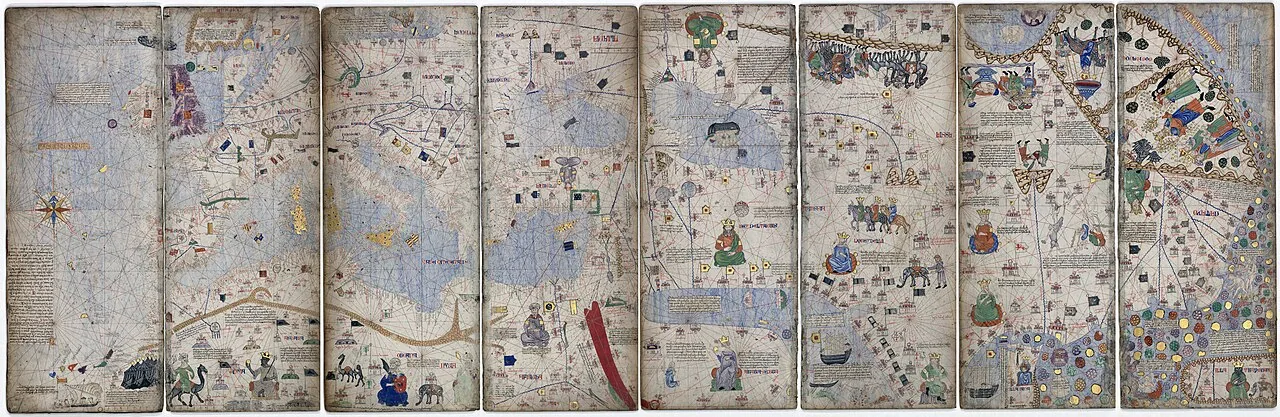
Commentary. The Catalan Atlas was made in Majorca in 1375 for King Peter IV of Aragon, who gave it to the French crown. It was a luxury object, but it also represents the knowledge that merchants and travelers carried. It shows the Sahara routes and Mali’s king, the Mongol realms, and the Indian Ocean. The design of the atlas shows a Mediterranean viewpoint; Europe is shown in detail, and distant places are less accurate.
4. The Black Death
The same network that carried silk and gold also carried disease. The Black Death, an outbreak of plague caused by the bacterium Yersinia pestis, appears to have spread from Central Asia, where it lived among rodents. Fleas on rats and on the goods carried by caravans and ships moved it along trade routes. By 1346 it had reached the Black Sea port of Caffa.
In October 1347 Genoese ships brought it to Messina in Sicily. Within four years it had spread through the Mediterranean, North Africa, and the Middle East, and across Europe. Historians believe it killed between a third and a half of the population in many parts of Europe. The Middle East and North Africa suffered heavy losses too. Records are incomplete, and estimates vary.
Document 5 – The plague in Florence
thousand three hundred and forty-eight, when into the notable city of Florence, fair over every other of Italy, there came the death-dealing pestilence, which, through the operation of the heavenly bodies or of our own iniquitous dealings, being sent down upon mankind for our correction by the just wrath of God, had some years before appeared in the parts of the East and after having bereft these latter of an innumerable number of inhabitants, extending without cease from one place to another, had now unhappily spread towards the West.
Source: Giovanni Boccaccio, The Decameron, introduction to the first day, written about 1349-1353, on the plague in Florence in 1348; translated by John Payne (1886); Project Gutenberg.
*Pestilence: epidemic disease; *plague-boils: swellings (buboes) on the body.
Commentary. Giovanni Boccaccio, a Florentine writer, lived through the plague of 1348 and opened his Decameron, a collection of stories told by ten young people who flee the city. The book opens with a vivid description of the disease. His explanation of its origin, as a sign of divine anger or of the stars, shows how people of his time understood disease. His description of swellings in the groin and armpits matches the bubonic plague. He was an educated city-dweller writing a few years later for readers who had survived. Therefore, he may have exaggerated the social breakdown he describes.
The plague brought great social and economic change. So many workers died that labor became scarce, wages rose, and landlords tried to hold peasants down. In England the Statute of Labourers (1351) tried to freeze wages. Peasants resisted: the Jacquerie in France (1358) and the Peasants’ Revolt in England (1381) were violent protests against taxes and restrictions. The shortage of labor weakened serfdom in western Europe. People looked for explanations and scapegoats, and in many towns Jews were falsely accused and massacred. The plague also disrupted the Mongol networks. Trade along the Silk Roads shrank in the later 1300s as the khanates weakened and the Ming replaced the Yuan.
5. Comparing the networks and tracing their effects
Each network had its own character. The Silk Roads were overland routes across Eurasia that carried luxury goods such as silk and porcelain, but also religions and technologies. They were safest under the Mongols.
The Indian Ocean compared
The Indian Ocean network was the largest by volume, moved bulkier goods such as cotton cloth and spices, and depended on predictable winds. It was run mostly by merchants rather than states, with Zheng He’s expeditions an exception. The trans-Saharan caravans were smaller but had great political effects, since gold and salt created states such as Mali. All three networks spread religions: Islam in Africa and Asia, Buddhism and Christianity along the Silk Roads. All three also helped to spread technologies and, in the end, disease.
Economic and cultural consequences were large. Cities such as Venice and Genoa grew rich by linking Mediterranean markets with the East; Swahili cities and Malacca prospered. New systems of credit and banking emerged, such as the use of bills of exchange. The movement of Chinese inventions to Europe, including paper, gunpowder, and the compass, helped to change European warfare and navigation. Yet there were costs: the Mongol conquests killed many people, and the plague killed far more. For the AP exam, a strong answer explains how connections produced both growth and disruption. It also gives specific evidence such as the yam system, the monsoon, the camel saddle, or the Black Death.
- 1206 Temujin is proclaimed Genghis Khan
- 1258 Mongols sack Baghdad
- 1260 Khubilai becomes Great Khan; Mamluks defeat Mongols at Ain Jalut
- 1271 Khubilai proclaims the Yuan dynasty
- 1324-1325 Mansa Musa’s hajj
- 1347-1351 Black Death sweeps Eurasia and North Africa
- 1368 Ming dynasty replaces Yuan
- 1405-1433 Voyages of Zheng He
Key takeaways
- The Mongol conquests, starting with Genghis Khan in 1206, created the largest land empire in history. The Pax Mongolica made Silk Road travel safe for about a century, helped by the yam relay system.
- The Indian Ocean network depended on monsoon winds, dhows, the compass, and the astrolabe. Islam, Hinduism, and Buddhism spread along its routes.
- Camel caravans carried salt and gold across the Sahara. Gold made Mali rich and Mansa Musa famous.
- The Black Death (1347-1351) followed the trade routes. It killed a very large share of the population in many regions, changed labor relations, and disrupted trade.
- AP skill: explain connections as causes and effects, and read travelers’ accounts with attention to their purposes.

Quick review: flashcards
Tap a card to see the answer.