


This AP World History: Modern lesson covers AP World Unit 3: Land-Based Empires, part of the unit “AP World units.” First, read the full lesson with its primary sources, maps and key terms. Then practice with the worksheet, check yourself with the quiz and get ready with the test.
Focus question : How did land-based empires expand, govern diverse populations, and justify their rule between 1450 and 1750, and what challenges did they face?
On May 29, 1453, after a siege of almost two months, the army of the Ottoman sultan Mehmed II broke through the walls of Constantinople. The city had been the capital of the Byzantine Empire for more than a thousand years. Mehmed rode to the church of Hagia Sophia and turned it into a mosque. The city soon became the center of the Ottoman Empire under the name Istanbul. The Ottomans’ victory was won in part by cannon, some made by a Hungarian engineer.
Within a century, three other large states, Safavid Iran, Mughal India, and Ming and then Qing China, had grown up. So had Russia and the African empire of Songhai. Historians call them land-based empires because they gained and held power chiefly by controlling large territories with armies and administrators. They contrasted with the maritime empires that Europeans were building at sea (Unit 4). This unit asks how these empires conquered, governed, and justified their rule between 1450 and 1750.
Guiding question: How did the land-based empires of Eurasia and Africa expand, govern diverse populations, and justify their rule between 1450 and 1750, and what challenges did they face?
AP framing. This is College Board Unit 3. The key skills are comparison and continuity and change over time. The themes are state-building, expansion and conflict; cultural developments; and social interactions and organization. A common pitfall is to treat the empires as identical. They shared gunpowder weapons, powerful rulers, and efforts to manage religious diversity. However, they differed in how they chose administrators, how they treated minorities, and how they collected taxes.
1. The Ottoman Empire
The Ottomans began as one of many Turkish warrior bands in Anatolia around 1300, and grew by conquest in the Balkans. After 1453 they expanded in three directions. Selim I (r. 1512-1520) defeated the Safavids at Chaldiran in 1514 and conquered the Mamluk Sultanate of Syria and Egypt in 1516-1517, which brought him control of Mecca, Medina, and Cairo. It also gave the Ottoman sultans a strong claim to leadership of the Muslim world. Suleiman I (r. 1520-1566) took Belgrade in 1521, Rhodes in 1522. He defeated the Hungarians at Mohacs in 1526, besieged Vienna in 1529, and captured Baghdad in 1534. At its height in the 1500s the empire spanned southeastern Europe, the Middle East, and North Africa.
The Ottomans ruled a mixed population of Muslims, Christians, and Jews. They allowed non-Muslim communities to run their own religious courts and schools under their own leaders. In exchange, they paid a special tax (the jizya), a practice that historians later called the millet system. Muslims who followed the sultan’s law also paid taxes.
For the army and the bureaucracy, the sultans used the devshirme: Christian boys from Balkan villages were taken to Istanbul, converted to Islam, and trained for service. The best became officials and the others became janissaries, the sultan’s infantry, armed with firearms. Because these men owed everything to the sultan, he could trust them more than nobles with their own bases of power. Cavalry officers held timars, grants of land revenue in return for military service.
Definition: Devshirme
the Ottoman practice of levying Christian boys from the Balkans, converting them to Islam, and training them for the army and the government. It gave sultans a loyal professional force and a bureaucracy that did not depend on the old nobility.
Document 1 – The janissaries seen by an ambassador
At Buda I made my first acquaintance with the Janissaries; this is the name by which the Turks call the infantry of the royal guard. The Turkish state has 12,000 of these troops when the corps is at its full strength. They are scattered through every part of the empire, either to garrison the forts against the enemy, or to protect the Christians and Jews from the violence of the mob. There is no district with any considerable amount of population, no borough or city, which has not a detachment of Janissaries to protect the Christians, Jews, and other helpless people from outrage and wrong.
Source: Ogier Ghiselin de Busbecq, Turkish Letters, 1555-1562, on the Janissaries; translated by C. T. Forster and F. H. B. Daniell, The Life and Letters of Ogier Ghiselin de Busbecq (1881); Fordham Modern History Sourcebook.
*Janissaries: the sultan’s infantry; *Buda: capital of Hungary under Ottoman rule after 1541.
Commentary. Ogier Ghiselin de Busbecq, a Flemish diplomat, was the ambassador of the Habsburg ruler Ferdinand I to Suleiman’s court from 1555 to 1562. He wrote letters to a friend about what he saw. Busbecq admired Ottoman discipline and wanted Europeans to reform their own armies. His account, which says that the janissaries protected Christians and Jews from mobs, was also written to persuade readers. It does not mention that most janissaries had been taken from Christian families by force. It shows how the Ottoman state placed soldiers in towns to keep order.
Suleiman’s reign is remembered as a golden age. He was known among his subjects as Kanuni, the Lawgiver, because he reformed the laws of the empire. His architect Sinan built mosques with great domes, among them the Suleymaniye in Istanbul (1550-1557). Poets, painters, and calligraphers worked at court. In the late 1500s and 1600s, however, the empire faced pressures. These included a naval defeat by a Christian alliance at Lepanto in 1571, inflation caused by silver arriving from the Americas, and growing competition in trade. It remained a major power until 1683. The failed siege of Vienna that year and the loss of Hungary in the Treaty of Karlowitz in 1699 began a long period of retreat.
2. The Safavid Empire
In 1501 a young leader named Ismail, the head of a Sufi order whose followers, the Qizilbash (“red heads”), were Turkish warriors, took Tabriz and proclaimed himself shah of Iran. He made Twelver Shi’ism the official religion of his state and forced his Sunni subjects to convert. This set Safavid Iran apart from its Sunni neighbors, the Ottomans and the Uzbeks. The difference in religion made the Ottoman-Safavid conflict bitter and long.
The Safavids lost at Chaldiran in 1514, because the Ottomans had firearms and artillery, but they survived. Under Shah Abbas I (r. 1588-1629), they rebuilt the army with guns and with slave soldiers of Caucasian origin, as a counterweight to the Qizilbash. Abbas moved the capital to Isfahan about 1598 and laid out the great square, Naqsh-e Jahan, with mosques and a covered bazaar. He promoted the silk trade and invited Armenian merchants to New Julfa near Isfahan. After a long decline, Afghan invaders captured Isfahan in 1722.
Document 2 – A capital built for a dynasty
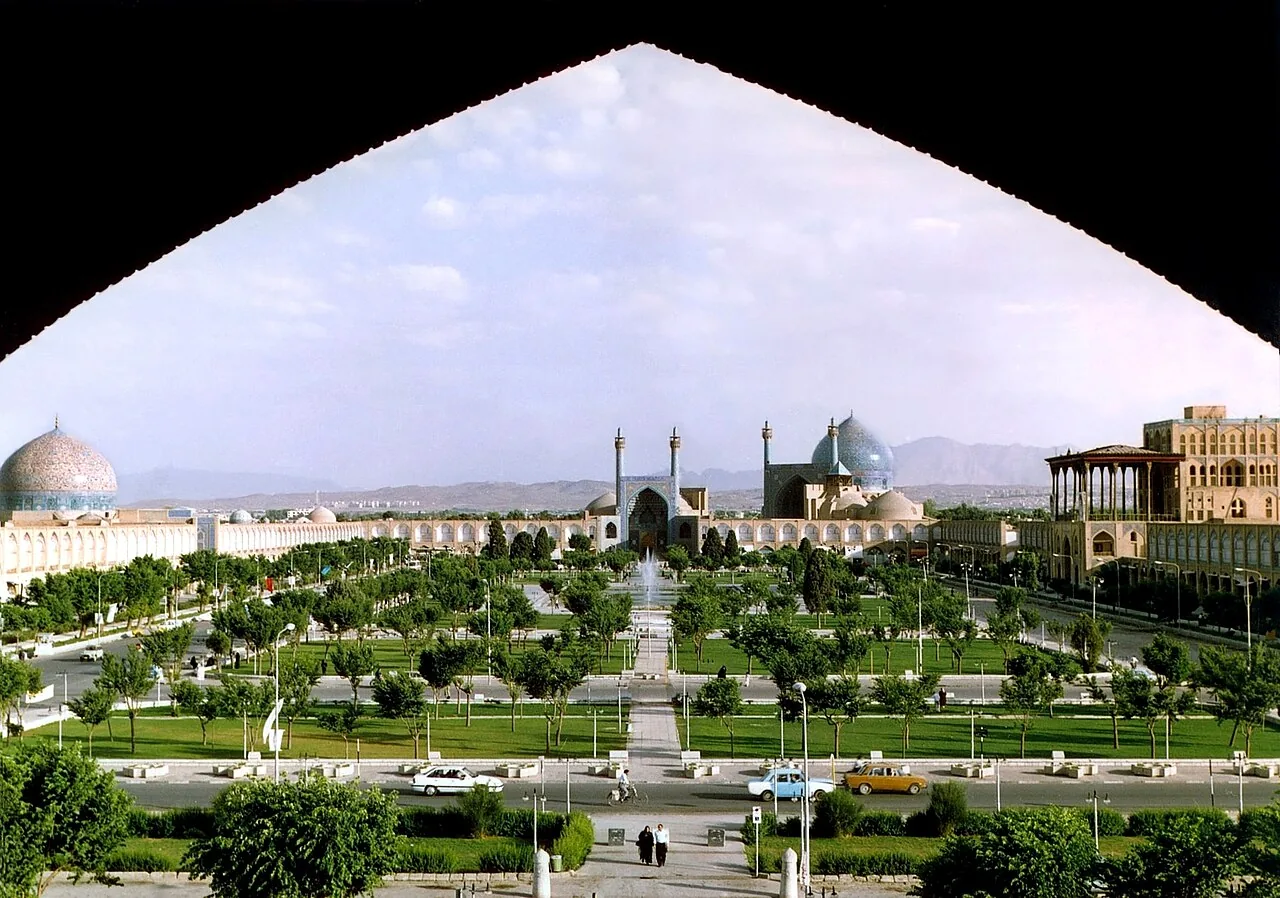
Commentary. The great square of Isfahan was meant to display the power of the shah and his connection to religion and trade. The mosque of the shah at one end shows the ruler’s role as protector of Shi’ism. At the other end, the palace gate shows political authority. Finally, the bazaar around the square shows the economic base of the state. A visitor in the 1600s could see the three together. The image is a modern photograph, so it shows the buildings, not their use in the 1600s.
3. The Mughal Empire
Babur, a descendant of Timur (Tamerlane) and of Genghis Khan, was forced out of Central Asia and took Kabul. In 1526 he defeated the sultan of Delhi at Panipat, using cannon and mounted archers, and founded the Mughal Empire. His grandson Akbar (r. 1556-1605) made it a stable state. He ended the special tax on non-Muslims in 1564, married Hindu Rajput princesses, and appointed Hindus to high office. He created the mansabdar system, in which officials held ranks tied to the number of cavalry they had to supply and were paid mostly in cash or revenue from land.
As a result, they could not turn their posts into hereditary estates. Akbar welcomed debates among scholars of different faiths at his court. His grandson Shah Jahan (r. 1628-1658) built the Taj Mahal, the tomb of his wife Mumtaz Mahal, and a new capital at Delhi. Aurangzeb (r. 1658-1707) extended the empire to its largest size by conquest in the south. However, he reimposed the tax on non-Muslims in 1679, fought long wars, and left a state strained financially. After his death the empire weakened and provincial governors became independent.
Definition: Mansabdar
an official of the Mughal state who held a numerical rank (a mansab) that fixed his pay and the number of cavalry he had to supply. Ranks were granted and could be taken away, so officials could not easily found hereditary dynasties.
Document 3 – A conqueror looks at India
Hindūstān is a country of few charms. Its people have no good looks; of social intercourse, paying and receiving visits there is none; of genius and capacity none; of manners none; in handicraft and work there is no form or symmetry, method or quality; there are no good horses, no good dogs, no grapes, musk-melons or first-rate fruits, no ice or cold water, no good bread or cooked food in the _bāzārs_, no Hot-baths, no Colleges, no candles, torches or candlesticks. […] Pleasant things of Hindūstān are that it is a large country and has masses of gold and silver.
Source: Babur, Baburnama (memoirs), written about 1526-1530 after the conquest of northern India; translated by Annette Susannah Beveridge (1922); Project Gutenberg.
*Hindustan: northern India; *begs: nobles; *lungi: loincloth.
Commentary. Babur wrote his memoirs in Chagatai Turkish, his native language, and they are among the most personal records of any ruler. After his conquest of northern India he compared it with Central Asia and Afghanistan, which he loved. His complaint about India shows the viewpoint of an outsider and conqueror from a culture of gardens, running water, and fine fruit. He also admits its wealth and its rainy season. The passage reveals more about Babur than about Indian society. It also shows that the Mughal rulers came from the Persian and Turkic world and had to learn to rule a population very different from their own.
Document 4 – A tomb as a statement of power
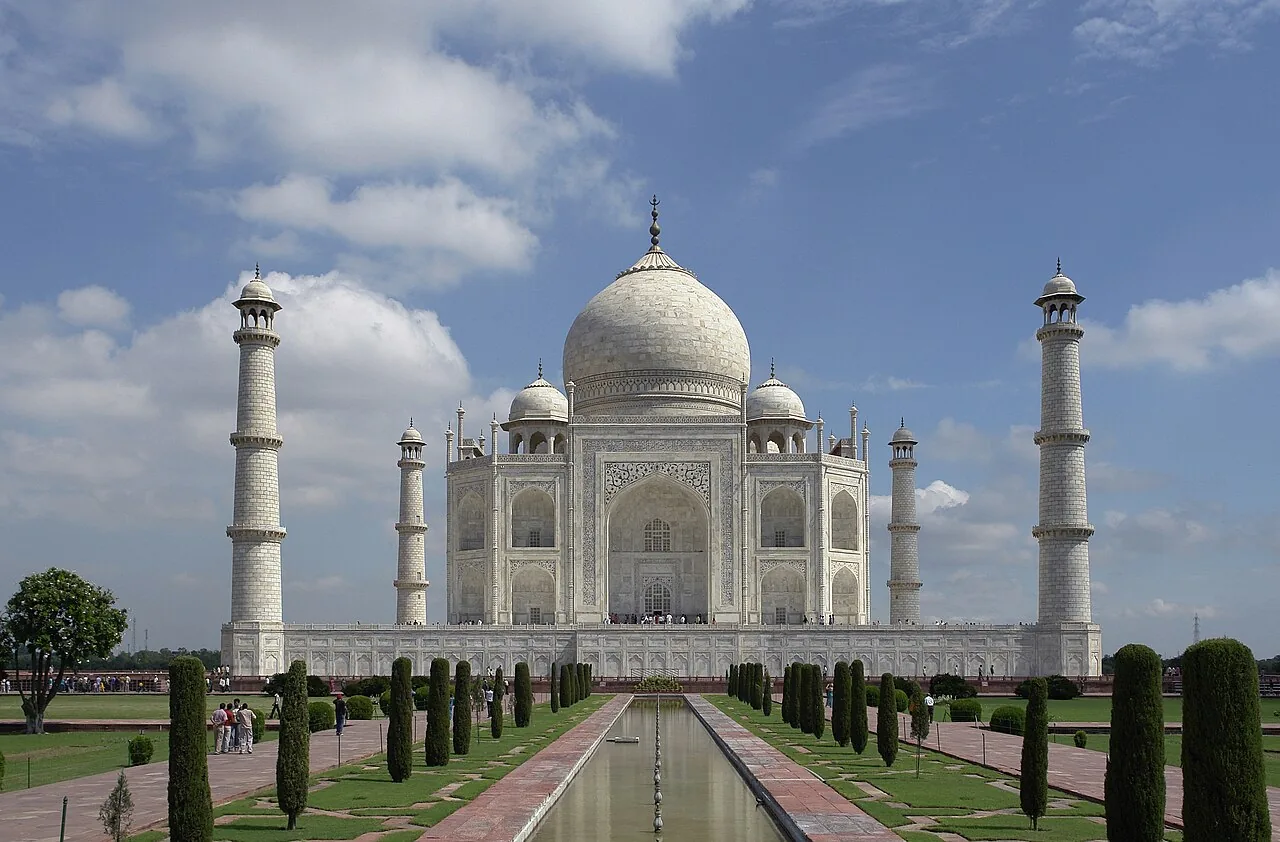
Commentary. The Taj Mahal was built by Shah Jahan after the death of his wife in 1631. It used white marble from Rajasthan and thousands of artisans and workers. Its symmetrical gardens, domes, and calligraphy combine Persian, Islamic, and Indian styles. It is both a personal monument and a display of imperial wealth and taste. A historian would note that the empire’s revenues from taxes on farmers paid for it.
4. Ming and Qing China
The Ming dynasty (1368-1644) restored Chinese rule after the Mongols, rebuilt the Grand Canal and the Great Wall. Under the Yongle emperor it built the Forbidden City in Beijing (1406-1420). Its government relied on the examination system and an educated scholar-official class. In the 1500s and 1600s the economy was linked to the world. Spanish silver from the Americas flowed to China in exchange for silk and porcelain.
This increased commerce but also caused inflation and made the government’s tax system harder to manage. High taxes, famine, and rebellion weakened the Ming. In 1644 a rebel army captured Beijing and the last Ming emperor killed himself. The Manchus, a people from the northeast who had organized their army into units called banners, took the capital and founded the Qing dynasty (1644-1912).
The Qing were foreign conquerors who ruled a large Chinese majority. They kept the examination system and Confucian institutions, but they also preserved Manchu identity. For example, they required Chinese men to wear the queue, a hairstyle, as a sign of submission. They also kept Manchu bannermen in garrisons. Under the emperors Kangxi (r. 1661-1722) and Qianlong (r. 1735-1796), the empire expanded into Taiwan, Mongolia, Tibet, and Xinjiang, doubling in size.
Population grew rapidly with new crops from the Americas such as maize and sweet potatoes. Foreign trade was restricted: after 1757 European merchants could trade only in Guangzhou (Canton), under strict rules. In 1793 a British embassy under Lord Macartney asked for more trade and a permanent embassy at Beijing. Qianlong refused in an edict to King George III.
Document 5 – The emperor replies to a king
As to your entreaty to send one of your nationals to be accredited to my Celestial Court and to be in control of your country’s trade with China, this request is contrary to all usage of my dynasty and cannot possibly be entertained. It is true that Europeans, in the service of the dynasty, have been permitted to live at Peking, but they are compelled to adopt Chinese dress, they are strictly confined to their own precincts and are never permitted to return home.
Source: Qianlong Emperor, edict to King George III of Great Britain in reply to the Macartney embassy, September 1793; translated by E. Backhouse and J. O. P. Bland, Annals and Memoirs of the Court of Peking (1914); Fordham Modern History Sourcebook.
*Celestial Court: the emperor’s court; *accredited: officially sent as a representative.
Commentary. This is part of the reply of the Qianlong Emperor to King George III. The emperor writes as the center of the world, receiving a tribute-bearing ambassador, and he refuses to allow a permanent British representative. The text is a Chinese court document translated into English in 1914 by two Westerners, and the tone depends in part on translation. It shows the Qing view of foreign relations as a system of tribute, and the policy of limiting trade and contact. It does not show that China was ignorant of Europe: Jesuit scholars already served the court.
Another well-known empire was Russia. Moscow’s princes ended Mongol overlordship in 1480 under Ivan III, and Ivan IV (the Terrible) took the title of tsar in 1547. Russian forces, with Cossacks, crossed the Urals into Siberia in the 1580s to find furs. Peter the Great (r. 1682-1725) reformed the army with Western methods, built a new capital, St. Petersburg, in 1703, and forced nobles to adopt Western dress and serve the state.
In West Africa, the empire of Songhai under Sunni Ali (r. 1464-1492) and Askia Muhammad (r. 1493-1528) took over Mali’s old territory and its gold trade, with Timbuktu and Gao as centers. In 1591 a Moroccan army with muskets defeated Songhai. In Japan, the Tokugawa shogunate (1603-1868) united the country under one military ruler in Edo and, in the 1630s, strictly limited contact with foreigners.
5. Comparing the empires
Definition: Gunpowder empires
a term for the Ottoman, Safavid, and Mughal empires, whose expansion in the 1400s to 1600s relied on cannon and firearms. Historians use it with caution because these states also depended on administration, taxation, and religious legitimacy.
The empires faced the same problems: how to control territory, how to feed and pay armies, and how to hold together peoples of different religions and languages. They shared gunpowder weapons, which required money and a central government to produce, so that they favored large states over small ones. This is why the Ottomans, Safavids, and Mughals have been called “gunpowder empires,” although historians argue that the label hides other sources of strength. They also shared an emphasis on a ruler who claimed divine favor and who patronized monuments. Sinan’s mosques, Isfahan’s square, and the Taj Mahal all announced the glory of the dynasty.
Where the empires differed
The empires differed in the ways they chose officials (devshirme in the Ottoman Empire, the examination system in China, the mansabdari ranks in Mughal India, service nobility in Russia). They also differed in how they treated religion (Safavid Shi’ism, Akbar’s tolerance, Ottoman pluralism, Qing support of Confucianism and Tibetan Buddhism). Finally, they differed in their relation to the sea. Most were challenged by similar internal forces. These were the cost of war, inflation tied to the flow of silver, and revolts by peasants or provincial leaders.
By 1750 the Safavid state had collapsed and the Mughal state was weakening. Meanwhile, European maritime powers were gaining footholds in Asia, a theme taken up in Units 4 and 6. For the AP exam, strong comparisons choose specific features. For example, the Ottoman devshirme and the Mughal mansabdari system both aimed to prevent officials from building hereditary power. However, one drew on converted boys and the other on ranks that could be given and taken away.
- 1453 Ottomans capture Constantinople
- 1501 Ismail founds the Safavid state in Iran
- 1526 Babur defeats the Delhi sultan at Panipat
- 1520-1566 Reign of Suleiman I
- 1556-1605 Reign of Akbar
- c. 1598 Shah Abbas makes Isfahan his capital
- 1644 Manchus take Beijing; Qing dynasty
- 1703 Peter the Great founds St. Petersburg
- 1793 Qianlong refuses Britain’s requests
Key takeaways
- The Ottomans conquered Constantinople in 1453 and ruled southeastern Europe, the Middle East, and North Africa. They used the devshirme and janissaries and allowed non-Muslim communities self-government in religious matters.
- The Safavids made Twelver Shi’ism the state religion. The Mughals built a large empire in India, with Akbar’s policy of tolerance. Meanwhile, the Ming and then the Qing ruled China through an examination-based bureaucracy.
- Russia expanded into Siberia; Songhai controlled the Niger valley until 1591; the Tokugawa united Japan and limited foreign contact.
- Gunpowder, strong rulers, monumental architecture, and efforts to manage religious diversity were shared features; the empires differed in recruitment of officials and religious policy.
- AP skill: compare empires using specific features and note that their problems (cost of war, inflation, revolts) were similar.

Quick review: flashcards
Tap a card to see the answer.