


This AP World History: Modern lesson covers AP World Unit 4: Transoceanic Interconnections, part of the unit “AP World units.” First, read the full lesson with its primary sources, maps and key terms. Then practice with the worksheet, check yourself with the quiz and get ready with the test.
On the night of October 11, 1492, the crew of a small Spanish ship saw a light ahead. At two in the morning a lookout on the Pinta cried “Land!” Christopher Columbus, a Genoese sailor in the service of the king and queen of Spain, believed that he had reached islands near Japan and China. He had in fact reached an island in the Bahamas that its inhabitants, the Taino, called Guanahani. The meeting changed the history of the world.
Within thirty years Spain had conquered the Aztec Empire. Within forty years it had begun to topple the Inca. Meanwhile, ships of Portugal, Spain, and later the Dutch, English, and French were carrying silver, sugar, spices, and enslaved people across the Atlantic and Pacific. For the first time, all the continents except Antarctica were in regular contact. This unit studies how and why that happened, who gained, and who paid.
Guiding question: Why did European states begin to cross the oceans after 1450, and how did these voyages create new empires, new economies, new labor systems, and new societies between 1450 and 1750?
AP framing. This is College Board Unit 4, “Transoceanic Interconnections.” The main skills are causation and continuity and change; the themes are humans and the environment (the Columbian Exchange), economic systems, and social interactions. Remember that the same events can be told from at least three points of view: Europeans, Native Americans, and Africans.
1. Why Europe went to sea
By 1450 several trends pushed Portugal and Spain to look for new routes. Europeans wanted Asian goods, especially spices and silk, and merchants in Venice and in Muslim cities controlled their sale at high prices. Rulers in Portugal and Spain, new states that had recently expelled Muslim rulers from the Iberian Peninsula (the Reconquista, completed in 1492 with the fall of Granada), wanted wealth and allies against Muslim powers. The Catholic Church encouraged missions. Competition among European states made them look for advantage: a king who found a new route could gain revenue and power.
Technology made long voyages possible. Portuguese shipbuilders developed the caravel, a small, fast ship with triangular sails that could sail against the wind. Later they built larger ships with both square and triangular sails. Sailors used the compass (from China), the astrolabe (from the Muslim world), and improved maps and charts.
Prince Henry of Portugal, later called “the Navigator,” sponsored voyages down the African coast beginning in the 1420s. In 1488 Bartolomeu Dias rounded the southern tip of Africa. In 1497-1498 Vasco da Gama sailed around Africa to Calicut in India, where Hindu and Muslim merchants already traded. He returned with spices. Portugal then began to build a chain of fortified trading posts: Goa (1510), Malacca (1511), and later Macao.
Definition: Caravel
a small, maneuverable sailing ship developed by the Portuguese in the 1400s, with triangular (lateen) sails that allowed it to sail close to the wind. Columbus’s Nina and Pinta were caravels.
2. Spain, Portugal, and the division of the world
Columbus, who thought Asia could be reached by sailing west, won the support of Queen Isabella and King Ferdinand. He sailed in August 1492. On October 12 he landed in the Bahamas, and then visited Cuba and Hispaniola. He made three more voyages. He never understood that he had found a continent unknown to Europeans, but his voyages began Spanish colonization of the Caribbean. Spain and Portugal quarreled over their claims.
In 1494 they signed the Treaty of Tordesillas, which drew a line 370 leagues west of the Cape Verde Islands. Lands east of it would belong to Portugal and lands west of it to Spain. This is why Brazil, which lies partly east of the line and which Cabral reached in 1500, became Portuguese. Most of the rest of Latin America became Spanish. Other European powers did not accept the division.
Document 1 – Columbus describes the people he met
They have no iron, their javelins being without it, and nothing more than sticks, though some have fish-bones or other things at the ends. They are all of a good size and stature, and handsomely formed. I saw some with scars of wounds upon their bodies, and demanded by signs the of them; they answered me in the same way, that there came people from the other islands in the neighborhood who endeavored to make prisoners of them, and they defended themselves. I thought then, and still believe, that these were from the continent. It appears to me, that the people are ingenious, and would be good servants and I am of opinion that they would very readily become Christians, as they appear to have no religion.
Source: Christopher Columbus, Journal of the first voyage, entry for October 12, 1492, as abstracted by Bartolome de las Casas; translated by Clements R. Markham (Hakluyt Society, 1893); Fordham Medieval Sourcebook.
*Admiral: Columbus, who held the title Admiral of the Ocean Sea; *Christians: here, converts to Christianity.
Commentary. The original journal of Columbus is lost. This text comes from an abstract of it made by the friar Bartolome de las Casas, so the words reach us through two authors. Columbus wrote for the king and queen, who were paying for the voyage. His aim was to show that the new lands offered gold, people to convert, and possible servants. His remarks about “good servants” and “no religion” tell us about his goals and assumptions, not about Taino beliefs. The Taino had their own religion and social order. The passage is valuable as evidence of how the first Europeans described the people they met, and how quickly they imagined control over them.
Document 2 – A painter imagines the landing
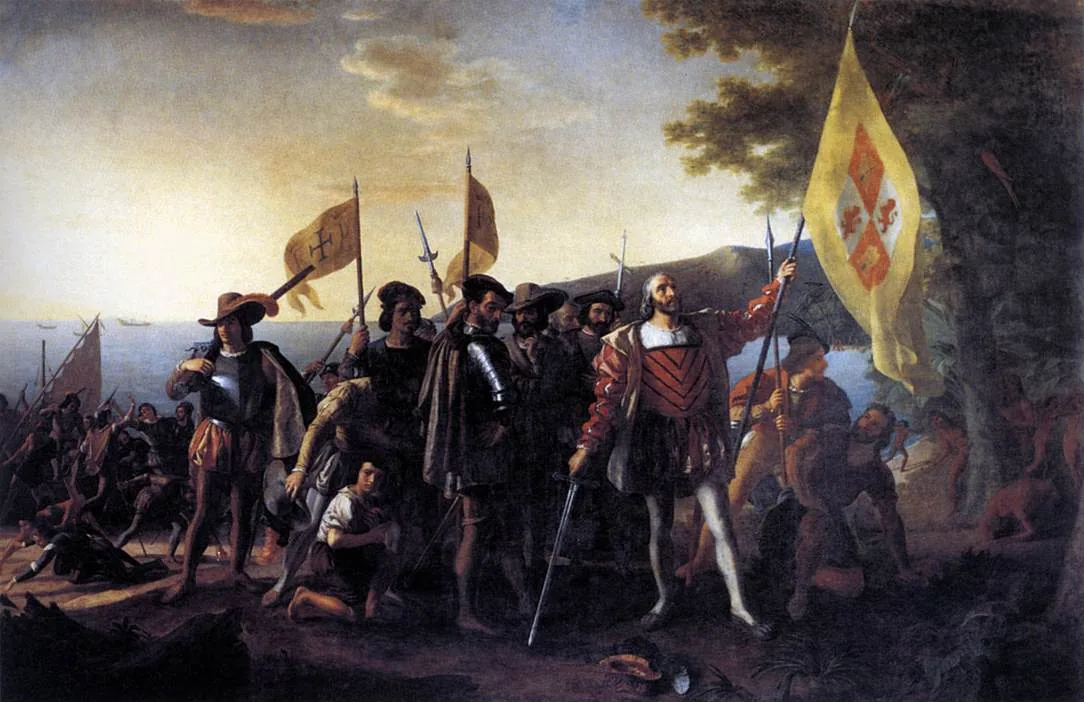
Commentary. This painting was made in the nineteenth century for the U.S. Capitol. It presents Columbus as a heroic discoverer with banners and officers, and the people of the island as onlookers. It shows how a later age wished to remember the landing, not how it appeared. A historian would use it as evidence of nineteenth-century American attitudes. For the reality of 1492 the historian would turn to documents such as the journal in Document 1.
3. Conquest and colonial society in the Americas
In 1519 Hernan Cortes landed on the coast of Mexico with about 500 men and a few cannon and horses. With the help of local interpreters, among them an indigenous woman known as Malinche, and of thousands of allies from city-states, such as the Tlaxcalans, who hated Aztec tribute demands, he marched to Tenochtitlan and entered it in November 1519. After a time of conflict and the death of Moctezuma, the Aztecs drove the Spaniards from the city in 1520.
The Spaniards then returned with their allies and took it in August 1521 after a long siege. The decisive factor was disease: smallpox, brought to Mexico by a member of the expedition, killed a large share of the population. In 1532 Francisco Pizarro captured the Inca ruler Atahualpa at Cajamarca, in a time of civil war and smallpox epidemics in the Andes. Within a few years the Spaniards held Cuzco.
Document 3 – The Spaniards see Tenochtitlan
The next morning we reached the broad high road of Iztapalapan, whence we for the first time beheld the numbers of towns and villages built in the lake, and the still greater number of large townships on the mainland, with the level causeway which ran in a straight line into Mexico. Our astonishment was indeed raised to the highest pitch, and we could not help remarking to each other, that all these buildings resembled the fairy castles we read of in Amadis de Gaul; so high, majestic, and splendid did the temples, towers, and houses of the town, all built of massive stone and lime, rise up out of the midst of the lake. Indeed, many of our men believed what they saw was a mere dream.
Source: Bernal Diaz del Castillo, Memoirs (the True History of the Conquest of New Spain), written decades after 1519, describing the Spaniards approaching Tenochtitlan (Mexico) in November 1519; translated by John Ingram Lockhart (1844); Project Gutenberg.
*Amadis de Gaul: a Spanish romance of chivalry; *causeway: a raised road across water.
Commentary. Bernal Diaz del Castillo marched with Cortes and wrote his memoirs when he was an old man. His astonishment at the size and beauty of Tenochtitlan shows that the conquerors did not think of Native Americans as lacking cities or culture. Yet he also wrote to claim a place for himself and his companions in the history of the conquest, and he wrote many years afterward from memory.
Ruling the conquered lands
To rule the conquered lands, Spain created institutions. The Crown granted conquistadors an encomienda, the right to collect tribute and labor from a group of Native Americans. In return, the conquistadors had to protect them and teach them Christianity. In practice it often became forced labor and brought abuse. The Dominican friar Bartolome de las Casas condemned the system. His Brief Account of the Destruction of the Indies (written in 1542 and published in 1552) was read across Europe.
Spain’s enemies used it in what later was called the Black Legend. His numbers are debated, but his picture of cruelty is supported by other witnesses. The New Laws of 1542 tried to limit the encomienda, and in 1550-1551 a debate at Valladolid examined the rights of Native Americans. In the end the Crown shifted to other systems. These were the mita in the Andes, which adapted the Inca labor draft to supply workers for the silver mines of Potosi, and the hacienda, a large landed estate.
Definition: Encomienda
a grant by the Spanish Crown to a colonist of the right to collect tribute and labor from a community of Native Americans, in return for protecting them and teaching them Christianity. In practice it often became forced labor.
Document 4 – A friar condemns the conquerors
The Spaniards first assaulted the innocent Sheep, so qualified by the Almighty, as is premention’d, like most cruel Tygers, Wolves and Lions hunger-starv’d, studying nothing, for the space of Forty Years, after their first landing, but the Massacre of these Wretches, whom they have so inhumanely and barbarously butcher’d and harass’d with several kinds of Torments, never before known, or heard (of which you shall have some account in the following Discourse) that of Three Millions of Persons, which lived in Hispaniola itself, there is at present but the inconsiderable remnant of scarce Three Hundred.
Source: Bartolome de las Casas, A Brief Account of the Destruction of the Indies, written 1542, published 1552; English translation by John Phillips (London, 1699); Project Gutenberg.
*Hispaniola: the island now divided between Haiti and the Dominican Republic.
Commentary. Las Casas, a former encomendero who became a Dominican, wrote to persuade the Spanish crown to protect Native Americans. His style is passionate and his figures are very likely too high, since there are no reliable counts for the population of Hispaniola in 1492. However, modern estimates also show a catastrophic decline. He blamed Spanish greed; historians also stress disease. His text is a source on how Spaniards debated their own empire.
Origin and color divided colonial society. At the top were peninsulares, people born in Spain, then creoles, people of Spanish descent born in the colonies, then mestizos (of Spanish and Native American descent), then Native Americans, with Africans and people of mixed African ancestry below. The Catholic Church ran missions, schools, and courts. Spain also began to link Asia and the Americas. From 1565 galleons sailed each year from Manila in the Philippines to Acapulco in Mexico. They carried Chinese silk and porcelain and returned with American silver.
4. The Columbian Exchange
The Columbian Exchange is the name for the transfer of plants, animals, diseases, and people between the Eastern and Western Hemispheres after 1492. From the Americas to the rest of the world went maize, potatoes, cassava, tomatoes, chocolate, and tobacco. Potatoes and maize fed growing populations in Europe, Africa, and China. From the Old World to the Americas went wheat, sugarcane, coffee, horses, cattle, pigs, and sheep.
With them came new ways of life: the horse transformed the Plains peoples of North America. The most terrible exchange was disease. Native Americans had had no contact with smallpox, measles, and influenza, and they died in huge numbers. Estimates vary, but most scholars agree that in many regions the large majority of the population died within a century of contact.
Definition: Columbian Exchange
the exchange of crops, animals, diseases, and people between the Eastern and Western Hemispheres that followed the voyages of Columbus in 1492. It changed diets, economies, and populations on every inhabited continent.
5. The Atlantic slave trade and plantation economies
As Native American populations collapsed, European colonists needed other labor for mines and plantations, above all for sugar, which required intense labor. The Portuguese had begun to carry enslaved Africans to Atlantic islands in the 1400s. After 1500, traders took enslaved Africans to Brazil, the Caribbean, and North and South America. The Atlantic slave trade lasted until the 1860s. According to the Slave Voyages database, about 12.5 million people were put on ships in Africa.
About 10.7 million arrived in the Americas, and the others died during the voyage, called the Middle Passage. European and American demand drove the trade, and so did African states and merchants. They sold captives taken in wars and raids in exchange for guns, cloth, and metal goods. It devastated many African communities, and it created plantation societies in which race was used to justify slavery.
Document 5 – The Middle Passage
The closeness of the place, and the heat of the climate, added to the number in the ship, which was so crowded that each had scarcely room to turn himself, almost suffocated us. This produced copious perspirations, so that the air soon became unfit for respiration, from a variety of loathsome smells, and brought on a sickness among the slaves, of which many died, thus falling victims to the improvident avarice, as I may call it, of their purchasers. This wretched situation was again aggravated by the galling of the chains, now become insupportable; and the filth of the necessary tubs, into which the children often fell, and were almost suffocated. The shrieks of the women, and the groans of the dying, rendered the whole a scene of horror almost inconceivable.
Source: Olaudah Equiano, The Interesting Narrative of the Life of Olaudah Equiano, 1789, chapter 2, on the Middle Passage; Project Gutenberg.
*Fetid: foul-smelling.
Commentary. Olaudah Equiano, who said that he was born in the Igbo region of present-day Nigeria and was taken to the Americas as a child, published his autobiography in 1789. By then he was a free man and an active abolitionist in London. Some scholars question whether he was born in Africa, since a baptismal record names South Carolina. His account of the voyage is nonetheless consistent with other testimony. The book was written to persuade British readers to end the slave trade, which shapes its selection of detail. It is one of the few accounts of the Middle Passage by someone who experienced it.
Document 6 – The plan of a slave ship
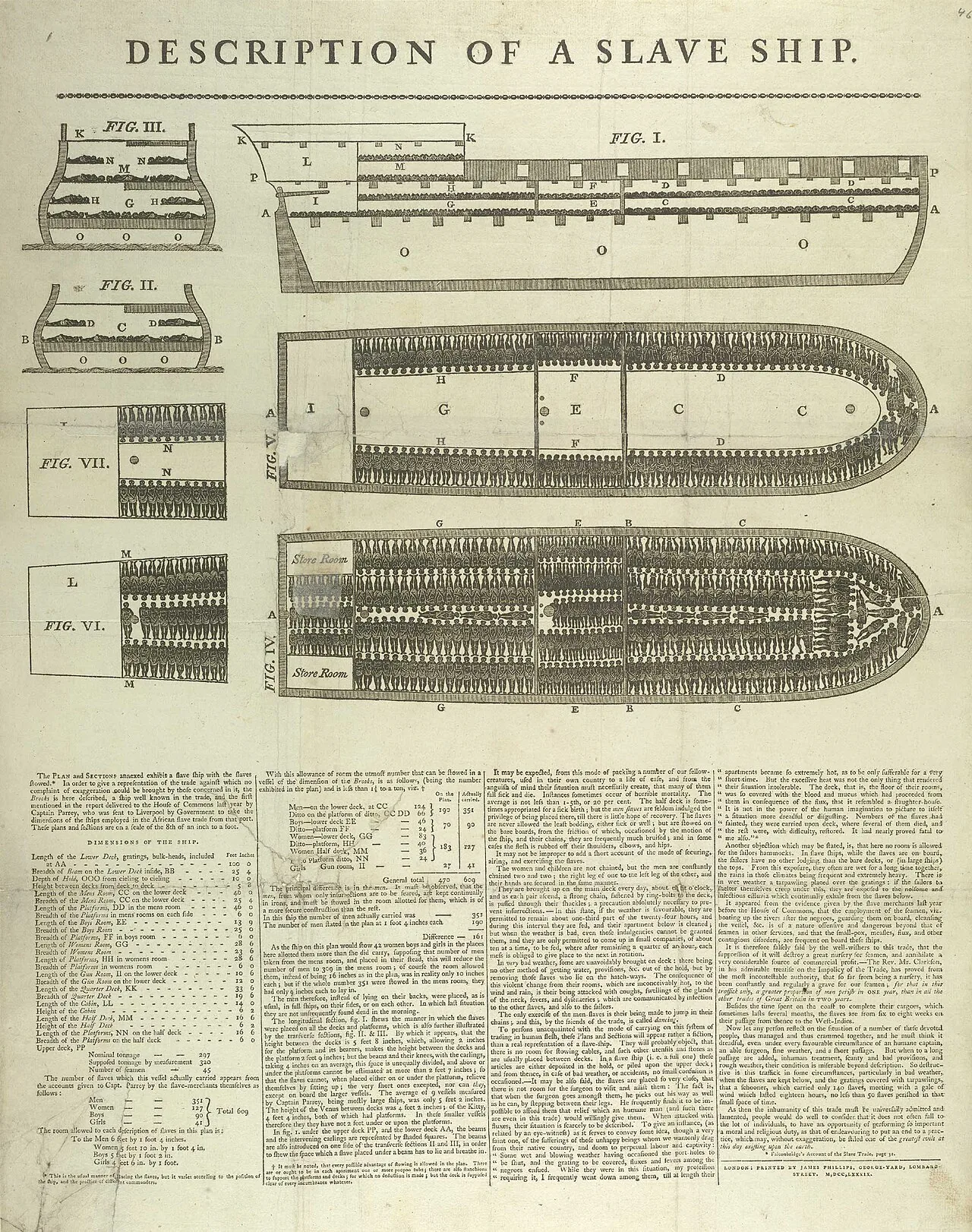
Commentary. This print was made by abolitionists in 1789 from the plan of a real ship, the Brookes, to show Britons how people were packed into the holds. The original diagram came from a ship owned by a Liverpool merchant. It was meant to shock. It is a strong source for how abolitionists argued. The small size of the human figures shows the cruelty of the conditions, though it does not give the experience of the captives that Equiano’s text does.
Slavery in the Americas took many forms. In Brazil and the Caribbean, most enslaved people worked on sugar plantations in harsh conditions, with high death rates. In North America, tobacco, rice, and later cotton shaped slavery. Enslaved people resisted in many ways: by work slowdowns, by escape, and by revolt. Communities of runaways, called maroons, formed in Jamaica, Suriname, and Brazil, where Palmares survived for much of the 1600s. In Africa, some states such as Kongo, under King Afonso I (r. 1506-1543), tried to limit the Portuguese slave trade, and others, such as Dahomey and Asante, grew strong by taking part in it.
6. New trade empires and the global economy
Other European states entered the contest. The English East India Company (1600) and the Dutch East India Company (1602) were joint-stock companies: many investors put in money and shared profits and risks. The company received from the state the right to trade and sometimes to fight in a region. The Dutch took over much of the spice trade in Indonesia and built Amsterdam into the main commercial center of Europe in the 1600s.
England and France founded colonies in North America and the Caribbean: Jamestown in 1607, Quebec in 1608, Plymouth in 1620. European governments followed mercantilism, the idea that a state grows strong by exporting more than it imports and by holding colonies that supply raw materials and buy manufactured goods.
Definition: Joint-stock company
a business owned by many investors who buy shares, share the profits and risks, and are not personally responsible for all of its debts. The English and Dutch East India Companies were joint-stock companies with state charters.
Silver and global trade
Silver tied the world together. Mines at Potosi in present-day Bolivia, found in 1545, and in Mexico produced enormous amounts. Much of it went to China, where it was in demand as currency. The effects reached from American mines to Chinese markets. Spain’s economy suffered inflation, China’s government depended on silver taxes, and Manila became a link between hemispheres.
Asian states mostly kept control of their own trade in this period. Europeans were mostly one group among many in the Indian Ocean and had to trade on terms set by rulers such as the Mughals, the Ming, and the Tokugawa. By 1750, however, European maritime empires had created an Atlantic world, which is the setting for the revolutions of Unit 5.
- 1488 Dias rounds the southern tip of Africa
- 1492 Columbus lands in the Bahamas; Spain completes the Reconquista
- 1494 Treaty of Tordesillas
- 1498 Vasco da Gama reaches Calicut
- 1519-1521 Cortes and the fall of Tenochtitlan
- 1532 Pizarro captures Atahualpa
- 1545 Silver found at Potosi
- 1602 Dutch East India Company founded
- 1607 Jamestown founded
Key takeaways
- European states sought wealth, spices, and allies, and used new ships and navigation tools to reach India (1498) and the Americas (1492). The Treaty of Tordesillas (1494) divided claims between Spain and Portugal.
- Spain conquered the Aztec and Inca states with the help of Native allies and disease, and ruled through the encomienda, the mita, and a social order based on origin and color.
- The Columbian Exchange moved crops, animals, and diseases between hemispheres; disease killed a very large share of Native Americans.
- About 12.5 million Africans were taken on slave ships between about 1500 and 1866, and about 10.7 million survived the Atlantic crossing, according to the Slave Voyages database.
- AP skill: explain causes and effects using several points of view, and use sources with attention to author, purpose, and date.

Quick review: flashcards
Tap a card to see the answer.