


This worksheet on AP World Unit 4: Transoceanic Interconnections belongs to the AP World History: Modern course. Its questions use primary sources, maps and timelines, and they move from basic recall to short writing tasks. Before you start, review the lesson; afterward, try the true or false quiz.
Exercise 1 : Key terms
Match each term to its definition: (a) caravel, (b) Columbian Exchange, (c) encomienda, (d) joint-stock company, (e) Middle Passage, (f) mercantilism.
- The idea that a state grows strong by exporting more than it imports and holding colonies.
- A Spanish grant of tribute and labor from Native Americans.
- The transfer of crops, animals, and diseases between hemispheres after 1492.
- A small, maneuverable ship with triangular sails.
- The ocean crossing of enslaved Africans to the Americas.
- A company owned by investors who share profits and risks.
Exercise 2 : Columbus's first impressions
Read Document A.
They have no iron, their javelins being without it, and nothing more than sticks, though some have fish-bones or other things at the ends. They are all of a good size and stature, and handsomely formed. I saw some with scars of wounds upon their bodies, and demanded by signs the of them; they answered me in the same way, that there came people from the other islands in the neighborhood who endeavored to make prisoners of them, and they defended themselves. I thought then, and still believe, that these were from the continent. It appears to me, that the people are ingenious, and would be good servants and I am of opinion that they would very readily become Christians, as they appear to have no religion.
Source: Christopher Columbus, Journal of the first voyage, entry for October 12, 1492, as abstracted by Bartolome de las Casas; translated by Clements R. Markham (Hakluyt Society, 1893); Fordham Medieval Sourcebook.
*Admiral: Columbus; *Christians: converts.
- Present the document. Why is it an abstract rather than the original?
- What does Columbus observe about the people’s weapons and appearance?
- What does he propose to do with them?
- What does the passage reveal about his goals?
Exercise 3 : A friar's accusation
Read Document B.
The Spaniards first assaulted the innocent Sheep, so qualified by the Almighty, as is premention’d, like most cruel Tygers, Wolves and Lions hunger-starv’d, studying nothing, for the space of Forty Years, after their first landing, but the Massacre of these Wretches, whom they have so inhumanely and barbarously butcher’d and harass’d with several kinds of Torments, never before known, or heard (of which you shall have some account in the following Discourse) that of Three Millions of Persons, which lived in Hispaniola itself, there is at present but the inconsiderable remnant of scarce Three Hundred.
Source: Bartolome de las Casas, A Brief Account of the Destruction of the Indies, written 1542, published 1552; English translation by John Phillips (London, 1699); Project Gutenberg.
*Hispaniola: the island now divided between Haiti and the Dominican Republic.
- Present the document (author, date, aim).
- What does Las Casas say happened to the population?
- How does he describe the Spaniards?
- Why must a historian be cautious with his numbers?
Exercise 4 : Two views of the Taino
Compare Documents A and B.
They have no iron, their javelins being without it, and nothing more than sticks, though some have fish-bones or other things at the ends. They are all of a good size and stature, and handsomely formed. I saw some with scars of wounds upon their bodies, and demanded by signs the of them; they answered me in the same way, that there came people from the other islands in the neighborhood who endeavored to make prisoners of them, and they defended themselves. I thought then, and still believe, that these were from the continent. It appears to me, that the people are ingenious, and would be good servants and I am of opinion that they would very readily become Christians, as they appear to have no religion.
Source: Christopher Columbus, Journal of the first voyage, entry for October 12, 1492, as abstracted by Bartolome de las Casas; translated by Clements R. Markham (Hakluyt Society, 1893); Fordham Medieval Sourcebook.
*Admiral: Columbus; *Christians: converts.
The Spaniards first assaulted the innocent Sheep, so qualified by the Almighty, as is premention’d, like most cruel Tygers, Wolves and Lions hunger-starv’d, studying nothing, for the space of Forty Years, after their first landing, but the Massacre of these Wretches, whom they have so inhumanely and barbarously butcher’d and harass’d with several kinds of Torments, never before known, or heard (of which you shall have some account in the following Discourse) that of Three Millions of Persons, which lived in Hispaniola itself, there is at present but the inconsiderable remnant of scarce Three Hundred.
Source: Bartolome de las Casas, A Brief Account of the Destruction of the Indies, written 1542, published 1552; English translation by John Phillips (London, 1699); Project Gutenberg.
*Hispaniola: now Haiti and the Dominican Republic.
- Present both authors.
- How does each describe the Native people?
- What does each propose for their future?
- Explain how the 50 years between them change the picture.
Exercise 5 : A voice from the ship
Read Document C.
The closeness of the place, and the heat of the climate, added to the number in the ship, which was so crowded that each had scarcely room to turn himself, almost suffocated us. This produced copious perspirations, so that the air soon became unfit for respiration, from a variety of loathsome smells, and brought on a sickness among the slaves, of which many died, thus falling victims to the improvident avarice, as I may call it, of their purchasers. This wretched situation was again aggravated by the galling of the chains, now become insupportable; and the filth of the necessary tubs, into which the children often fell, and were almost suffocated. The shrieks of the women, and the groans of the dying, rendered the whole a scene of horror almost inconceivable.
Source: Olaudah Equiano, The Interesting Narrative of the Life of Olaudah Equiano, 1789, chapter 2, on the Middle Passage; Project Gutenberg.
*Fetid: foul-smelling.
- Present the document (author, date, purpose).
- List three conditions on the ship.
- What does the author say about its effect on the captives?
- Explain one reason the account is reliable and one reason for caution.
Exercise 6 : Arrival and fear
Read Document D.
The first object which saluted my eyes when I arrived on the coast was the sea, and a slave ship, which was then riding at anchor, and waiting for its cargo. These filled me with astonishment, which was soon converted into terror when I was carried on board. I was immediately handled and tossed up to see if I were sound by some of the crew; […] I was now persuaded that I had gotten into a world of bad spirits, and that they were going to kill me.
Source: Olaudah Equiano, The Interesting Narrative of the Life of Olaudah Equiano, 1789, chapter 2, on his arrival on the African coast; Project Gutenberg.
*Bad spirits: a reference to the African belief that Europeans could be demons.
- Present the document.
- What does Equiano see first on the African coast?
- How does he react to the crew?
- What does the passage show about misunderstanding between peoples?
Exercise 7 : The ship and the narrative
Compare Document C with the print of the Brookes (Document E).
The closeness of the place, and the heat of the climate, added to the number in the ship, which was so crowded that each had scarcely room to turn himself, almost suffocated us. This produced copious perspirations, so that the air soon became unfit for respiration, from a variety of loathsome smells, and brought on a sickness among the slaves, of which many died, thus falling victims to the improvident avarice, as I may call it, of their purchasers. This wretched situation was again aggravated by the galling of the chains, now become insupportable; and the filth of the necessary tubs, into which the children often fell, and were almost suffocated. The shrieks of the women, and the groans of the dying, rendered the whole a scene of horror almost inconceivable.
Source: Olaudah Equiano, The Interesting Narrative of the Life of Olaudah Equiano, 1789, chapter 2, on the Middle Passage; Project Gutenberg.
*Fetid: foul-smelling.
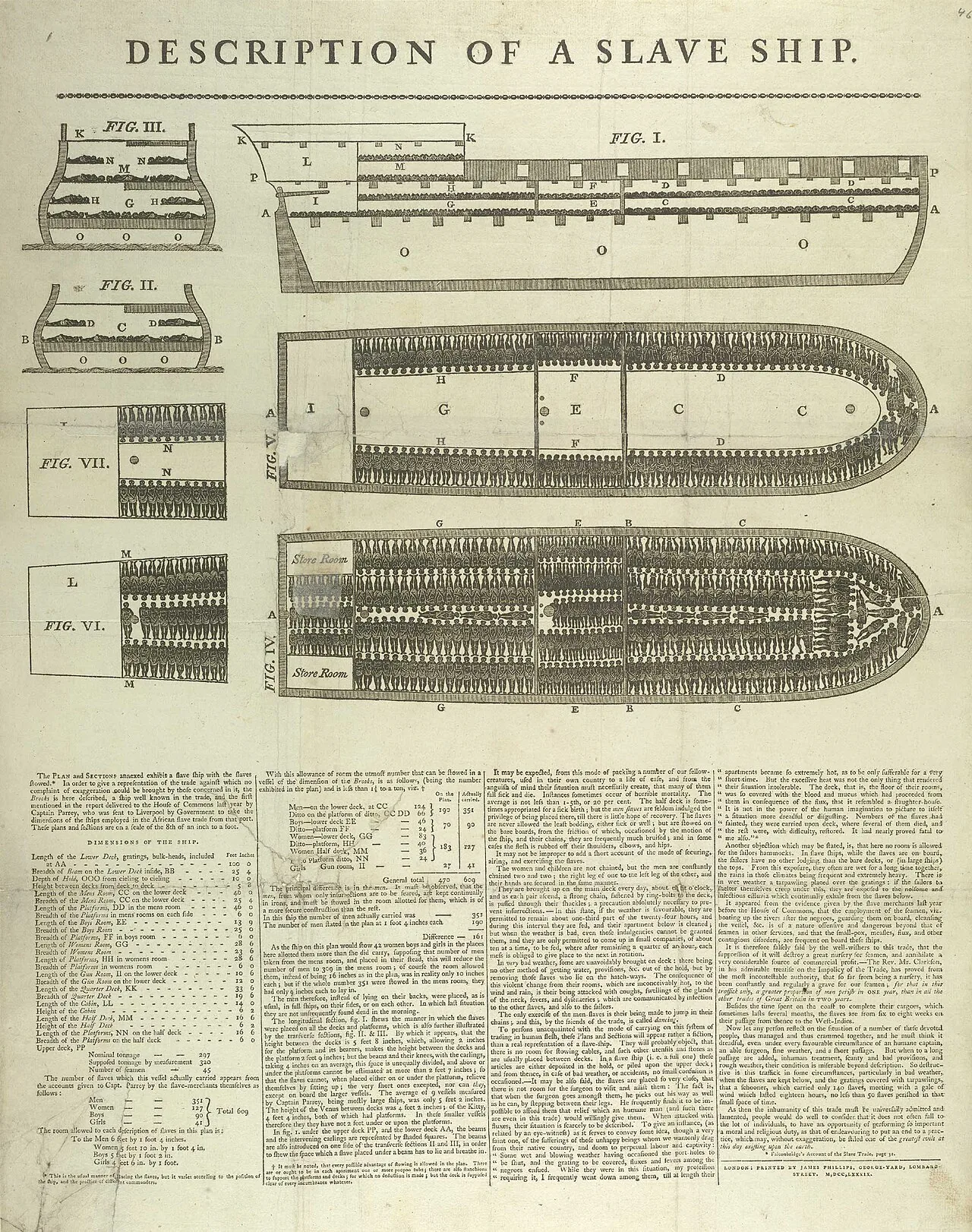
- Present both documents.
- What does the image show that the text does not?
- What does the text show that the image does not?
- Why did abolitionists use both?
Exercise 8 : Mapping the voyages
Use Map 1 in the lesson and the numbered map below.
- Name the places 1 to 6: Lisbon, San Salvador (Bahamas), Calicut, Mexico (Tenochtitlan), the Gulf of Guinea, Rio de Janeiro.
- Which side of the line did Portugal claim?
- Why did Brazil become Portuguese?
- Which route did da Gama follow?
Exercise 9 : The Atlantic system
Study the map of the Atlantic trade system.
- Name the three regions linked by the routes.
- What goods moved from Europe to Africa?
- What moved from the Caribbean to Europe?
- Why is the map a simplification?
Exercise 10 : The Treaty of Tordesillas
Read Document F and use Map 1 in the lesson.
a boundary or straight line be determined and drawn north and south, from pole to pole, on the said ocean sea, from the Arctic to the Antarctic pole. This boundary or line shall be drawn straight, as aforesaid, at a distance of three hundred and seventy leagues west of the Cape Verde Islands […] And all lands, both islands and mainlands, found and discovered already, or to be found and discovered hereafter, by the said King of Portugal and by his vessels on this side of the said line and bound determined as above, toward the east, in either north or south latitude, on the eastern side of the said bound provided the said bound is not crossed, shall belong to, and remain in the possession of, and pertain forever to, the said King of Portugal and his successors.
Source: Treaty of Tordesillas, June 7, 1494, between Spain and Portugal; English text from the Avalon Project, Yale Law School.
*Leagues: a unit of distance, about three miles; *Cape Verde: islands off West Africa.
- Present the document.
- Describe the line it creates.
- Which lands go to Portugal and which to Spain?
- Why did other European states reject the treaty?
Exercise 11 : Cortes and Tenochtitlan
Compare Document G (text) and Document H (map).
The next morning we reached the broad high road of Iztapalapan, whence we for the first time beheld the numbers of towns and villages built in the lake, and the still greater number of large townships on the mainland, with the level causeway which ran in a straight line into Mexico. Our astonishment was indeed raised to the highest pitch, and we could not help remarking to each other, that all these buildings resembled the fairy castles we read of in Amadis de Gaul; so high, majestic, and splendid did the temples, towers, and houses of the town, all built of massive stone and lime, rise up out of the midst of the lake. Indeed, many of our men believed what they saw was a mere dream.
Source: Bernal Diaz del Castillo, Memoirs (the True History of the Conquest of New Spain), written decades after 1519, describing the Spaniards approaching Tenochtitlan (Mexico) in November 1519; translated by John Ingram Lockhart (1844); Project Gutenberg.
*Amadis de Gaul: a Spanish romance of chivalry.
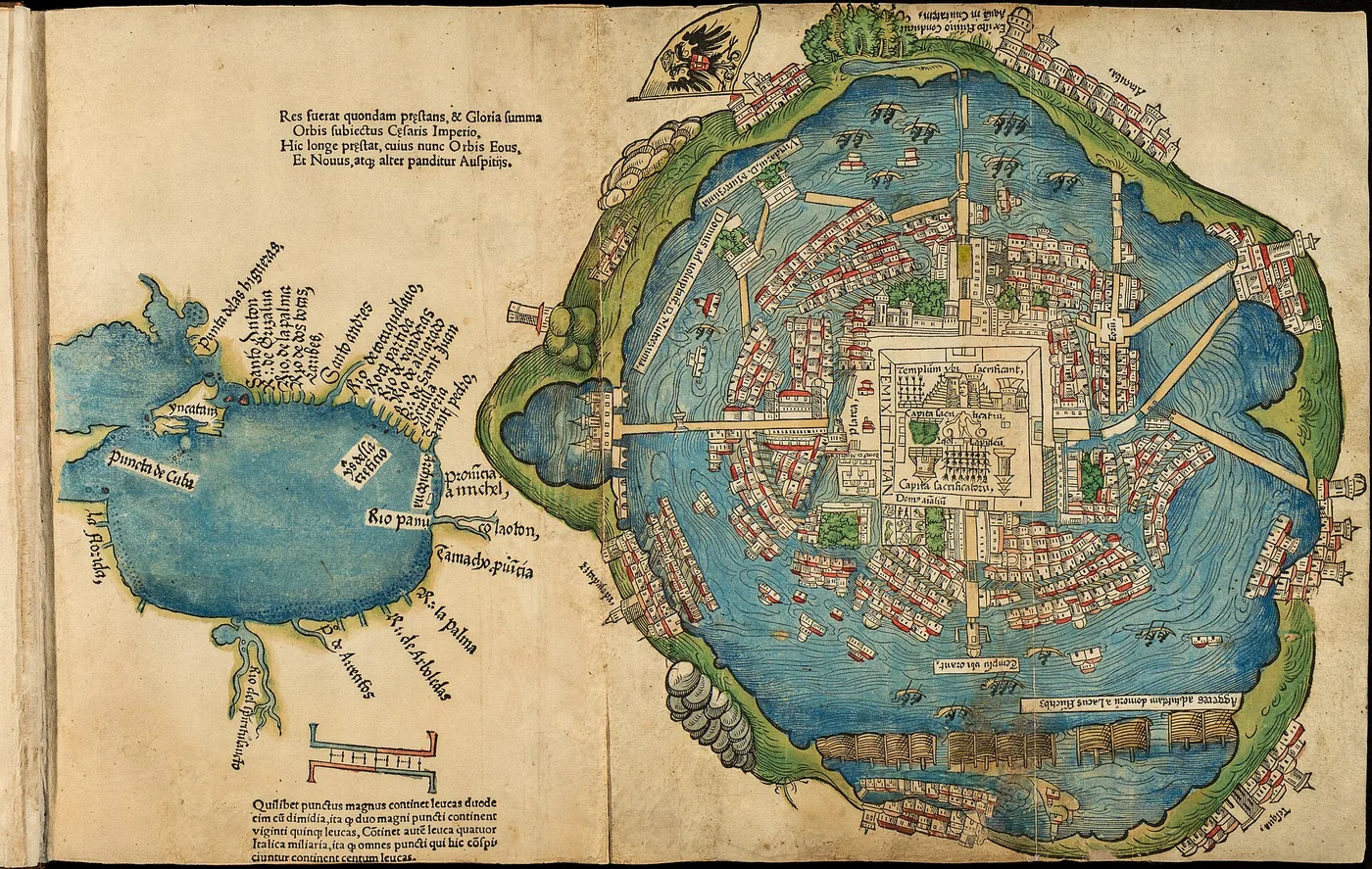
- Present each.
- Which features of the city appear in both?
- Why did Europeans want such maps?
Exercise 12 : Landing in 1492
Look at Document I.
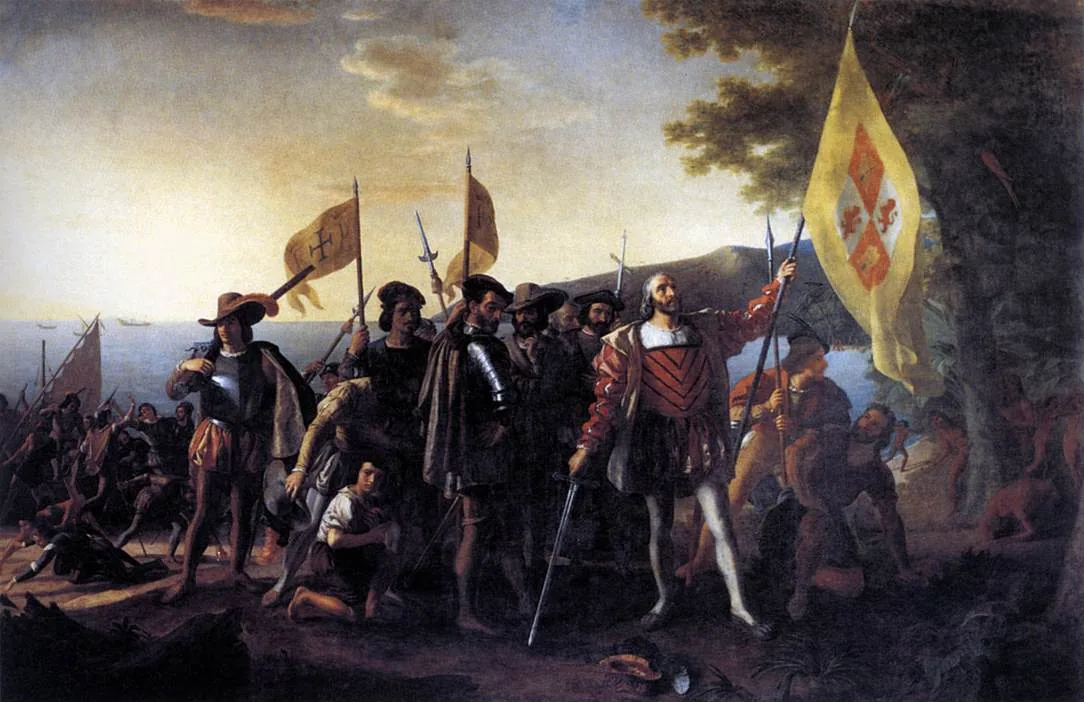
- Present the image.
- Describe the figures and objects.
- How does the painter present the Spaniards and the island people?
- Why is this not strong evidence about 1492?
Exercise 13 : An author and his image
Look at Document J.
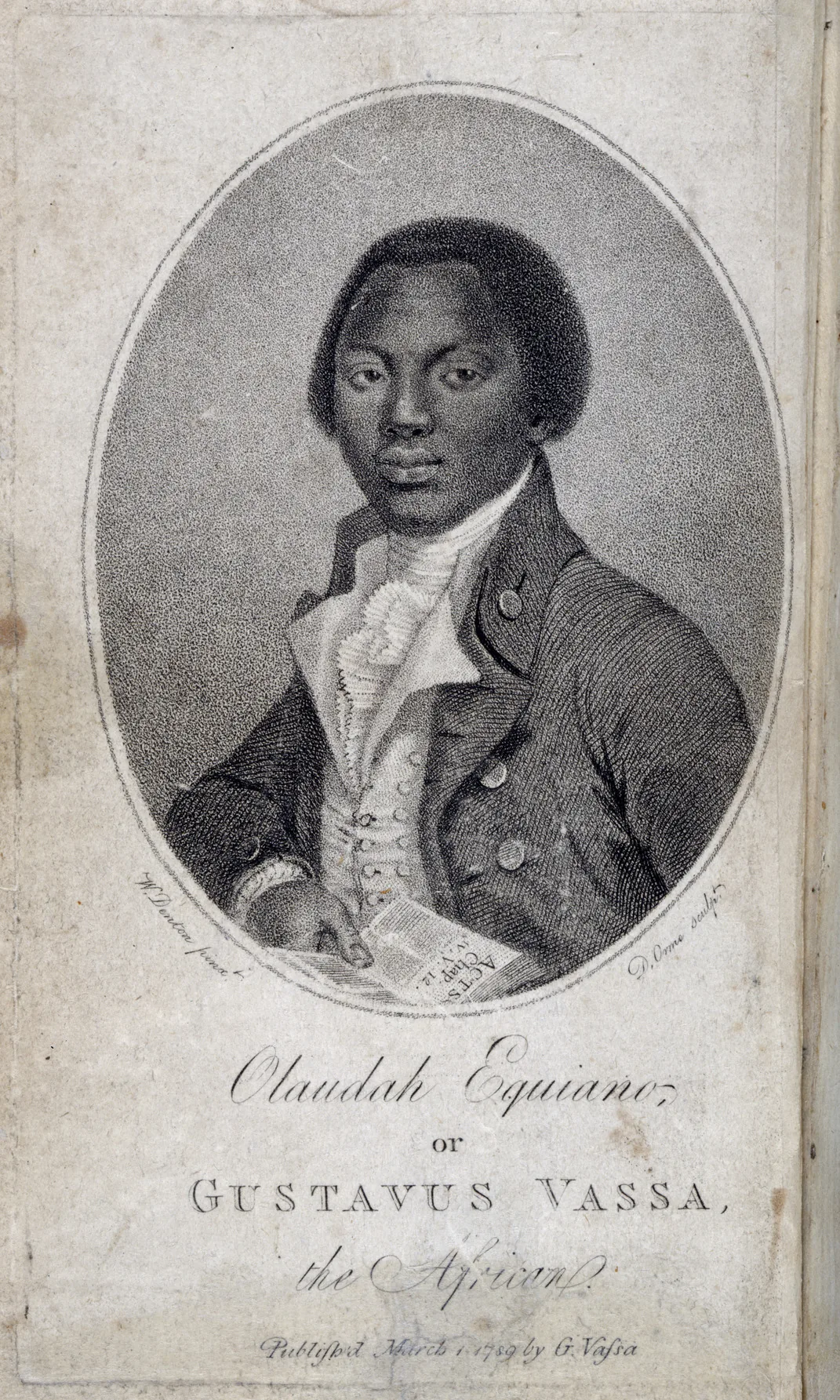
- Present the image.
- How is the author dressed and posed?
- Why would he choose to appear as a gentleman?
- What does the image suggest about his goals?
Exercise 14 : Numbers of the Atlantic slave trade
Study the table (estimates from the Slave Voyages database, slavevoyages.org/estimates).
| Estimate | Number of people |
|---|---|
| Embarked in Africa, about 1500-1866 | about 12,520,000 |
| Disembarked in the Americas and elsewhere | about 10,700,000 |
- Calculate the difference between the two numbers.
- What percentage of those embarked does the difference represent (to the nearest whole number)?
- What does the difference mean?
- Why are these called estimates?
Exercise 15 : Ordering the voyages
Put in order: Columbus lands; da Gama reaches Calicut; the fall of Tenochtitlan; Dias rounds the Cape; the Treaty of Tordesillas; the Dutch East India Company is founded.
- Give the dates.
- How many years separate Columbus’s landing and da Gama’s arrival?
Exercise 16 : Cause chains
Arrange as a chain of cause and effect: Native Americans die of disease; Europeans need labor; the Atlantic slave trade grows; plantation economies expand. Explain each link.
Exercise 17 : Guided research: Potosi
Investigate Potosi and the silver trade.
- Keywords: Potosi silver mine, mita labor, Manila galleon, Spanish silver China.
- Reliable sites: UNESCO World Heritage page on Potosi, Metropolitan Museum of Art, Encyclopaedia Britannica. Check authors and dates.
- Fill in: when was silver found at Potosi; who worked in the mines and under what system; where did the silver go; with what effects; your sources.
Exercise 18 : Short answer: the conquest
Answer A, B, and C.
- A. Identify one factor that helped Cortes defeat the Aztec Empire.
- B. Explain one way Spain governed its American colonies.
- C. Explain one consequence of the Columbian Exchange for Native American populations.
Exercise 19 : Stimulus-based multiple choice
Use Document C (Equiano) to answer.
The closeness of the place, and the heat of the climate, added to the number in the ship, which was so crowded that each had scarcely room to turn himself, almost suffocated us. This produced copious perspirations, so that the air soon became unfit for respiration, from a variety of loathsome smells, and brought on a sickness among the slaves, of which many died, thus falling victims to the improvident avarice, as I may call it, of their purchasers. This wretched situation was again aggravated by the galling of the chains, now become insupportable; and the filth of the necessary tubs, into which the children often fell, and were almost suffocated. The shrieks of the women, and the groans of the dying, rendered the whole a scene of horror almost inconceivable.
Source: Olaudah Equiano, The Interesting Narrative of the Life of Olaudah Equiano, 1789, chapter 2, on the Middle Passage; Project Gutenberg.
*Fetid: foul-smelling.
- 1. The author’s purpose in publishing the account in 1789 was most likely to (A) support abolition; (B) promote trade; (C) defend slavery; (D) attract settlers.
- 2. The passage best illustrates conditions of (A) the Middle Passage; (B) the Silk Roads; (C) the mit’a; (D) the Black Death.
- 3. This source is most valuable for historians because it (A) comes from an enslaved person; (B) gives numbers of people embarked; (C) was written at the time of the voyage; (D) is neutral.
Exercise 20 : Cause and effect: the Columbian Exchange
Explain two effects of the Columbian Exchange on the Eastern Hemisphere and two on the Western Hemisphere.
Exercise 21 : True or false? Justify
Decide whether each statement is true or false and justify it.
- Columbus found a continent unknown to Europeans but believed he had reached Asia.
- The Treaty of Tordesillas gave all the Americas to Spain.
- The Dutch East India Company was a joint-stock company.
- Spain’s conquest of the Aztecs was achieved without Indigenous allies.
Exercise 22 : LEQ: causation
Prompt (AP style): Evaluate the extent to which the Columbian Exchange was the most important cause of change in the Americas between 1492 and 1750. Write a thesis and plan two body paragraphs.
Hint: Weigh the Columbian Exchange against other causes such as conquest, forced labor, or the silver economy.


Quick review: flashcards
Tap a card to see the answer.