


This worksheet on AP World Unit 5: Revolutions belongs to the AP World History: Modern course. Its questions use primary sources, maps and timelines, and they move from basic recall to short writing tasks. Before you start, review the lesson; afterward, try the true or false quiz.
Exercise 1 : Key terms
Match each term to its definition: (a) Enlightenment, (b) natural rights, (c) estates, (d) creole, (e) social contract, (f) nationalism.
- Rights people are said to have by nature, such as life, liberty, and property.
- The three orders of society in old regime France.
- American-born person of Spanish descent.
- An agreement among people that creates a government and authorizes its power.
- The belief that a people with a shared identity should form a state.
- A movement of the 1700s that applied reason to society.
Exercise 2 : The American Declaration
Read Document A.
We hold these truths to be self-evident: That all men are created equal; that they are endowed by their Creator with certain unalienable rights; that among these are life, liberty, and the pursuit of happiness; that, to secure these rights, governments are instituted among men, deriving their just powers from the consent of the governed; that whenever any form of government becomes destructive of these ends, it is the right of the people to alter or to abolish it, and to institute new government, laying its foundation on such principles, and organizing its powers in such form, as to them shall seem most likely to effect their safety and happiness.
Source: Declaration of Independence, July 4, 1776, second paragraph; Avalon Project, Yale Law School.
*Endowed: provided with; *Creator: God.
- Present the document.
- List the rights named.
- According to the text, why do governments exist?
- What right do people have if a government fails?
- Whom did “all men” leave out in 1776?
Exercise 3 : The French Declaration
Read Document B.
Men are born and remain free and equal in rights. Social distinctions may be founded only upon the general good. 2. The aim of all political association is the preservation of the natural and imprescriptible rights of man. These rights are liberty, property, security, and resistance to oppression. 3. The principle of all sovereignty resides essentially in the nation. No body nor individual may exercise any authority which does not proceed directly from the nation. 4. Liberty consists in the freedom to do everything which injures no one else; hence the exercise of the natural rights of each man has no limits except those which assure to the other members of the society the enjoyment of the same rights.
Source: Declaration of the Rights of Man and of the Citizen, adopted by the French National Assembly, August 26, 1789, articles 1 to 6; English text from the Avalon Project, Yale Law School.
*Social distinctions: differences of rank.
- Present the document.
- What does article 1 say about social distinctions?
- Which Enlightenment idea does article 6 reflect?
- Who is missing from the declaration?
Exercise 4 : Two declarations
Compare Documents A and B.
We hold these truths to be self-evident: That all men are created equal; that they are endowed by their Creator with certain unalienable rights; that among these are life, liberty, and the pursuit of happiness; that, to secure these rights, governments are instituted among men, deriving their just powers from the consent of the governed; that whenever any form of government becomes destructive of these ends, it is the right of the people to alter or to abolish it, and to institute new government, laying its foundation on such principles, and organizing its powers in such form, as to them shall seem most likely to effect their safety and happiness.
Source: Declaration of Independence, July 4, 1776, second paragraph; Avalon Project, Yale Law School.
*Endowed: provided with.
Men are born and remain free and equal in rights. Social distinctions may be founded only upon the general good. 2. The aim of all political association is the preservation of the natural and imprescriptible rights of man. These rights are liberty, property, security, and resistance to oppression. 3. The principle of all sovereignty resides essentially in the nation. No body nor individual may exercise any authority which does not proceed directly from the nation. 4. Liberty consists in the freedom to do everything which injures no one else; hence the exercise of the natural rights of each man has no limits except those which assure to the other members of the society the enjoyment of the same rights.
Source: Declaration of the Rights of Man and of the Citizen, adopted by the French National Assembly, August 26, 1789, articles 1 to 6; English text from the Avalon Project, Yale Law School.
*Social distinctions: differences of rank.
- Present each text.
- Identify two similarities.
- Identify one difference in emphasis.
- Which influenced the other, and how do you know?
Exercise 5 : Locke and Rousseau
Compare Documents C and D.
The state of nature has a law of nature to govern it, which obliges every one: and reason, which is that law, teaches all mankind, who will but consult it, that being all equal and independent, no one ought to harm another in his life, health, liberty, or possessions: for men being all the workmanship of one omnipotent, and infinitely wise maker; all the servants of one sovereign master, sent into the world by his order, and about his business; they are his property, whose workmanship they are, made to last during his, not one another’s pleasure: and being furnished with like faculties, sharing all in one community of nature, there cannot be supposed any such subordination among us, that may authorize us to destroy one another, as if we were made for one another’s uses, as the inferior ranks of creatures are for our’s.
Source: John Locke, Second Treatise of Government, 1689, chapter 2, section 6; Project Gutenberg.
*Subordination: ranking of some below others.
Man is born free; and everywhere he is in chains. One thinks himself the master of others, and still remains a greater slave than they. How did this change come about? I do not know. What can make it legitimate? That question I think I can answer.
Source: Jean-Jacques Rousseau, The Social Contract, 1762, book 1, chapter 1; translated by G. D. H. Cole (1913); Project Gutenberg.
*Legitimate: lawful.
- Present both authors.
- What does each say about liberty?
- How do they differ in their starting point?
- How could revolutionaries use both?
Exercise 6 : A woman's argument
Read Document E.
I do not wish them to have power over men; but over themselves. In the same strain have I heard men argue against instructing the poor; for many are the forms that aristocracy assumes. “Teach them to read and write,” say they, “and you take them out of the station assigned them by nature.” An eloquent Frenchman, has answered them; I will borrow his sentiments. But they know not, when they make man a brute, that they may expect every instant to see him transformed into a ferocious beast. Without knowledge there can be no morality! Ignorance is a frail base for virtue!
Source: Mary Wollstonecraft, A Vindication of the Rights of Woman, 1792, chapter 3; Project Gutenberg.
*Frail: weak.
- Present the document.
- What does Wollstonecraft say women want?
- What does she claim about ignorance and virtue?
- How does her argument use Enlightenment ideas?
Exercise 7 : The Third Estate
Read Document F.
Who then shall dare to say that the Third Estate has not within itself all that is necessary for the formation of a complete nation? It is the strong and robust man who has one arm still shackled. If the privileged order should be abolished, the nation would be nothing less, but something more. Therefore, what is the Third Estate? Everything; but an everything shackled and oppressed. What would it be without the privileged order? Everything, but an everything free and flourishing.
Source: Emmanuel Joseph Sieyes, What Is the Third Estate?, pamphlet, January 1789; Fordham Modern History Sourcebook.
*Privileged order: nobility and clergy.
- Present the document.
- What does Sieyes claim the Third Estate is?
- What would happen without the privileged order?
- What was the author’s own position in society?
Exercise 8 : Revolution and reaction
Compare Document F (Sieyes) and Document G (Burke).
Who then shall dare to say that the Third Estate has not within itself all that is necessary for the formation of a complete nation? It is the strong and robust man who has one arm still shackled. If the privileged order should be abolished, the nation would be nothing less, but something more. Therefore, what is the Third Estate? Everything; but an everything shackled and oppressed. What would it be without the privileged order? Everything, but an everything free and flourishing.
Source: Emmanuel Joseph Sieyes, What Is the Third Estate?, pamphlet, January 1789; Fordham Modern History Sourcebook.
*Privileged order: nobility and clergy.
I thought ten thousand swords must have leaped from their scabbards to avenge even a look that threatened her with insult. But the age of chivalry is gone. That of sophisters, economists, and calculators has succeeded; and the glory of Europe is extinguished forever.
Source: Edmund Burke, Reflections on the Revolution in France, 1790; Project Gutenberg.
*Scabbards: sheaths for swords; *chivalry: the medieval code of honor of knights.
- Present both authors.
- What does each think of the old order?
- What does Burke regret?
- Why is Burke a good source for conservative reaction?
Exercise 9 : Haiti's constitution
Read Document H.
Art. 3. There cannot exist slaves on this territory, servitude is therein forever abolished. All men are born, live and die free and French. Art. 4. All men, regardless of color, are eligible to all employment. Art. 5. There shall exist no distinction other than those based on virtue and talent, and other superiority afforded by law in the exercise of a public function. The law is the same for all whether in punishment or in protection.
Source: Constitution of the French Colony of Saint-Domingue, July 1801, title II, articles 3 to 5; English translation by Charmant Theodore, published by the Louverture Project; Wikisource.
*Servitude: slavery; *public function: government office.
- Present the document.
- What does article 3 abolish?
- What distinctions does article 5 allow?
- How does the text connect to the French Declaration?
Exercise 10 : Rights proclaimed, rights denied
Compare Document B (France, 1789) and Document H (Saint-Domingue, 1801).
Men are born and remain free and equal in rights. Social distinctions may be founded only upon the general good. 2. The aim of all political association is the preservation of the natural and imprescriptible rights of man. These rights are liberty, property, security, and resistance to oppression. 3. The principle of all sovereignty resides essentially in the nation. No body nor individual may exercise any authority which does not proceed directly from the nation. 4. Liberty consists in the freedom to do everything which injures no one else; hence the exercise of the natural rights of each man has no limits except those which assure to the other members of the society the enjoyment of the same rights.
Source: Declaration of the Rights of Man and of the Citizen, adopted by the French National Assembly, August 26, 1789, articles 1 to 6; English text from the Avalon Project, Yale Law School.
*Social distinctions: differences of rank.
Art. 3. There cannot exist slaves on this territory, servitude is therein forever abolished. All men are born, live and die free and French. Art. 4. All men, regardless of color, are eligible to all employment. Art. 5. There shall exist no distinction other than those based on virtue and talent, and other superiority afforded by law in the exercise of a public function. The law is the same for all whether in punishment or in protection.
Source: Constitution of the French Colony of Saint-Domingue, July 1801, title II, articles 3 to 5; English translation by Charmant Theodore, published by the Louverture Project; Wikisource.
*Servitude: slavery.
- Present each.
- What principle do they share?
- What does the 1801 text add?
- Why was the 1801 text more radical than the French law of 1789?
Exercise 11 : The Declaration painted
Look at Document I.
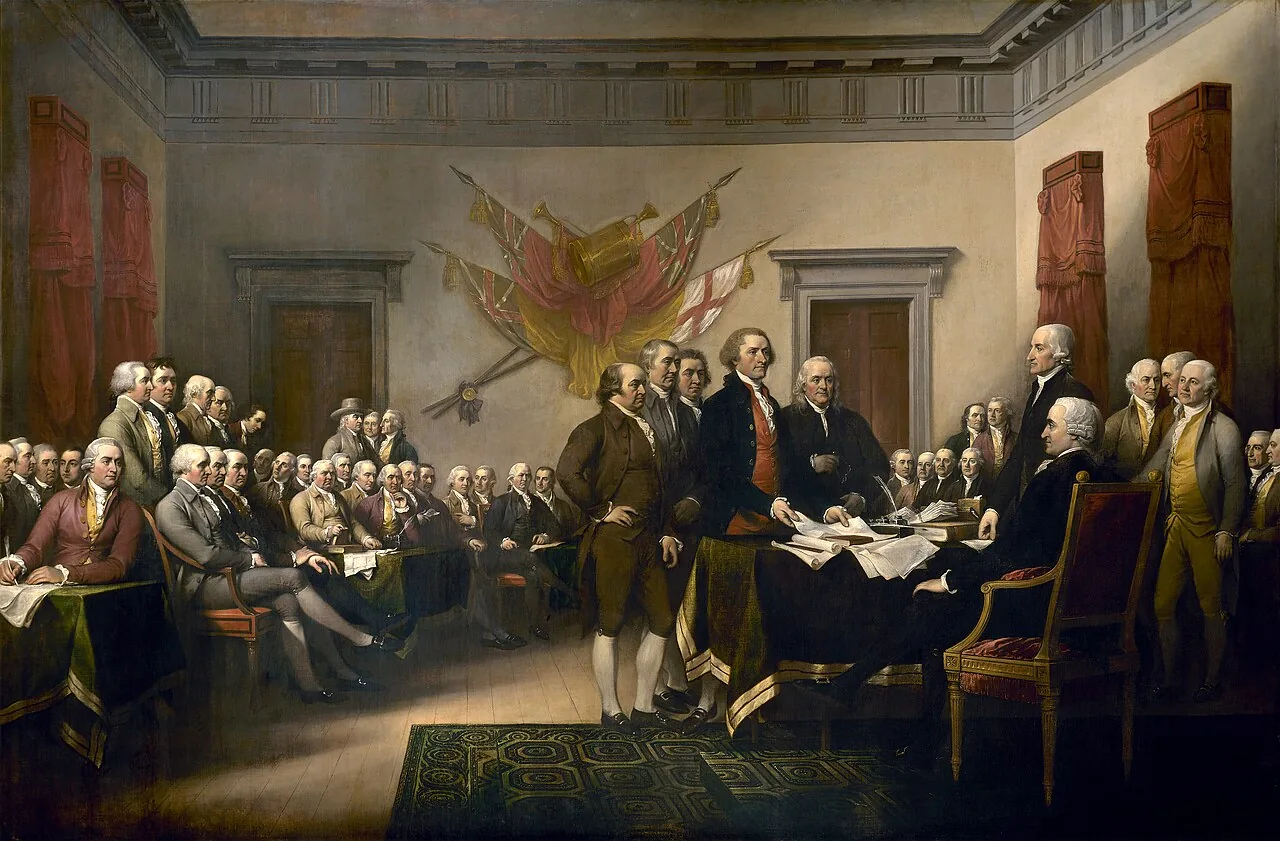
- Present the image.
- Describe the arrangement of figures.
- What event is shown, and what is not?
- What is the painter’s purpose?
Exercise 12 : The Bastille
Look at Document J.
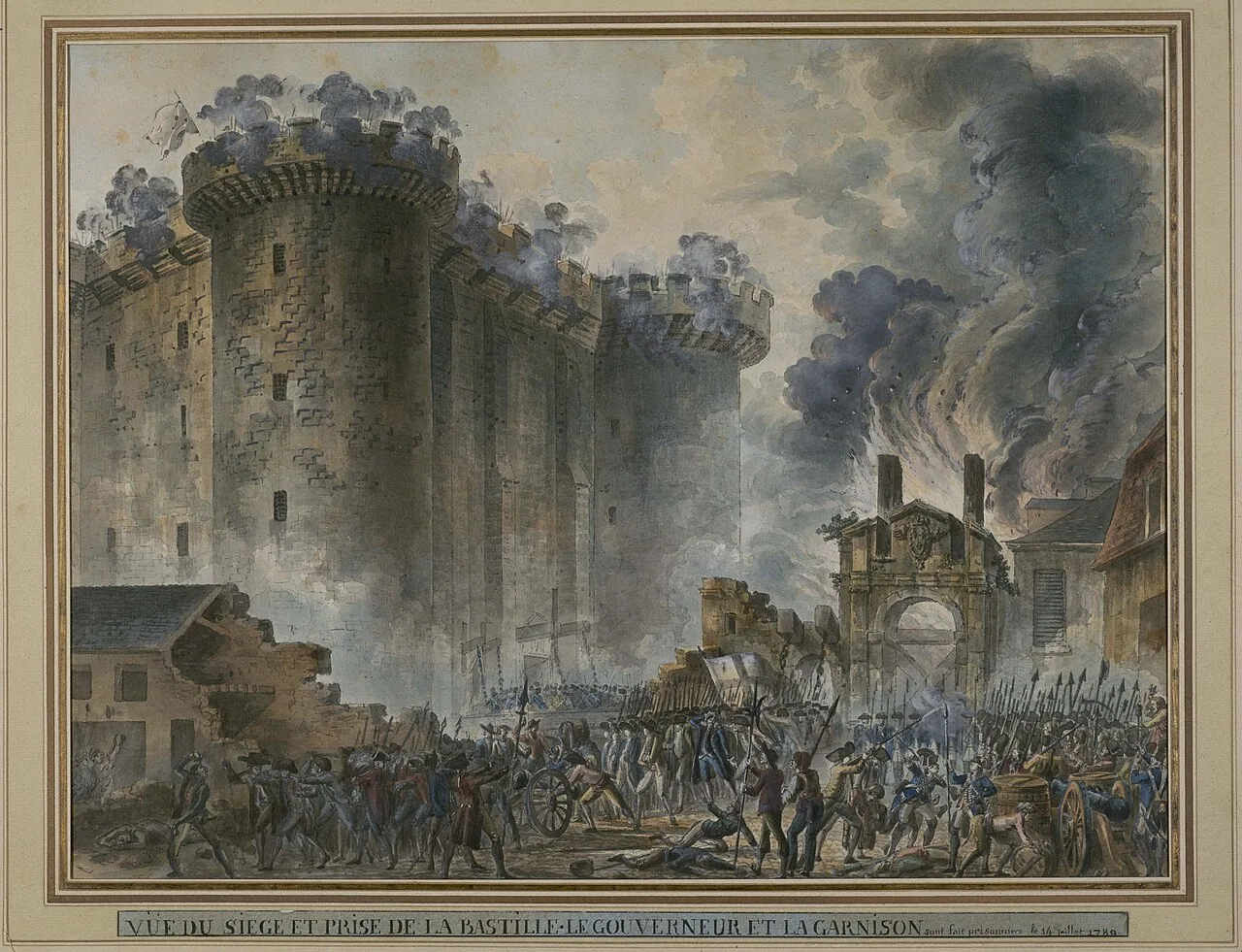
- Present the image.
- Describe the scene.
- Why did contemporaries see the fall of the Bastille as a symbol?
- What does the image not show about the event?
Exercise 13 : Liberty on the barricade
Look at Document K.
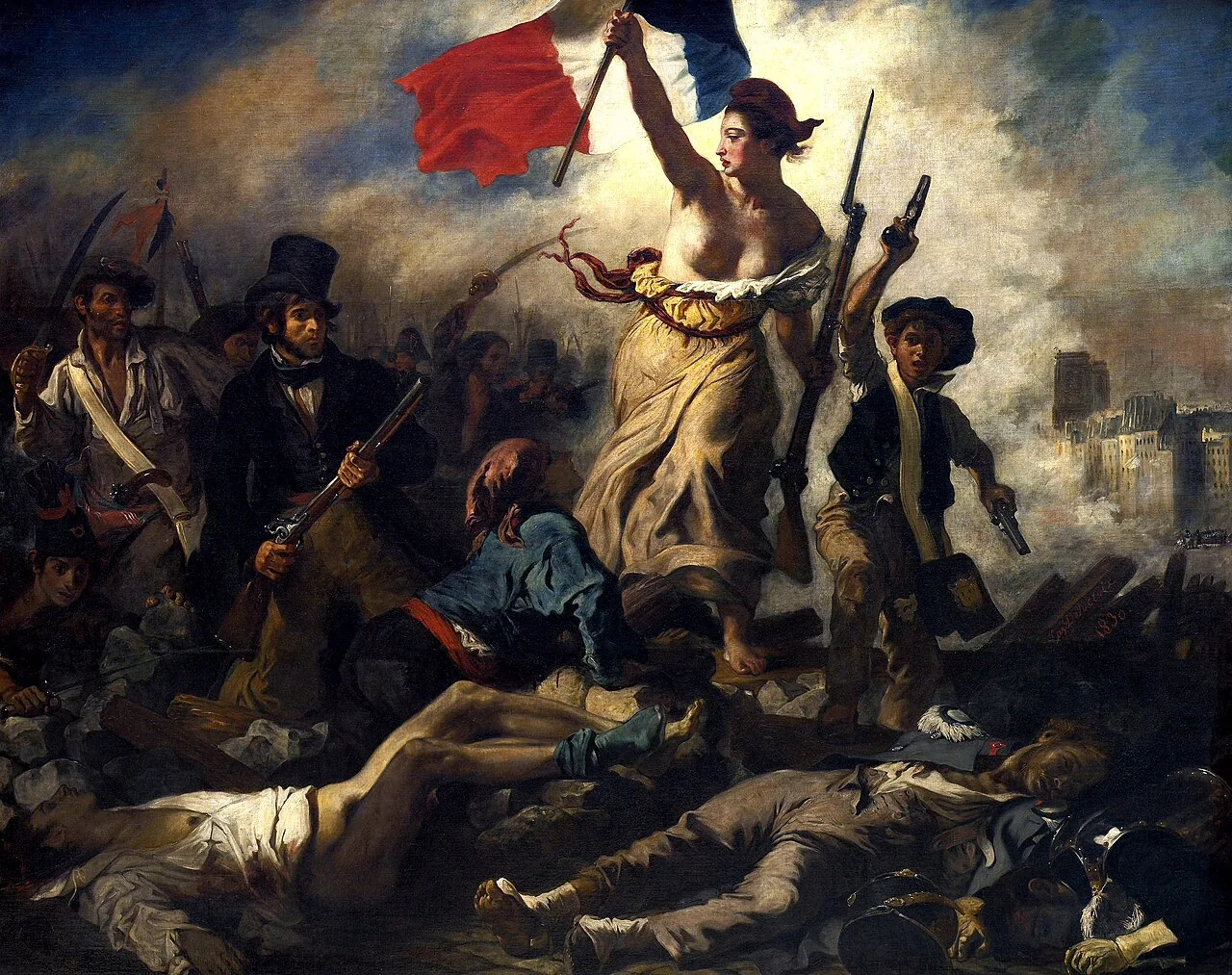
- Present the image. In which revolution was it painted?
- Describe the central figure and the people around her.
- What does the tricolor flag stand for?
- Why is the date of the painting important for the unit?
Exercise 14 : Toussaint Louverture
Look at Document L.
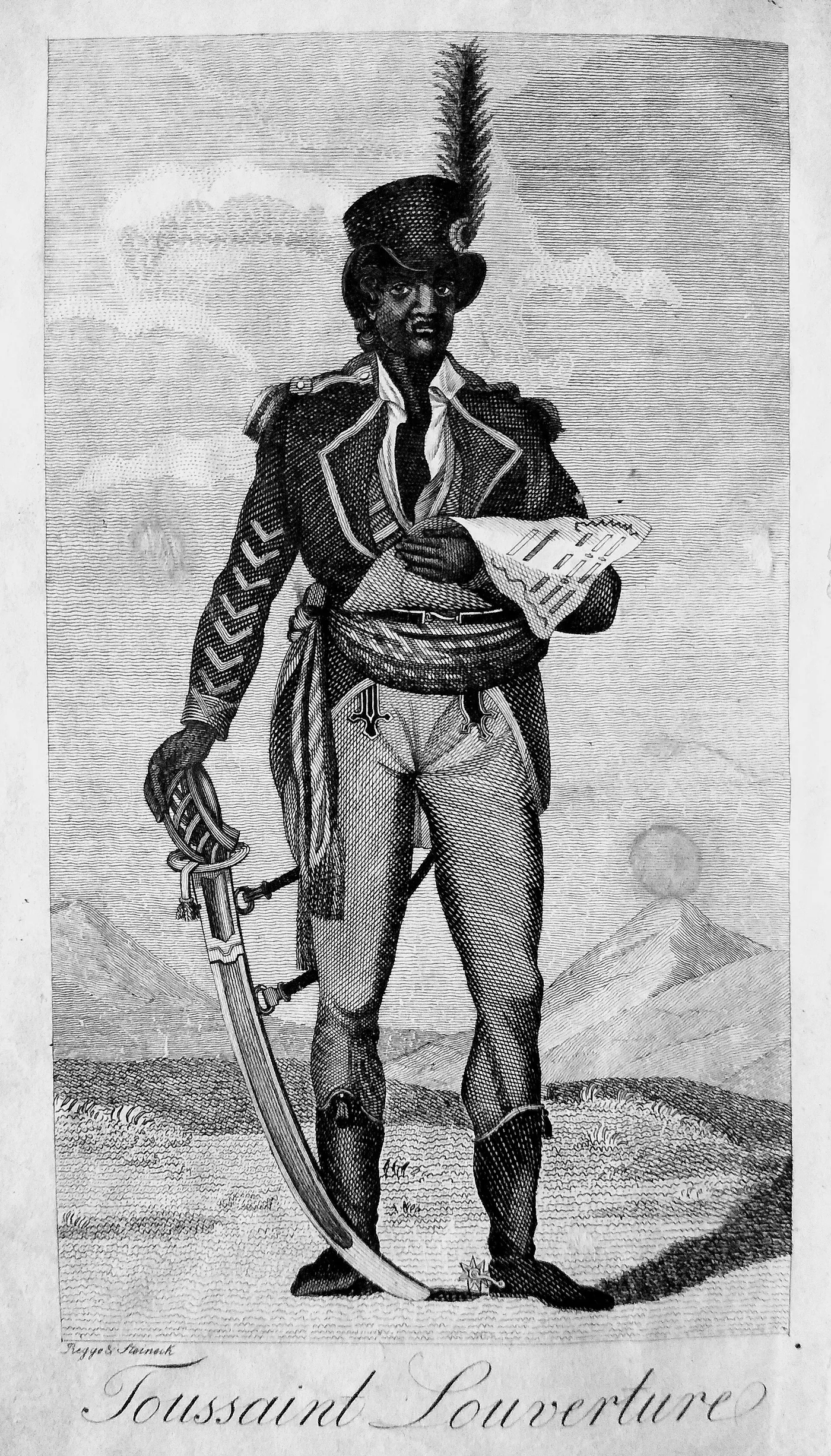
- Present the image.
- Describe the clothing and pose.
- How does the artist present Toussaint?
- Why is a European engraving of 1806 an imperfect source?
Exercise 15 : Atlantic revolutions on the map
Use Map 1 in the lesson and the numbered map below.
- Name the places 1 to 6: Philadelphia, Paris, Saint-Domingue, Caracas, Buenos Aires, Rio de Janeiro.
- Which revolution took place on an island?
- Which two places belonged to Spanish America?
- Which place was in a Portuguese colony?
Exercise 16 : South American campaigns
Study Map 2 in the lesson, showing the campaigns of Bolivar and San Martin.
- Where did Bolivar begin and where did he go?
- Where did San Martin begin and where did he go?
- Which city did both aim at, and why?
- Why did Brazil follow a different path?
Exercise 17 : Order the revolutions
Put these in order: fall of the Bastille; Declaration of Independence; Haiti proclaimed independent; Hidalgo’s revolt; Battle of Ayacucho; Execution of Louis XVI.
- Give dates.
- How many years between the American Declaration and the fall of the Bastille?
Exercise 18 : Cause chains
Arrange as a chain of cause and effect: Seven Years’ War; British debt; new colonial taxes; colonial protest; Declaration of Independence. Then do the same for France.
Exercise 19 : Guided research: Toussaint Louverture
Investigate the life of Toussaint Louverture.
- Keywords: Toussaint Louverture biography, Haitian Revolution, Fort de Joux, Constitution of 1801.
- Reliable sites: the Library of Congress, the Metropolitan Museum of Art, Encyclopaedia Britannica, a university history page. Check authors and dates.
- Fill in: when and where he was born; his role in 1791-1801; how he was removed; when he died; your sources.
Exercise 20 : Short answer: revolutions
Answer A, B, and C.
- A. Identify one Enlightenment idea used in the Declaration of Independence.
- B. Explain one way in which the French Revolution became more radical after 1792.
- C. Explain one difference between the Haitian Revolution and the American Revolution.
Exercise 21 : Stimulus-based multiple choice
Use Document H (Haiti, 1801) to answer.
Art. 3. There cannot exist slaves on this territory, servitude is therein forever abolished. All men are born, live and die free and French. Art. 4. All men, regardless of color, are eligible to all employment. Art. 5. There shall exist no distinction other than those based on virtue and talent, and other superiority afforded by law in the exercise of a public function. The law is the same for all whether in punishment or in protection.
Source: Constitution of the French Colony of Saint-Domingue, July 1801, title II, articles 3 to 5; English translation by Charmant Theodore, published by the Louverture Project; Wikisource.
*Servitude: slavery; *public function: government office.
- 1. Article 3 most directly reflects (A) the Declaration of the Rights of Man; (B) the Congress of Vienna; (C) the Tea Act; (D) the Napoleonic Code.
- 2. The document differs from the 1789 French law by (A) abolishing slavery; (B) establishing a monarchy; (C) giving women the vote; (D) banning religion.
- 3. A historian would use the source to study (A) the political goals of Toussaint Louverture’s government; (B) life on plantations; (C) the Bolivar campaigns; (D) the Terror.
Exercise 22 : Cause and effect: Latin America
Explain two causes of the Latin American wars of independence and one reason they brought limited social change.
Exercise 23 : True or false? Justify
Decide whether each statement is true or false and justify it.
- The Haitian Revolution created the first state in the Americas founded by formerly enslaved people.
- The Declaration of the Rights of Man gave women the vote.
- Napoleon crowned himself emperor in 1804.
- Bolivar and San Martin both fought in Europe.
Exercise 24 : LEQ: comparison
Prompt (AP style): Compare the causes of the American Revolution and the Haitian Revolution. Write a thesis and plan two body paragraphs.
Hint: A comparison thesis names a similarity and a difference.


Quick review: flashcards
Tap a card to see the answer.