


This AP World History: Modern test covers AP World Unit 5: Revolutions. Like a classroom assessment, it includes documents to analyze, knowledge questions and a short writing task. To prepare, review the lesson first, then practice with the worksheet.
Time : 90 min
AP style. Part A: documents and short answers (64 points). Part B: LEQ (36 points).
Document 1 – The Declaration of Independence (1776)
We hold these truths to be self-evident: That all men are created equal; that they are endowed by their Creator with certain unalienable rights; that among these are life, liberty, and the pursuit of happiness; that, to secure these rights, governments are instituted among men, deriving their just powers from the consent of the governed; that whenever any form of government becomes destructive of these ends, it is the right of the people to alter or to abolish it, and to institute new government, laying its foundation on such principles, and organizing its powers in such form, as to them shall seem most likely to effect their safety and happiness.
Source: Declaration of Independence, July 4, 1776, second paragraph; Avalon Project, Yale Law School.
*Endowed: provided with; *Creator: God.
Declaration of Independence, Avalon Project
Document 2 – The Constitution of Saint-Domingue (1801)
Art. 3. There cannot exist slaves on this territory, servitude is therein forever abolished. All men are born, live and die free and French. Art. 4. All men, regardless of color, are eligible to all employment. Art. 5. There shall exist no distinction other than those based on virtue and talent, and other superiority afforded by law in the exercise of a public function. The law is the same for all whether in punishment or in protection.
Source: Constitution of the French Colony of Saint-Domingue, July 1801, title II, articles 3 to 5; English translation by Charmant Theodore, published by the Louverture Project; Wikisource.
*Servitude: slavery; *public function: government office.
Constitution of 1801, translation by Charmant Theodore
Document 3 – The capture of the Bastille (1789)
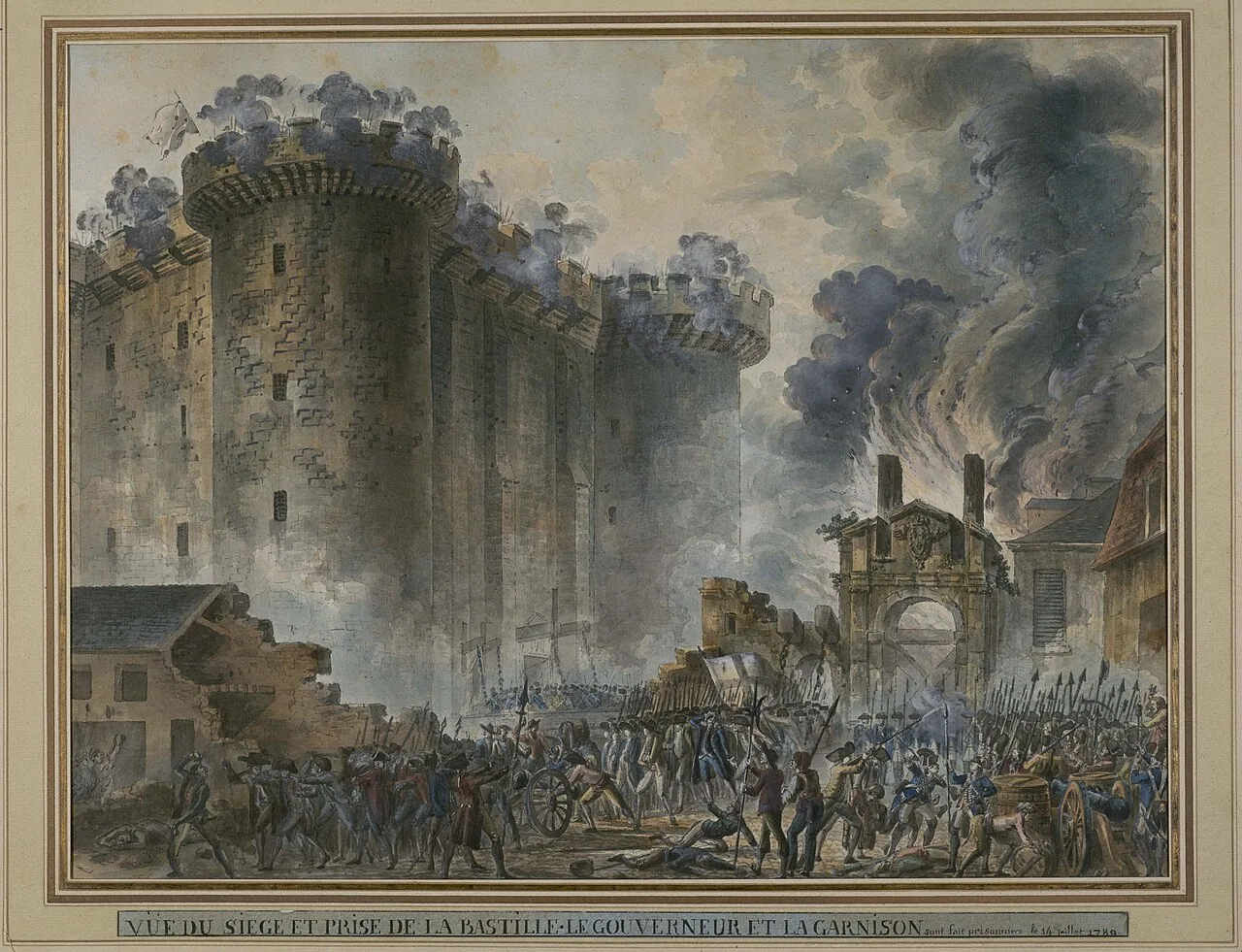
Contemporary French print, Wikimedia Commons
Document 4 – South American independence
Map prepared from Natural Earth data
Questions
- 1. (Document 1) Identify two rights or principles stated in the passage. (6 points) (6 pts)
- 2. (Document 1) Explain one limit of these principles in the United States in 1776. (8 points) (8 pts)
- 3. (Document 2) Identify one provision of article 3 or article 5. (6 points) (6 pts)
- 4. (Documents 1 and 2) Compare how the two texts treat equality. (12 points) (12 pts)
- 5. (Document 3) Explain how the print presents the fall of the Bastille as a symbol. (10 points) (10 pts)
- 6. (Document 4) Explain how the map shows that independence came from two directions. (10 points) (10 pts)
- 7. SAQ. (a) Identify one cause of the French Revolution. (b) Explain one effect of the Haitian Revolution on slavery in the Americas. (c) Explain one similarity between Latin American and American independence. (12 points) (12 pts)
- 8. LEQ. Evaluate the extent to which Enlightenment ideas caused revolutions in the Atlantic world between 1750 and 1830. (36 points) (36 pts)


Quick review: flashcards
Tap a card to see the answer.