


This AP World History: Modern test covers AP World Unit 4: Transoceanic Interconnections. Like a classroom assessment, it includes documents to analyze, knowledge questions and a short writing task. To prepare, review the lesson first, then practice with the worksheet.
Time : 90 min
AP style. Part A: documents and short answers (70 points). Part B: LEQ (30 points).
Document 1 – Columbus on October 12, 1492
They have no iron, their javelins being without it, and nothing more than sticks, though some have fish-bones or other things at the ends. They are all of a good size and stature, and handsomely formed. I saw some with scars of wounds upon their bodies, and demanded by signs the of them; they answered me in the same way, that there came people from the other islands in the neighborhood who endeavored to make prisoners of them, and they defended themselves. I thought then, and still believe, that these were from the continent. It appears to me, that the people are ingenious, and would be good servants and I am of opinion that they would very readily become Christians, as they appear to have no religion.
Source: Christopher Columbus, Journal of the first voyage, entry for October 12, 1492, as abstracted by Bartolome de las Casas; translated by Clements R. Markham (Hakluyt Society, 1893); Fordham Medieval Sourcebook.
*Admiral: Columbus; *Christians: converts.
Columbus, Journal, abstract by Las Casas, translation of Markham
Document 2 – Equiano on the Middle Passage (1789)
The closeness of the place, and the heat of the climate, added to the number in the ship, which was so crowded that each had scarcely room to turn himself, almost suffocated us. This produced copious perspirations, so that the air soon became unfit for respiration, from a variety of loathsome smells, and brought on a sickness among the slaves, of which many died, thus falling victims to the improvident avarice, as I may call it, of their purchasers. This wretched situation was again aggravated by the galling of the chains, now become insupportable; and the filth of the necessary tubs, into which the children often fell, and were almost suffocated. The shrieks of the women, and the groans of the dying, rendered the whole a scene of horror almost inconceivable.
Source: Olaudah Equiano, The Interesting Narrative of the Life of Olaudah Equiano, 1789, chapter 2, on the Middle Passage; Project Gutenberg.
*Fetid: foul-smelling.
Equiano, Interesting Narrative, 1789
Document 3 – The plan of the slave ship Brookes (1789)
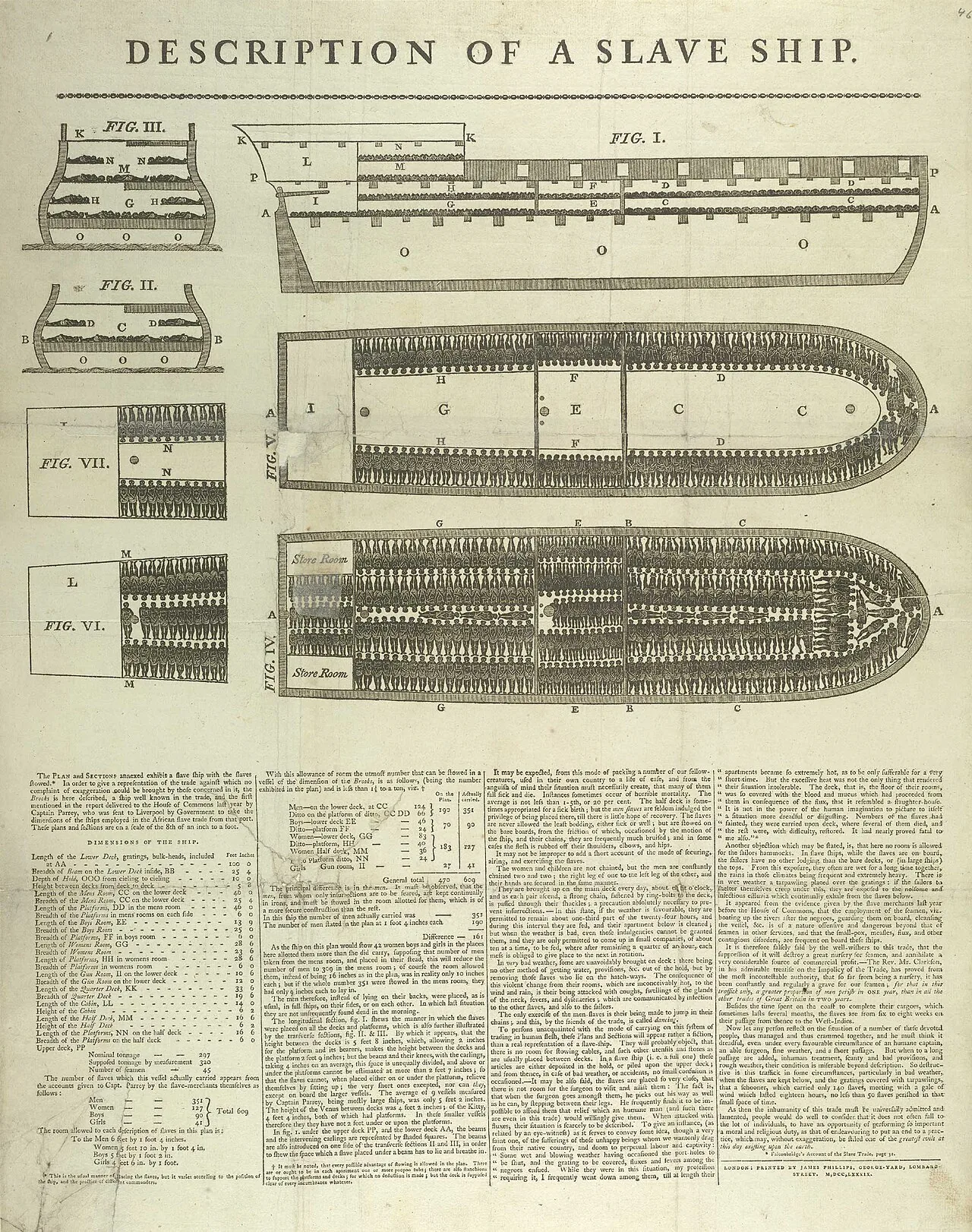
Print, British Library, Wikimedia Commons
Document 4 – The Atlantic trade system
Map prepared from Natural Earth data
Questions
- 1. (Document 1) Identify two things Columbus observes about the people he meets. (6 points) (6 pts)
- 2. (Document 1) Explain how Columbus’s purpose shapes his description. (10 points) (10 pts)
- 3. (Document 2) Identify two features of the conditions on the ship. (6 points) (6 pts)
- 4. (Documents 2 and 3) Compare what the text and the print show about the slave trade. (12 points) (12 pts)
- 5. (Document 4) Explain how the routes on the map link three regions. (10 points) (10 pts)
- 6. SAQ. (a) Identify one cause of European exploration. (b) Explain one effect of the encomienda on Native Americans. (c) Explain one way African societies were affected by the slave trade. (12 points) (12 pts)
- 7. DBQ-style synthesis. Using Documents 1 to 4, evaluate the extent to which European expansion brought change for people in Africa and the Americas. (14 points) (14 pts)
- 8. LEQ. Evaluate the extent to which the Atlantic slave trade transformed economies in the Atlantic world between 1450 and 1750. (30 points) (30 pts)


Quick review: flashcards
Tap a card to see the answer.