


This AP World History: Modern test covers AP World Unit 1: The Global Tapestry. Like a classroom assessment, it includes documents to analyze, knowledge questions and a short writing task. To prepare, review the lesson first, then practice with the worksheet.
Time : 90 min
AP style. Part A: documents and short answers (70 points). Part B: LEQ (30 points). Use the documents and your own knowledge.
Document 1 – Ibn Battuta on Mali (1352-1353)
They are seldom unjust, and have a greater abhorrence of injustice than any other people. Their sultan shows no mercy to anyone who is guilty of the least act of it. There is complete security in their country. Neither traveller nor inhabitant in it has anything to fear from robbers or men of violence. They do not confiscate the property of any white man who dies in their country, even if it be uncounted wealth. On the contrary, they give it into the charge of some trustworthy person among the whites, until the rightful heir takes possession of it.
Source: Ibn Battuta, Rihla (Travels), account of his stay in the empire of Mali, 1352-1353, as dictated in 1355; translated by H. A. R. Gibb, Ibn Battuta: Travels in Asia and Africa, 1325-1354 (London, 1929); Fordham Medieval Sourcebook.
*Whites: light-skinned North African and Arab visitors.
Ibn Battuta, Rihla, in the translation of H. A. R. Gibb (1929)
Document 2 – Magna Carta, clauses 39 and 40 (1215)
39. No freemen shall be taken or imprisoned or disseised or exiled or in any way destroyed, nor will we go upon him nor send upon him, except by the lawful judgment of his peers or by the law of the land. 40. To no one will we sell, to no one will we refuse or delay, right or justice.
Source: Magna Carta, clauses 39 and 40, issued by King John of England at Runnymede, June 1215; Avalon Project, Yale Law School.
Magna Carta, 1215, Avalon Project
Document 3 – The Sankore mosque, Timbuktu
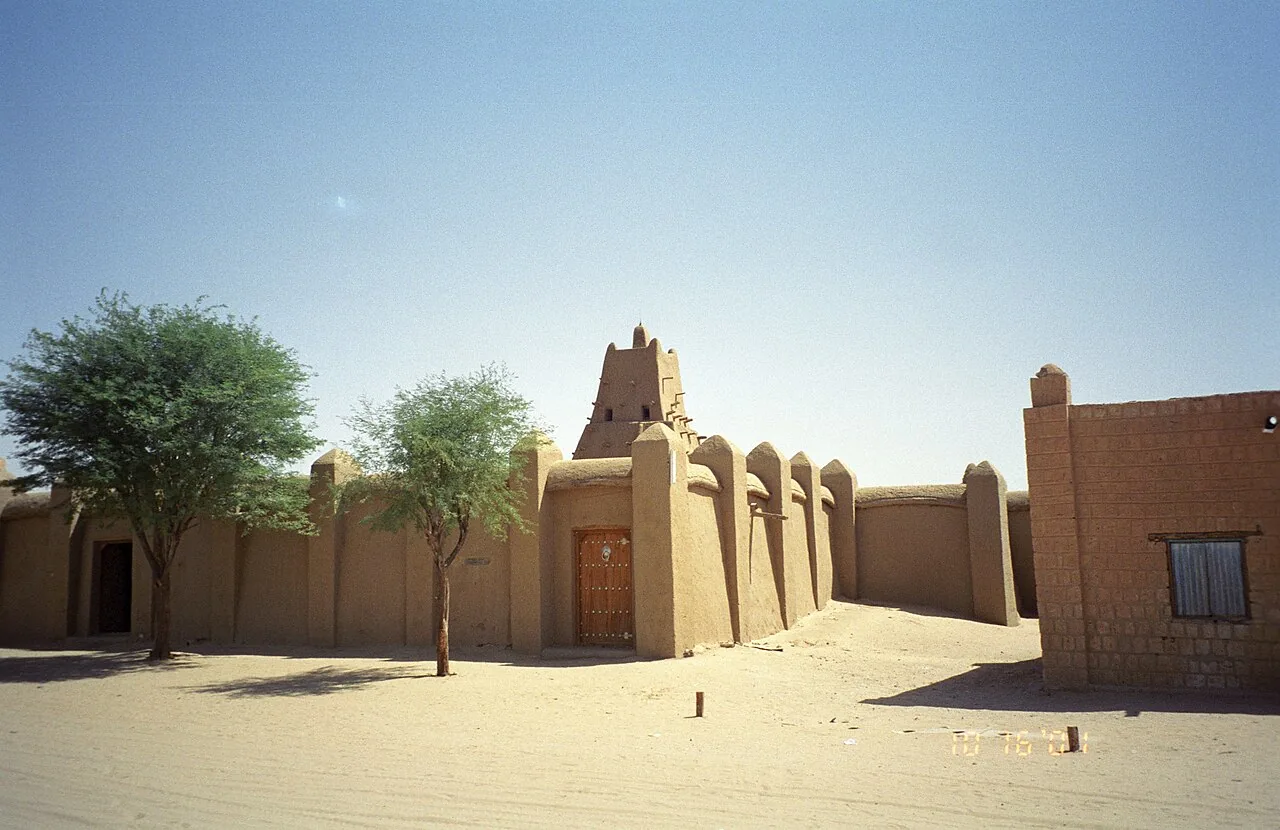
Photograph, Wikimedia Commons
Document 4 – Afro-Eurasia around 1300
Map prepared from Natural Earth data
Questions
- 1. (Documents 1-4) Identify two states or regions shown on Document 4 where Islam was an important religion. (6 points) (6 pts)
- 2. (Document 1) Explain one way in which the author’s point of view shapes this account of Mali. (10 points) (10 pts)
- 3. (Document 2) Identify the principle stated in clause 39 and explain its limits in 1215. (10 points) (10 pts)
- 4. (Documents 1 and 2) Compare how each text links justice to the ruler. (12 points) (12 pts)
- 5. (Document 3) Explain how the Sankore mosque shows the connection between trade and religion in West Africa. (10 points) (10 pts)
- 6. (Document 4) Explain two features of the geography of Afro-Eurasia in 1300 that favored long-distance trade. (10 points) (10 pts)
- 7. SAQ. (a) Identify one development in Song China that increased its wealth. (b) Explain one reason Mansa Musa’s hajj mattered. (c) Explain one way the Inca used labor service. (12 points) (12 pts)
- 8. LEQ. Evaluate the extent to which trade, rather than conquest, explains the growth of states between 1200 and 1450. (30 points) (30 pts)


Quick review: flashcards
Tap a card to see the answer.