


This AP US History lesson covers APUSH Period 1: 1491-1607, part of the unit “APUSH periods.” First, read the full lesson with its primary sources, maps and key terms. Then practice with the worksheet, check yourself with the quiz and get ready with the test.
In 1491 tens of millions of people, by most scholarly estimates, lived in the Western Hemisphere. Some built cities with causeways and temples, and some farmed river valleys with irrigation ditches. Others followed the bison across grassland, and still others fished for salmon along rain-soaked coasts. A single year later, a Genoese captain sailing for the Spanish crown stepped onto a Caribbean beach. He started a chain of events that would link four continents. The College Board’s Period 1 (1491-1607) asks you to hold two stories at once. The first is the diverse worlds that already existed in the Americas. The second is the arrival of Europeans whose ships, weapons, diseases, and ambitions rearranged those worlds within a few generations.
Guiding question: How did contact among Native Americans, Europeans, and Africans reshape the Atlantic world between 1491 and 1607, and why did the Spanish, French, Dutch, and English build such different colonial societies?
This unit follows the structure of the APUSH Course and Exam Description. It develops Key Concept 1.1 (the diversity of Native societies and their adaptation to their environments) It also develops Key Concept 1.2 (the Atlantic world after 1492: the Columbian Exchange, Spanish colonization, and the first moves of other European powers). The thematic learning objectives you will meet again and again: Migration and Settlement (MIG) and Work, Exchange, and Technology (WXT). Two more are American and Regional Culture (ARC) and Geography and the Environment (GEO). The historical thinking skills practiced here are contextualization, causation, comparison, and the sourcing of primary documents.
1. The Americas before 1492
Adapting to the environment
Historians avoid speaking of a single “Indian” way of life. This is because Native societies differed as much as the lands they inhabited. The key point for the AP exam is the link between environment and economy.
Societies of the Southwest, Woodlands, and Plains
In the Southwest, the ancestors of the Pueblo peoples developed irrigated farming of maize, beans, and squash. They also built multi-story stone and adobe villages. Maize, which had spread north from Mesoamerica over centuries, became the foundation of many societies because it produced surplus food. Surplus food allowed population growth, specialized crafts, trade, and complex political systems. In the Eastern Woodlands, Algonquian-speaking peoples along the Atlantic coast combined farming with hunting and fishing, moving between seasonal villages.
The Haudenosaunee (the Iroquois, whose league united five nations in what is now upstate New York) lived in longhouses and traced descent through the mother’s line. They also gave women real authority over farming and the selection of leaders. On the Great Plains, before the arrival of the horse (brought by the Spanish) peoples hunted bison on foot. Many also grew crops in river valleys. Along the Pacific Northwest coast, abundant salmon and cedar supported permanent villages without farming.
The most famous city north of Mexico in this period was Cahokia, near the Mississippi River in present-day Illinois. The people of the Mississippian culture built enormous earthen mounds there, the largest of them rising in terraces above the floodplain. The city also traded over great distances. By the time Europeans arrived, Cahokia had been abandoned for generations, probably because of environmental stress and political upheaval. The point is not to count its people exactly, since estimates vary. Instead, we should understand that North America was already home to large, organized societies with their own histories, trade networks, and religions.
Definition: Maize
corn, domesticated in Mesoamerica thousands of years ago. Its spread north made settled farming and larger populations possible in the Southwest and the Eastern Woodlands. It became the most important crop in the Columbian Exchange.
Land and ideas about ownership
Native peoples held ideas about land that confused many Europeans. In much of eastern North America, communities claimed the right to use territory for farming, hunting, and fishing, but individuals did not own land to sell it permanently. When an English colonist handed over copper kettles and cloth for a grant, he believed he had bought the land forever. The Native leader who accepted the goods often believed he had agreed to share its use and to form an alliance. Differences of this kind would cause conflict throughout the colonial period. For this reason, the AP exam often asks students to explain them as a cause of war or as a source of misunderstanding.
2. Europe, Africa, and the Atlantic: why 1492 changed everything
Portugal, Spain, and the search for Asia
By the late 1400s the monarchs of Western Europe wanted direct access to the spices, silk, and gold of Asia and Africa. Italian merchants and Muslim intermediaries controlled this trade in the eastern Mediterranean. New technologies made voyages possible. They included the caravel and the carrack, improved navigational tools such as the compass and the astrolabe, and better maps. Portugal, under Prince Henry and his successors, sailed down the coast of West Africa and built trading posts.
The Portuguese also began buying and transporting enslaved Africans, first to Iberia and the Atlantic islands. There, sugar plantations became a model for later slavery in the Americas. In 1492 Spain finished the Reconquista by capturing Granada. The Reconquista was the centuries-long Christian campaign to take back the Iberian Peninsula from Muslim rulers. The same year, Queen Isabella and King Ferdinand agreed to finance Christopher Columbus. He argued that he could reach Asia by sailing west.
Document 1 – What the Spanish crown promised Columbus, 1492
and that you be our Admiral, Vice-Roy, and Governour in them, and that for the future, you may call and stile yourself, D. Christopher Columbus, and that your sons and successors in the said employment, may call themselves Dons, Admirals, Vice-Roys, and Governours of them; and that you may exercise the office of Admiral, with the charge of Vice-Roy and Governour of the said Islands and Continent, which you and your Lieutenants shall conquer, and freely decide all causes, civil and criminal, appertaining to the said employment of Admiral, Vice-Roy, and Governour, as you shall think fit in justice, and as the Admirals of our kingdoms use to do; and that you have power to punish offenders;
Source: Privileges and Prerogatives Granted by Their Catholic Majesties to Christopher Columbus, April 30, 1492 (English translation); the Avalon Project, Yale Law School.
*Vice-Roy: a viceroy, a governor who rules on behalf of the king. *Perquisites: income and benefits that come with an office.
Commentary. Notice what the monarchs offered: offices, legal power, and income, not scientific glory. Columbus was to rule the lands he “discovered” as the crown’s representative and to judge disputes there. The document shows that from the start exploration was a business and a political project of the Spanish state.
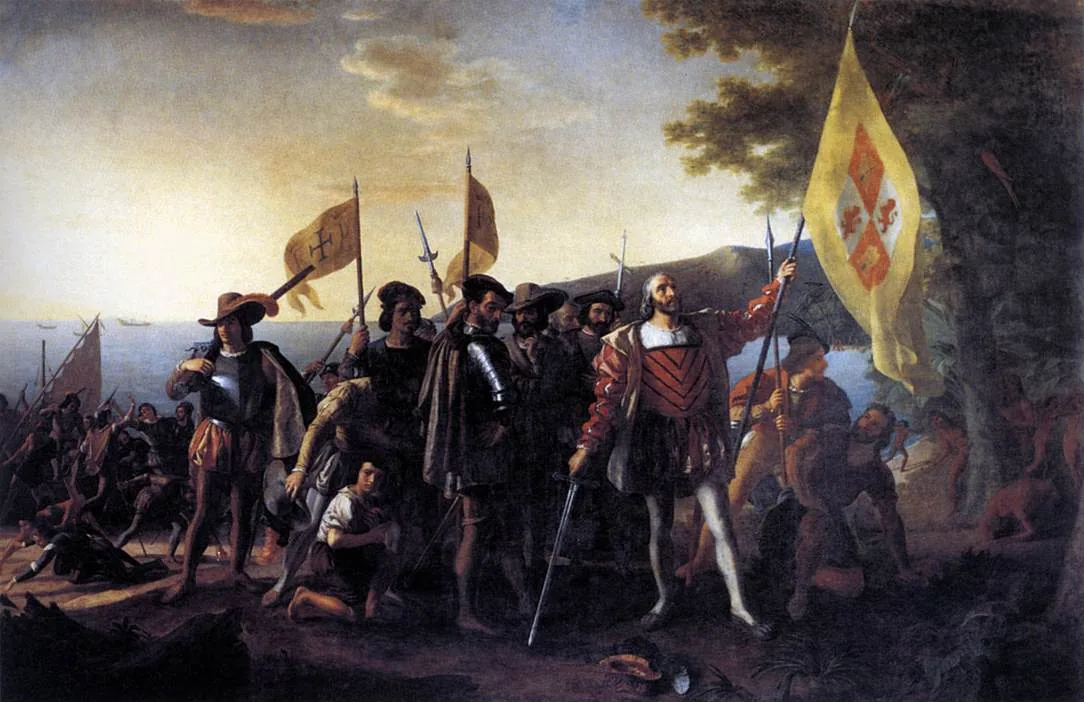
Columbus’s landfall in October 1492 in the Bahamas began sustained contact between the Americas and Europe. The Taino people who lived on the island called it Guanahani. They greeted the Spaniards peacefully. Within a few years, Columbus’s settlers on Hispaniola were demanding gold tribute and forced labor. As a result, the Taino population collapsed under violence, overwork, and disease. Columbus died believing he had reached the edge of Asia. It was Amerigo Vespucci, who explored the coast of South America around 1500, who argued that these lands were a “New World”. Then the German mapmaker Martin Waldseemuller placed the name America on his 1507 map.
Dividing the world on paper
Spain and Portugal quarreled over the new discoveries. In 1494 they signed the Treaty of Tordesillas, which drew a north-south line down the Atlantic. Lands to the west of the line would belong to Spain; lands to the east would belong to Portugal. Because the line, as it happened, cut through the bulge of South America, Portugal later claimed Brazil. England, France, and the Dutch Republic, who had signed nothing, ignored the agreement. Henry VII of England had already commissioned the Venetian John Cabot in 1496 to sail west under the English flag. In 1497 Cabot reached the coast of North America, probably Newfoundland. England did little with his claim for almost a century.
Document 2 – Dividing the world, 1494
That, whereas a certain controversy exists between the said lords, their constituents, as to what lands, of all those discovered in the ocean sea up to the present day, the date of this treaty, pertain to each one of the said parts respectively; therefore, for the sake of peace and concord, and for the preservation of the relationship and love of the said King of Portugal for the said King and Queen of Castile, Aragon, etc., it being the pleasure of their Highnesses, they, their said representatives, acting in their name and by virtue of their powers herein described, covenanted and agreed that a boundary or straight line be determined and drawn north and south, from pole to pole, on the said ocean sea, from the Arctic to the Antarctic pole.
Source: Treaty of Tordesillas, signed by Spain and Portugal, June 7, 1494 (English translation); the Avalon Project, Yale Law School.
*Leagues: a measure of distance at sea, roughly three miles each.
Commentary. The treaty is written as a deal between two Christian kings, with no sign that anyone who lived in the lands in question had been consulted. The purpose is “peace and concord” between Spain and Portugal. The sentence shows how Europeans treated the Atlantic as a space to be divided among themselves.
3. The Columbian Exchange and the Spanish empire
A biological revolution
The historian Alfred Crosby gave the name Columbian Exchange to the movement of plants, animals, people, and diseases across the Atlantic that followed 1492. Europe and Africa received maize, potatoes, tomatoes, and beans, which fed growing populations. Tobacco, which Native peoples had cultivated for centuries, became a major cash crop and a source of wealth. The Americas received wheat, sugarcane, rice, horses, cattle, pigs, and sheep. Horses changed the lives of many Plains peoples, They built new ways of hunting and war on horseback in the following centuries. Pigs and cattle spread and changed landscapes.
The most devastating cargo was disease. Native peoples had no immunity to smallpox, measles, and other illnesses that Europeans and Africans carried. As a result, epidemics killed huge numbers of people, often before they had even met a European. Scholars disagree about the size of the losses, and estimates differ from region to region. Still, there is broad agreement that in some areas the population fell by more than half within a few generations. The effect was political as well as human: whole communities lost their leaders and their knowledge. Spanish conquerors therefore often found societies already weakened by epidemic.
Definition: Columbian Exchange
the transfer of plants, animals, people, technologies, and diseases between the Eastern and Western hemispheres after 1492. It changed diets, economies, and populations on every continent, and it caused catastrophic epidemics among Native Americans.
Conquest and colonial rule
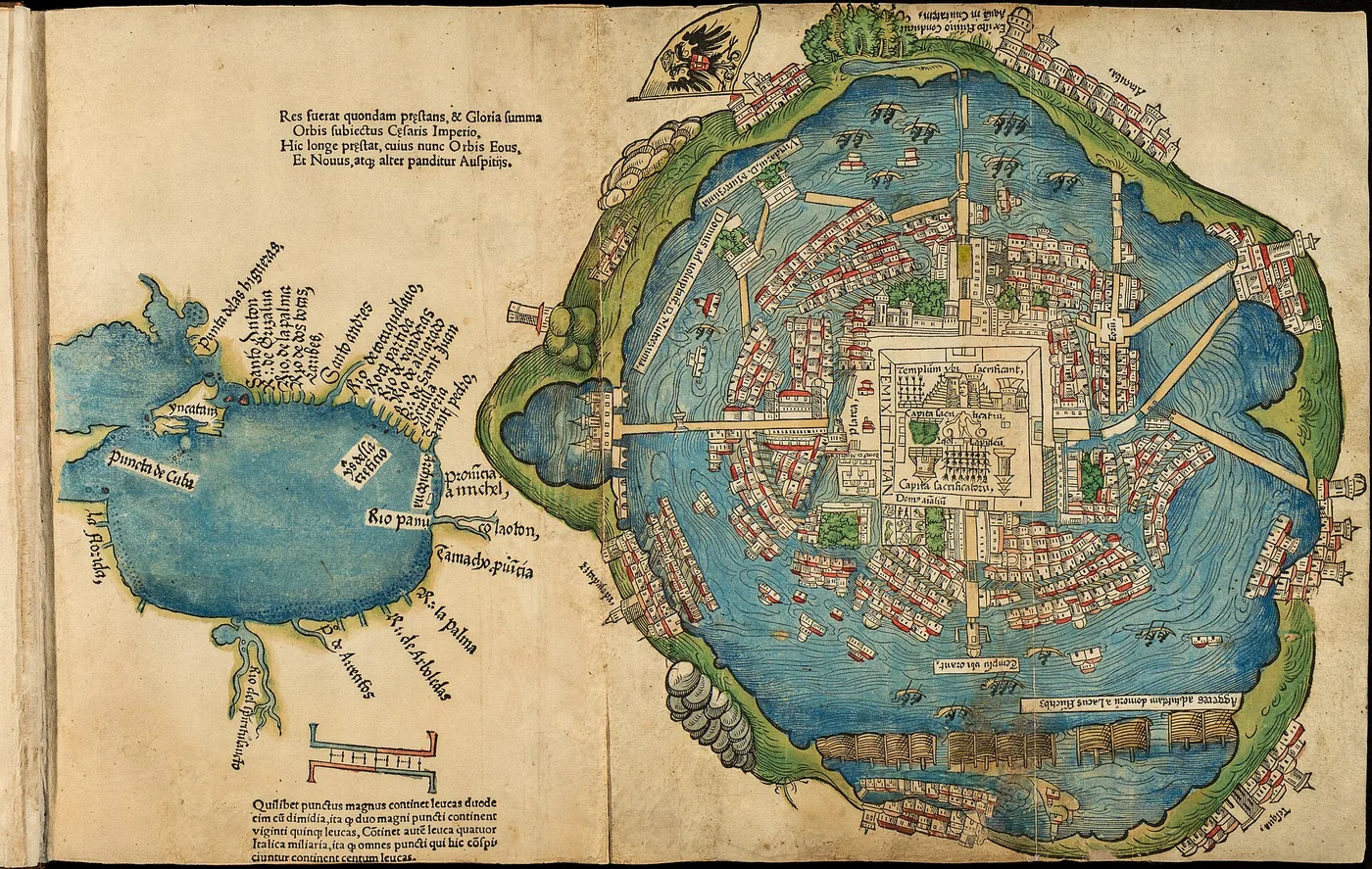
The Spanish conquered the largest Native empires of the hemisphere in a remarkably short time. Hernan Cortes landed on the coast of Mexico in 1519 with a few hundred men and entered Tenochtitlan, the Aztec capital. The city, built on an island in a lake, dazzled the Spaniards. In 1521, after a long siege, the city fell. Cortes succeeded for three reasons. First, thousands of Native allies, above all Tlaxcalans who hated Aztec tribute demands, fought alongside him. Second, smallpox struck the city.
Third, he had help from an interpreter, Malintzin (called Dona Marina or La Malinche by the Spanish). In the 1530s Francisco Pizarro used a similar mix of alliance, force, and a civil war among the Incas to seize Peru. Spanish expeditions moved north as well. Juan Ponce de Leon landed in Florida in 1513. Hernando de Soto marched across the Southeast between 1539 and 1542. Francisco Vasquez de Coronado searched the Southwest in 1540-1542. They found no new empires of gold and left behind epidemics, deaths, and lasting memories.
Spanish colonial institutions
To control the conquered lands, Spain created institutions that drew on Roman Catholic faith and on the Reconquista. The encomienda system granted Spanish colonists the right to demand tribute and labor from Native communities. In exchange, the colonists were to protect them and teach them Christianity. In practice it was a form of forced labor that often led to terrible abuse. Catholic missions, run by Franciscans, Dominicans, and Jesuits, sought to convert Native peoples and to change how they lived.
A rigid social hierarchy, later called the casta system, ranked people by ancestry. Spaniards born in Spain were at the top, followed by Spaniards born in the colonies. Next came people of mixed Spanish and Native descent (mestizos), then people of African descent and Native peoples. Silver mined at Potosi in Peru and in Mexico made Spain the richest power in Europe. The silver flowed across the world. Spain also increasingly relied on enslaved Africans for work in mines and on sugar plantations in the Caribbean.
Definition: Encomienda
a Spanish system in which the crown granted colonists authority over Native communities, whose people owed them labor and tribute. Reformers such as Bartolome de las Casas protested its cruelty. The New Laws of 1542 tried, with limited success, to restrict it.
Debate and conscience
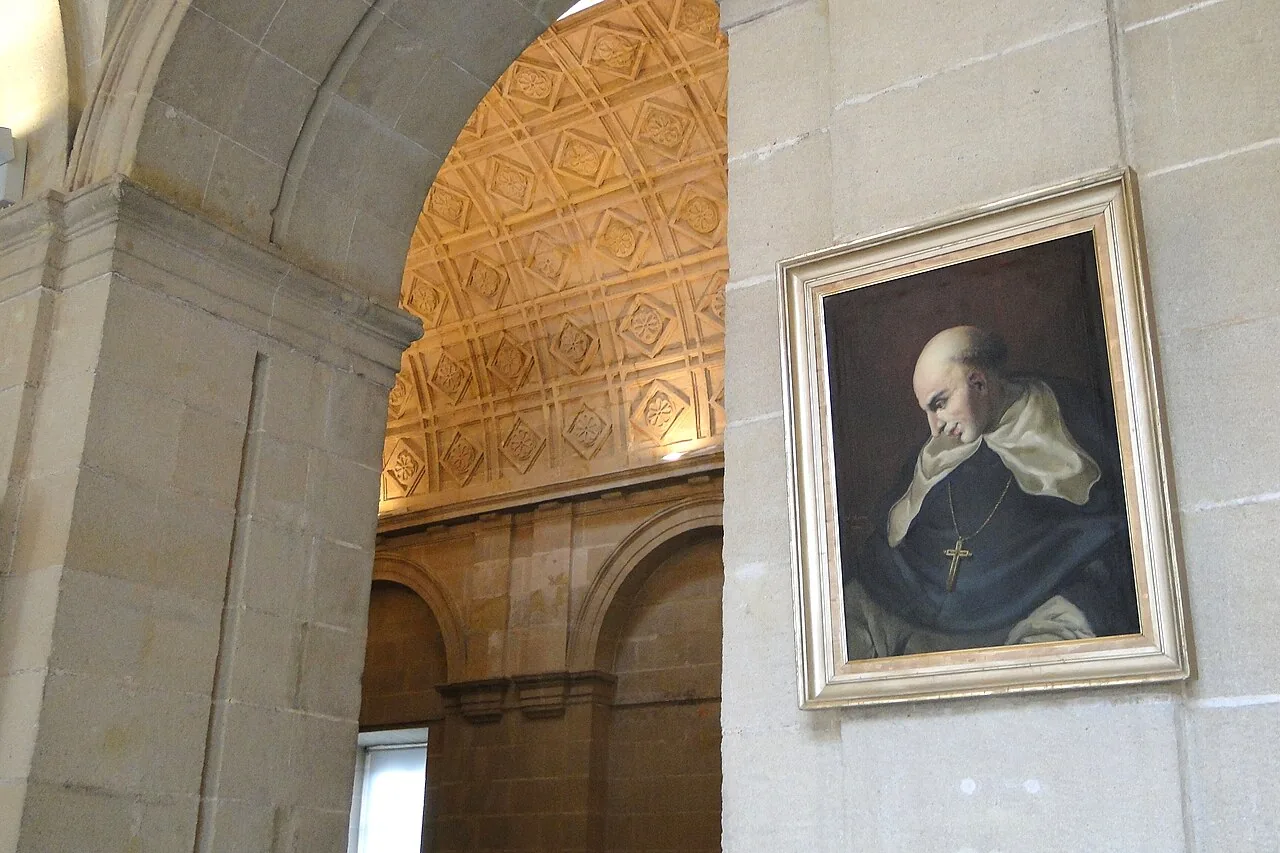
Some Spaniards were horrified by what they saw. Antonio de Montesinos, a Dominican, preached against the treatment of the Taino as early as 1511. Bartolome de las Casas, who had himself held an encomienda, became a friar and spent decades arguing for Native rights. His Short Account of the Destruction of the Indies, written in 1542 and published in 1552, shocked readers. Ironically, it also supplied other European powers with material for the “Black Legend” of Spanish cruelty.
In 1550-1551 the crown held a formal debate at Valladolid between Las Casas and the scholar Juan Gines de Sepulveda. Sepulveda argued that Native peoples were naturally meant for Spanish rule. The debate ended without a clear ruling. However, Spanish colonial practice continued to fall short of the laws meant to protect Native people. The Valladolid debate is a favorite AP topic because it shows that Europeans disagreed about the morality of empire.
4. The English, the French, and the roads to 1607
The Spanish dominated the first century of colonization, and their rivals watched with envy. France sent Giovanni da Verrazzano along the Atlantic coast in 1524 and Jacques Cartier up the St. Lawrence River in 1534-1536. However, its first lasting settlements, built around the fur trade and alliances with Algonquian and Huron peoples, belong to the next period. Quebec was founded in 1608.
The Dutch were busy fighting for independence from Spain and began colonizing in the early 1600s. England, a Protestant kingdom that broke with the Roman Catholic Church under Henry VIII, entered the competition later. Its motives were mixed. They included profit, rivalry with Spain, and the wish to spread Protestant Christianity. Some English writers also hoped to relieve what they called an excess of population at home.
The early English attempts failed. Sir Walter Raleigh sponsored colonies on Roanoke Island, off the coast of what is now North Carolina, in 1585 and 1587. The second group, which included women and children, was left behind when its leader, John White, sailed home to bring supplies. The Spanish Armada crisis of 1588 delayed his return until 1590.
Then he found the settlement empty and the word CROATOAN carved on a post. The fate of the “Lost Colony” is still debated; most historians think its members dispersed among nearby Native communities. A member of the first group, the scientist Thomas Hariot, wrote a report on the region in 1588. In it he recorded both Algonquian beliefs and the epidemics that followed English visits.
Document 3 – Disease and the English at Roanoke, 1588
but that within a few dayes after our departure from euerie such towne, the people began to die very fast, and many in short space; in some townes about twentie, in some fourtie, in some sixtie, & in one sixe score, which in trueth was very manie in respect of their numbers. This happened in no place that wee coulde learne but where wee had bene, where they vsed some practise against vs, and after such time; The disease also so strange, that they neither knew what it was, nor how to cure it; the like by report of the oldest men in the countrey neuer happened before, time out of minde. […] Some therefore were of opinion that wee were not borne of women,
Source: Thomas Hariot, A Briefe and True Report of the New Found Land of Virginia, 1588, on the Roanoke colony of 1585-1586 (original spelling); Documenting the American South, University of North Carolina.
*euerie: every. *Wiroans: werowance, a chief. *vtterance: speech.
Commentary. Hariot writes as an English observer, not as a neutral scientist, and his interpretation is shaped by his culture. Still, he reports that Algonquian communities where the English had stayed suffered terrible mortality from an unfamiliar illness. He adds that some Native people drew the conclusion that the Englishmen were more than mortal. The passage is useful evidence for the Columbian Exchange, and it also shows how disease changed relations of power.
In 1606 King James I issued a charter to the Virginia Company, a joint-stock company. It let investors pool their money to share the cost and risk of a colony. In the spring of 1607 about one hundred English men and boys settled on a marshy peninsula on the James River, in the lands of the Powhatan chiefdom.
It was a union of roughly thirty Algonquian-speaking groups led by the paramount chief Wahunsenacawh, whom the English called Powhatan. They called their settlement Jamestown. The story of the colony belongs to Period 2. Still, the charter that created it already contains the ideas that will matter later: a promise that English colonists would keep the rights of Englishmen, and a mission to spread Christianity.
Document 4 – The aims of the Virginia Company, 1606
in propagating of Christian Religion to such People, as yet live in Darkness and miserable Ignorance of the true Knowledge and Worship of God, and may in time bring the Infidels and Savages, living in those parts, to human Civility, and to a settled and quiet Government:
Source: The First Charter of Virginia, April 10, 1606; the Avalon Project, Yale Law School.
*Infidels and Savages: the charter’s terms for Native peoples, which reveal how the English saw them.
Commentary. The charter blends religious duty with ideas of “civility” and orderly government. For AP, note how this purpose statement justified colonization by presenting it as a benefit to Native peoples. You will see this pattern in many later documents.
Definition: Joint-stock company
a business in which many investors buy shares to raise money for a risky venture, such as founding a colony. The Virginia Company of London (1606) was the model for English settlement in North America.
Definition: Mercantilism
the economic idea that a nation grows strong by exporting more than it imports and by controlling colonies that supply raw materials and buy manufactured goods. It drove European competition for colonies.
5. Thinking like a historian: using Period 1 on the AP exam
Period 1 is about 4 to 6 percent of the multiple-choice questions on the exam, yet its ideas return throughout the course. Therefore, it is worth mastering the cause-and-effect chains. Study these four. First, environment shaped Native economies, and those economies shaped political organization. Second, Europeans’ search for wealth and religious conversion led to exploration, and exploration produced the Columbian Exchange. Third, disease and alliance, not only guns, explain the speed of the Spanish conquests. Fourth, differing European goals produced different colonial societies. The Spanish built a hierarchical empire based on Native labor and mining. The French built a trading empire based on alliances. The English built a colonial society of settlers who would, later, seek land for farms.
Writing about Period 1
When you write a short-answer response, name the specific evidence: the encomienda, the Treaty of Tordesillas, the epidemic at Roanoke. For a long essay on causation, begin with a thesis that gives a reason and a limit. For example: “Although guns and horses helped the Spanish, the collapse of Native empires owed more to disease and to Native allies who joined the conquerors, because…” Then use at least two pieces of evidence and show how they support the claim. Contextualize first. A sentence about the political conditions in the Aztec Empire or in Spain in 1492 will make a stronger argument.
- c. 1050-1350 Cahokia flourishes as the largest Mississippian center
- 1492 Columbus lands in the Bahamas; Spain captures Granada
- 1494 Treaty of Tordesillas divides the Atlantic world
- 1497 John Cabot reaches North America for England
- 1513 Ponce de Leon lands in Florida
- 1519-1521 Cortes and Native allies conquer the Aztec Empire
- 1542 New Laws attempt to restrict the encomienda
- 1550-1551 Valladolid debate between Las Casas and Sepulveda
- 1565 Spain founds St. Augustine, Florida
- 1585-1590 Roanoke colonies founded; the Lost Colony
- 1606-1607 Virginia Company chartered; Jamestown founded
Key takeaways
- Native societies of 1491 were diverse and adapted to their environments; maize agriculture supported large populations and complex societies.
- Spain, Portugal, England, and France expanded overseas to seek wealth, spread Christianity, and gain advantage over rivals (mercantilism).
- The Columbian Exchange moved crops, animals, and diseases across the Atlantic; epidemics devastated Native populations.
- Spain built an empire based on conquest, encomienda, missions, silver mining, and a racial hierarchy; reformers such as Las Casas protested.
- England and France entered later; the Virginia Company (1606) used the joint-stock model to start Jamestown (1607).
- Use evidence and context in AP writing: name the document or event, then explain how it supports the claim.

Quick review: flashcards
Tap a card to see the answer.