


This worksheet on APUSH Period 1: 1491-1607 belongs to the AP US History course. Its questions use primary sources, maps and timelines, and they move from basic recall to short writing tasks. Before you start, review the lesson; afterward, try the true or false quiz.
Exercise 1 : Vocabulary of Period 1
Match each term with its definition and write one sentence using it.
- Columbian Exchange
- encomienda
- mercantilism
- joint-stock company
- Reconquista
- maize
Definitions (mixed): (a) a company funded by many investors; (b) the Christian campaign to retake Iberia from Muslim rulers; (c) the transfer of plants, animals, and diseases across the Atlantic; (d) a staple crop domesticated in Mesoamerica; (e) the idea that colonies exist to enrich the home country; (f) a Spanish grant of Native labor and tribute.
Exercise 2 : Dividing the world
Document.
That, whereas a certain controversy exists between the said lords, their constituents, as to what lands, of all those discovered in the ocean sea up to the present day, the date of this treaty, pertain to each one of the said parts respectively; therefore, for the sake of peace and concord, and for the preservation of the relationship and love of the said King of Portugal for the said King and Queen of Castile, Aragon, etc., it being the pleasure of their Highnesses, they, their said representatives, acting in their name and by virtue of their powers herein described, covenanted and agreed that a boundary or straight line be determined and drawn north and south, from pole to pole, on the said ocean sea, from the Arctic to the Antarctic pole.
Source: Treaty of Tordesillas, signed by Spain and Portugal, June 7, 1494 (English translation); the Avalon Project, Yale Law School.
- Present the document (nature, authors, date, context).
- Identify the two parties and what each gets.
- Explain why England and France did not accept this division.
- Evaluate: whose point of view is missing?
Hint: consider who signed the treaty, and who lived in the lands being divided.
Exercise 3 : A patent for Cabot
Document.
full and free authority, leaue, and power to saile to all parts, countreys, and seas of the East, of the West, and of the North, vnder our banners and ensignes, with fine ships of what burthen or quantity soeuer they be, and as many mariners or men as they will haue with them in the sayd ships, vpon their owne proper costs and charges, to seeke out, discouer, and finde whatsoever isles, countreys, regions or prouinces of the heathen and infidels whatsoeuer they be, and in what part of the world soeuer they be, which before this time haue bene vnknowen to all Christians:
Source: Letters Patent of King Henry VII to John Cabot and his sons, March 5, 1496 (text as printed by Richard Hakluyt, original spelling); the Avalon Project, Yale Law School.
*vnknowen: unknown. *countreys: countries, lands. *heathen and infidels: terms Christians used for non-Christians.
- What powers does the king give Cabot and his sons?
- What do they have to do, and at whose cost?
- What does the text show about English aims in 1496?
Exercise 4 : Two royal grants compared
Read the two documents.
Document A – Spain, 1492
and that you be our Admiral, Vice-Roy, and Governour in them, and that for the future, you may call and stile yourself, D. Christopher Columbus, and that your sons and successors in the said employment, may call themselves Dons, Admirals, Vice-Roys, and Governours of them; and that you may exercise the office of Admiral, with the charge of Vice-Roy and Governour of the said Islands and Continent, which you and your Lieutenants shall conquer, and freely decide all causes, civil and criminal, appertaining to the said employment of Admiral, Vice-Roy, and Governour, as you shall think fit in justice, and as the Admirals of our kingdoms use to do; and that you have power to punish offenders;
Source: Privileges and Prerogatives Granted by Their Catholic Majesties to Christopher Columbus, April 30, 1492 (English translation); the Avalon Project, Yale Law School.
Document B – England, 1496
full and free authority, leaue, and power to saile to all parts, countreys, and seas of the East, of the West, and of the North, vnder our banners and ensignes, with fine ships of what burthen or quantity soeuer they be, and as many mariners or men as they will haue with them in the sayd ships, vpon their owne proper costs and charges, to seeke out, discouer, and finde whatsoever isles, countreys, regions or prouinces of the heathen and infidels whatsoeuer they be, and in what part of the world soeuer they be, which before this time haue bene vnknowen to all Christians:
Source: Letters Patent of King Henry VII to John Cabot and his sons, March 5, 1496 (text as printed by Richard Hakluyt, original spelling); the Avalon Project, Yale Law School.
- Identify two similarities.
- Identify one important difference in who pays and who governs.
- Explain what the comparison tells you about state power in the early Atlantic world.
Exercise 5 : The map that named America
Study the map.
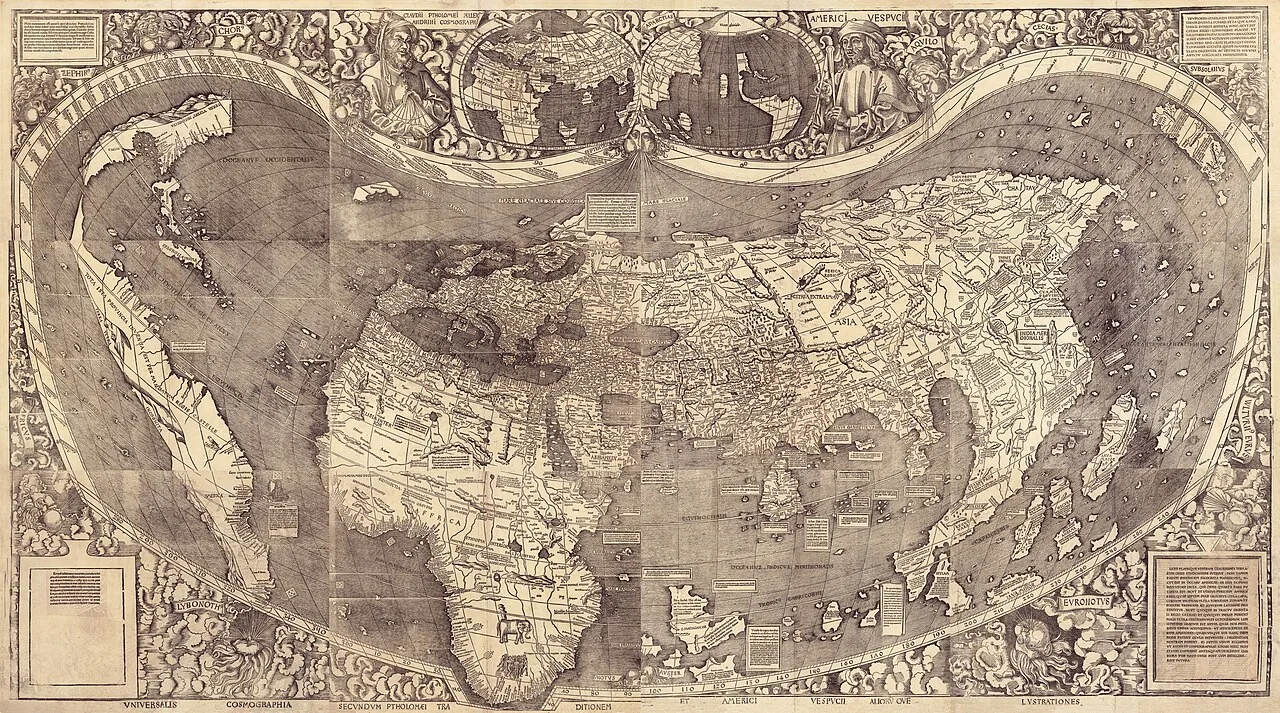
- Present the document (author, date, place).
- Describe how the mapmaker shows the Americas. What is accurate, and what is not?
- Explain what the map tells you about how European knowledge of the world changed after 1492.
Exercise 6 : Disease at Roanoke
Document.
but that within a few dayes after our departure from euerie such towne, the people began to die very fast, and many in short space; in some townes about twentie, in some fourtie, in some sixtie, & in one sixe score, which in trueth was very manie in respect of their numbers. This happened in no place that wee coulde learne but where wee had bene, where they vsed some practise against vs, and after such time; The disease also so strange, that they neither knew what it was, nor how to cure it; the like by report of the oldest men in the countrey neuer happened before, time out of minde. […] Some therefore were of opinion that wee were not borne of women,
Source: Thomas Hariot, A Briefe and True Report of the New Found Land of Virginia, 1588, on the Roanoke colony of 1585-1586 (original spelling); Documenting the American South, University of North Carolina.
*euerie: every. *Wiroans: chief.
- Present the author and his purpose.
- Summarize what Hariot says happened in Native towns after English visits.
- Explain two ways in which disease affected the balance of power between colonists and Native peoples.
Exercise 7 : A table of expeditions
Use the table (dates and sponsors are from standard reference works).
| Year | Leader | Sponsor | Region reached |
|---|---|---|---|
| 1492 | Christopher Columbus | Spain | Caribbean |
| 1497 | John Cabot | England | North Atlantic coast (Newfoundland) |
| 1513 | Juan Ponce de Leon | Spain | Florida |
| 1519-1521 | Hernan Cortes | Spain (private venture) | Mexico |
| 1524 | Giovanni da Verrazzano | France | Atlantic coast of North America |
| 1534 | Jacques Cartier | France | St. Lawrence River |
| 1585 | Ralph Lane and Sir Walter Raleigh’s colonists | England | Roanoke Island |
- Which country led the early expeditions? Which came later?
- What does this order suggest about the reasons for English and French colonization?
- Write one causal claim based on the table.
Exercise 8 : Map reading: Columbus and Cabot
Use the numbered map.
- Name places 1 to 5 (Palos, Guanahani, Bristol, Newfoundland, Lisbon).
- Which two voyages are shown, and which countries sponsored them?
- What does the dashed line represent?
Exercise 9 : Reading a map of 1507 and 1502
Look at the Portuguese map.
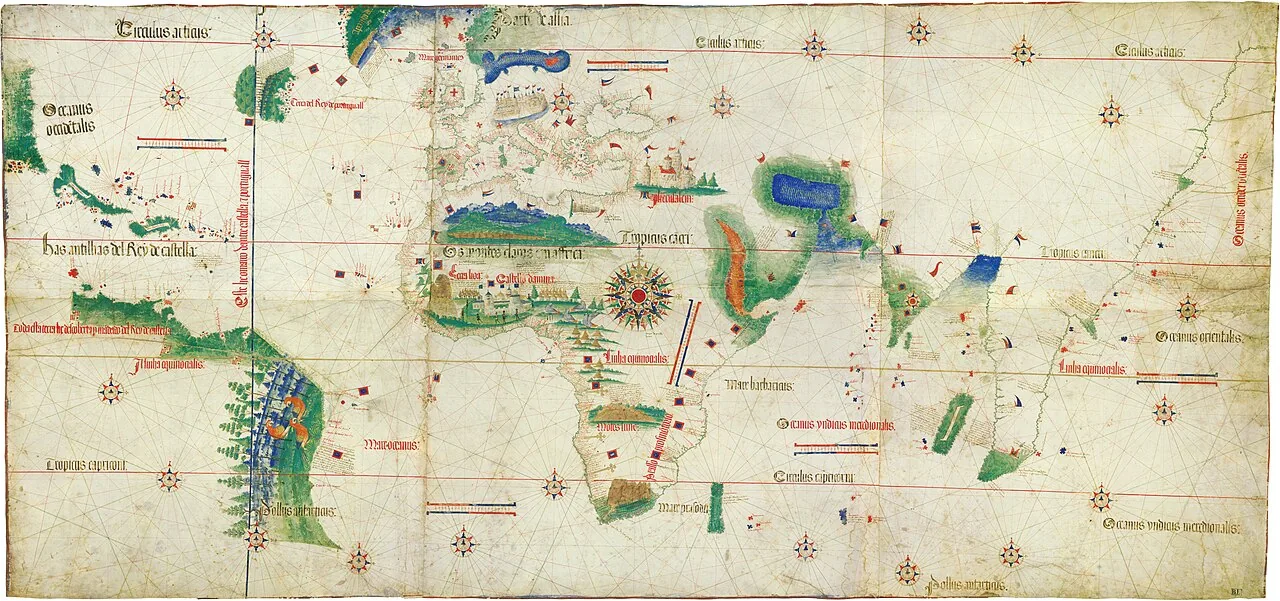
- Present the document.
- The mapmaker drew the Tordesillas line. Why would a Portuguese map show it?
- How does this map show that information about the Americas spread quickly through Europe?
Exercise 10 : Disease and religion
Read two passages by the same author.
Passage A
but that within a few dayes after our departure from euerie such towne, the people began to die very fast, and many in short space; in some townes about twentie, in some fourtie, in some sixtie, & in one sixe score, which in trueth was very manie in respect of their numbers. This happened in no place that wee coulde learne but where wee had bene, where they vsed some practise against vs, and after such time; The disease also so strange, that they neither knew what it was, nor how to cure it; the like by report of the oldest men in the countrey neuer happened before, time out of minde. […] Some therefore were of opinion that wee were not borne of women,
Source: Thomas Hariot, A Briefe and True Report of the New Found Land of Virginia, 1588, on the Roanoke colony of 1585-1586 (original spelling); Documenting the American South, University of North Carolina.
Passage B
And this is the summe of their religion, which I learned by hauing special familiarity with some of their priestes. Wherein they were not so sure grounded, nor gaue such credite to their traditions and stories but through conuersing with vs they were brought into great doubts of their owne, and no small admiratiõ of ours, with earnest desire in many, to learne more than we had meanes for want of perfect vtterance in their language to expresse.
Source: Thomas Hariot, A Briefe and True Report of the New Found Land of Virginia, 1588, on the beliefs of the Algonquian people near Roanoke (original spelling); Documenting the American South, University of North Carolina.
- What do the two passages show about how Algonquian people responded to the English?
- What attitude does Hariot show toward their beliefs?
- Explain why historians use such sources with caution.
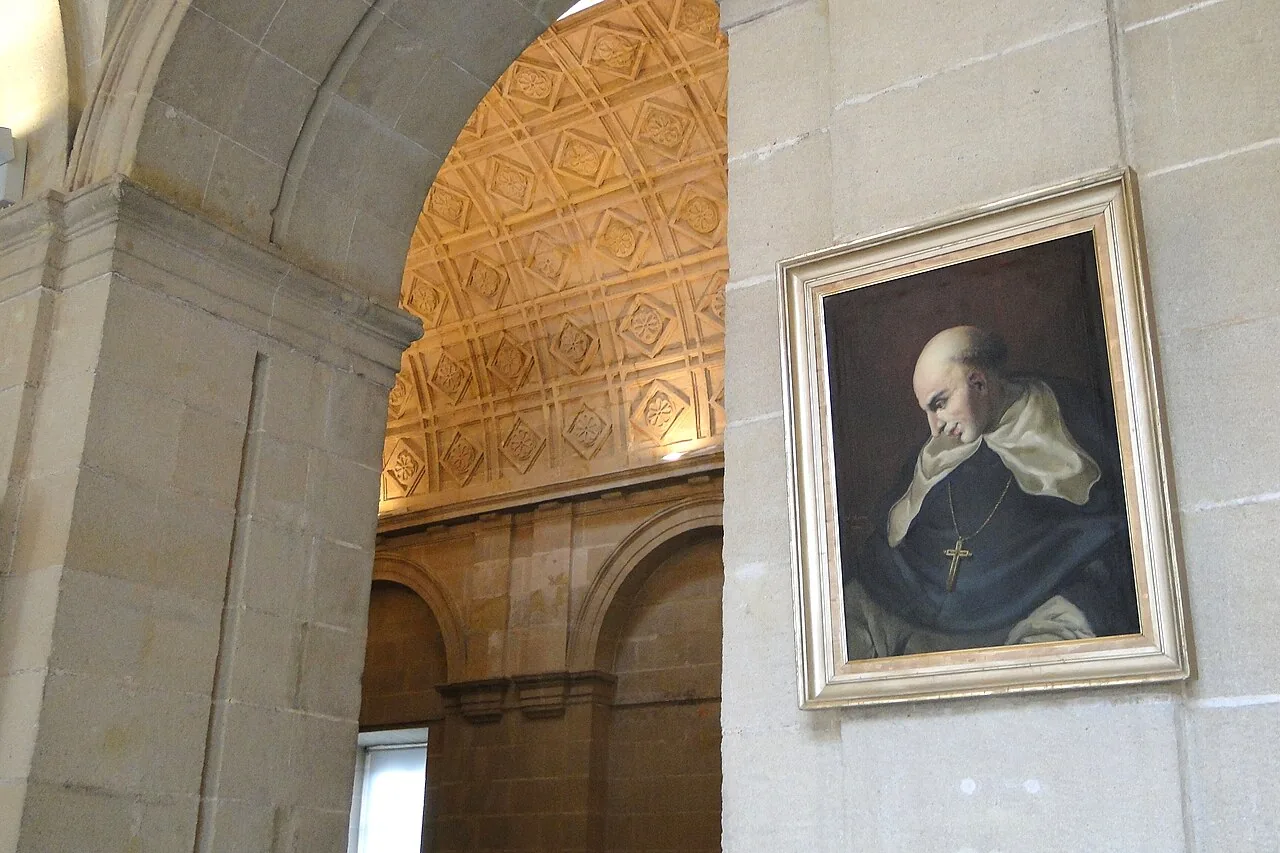
Exercise 11 : The Valladolid debate
Write a short answer (SAQ format, 3 parts):
- Identify one argument made by Las Casas about Spanish treatment of Native peoples.
- Explain one way in which the debate reflected disagreement within Spanish society.
- Explain one reason why Spanish practice in the colonies did not match the reforms discussed.
Exercise 12 : Stimulus-based multiple choice (Roanoke and disease)
Use the document to answer the questions.
but that within a few dayes after our departure from euerie such towne, the people began to die very fast, and many in short space; in some townes about twentie, in some fourtie, in some sixtie, & in one sixe score, which in trueth was very manie in respect of their numbers. This happened in no place that wee coulde learne but where wee had bene, where they vsed some practise against vs, and after such time; The disease also so strange, that they neither knew what it was, nor how to cure it; the like by report of the oldest men in the countrey neuer happened before, time out of minde. […] Some therefore were of opinion that wee were not borne of women,
Source: Thomas Hariot, A Briefe and True Report of the New Found Land of Virginia, 1588, on the Roanoke colony of 1585-1586 (original spelling); Documenting the American South, University of North Carolina.
*euerie: every. *Wiroans: chief.
- Which claim does the passage best support? (A) Native people welcomed English settlers; (B) epidemics followed English contact and changed Native views of the English; (C) the English defeated Native armies; (D) Native people refused all trade.
- The author’s point of view is most shaped by (A) a Native chief’s concerns; (B) a Spanish priest’s mission; (C) an English promoter of colonization; (D) a mapmaker’s goals.
- Which broader development does the passage illustrate? (A) the Columbian Exchange; (B) the Reconquista; (C) mercantilism; (D) the casta system.
Exercise 13 : Mapping Native societies and European claims
Use the map of eastern North America around 1607.
- Which European power held St. Augustine?
- Where did English colonists try to settle in 1585 and 1607?
- Explain one reason why the first English colonies depended on Native peoples for survival.
Exercise 14 : Chronology: ordering the encounter
Put the events in chronological order, then write the number of years between the first and the last: Jamestown founded; Columbus lands in the Bahamas; Treaty of Tordesillas; fall of Tenochtitlan; Roanoke colony founded; St. Augustine founded.
Exercise 15 : Contextualizing the Aztec capital
Look at the two images.
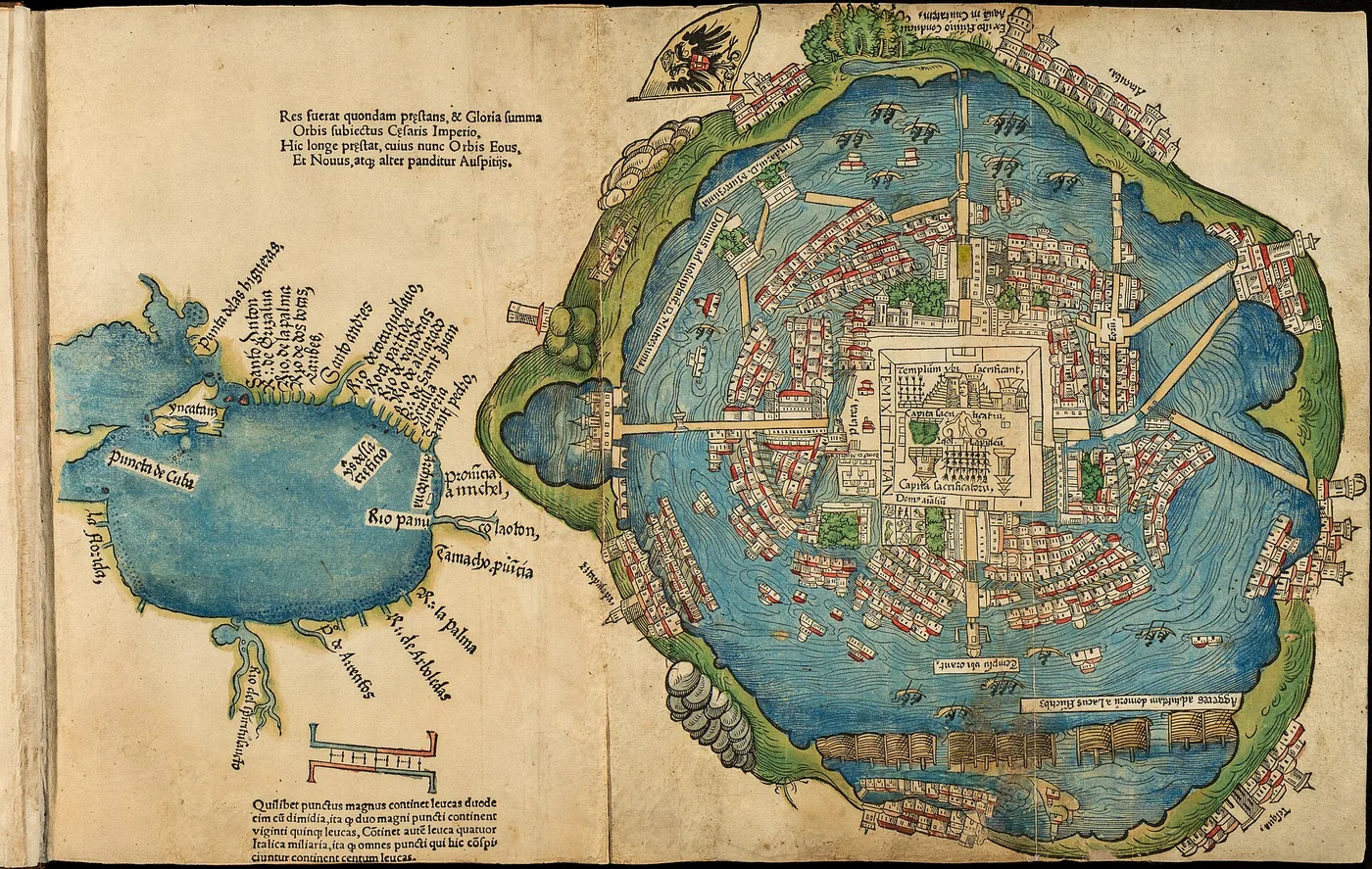
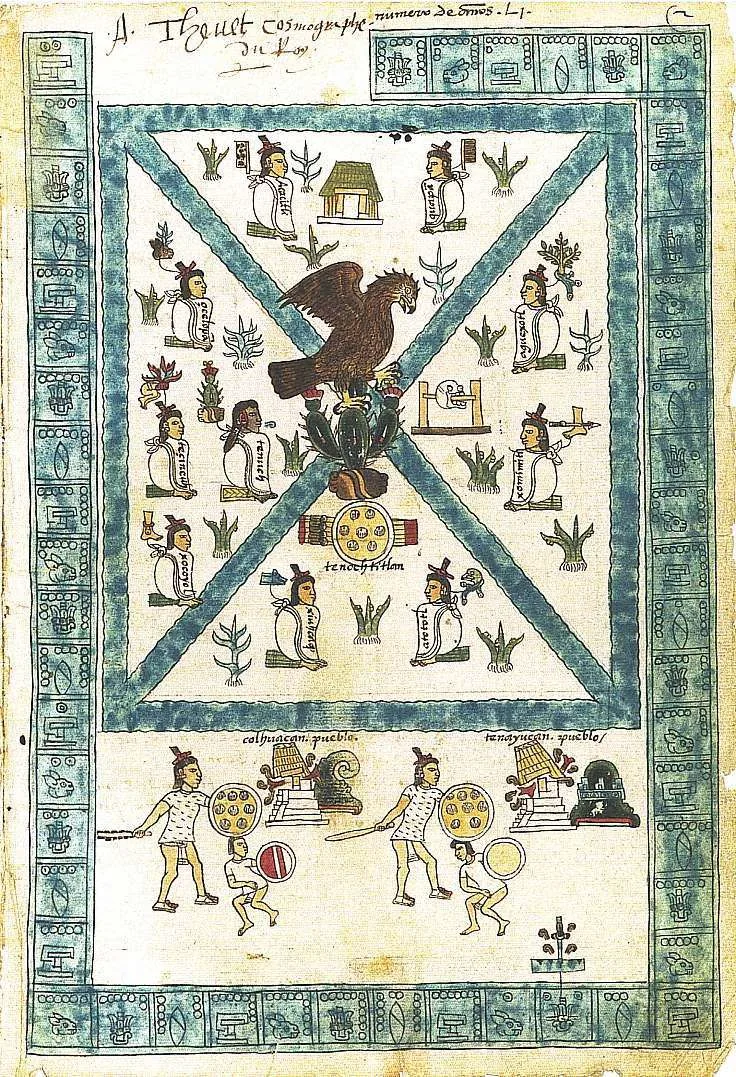
- Present each document (maker, date, purpose).
- Confront them: what does each show of the Aztec capital, and who made each picture?
- Explain which is better evidence of how Aztecs saw themselves.
Exercise 16 : Guided research: the Lost Colony
Mini-investigation. Search for: “Roanoke Lost Colony” and “John White 1590 CROATOAN.” Reliable sites: National Park Service (nps.gov), Library of Congress (loc.gov), the North Carolina Museum of History, and Documenting the American South (docsouth.unc.edu). Fill in a form: (1) years of the two colonies; (2) leader of the 1587 group; (3) the clue found in 1590; (4) two explanations historians offer; (5) the strongest evidence for one of them.
Exercise 17 : Causes of Spanish success
Write a paragraph (8 to 10 sentences) that answers: “Why were the Spanish able to conquer the Aztec Empire between 1519 and 1521?” Use at least three pieces of evidence: Native allies, disease, and the interpreter Malintzin, or technology.
Begin with a claim, give evidence, and end by weighing which factor mattered most.
Exercise 18 : True or false: Period 1 claims
Say whether each statement is true or false and correct the false ones.
- Native Americans all lived by hunting in 1491.
- The Tordesillas line gave Spain all of the Americas.
- Disease played a large role in the Spanish conquests.
- The English founded a lasting colony in 1585.
Exercise 19 : LEQ planning: comparing empires
AP LEQ prompt: “Evaluate the extent to which Spanish and English colonization of the Americas to 1607 differed in goals and methods.” Write a thesis and an outline with two body paragraphs. Include one piece of contextualization.
Exercise 20 : DBQ practice: sources on contact
DBQ prompt (Period 1): “Evaluate how Europeans justified colonization of the Americas between 1492 and 1607.” Use Documents A (Cabot’s patent) and B (the Virginia charter), and add one piece of outside evidence.
Document A
full and free authority, leaue, and power to saile to all parts, countreys, and seas of the East, of the West, and of the North, vnder our banners and ensignes, with fine ships of what burthen or quantity soeuer they be, and as many mariners or men as they will haue with them in the sayd ships, vpon their owne proper costs and charges, to seeke out, discouer, and finde whatsoever isles, countreys, regions or prouinces of the heathen and infidels whatsoeuer they be, and in what part of the world soeuer they be, which before this time haue bene vnknowen to all Christians:
Source: Letters Patent of King Henry VII to John Cabot and his sons, March 5, 1496 (text as printed by Richard Hakluyt, original spelling); the Avalon Project, Yale Law School.
Document B
in propagating of Christian Religion to such People, as yet live in Darkness and miserable Ignorance of the true Knowledge and Worship of God, and may in time bring the Infidels and Savages, living in those parts, to human Civility, and to a settled and quiet Government:
Source: The First Charter of Virginia, April 10, 1606; the Avalon Project, Yale Law School.
Write a thesis, say how each document supports it, and explain one point of view or purpose for each.


Quick review: flashcards
Tap a card to see the answer.