


This AP US History test covers APUSH Period 1: 1491-1607. Like a classroom assessment, it includes documents to analyze, knowledge questions and a short writing task. To prepare, review the lesson first, then practice with the worksheet.
Time : 55 min
Total 100 points. Part A: knowledge (questions 1 to 3, 25 points). Next comes Part B, on documents (questions 4 to 6, 30 points). Finally, Part C is the LEQ (question 7, 45 points).
Document 1 – Document 1 – Tordesillas (1494)
That, whereas a certain controversy exists between the said lords, their constituents, as to what lands, of all those discovered in the ocean sea up to the present day, the date of this treaty, pertain to each one of the said parts respectively; therefore, for the sake of peace and concord, and for the preservation of the relationship and love of the said King of Portugal for the said King and Queen of Castile, Aragon, etc., it being the pleasure of their Highnesses, they, their said representatives, acting in their name and by virtue of their powers herein described, covenanted and agreed that a boundary or straight line be determined and drawn north and south, from pole to pole, on the said ocean sea, from the Arctic to the Antarctic pole.
Source: Treaty of Tordesillas, signed by Spain and Portugal, June 7, 1494 (English translation); the Avalon Project, Yale Law School.
Treaty of Tordesillas, 1494 (Avalon Project)
Document 2 – Document 2 – Map: Atlantic claims
Map made from Natural Earth data
Document 3 – Document 3 – Tenochtitlan
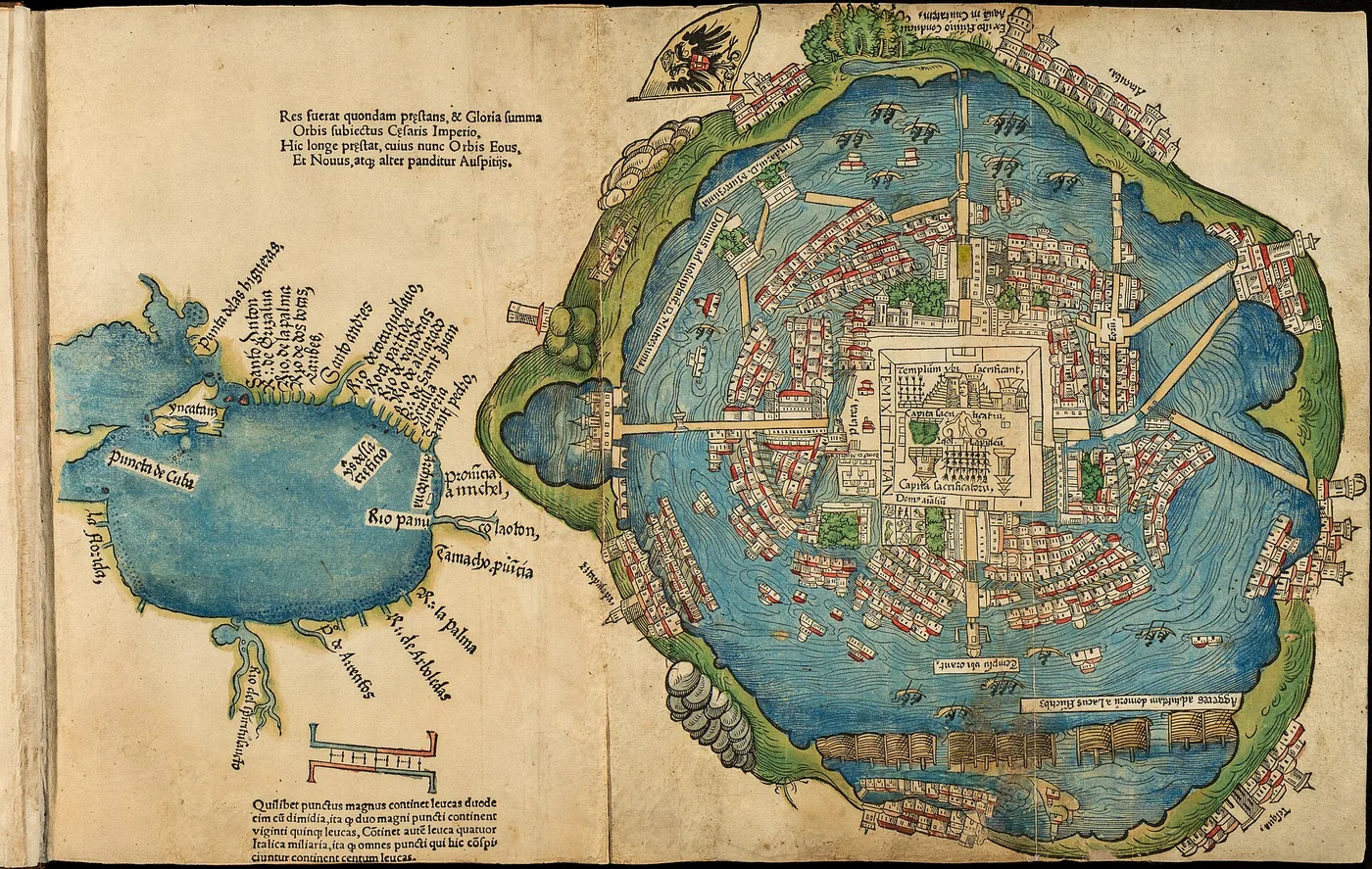
Wikimedia Commons, public domain
Document 4 – Document 4 – Roanoke and disease (1588)
but that within a few dayes after our departure from euerie such towne, the people began to die very fast, and many in short space; in some townes about twentie, in some fourtie, in some sixtie, & in one sixe score, which in trueth was very manie in respect of their numbers. This happened in no place that wee coulde learne but where wee had bene, where they vsed some practise against vs, and after such time; The disease also so strange, that they neither knew what it was, nor how to cure it; the like by report of the oldest men in the countrey neuer happened before, time out of minde. […] Some therefore were of opinion that wee were not borne of women,
Source: Thomas Hariot, A Briefe and True Report of the New Found Land of Virginia, 1588, on the Roanoke colony of 1585-1586 (original spelling); Documenting the American South, University of North Carolina.
*euerie: every.
Thomas Hariot, 1588 (docsouth.unc.edu)
Questions
- Define the Columbian Exchange and give two examples of plants or animals and one disease. (10 points) (10 pts)
- Explain two features of the Spanish colonial system (such as the encomienda, missions, or the casta system). (10 points) (10 pts)
- Identify two Native societies from different regions and explain how each adapted to its environment. (5 points) (5 pts)
- Document 1: identify the signers of the treaty and explain one reason why other powers rejected it. (10 points) (10 pts)
- Documents 2 and 3: use the map and the engraving to explain how Europeans’ knowledge of the Americas changed after 1492. (10 points) (10 pts)
- Document 4: explain one way in which the author’s point of view limits its use as evidence about Native peoples. (10 points) (10 pts)
- LEQ: Evaluate the extent to which the Columbian Exchange transformed the societies of both hemispheres between 1492 and 1607. (45 points) (45 pts)


Quick review: flashcards
Tap a card to see the answer.