



This AP US History test covers APUSH Period 2: 1607-1754. Like a classroom assessment, it includes documents to analyze, knowledge questions and a short writing task. To prepare, review the lesson first, then practice with the worksheet.
Time : 55 min
Total 100 points. Part A: knowledge (questions 1 to 3, 25 points). Next comes Part B, on documents (questions 4 to 6, 30 points). Finally, Part C is the LEQ (question 7, 45 points).
Document 1 – Document 1 – A city upon a hill (1630)
For this end, wee must be knitt together, in this worke, as one man. Wee must entertaine each other in brotherly affection. Wee must be willing to abridge ourselves of our superfluities, for the supply of other’s necessities. Wee must uphold a familiar commerce together in all meekeness, gentlenes, patience and liberality. Wee must delight in eache other; make other’s conditions our oune; rejoice together, mourne together, labour and suffer together, allwayes haueving before our eyes our commission and community in the worke, as members of the same body. […] For wee must consider that wee shall be as a citty upon a hill. The eies of all people are uppon us.
Source: John Winthrop, A Modell of Christian Charity, a lay sermon written in 1630 aboard the Arbella (spelling of the original); Hanover Historical Texts Project.
*Entertaine: treat.
John Winthrop, A Modell of Christian Charity, 1630
Document 2 – Document 2 – Atlantic trade
Map made from Natural Earth data
Document 3 – Document 3 – The slave ship Brookes (1789)
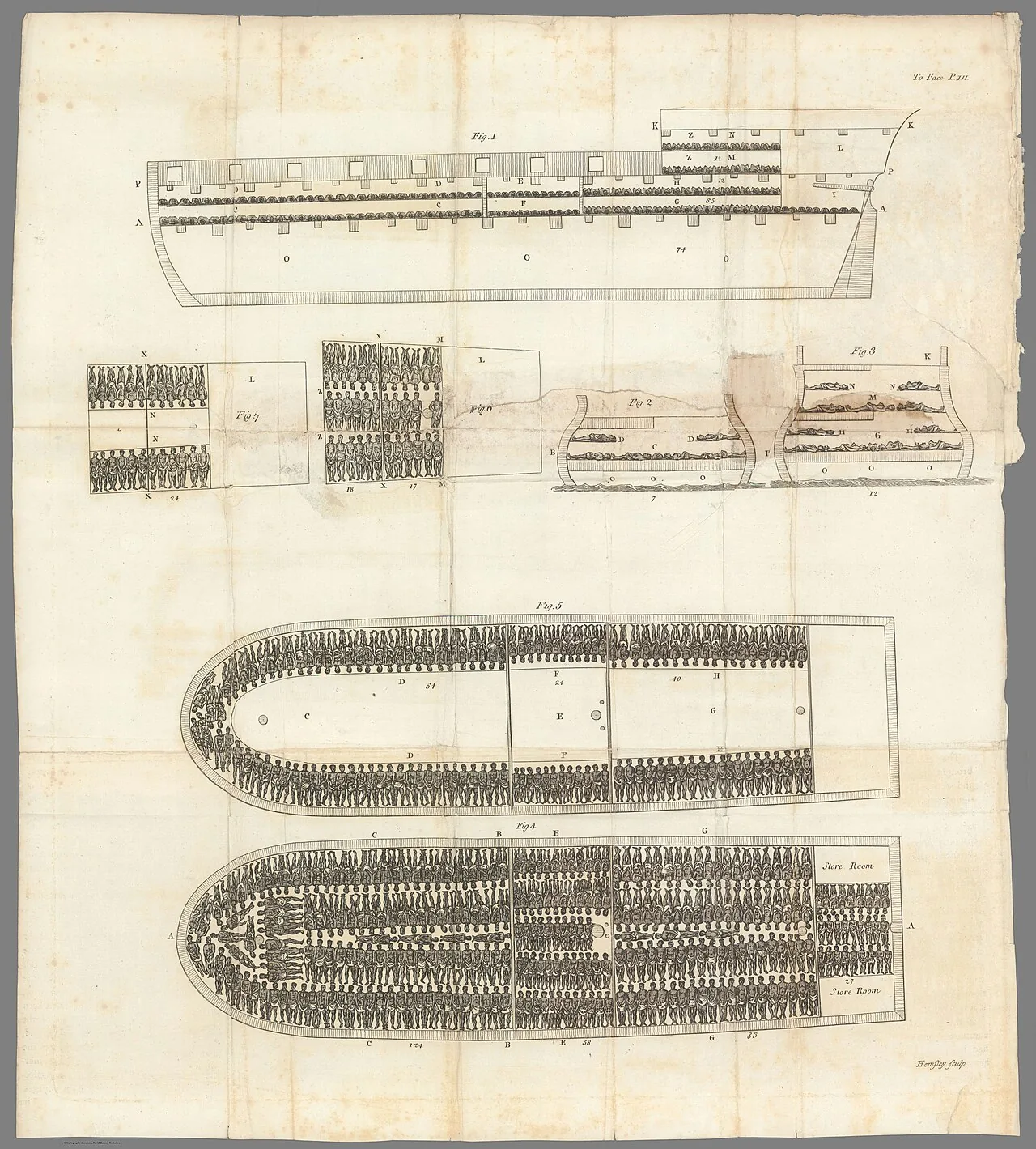
Wikimedia Commons, public domain
Document 4 – Document 4 – Population growth
| Year | Colonial population |
|---|---|
| 1700 | about 250,000 |
| 1750 | 1,170,760 |
| 1770 | 2,148,076 |
Source: U.S. Census Bureau, Historical Statistics of the United States, summarized in the article Thirteen Colonies.
U.S. Census Bureau
Questions
- Identify the main economic activity in each of the three colonial regions (New England, Middle Colonies, South). (10 points) (10 pts)
- Explain one way in which the Chesapeake colonies changed their labor system between 1607 and 1700. (10 points) (10 pts)
- Define salutary neglect and explain one effect on colonial government. (5 points) (5 pts)
- Document 1: explain the meaning of “a citty upon a hill” for the Puritans. (10 points) (10 pts)
- Documents 2 and 3: explain how the Atlantic slave trade fit into the colonial economy. (10 points) (10 pts)
- Document 4: describe the trend and give one cause. (10 points) (10 pts)
- LEQ: Compare the development of New England and the Chesapeake colonies between 1607 and 1754. (45 points) (45 pts)


Quick review: flashcards
Tap a card to see the answer.