


This worksheet on APUSH Period 2: 1607-1754 belongs to the AP US History course. Its questions use primary sources, maps and timelines, and they move from basic recall to short writing tasks. Before you start, review the lesson; afterward, try the true or false quiz.
Exercise 1 : Vocabulary of the colonies
Define each term and use it in a sentence about colonial America.
- indentured servant
- headright system
- Puritan
- salutary neglect
- Navigation Acts
- Great Awakening
Exercise 2 : The Mayflower Compact
Document.
We, whose names are underwritten, the Loyal Subjects of our dread Sovereign Lord King James, […] Having undertaken for the Glory of God, and Advancement of the Christian Faith, and the Honour of our King and Country, a Voyage to plant the first Colony in the northern Parts of Virginia; Do by these Presents, solemnly and mutually, in the Presence of God and one another, covenant and combine ourselves together into a civil Body Politick, for our better Ordering and Preservation, and Furtherance of the Ends aforesaid: And by Virtue hereof do enact, constitute, and frame, such just and equal Laws, Ordinances, Acts, Constitutions, and Officers, from time to time, as shall be thought most meet and convenient for the general Good of the Colony; unto which we promise all due Submission and Obedience.
Source: The Mayflower Compact, signed at Cape Cod, November 11, 1620 (Old Style); the Avalon Project, Yale Law School.
*Covenant and combine: join by solemn promise.
- Present the document (nature, signers, date, context).
- Relevé two phrases that show loyalty to England and one that shows self-government.
- Explain why the Compact was needed.
Exercise 3 : A city upon a hill
Document.
For this end, wee must be knitt together, in this worke, as one man. Wee must entertaine each other in brotherly affection. Wee must be willing to abridge ourselves of our superfluities, for the supply of other’s necessities. Wee must uphold a familiar commerce together in all meekeness, gentlenes, patience and liberality. Wee must delight in eache other; make other’s conditions our oune; rejoice together, mourne together, labour and suffer together, allwayes haueving before our eyes our commission and community in the worke, as members of the same body. […] For wee must consider that wee shall be as a citty upon a hill. The eies of all people are uppon us.
Source: John Winthrop, A Modell of Christian Charity, a lay sermon written in 1630 aboard the Arbella (spelling of the original); Hanover Historical Texts Project.
*Entertaine: treat. *Superfluities: extra goods.
- Present the document.
- According to Winthrop, what duties do colonists owe one another?
- What does the image of “a citty upon a hill” mean for his audience?
Exercise 4 : Two agreements on self-government
Read the two texts.
Document A – Plymouth, 1620
We, whose names are underwritten, the Loyal Subjects of our dread Sovereign Lord King James, […] Having undertaken for the Glory of God, and Advancement of the Christian Faith, and the Honour of our King and Country, a Voyage to plant the first Colony in the northern Parts of Virginia; Do by these Presents, solemnly and mutually, in the Presence of God and one another, covenant and combine ourselves together into a civil Body Politick, for our better Ordering and Preservation, and Furtherance of the Ends aforesaid: And by Virtue hereof do enact, constitute, and frame, such just and equal Laws, Ordinances, Acts, Constitutions, and Officers, from time to time, as shall be thought most meet and convenient for the general Good of the Colony; unto which we promise all due Submission and Obedience.
Source: The Mayflower Compact, signed at Cape Cod, November 11, 1620 (Old Style); the Avalon Project, Yale Law School.
Document B – Connecticut, 1639
For as much as it hath pleased Almighty God by the wise disposition of his divine providence so to order and dispose of things that we the Inhabitants and Residents of Windsor, Hartford and Wethersfield are now cohabiting and dwelling in and upon the River of Connectecotte and the lands thereunto adjoining; and well knowing where a people are gathered together the word of God requires that to maintain the peace and union of such a people there should be an orderly and decent Government established according to God,
Source: The Fundamental Orders of Connecticut, January 14, 1639 (preamble); the Avalon Project, Yale Law School.
- Identify two similarities.
- What does each rely on to justify government?
- Explain one significance for the later development of American ideas of government.
Exercise 5 : Freedom of conscience in Pennsylvania
Document.
BECAUSE no People can be truly happy, though under the greatest Enjoyment of Civil Liberties, if abridged of the Freedom of their Consciences, as to their Religious Profession and Worship: […] I do hereby grant and declare, That no Person or Persons, inhabiting in this Province or Territories, who shall confess and acknowledge One almighty God, the Creator, Upholder and Ruler of the World; and profess him or themselves obliged to live quietly under the Civil Government, shall be in any Case molested or prejudiced, in his or their Person or Estate, because of his or their conscientious Persuasion or Practice, nor be compelled to frequent or maintain any religious Worship, Place or Ministry, contrary to his or their Mind, or to do or super any other Act or Thing, contrary to their religious Persuasion.
Source: William Penn, Charter of Privileges Granted by William Penn to the Inhabitants of Pennsylvania and Territories, October 28, 1701; the Avalon Project, Yale Law School.
*Abridged: reduced.
- Present the document and its author.
- Explain what Penn promises and why he thinks it matters.
- Identify a limit to the freedom he describes.
Exercise 6 : Comparing Winthrop and Penn
Compare these two views of religion and community.
Document A
For this end, wee must be knitt together, in this worke, as one man. Wee must entertaine each other in brotherly affection. Wee must be willing to abridge ourselves of our superfluities, for the supply of other’s necessities. Wee must uphold a familiar commerce together in all meekeness, gentlenes, patience and liberality. Wee must delight in eache other; make other’s conditions our oune; rejoice together, mourne together, labour and suffer together, allwayes haueving before our eyes our commission and community in the worke, as members of the same body. […] For wee must consider that wee shall be as a citty upon a hill. The eies of all people are uppon us.
Source: John Winthrop, A Modell of Christian Charity, a lay sermon written in 1630 aboard the Arbella (spelling of the original); Hanover Historical Texts Project.
Document B
BECAUSE no People can be truly happy, though under the greatest Enjoyment of Civil Liberties, if abridged of the Freedom of their Consciences, as to their Religious Profession and Worship: […] I do hereby grant and declare, That no Person or Persons, inhabiting in this Province or Territories, who shall confess and acknowledge One almighty God, the Creator, Upholder and Ruler of the World; and profess him or themselves obliged to live quietly under the Civil Government, shall be in any Case molested or prejudiced, in his or their Person or Estate, because of his or their conscientious Persuasion or Practice, nor be compelled to frequent or maintain any religious Worship, Place or Ministry, contrary to his or their Mind, or to do or super any other Act or Thing, contrary to their religious Persuasion.
Source: William Penn, Charter of Privileges Granted by William Penn to the Inhabitants of Pennsylvania and Territories, October 28, 1701; the Avalon Project, Yale Law School.
- Identify the main idea of each.
- Explain one similarity and one difference.
- Why do these differences help explain the regional character of New England and the Middle Colonies?
Exercise 7 : Voice of a survivor
Document.
The first object which saluted my eyes when I arrived on the coast was the sea, and a slave ship, which was then riding at anchor, and waiting for its cargo. These filled me with astonishment, which was soon converted into terror when I was carried on board. I was immediately handled and tossed up to see if I were sound by some of the crew; […] I was now persuaded that I had gotten into a world of bad spirits, and that they were going to kill me.
Source: Olaudah Equiano, The Interesting Narrative of the Life of Olaudah Equiano, 1789, chapter 2 (arrival on the coast); Project Gutenberg.
- Present the author and the context in which he wrote.
- Describe what the author felt and saw.
- Explain one limit of this source for a historian of the Atlantic slave trade.
Exercise 8 : The Middle Passage: text and image
Study the two documents.
Document A
The closeness of the place, and the heat of the climate, added to the number in the ship, which was so crowded that each had scarcely room to turn himself, almost suffocated us. This produced copious perspirations, so that the air soon became unfit for respiration, from a variety of loathsome smells, and brought on a sickness among the slaves, of which many died, thus falling victims to the improvident avarice, as I may call it, of their purchasers. This wretched situation was again aggravated by the galling of the chains, now become insupportable; and the filth of the necessary tubs, into which the children often fell, and were almost suffocated. The shrieks of the women, and the groans of the dying, rendered the whole a scene of horror almost inconceivable.
Source: Olaudah Equiano, The Interesting Narrative of the Life of Olaudah Equiano, 1789, chapter 2 (the Middle Passage); Project Gutenberg.
Document B
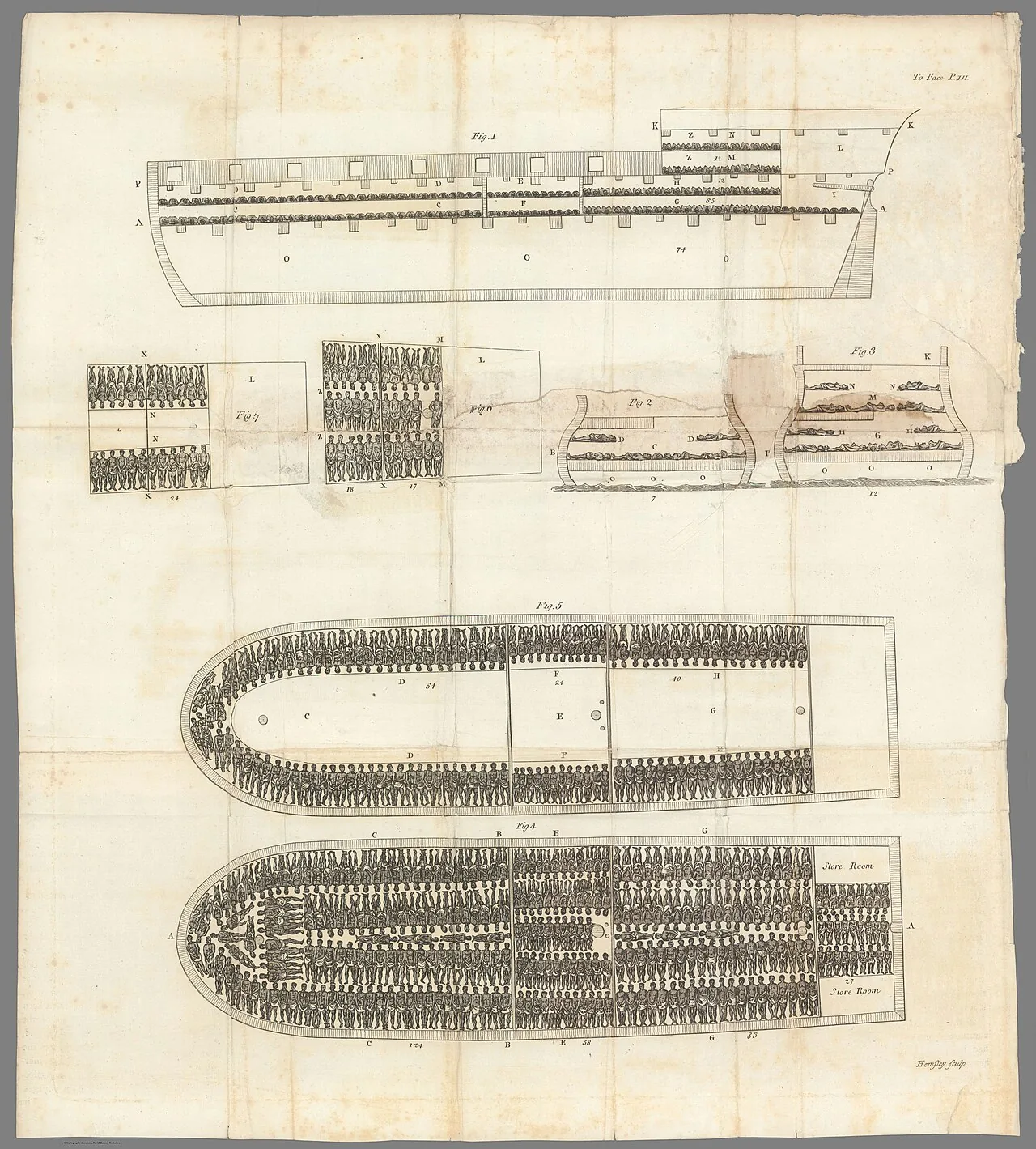
- Present each document.
- Explain how each source shows the conditions on slave ships.
- Which is more reliable as evidence, and why?
Exercise 9 : Rising in Philadelphia
Document.
Then I asked for a three-penny loaf, and was told they had none such. So not considering or knowing the difference of money, and the greater cheapness nor the names of his bread, I made him give me three-penny worth of any sort. He gave me, accordingly, three great puffy rolls. […] I was surpriz’d at the quantity, but took it, and, having no room in my pockets, walk’d off with a roll under each arm, and eating the other. Thus I went up Market-street as far as Fourth-street, passing by the door of Mr. Read, my future wife’s father; when she, standing at the door, saw me, and thought I made, as I certainly did, a most awkward, ridiculous appearance.
Source: Benjamin Franklin, Autobiography, written 1771-1790, on his arrival in Philadelphia in October 1723; Project Gutenberg.
- Present the author and his purpose.
- What does the passage suggest about opportunity in colonial Philadelphia?
- What kind of colonist could not share in this opportunity?
Exercise 10 : Treaty with the Lenape (image)
Study the painting.
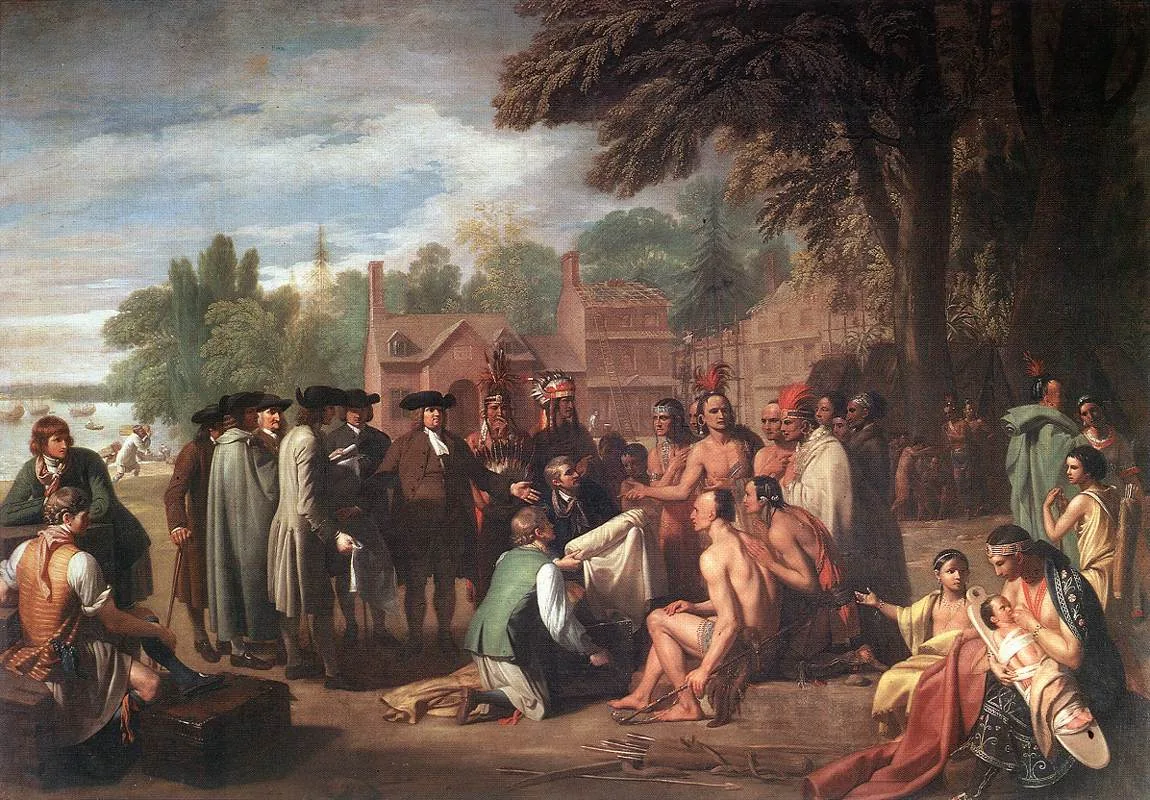
- Present the document (artist, date, subject).
- Describe how the artist shows Penn and the Lenape leaders.
- Explain why a painting made ninety years later must be used with caution.
Exercise 11 : Witchcraft panic (image)
Study the engraving.
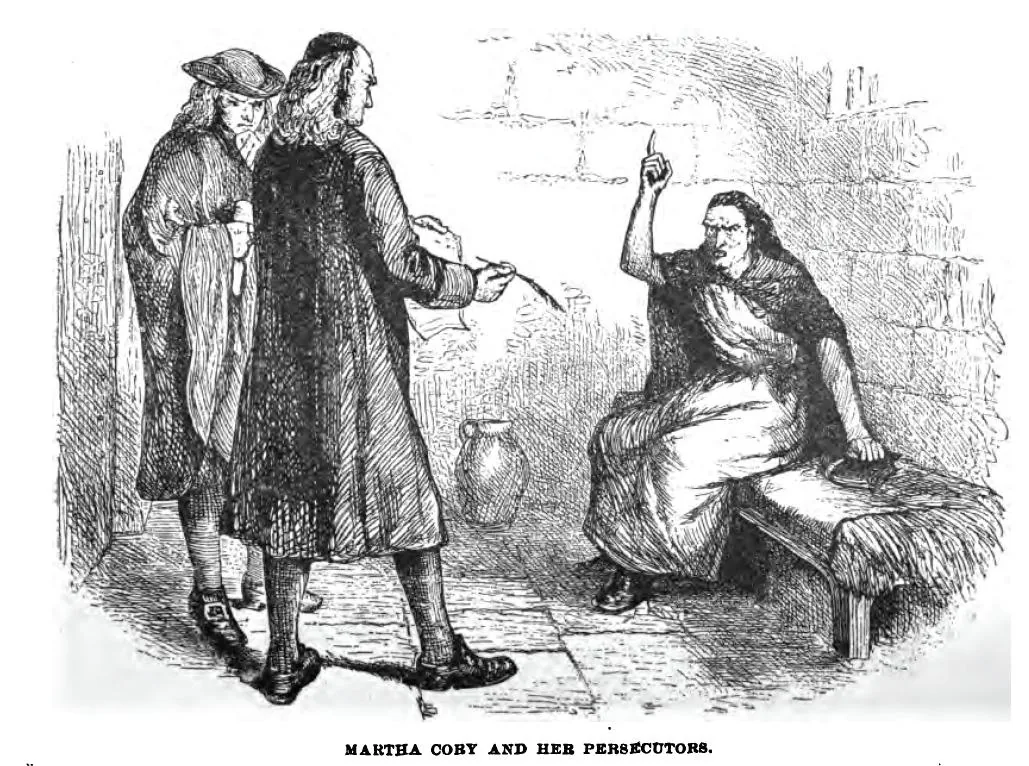
- Present the document.
- Describe the scene.
- Explain two causes historians offer for the Salem trials of 1692.
Exercise 12 : Africans in the colonies (image)
Study the frontispiece.
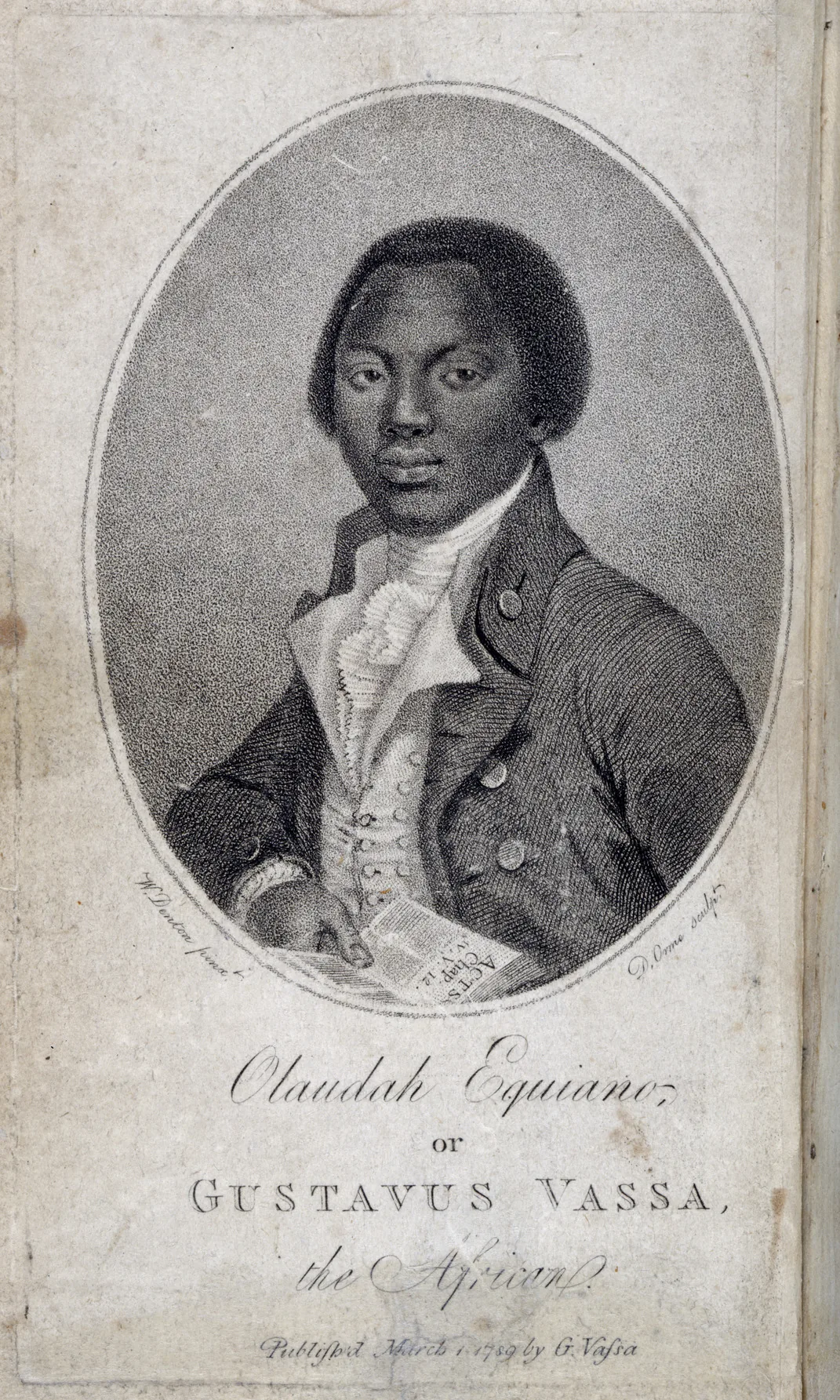
- Present the document.
- How does the portrait present the author?
- Explain why a publisher in 1789 would want this image.
Exercise 13 : Population growth
Use the table (estimates from the Census Bureau’s historical statistics; 1700 is a rounded estimate).
| Year | Colonial population (approximate) |
|---|---|
| 1700 | about 250,000 |
| 1750 | 1,170,760 |
| 1770 | 2,148,076 |
Source: U.S. Census Bureau, Historical Statistics of the United States, as summarized in the article “Thirteen Colonies,” Wikipedia, consulted November 2026.
- By what factor did the population grow between 1700 and 1750?
- Give two causes of the growth.
- What effect might it have on relations with Native peoples and France?
Exercise 14 : Map reading: the thirteen colonies
Use the numbered map.
- Name the cities numbered 1 to 5 (Jamestown, Boston, Philadelphia, Charleston, New York).
- Place each in a region.
- Choose one city and explain what kind of economy it served.
Exercise 15 : Map reading: the Atlantic economy
Use Map 2.
- Trace the route of enslaved Africans.
- Which products moved from the colonies to Britain?
- Explain how the Navigation Acts shaped these routes.
Exercise 16 : Chronology: from Jamestown to Albany
Place in order: Salem trials; Mayflower Compact; Bacon’s Rebellion; Jamestown founded; Great Awakening begins; founding of Pennsylvania; Stono Rebellion. How many years separate the first and last?
Exercise 17 : SAQ: comparing regions
Answer in complete sentences. (a) Identify one way in which colonial New England and the Chesapeake were similar. (b) Explain one difference in their economies or social structures. (c) Explain one reason for that difference.
Exercise 18 : Stimulus-based multiple choice (Connecticut)
Use the document.
For as much as it hath pleased Almighty God by the wise disposition of his divine providence so to order and dispose of things that we the Inhabitants and Residents of Windsor, Hartford and Wethersfield are now cohabiting and dwelling in and upon the River of Connectecotte and the lands thereunto adjoining; and well knowing where a people are gathered together the word of God requires that to maintain the peace and union of such a people there should be an orderly and decent Government established according to God,
Source: The Fundamental Orders of Connecticut, January 14, 1639 (preamble); the Avalon Project, Yale Law School.
- The document best illustrates (A) royal control of the colonies; (B) self-government by compact; (C) slavery; (D) mercantilism.
- Which belief is reflected? (A) government should follow religious principles; (B) the separation of church and state; (C) the divine right of kings; (D) equality of all men.
- A similar development was (A) the Navigation Acts; (B) the Mayflower Compact; (C) Bacon’s Rebellion; (D) the Pueblo Revolt.
Exercise 19 : Guided research: Bacon’s Rebellion
Mini-investigation. Search for: “Bacon’s Rebellion 1676” and “Virginia slave code 1705.” Reliable sites: Encyclopedia Virginia (encyclopediavirginia.org), Library of Congress, National Archives. Fill in: (1) the leader and the governor; (2) the cause (Native policy and taxes); (3) the result; (4) one long-term effect on labor in Virginia.
Exercise 20 : LEQ planning: causation of slavery’s growth
AP LEQ prompt: “Evaluate the extent to which economic factors explain the growth of slavery in the English colonies between 1607 and 1754.” Write a thesis and outline two paragraphs.
Exercise 21 : DBQ practice: religious tolerance
DBQ prompt: “Evaluate the extent to which religion shaped the development of the New England and Middle colonies.” Use Documents A and B and add one piece of outside evidence.
Document A
For this end, wee must be knitt together, in this worke, as one man. Wee must entertaine each other in brotherly affection. Wee must be willing to abridge ourselves of our superfluities, for the supply of other’s necessities. Wee must uphold a familiar commerce together in all meekeness, gentlenes, patience and liberality. Wee must delight in eache other; make other’s conditions our oune; rejoice together, mourne together, labour and suffer together, allwayes haueving before our eyes our commission and community in the worke, as members of the same body. […] For wee must consider that wee shall be as a citty upon a hill. The eies of all people are uppon us.
Source: John Winthrop, A Modell of Christian Charity, a lay sermon written in 1630 aboard the Arbella (spelling of the original); Hanover Historical Texts Project.
Document B
BECAUSE no People can be truly happy, though under the greatest Enjoyment of Civil Liberties, if abridged of the Freedom of their Consciences, as to their Religious Profession and Worship: […] I do hereby grant and declare, That no Person or Persons, inhabiting in this Province or Territories, who shall confess and acknowledge One almighty God, the Creator, Upholder and Ruler of the World; and profess him or themselves obliged to live quietly under the Civil Government, shall be in any Case molested or prejudiced, in his or their Person or Estate, because of his or their conscientious Persuasion or Practice, nor be compelled to frequent or maintain any religious Worship, Place or Ministry, contrary to his or their Mind, or to do or super any other Act or Thing, contrary to their religious Persuasion.
Source: William Penn, Charter of Privileges Granted by William Penn to the Inhabitants of Pennsylvania and Territories, October 28, 1701; the Avalon Project, Yale Law School.


Quick review: flashcards
Tap a card to see the answer.