


This worksheet on APUSH Period 3: 1754-1800 belongs to the AP US History course. Its questions use primary sources, maps and timelines, and they move from basic recall to short writing tasks. Before you start, review the lesson; afterward, try the true or false quiz.
Exercise 1 : Vocabulary of the Revolution
Define each term and use it in a sentence about 1754-1800.
- virtual representation
- Proclamation of 1763
- Loyalist
- federalism
- Anti-Federalist
- excise tax
Exercise 2 : The line in the mountains
Document.
And whereas it is just and reasonable, and essential to our Interest, and the Security of our Colonies, that the several Nations or Tribes of Indians with whom We are connected, and who live under our Protection, should not be molested or disturbed in the Possession of such Parts of Our Dominions and Territories as, not having been ceded to or purchased by Us, are reserved to them. or any of them, as their Hunting Grounds.
Source: The Royal Proclamation of October 7, 1763, issued by King George III; the Avalon Project, Yale Law School.
- Present the document.
- Explain the policy it announces.
- Give one reason for it and one reason colonists objected.
Exercise 3 : Representation and taxation
Read the two documents.
Document A – Stamp Act Congress, 1765
That it is inseparably essential to the freedom of a people, and the undoubted right of Englishmen, that no taxes be imposed on them, but with their own consent, given personally, or by their representatives. That the people of these colonies are not, and from their local circumstances cannot be, represented in the House of Commons in Great-Britain. That the only representatives of the people of these colonies, are persons chosen therein by themselves, and that no taxes ever have been, or can be constitutionally imposed on them, but by their respective legislatures.
Source: Resolutions of the Stamp Act Congress, New York, October 19, 1765; the Avalon Project, Yale Law School.
Document B – Declaratory Act, 1766
That the said colonies and plantations in America have been, are, and of right ought to be, subordinate unto, and dependent upon the imperial crown and parliament of Great Britain; […] to bind the colonies and people of America, subjects of the crown of Great Britain, in all cases whatsoever
Source: The Declaratory Act, Parliament, March 18, 1766; the Avalon Project, Yale Law School.
- State the main claim of each.
- Explain why the two claims could not be reconciled.
- What did each side fear?
Exercise 4 : The speech at St. John’s Church
Document.
Our chains are forged! Their clanking may be heard on the plains of Boston! The war is inevitable–and let it come! I repeat it, sir, let it come. It is in vain, sir, to extenuate the matter. Gentlemen may cry, Peace, Peace– but there is no peace. The war is actually begun! The next gale that sweeps from the north will bring to our ears the clash of resounding arms! Our brethren are already in the field! Why stand we here idle? What is it that gentlemen wish? What would they have? Is life so dear, or peace so sweet, as to be purchased at the price of chains and slavery? Forbid it, Almighty God! I know not what course others may take; but as for me, give me liberty or give me death!
Source: Patrick Henry, speech to the Second Virginia Convention, March 23, 1775, as reconstructed by William Wirt in 1817; the Avalon Project, Yale Law School.
*Brethren: fellow members.
- Present the document and note that it was reconstructed decades later.
- Identify the speaker’s argument.
- Evaluate the speech as evidence of colonial opinion in 1775.
Exercise 5 : Stimulus-based multiple choice (Common Sense)
Use the document.
Society in every state is a blessing, but government even in its best state is but a necessary evil; in its worst state an intolerable one; for when we suffer, or are exposed to the same miseries by a government, which we might expect in a country without government, our calamity is heightened by reflecting that we furnish the means by which we suffer. Government, like dress, is the badge of lost innocence; the palaces of kings are built on the ruins of the bowers of paradise.
Source: Thomas Paine, Common Sense, January 1776; Project Gutenberg.
*Provoked: made angry.
- The passage best reflects which idea? (A) the divine right of kings; (B) government as a necessary evil; (C) support for a strong monarchy; (D) hostility to representative government.
- The pamphlet most directly influenced which development? (A) the Stamp Act; (B) the decision for independence; (C) the Constitution; (D) the Alien Act.
- Paine’s intended audience was (A) the king; (B) ordinary colonists; (C) Parliament only; (D) Native leaders.
Exercise 6 : The Declaration
Document.
We hold these truths to be self-evident: That all men are created equal; that they are endowed by their Creator with certain unalienable rights; that among these are life, liberty, and the pursuit of happiness; that, to secure these rights, governments are instituted among men, deriving their just powers from the consent of the governed; that whenever any form of government becomes destructive of these ends, it is the right of the people to alter or to abolish it, and to institute new government, laying its foundation on such principles, and organizing its powers in such form, as to them shall seem most likely to effect their safety and happiness.
Source: The Declaration of Independence, July 4, 1776; the Avalon Project, Yale Law School.
- Present the document.
- Identify the three ideas on which Jefferson bases independence.
- Explain a contradiction between the words and the society that produced them.
Exercise 7 : Remember the ladies
Compare the two documents.
Document A – Declaration (1776)
We hold these truths to be self-evident: That all men are created equal; that they are endowed by their Creator with certain unalienable rights; that among these are life, liberty, and the pursuit of happiness; that, to secure these rights, governments are instituted among men, deriving their just powers from the consent of the governed; that whenever any form of government becomes destructive of these ends, it is the right of the people to alter or to abolish it, and to institute new government, laying its foundation on such principles, and organizing its powers in such form, as to them shall seem most likely to effect their safety and happiness.
Source: The Declaration of Independence, July 4, 1776; the Avalon Project, Yale Law School.
Document B – Abigail Adams (1776)
I long to hear that you have declared an independency — and by the way in the new Code of Laws which I suppose it will be necessary for you to make I desire you would Remember the Ladies, and be more generous and favourable to them than your ancestors. Do not put such unlimited power into the hands of the Husbands. Remember all Men would be tyrants if they could. If perticuliar care and attention is not paid to the Laidies we are determined to foment a Rebelion, and will not hold ourselves bound by any Laws in which we have no voice, or Representation.
Source: Abigail Adams to John Adams, Braintree, Massachusetts, March 31, 1776; Massachusetts Historical Society, Adams Family Papers. Spelling of the original.
- What does Abigail Adams ask of her husband?
- How does she use the language of the Declaration?
- Explain why her request had limited effect.
Exercise 8 : A propaganda print
Study the engraving.
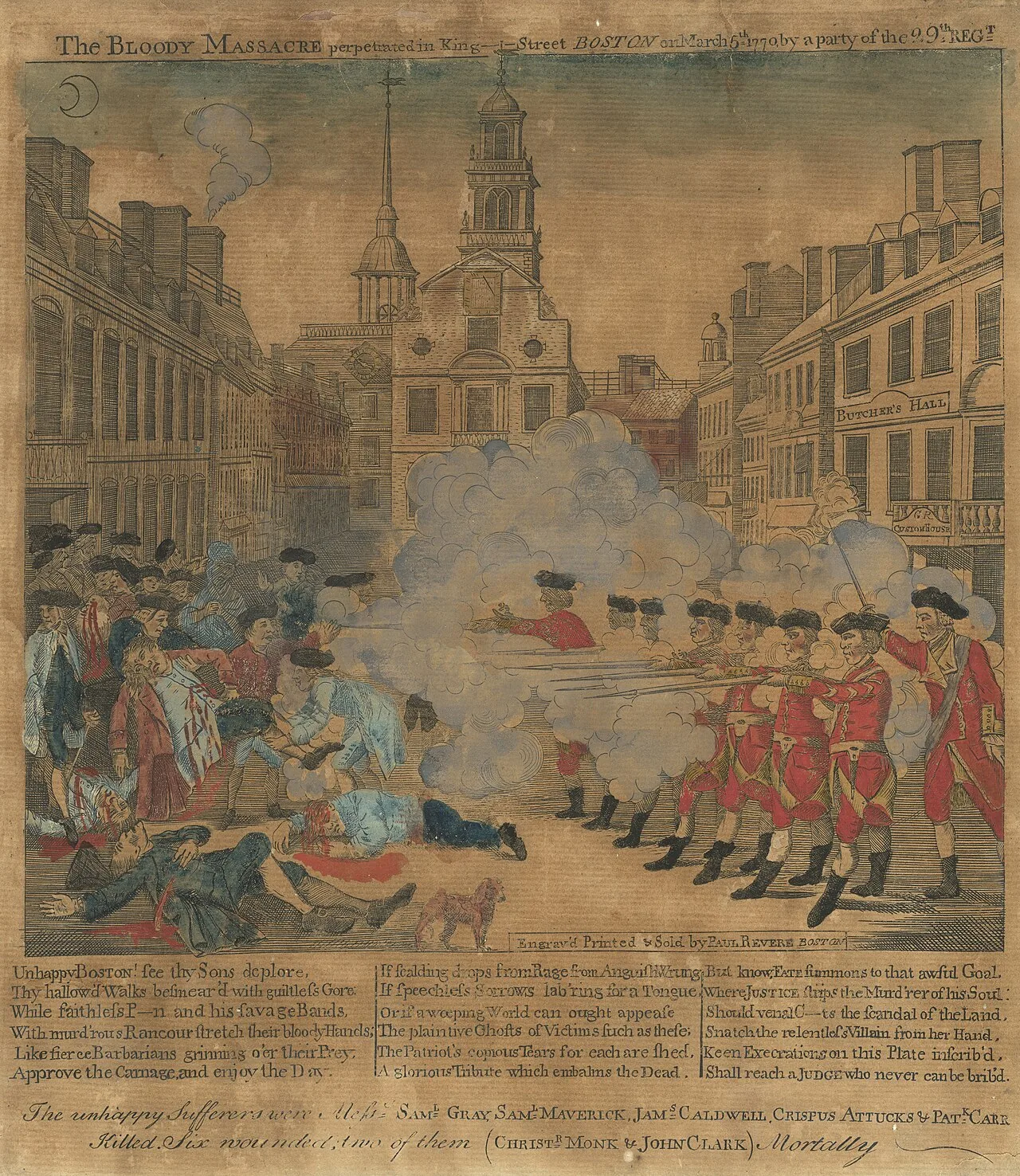
- Present the document.
- Describe how the artist shows the soldiers and the crowd.
- Explain how it served the patriot cause.
Exercise 9 : The Tea Party and memory
Study the print.
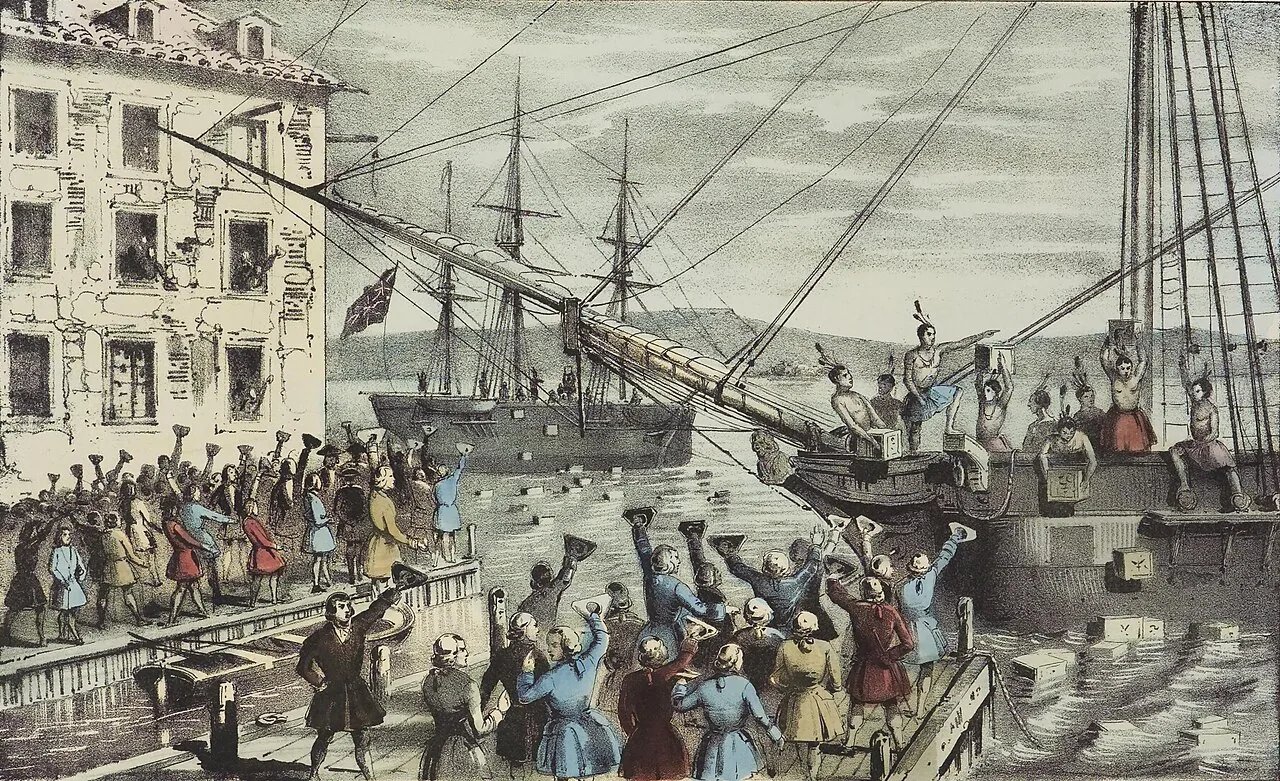
- Present the document.
- Describe what it shows.
- Explain why the date (1846) matters when using it as evidence.
Exercise 10 : Painting the founding
Compare two paintings of founding moments.
Document A
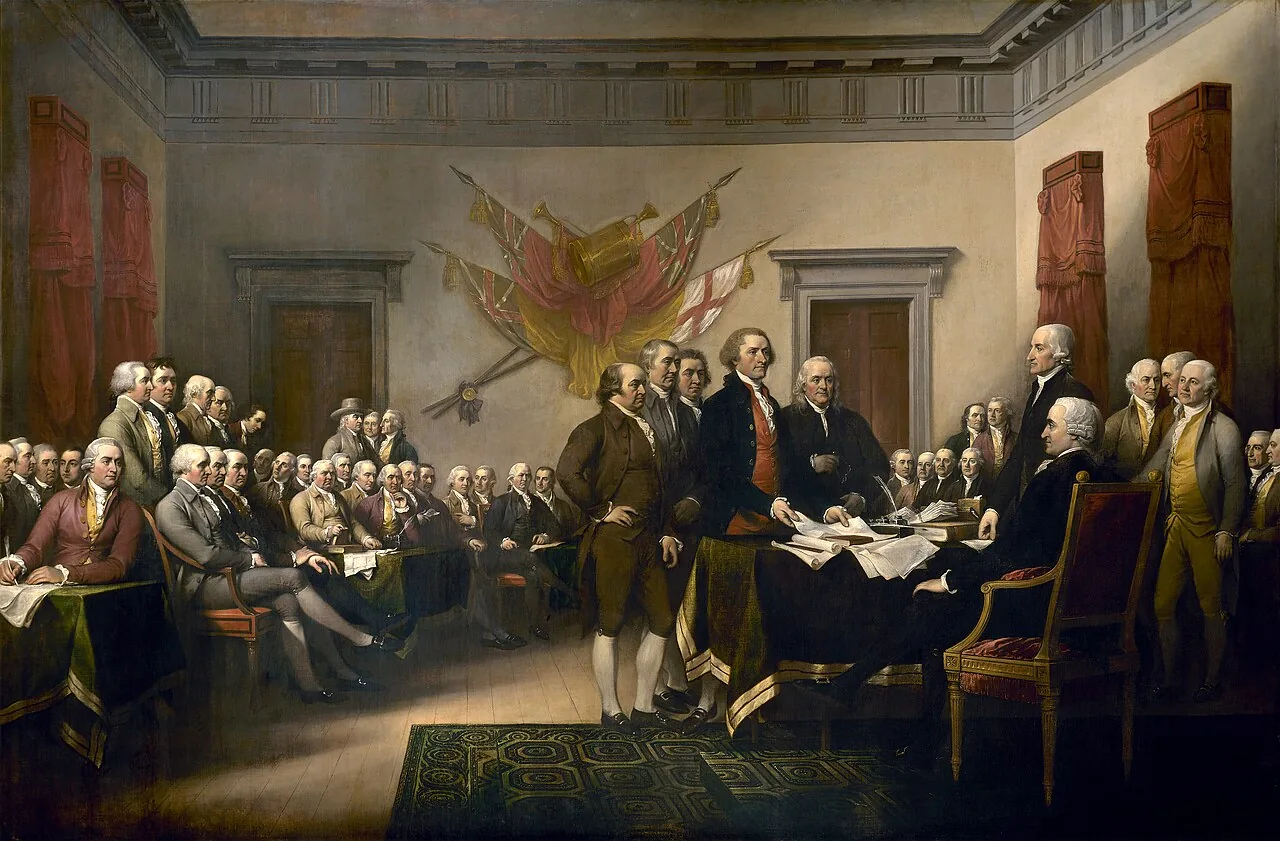
Document B
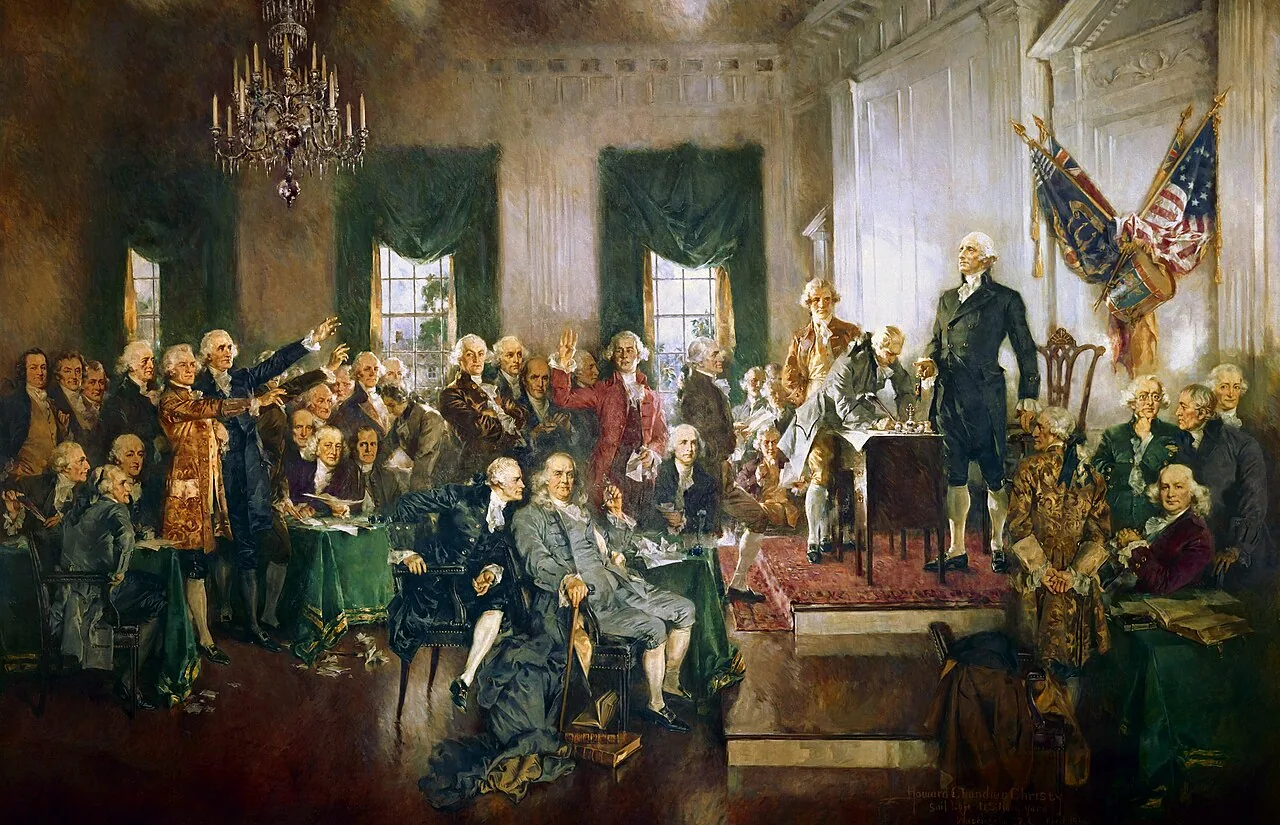
- Present each painting.
- Identify two similarities in how the artists show the Founders.
- Explain what the paintings tell you about when and why they were made.
Exercise 11 : Join, or Die
Study the cartoon.
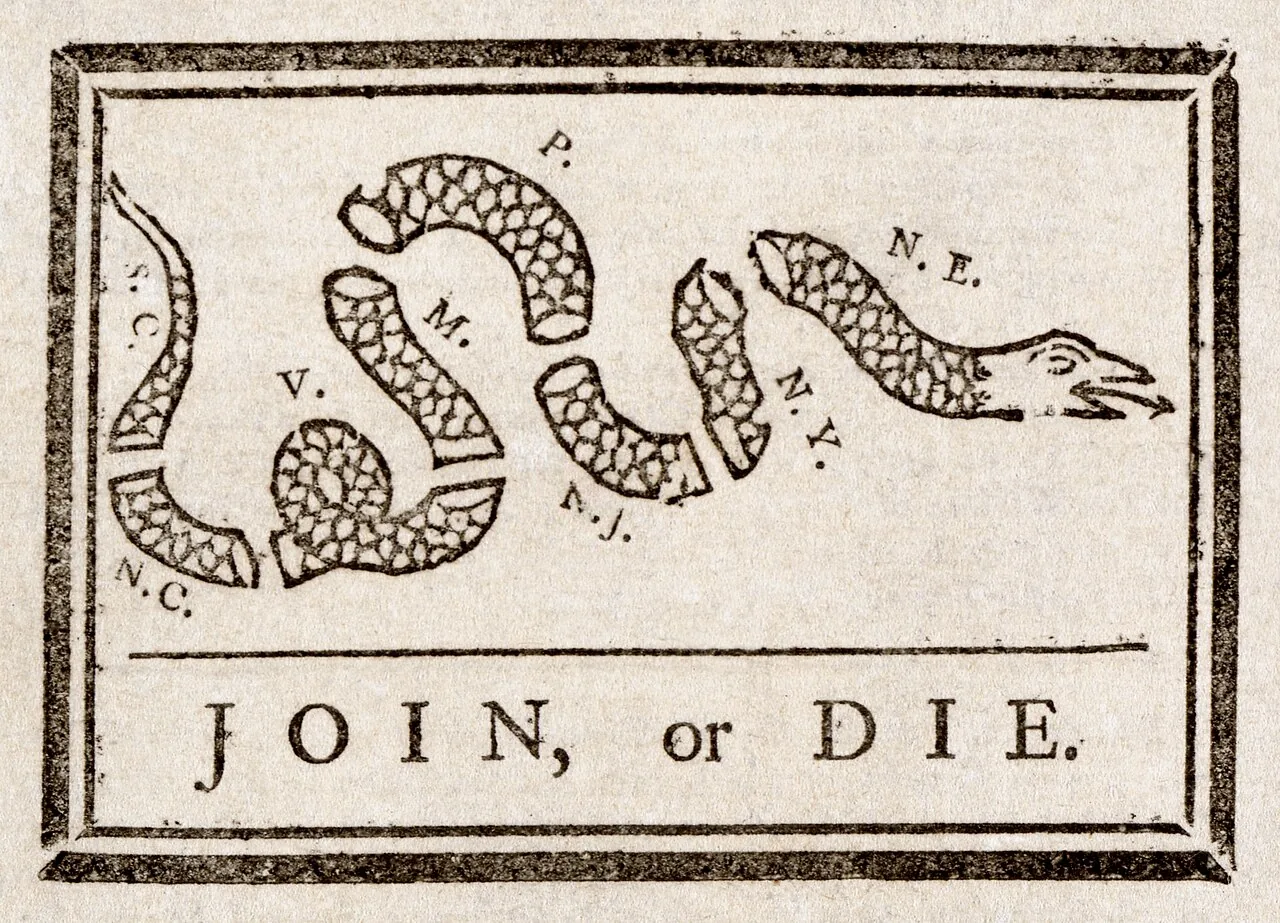
- Present the document.
- Explain the message of the snake.
- Why would this image be reused in 1765 and 1774?
Exercise 12 : A weak confederation
Document.
Each state retains its sovereignty, freedom, and independence, and every power, jurisdiction, and right, which is not by this Confederation expressly delegated to the United States, in Congress assembled. […] The said States hereby severally enter into a firm league of friendship with each other, for their common defense, the security of their liberties, and their mutual and general welfare, binding themselves to assist each other, against all force offered to, or attacks made upon them, or any of them, on account of religion, sovereignty, trade, or any other pretense whatever.
Source: Articles of Confederation, Article II, adopted 1777, ratified 1781; the Avalon Project, Yale Law School.
- Present the document.
- Identify the principle of the Articles in this clause.
- Explain how it led to weakness.
Exercise 13 : Large republic or small?
Compare the two arguments.
Document A – Madison
A republic, by which I mean a government in which the scheme of representation takes place, opens a different prospect, and promises the cure for which we are seeking. Let us examine the points in which it varies from pure democracy, and we shall comprehend both the nature of the cure and the efficacy which it must derive from the Union. […] The two great points of difference between a democracy and a republic are: first, the delegation of the government, in the latter, to a small number of citizens elected by the rest; secondly, the greater number of citizens, and greater sphere of country, over which the latter may be extended.
Source: James Madison, The Federalist No. 10, November 22, 1787; the Avalon Project, Yale Law School.
Document B – Brutus
In a republic, the manners, sentiments, and interests of the people should be similar. If this be not the case, there will be a constant clashing of opinions; and the representatives of one part will be continually striving against those of the other. This will retard the operations of government, and prevent such conclusions as will promote the public good. If we apply this remark to the condition of the United States, we shall be convinced that it forbids that we should be one government. The United States includes a variety of climates. The productions of the different parts of the union are very variant, and their interests, of consequence, diverse.
Source: “Brutus” (probably Robert Yates), Anti-Federalist Papers, No. 1, October 18, 1787; text from constitution.org.
- State each author’s view of the size of a republic.
- Identify the fear behind each.
- Which side was supported by the later adoption of the Bill of Rights?
Exercise 14 : Rights in writing
Document.
Congress shall make no law respecting an establishment of religion, or prohibiting the free exercise thereof; or abridging the freedom of speech, or of the press; or the right of the people peaceably to assemble, and to petition the Government for a redress of grievances.
Source: The Bill of Rights, First Amendment, ratified December 15, 1791; the National Archives.
- Present the document.
- List the freedoms it protects.
- Explain why Anti-Federalists demanded a bill of rights.
Exercise 15 : The Northwest Ordinance
Document.
Religion, morality, and knowledge, being necessary to good government and the happiness of mankind, schools and the means of education shall forever be encouraged. […] The utmost good faith shall always be observed towards the Indians; their lands and property shall never be taken from them without their consent; and, in their property, rights, and liberty, they shall never be invaded or disturbed, unless in just and lawful wars authorized by Congress; but laws founded in justice and humanity, shall from time to time be made for preventing wrongs being done to them, and for preserving peace and friendship with them.
Source: The Northwest Ordinance, July 13, 1787; the Avalon Project, Yale Law School.
- Present the document.
- What values does the text express?
- Compare its promise about Native peoples with what happened later.
Exercise 16 : Free speech and the Sedition Act
Read both texts.
Document A – Sedition Act (1798)
That if any person shall write, print, utter or publish, or shall cause or procure to be written, printed, uttered or published, or shall knowingly and willingly assist or aid in writing, printing, uttering or publishing any false, scandalous and malicious writing or writings against the government of the United States, or either house of the Congress of the United States, or the President of the United States, with intent to defame the said government, or either house of the said Congress, or the said President, or to bring them, or either of them, into contempt or disrepute; or to excite against them, or either or any of them, the hatred of the good people of the United States,
Source: The Sedition Act, July 14, 1798; the Avalon Project, Yale Law School.
Document B – Virginia Resolutions (1798)
That this assembly most solemnly declares a warm attachment to the Union of the States, to maintain which it pledges all its powers; and that for this end, it is their duty to watch over and oppose every infraction of those principles which constitute the only basis of that Union,
Source: The Virginia Resolutions, December 24, 1798, drafted by James Madison; the Avalon Project, Yale Law School.
- State each document’s argument.
- Explain how each side used the Constitution.
- Why do historians see these resolutions as a precedent for later conflicts?
Exercise 17 : The 1790 census
Use the table.
| Group (1790 census) | Number |
|---|---|
| Total population | 3,929,214 |
| Enslaved people | 697,681 |
| Free African Americans | 59,527 |
| Largest state (Virginia) | 747,610 |
Source: U.S. Census Bureau, First Census (1790), as reported in the articles “1790 United States census” and “Slavery in the United States” (Wikipedia, consulted November 2026).
- What share of the population was enslaved? (Round to the nearest percent.)
- Why did this fact matter for the Three-Fifths Compromise?
- What does the number of free African Americans suggest about the effects of the Revolution?
Exercise 18 : Map reading: the end of French power
Use the numbered map.
- Name places 1 to 4 (Fort Duquesne, Quebec, Louisbourg, Boston).
- What does the dashed line mark?
- Explain one effect of this boundary on colonists.
Exercise 19 : Map reading: the war in the South
Use Map 2.
- Which battle ended the northern invasion of 1777?
- Trace the British path in the South (1780-1781).
- Explain why the French alliance mattered for Yorktown.
Exercise 20 : Chronology: from Stamp Act to Constitution
Order these events and compute the years between the first and last: Boston Tea Party; Stamp Act; Yorktown; Constitutional Convention; Common Sense; Treaty of Paris (1763).
Exercise 21 : SAQ: the Revolution’s effects
Answer in complete sentences. (a) Identify one way in which the Revolution changed the status of enslaved people. (b) Identify one way it did not. (c) Explain one reason for the difference.
Exercise 22 : Guided research: the Constitutional Convention
Mini-investigation. Search for: “Constitutional Convention 1787 Great Compromise” and “Three-Fifths Compromise.” Reliable sites: National Archives (archives.gov), Library of Congress, Avalon Project. Fill in: (1) dates and place; (2) the two plans (Virginia and New Jersey); (3) the compromise on representation; (4) the compromise on slavery.
Exercise 23 : LEQ planning: causes of the Revolution
AP LEQ prompt: “Evaluate the extent to which British policies after 1763 caused the American Revolution.” Write a thesis and outline two paragraphs. Use at least three pieces of evidence.
Exercise 24 : DBQ practice: ideals and exclusions
DBQ prompt: “Evaluate the extent to which the American Revolution expanded liberty between 1776 and 1800.” Use Documents A and B and one piece of outside evidence.
Document A – Declaration (1776)
We hold these truths to be self-evident: That all men are created equal; that they are endowed by their Creator with certain unalienable rights; that among these are life, liberty, and the pursuit of happiness; that, to secure these rights, governments are instituted among men, deriving their just powers from the consent of the governed; that whenever any form of government becomes destructive of these ends, it is the right of the people to alter or to abolish it, and to institute new government, laying its foundation on such principles, and organizing its powers in such form, as to them shall seem most likely to effect their safety and happiness.
Source: The Declaration of Independence, July 4, 1776; the Avalon Project, Yale Law School.
Document B – Abigail Adams (1776)
I long to hear that you have declared an independency — and by the way in the new Code of Laws which I suppose it will be necessary for you to make I desire you would Remember the Ladies, and be more generous and favourable to them than your ancestors. Do not put such unlimited power into the hands of the Husbands. Remember all Men would be tyrants if they could. If perticuliar care and attention is not paid to the Laidies we are determined to foment a Rebelion, and will not hold ourselves bound by any Laws in which we have no voice, or Representation.
Source: Abigail Adams to John Adams, Braintree, Massachusetts, March 31, 1776; Massachusetts Historical Society, Adams Family Papers. Spelling of the original.


Quick review: flashcards
Tap a card to see the answer.