


This AP US History test covers APUSH Period 3: 1754-1800. Like a classroom assessment, it includes documents to analyze, knowledge questions and a short writing task. To prepare, review the lesson first, then practice with the worksheet.
Time : 55 min
Total 100 points. Part A: knowledge (questions 1 to 3, 25 points). Next comes Part B, on documents (questions 4 to 6, 30 points). Finally, Part C is the LEQ (question 7, 45 points).
Document 1 – Document 1 – The Declaration of Independence (1776)
We hold these truths to be self-evident: That all men are created equal; that they are endowed by their Creator with certain unalienable rights; that among these are life, liberty, and the pursuit of happiness; that, to secure these rights, governments are instituted among men, deriving their just powers from the consent of the governed; that whenever any form of government becomes destructive of these ends, it is the right of the people to alter or to abolish it, and to institute new government, laying its foundation on such principles, and organizing its powers in such form, as to them shall seem most likely to effect their safety and happiness.
Source: The Declaration of Independence, July 4, 1776; the Avalon Project, Yale Law School.
*Endowed: provided with. *Unalienable: that cannot be taken away.
Declaration of Independence, 1776
Document 2 – Document 2 – Map: campaigns of the Revolution
Map made from Natural Earth data
Document 3 – Document 3 – The Boston Massacre (1770)
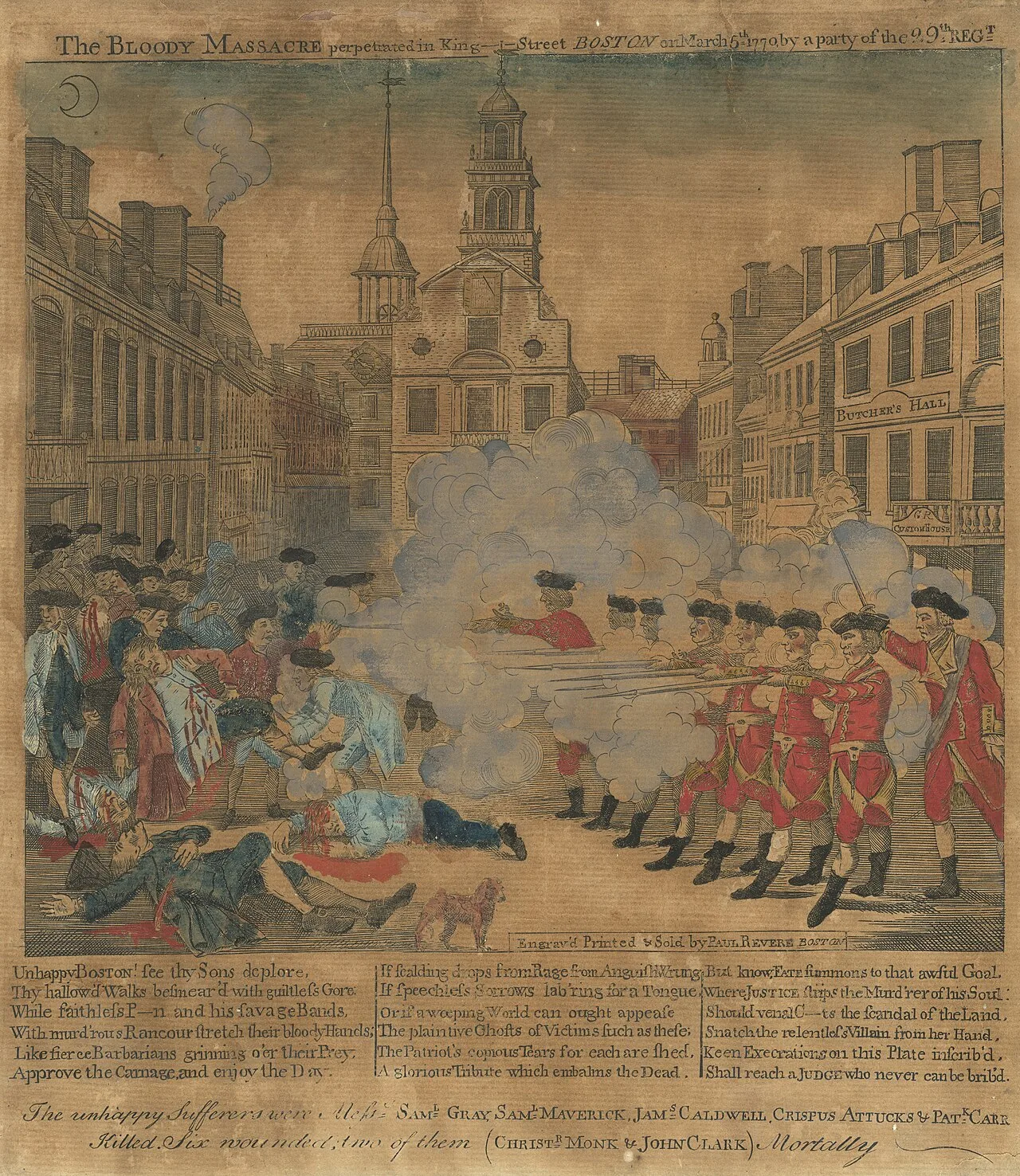
Wikimedia Commons, public domain
Document 4 – Document 4 – The 1790 census
| Group | Number |
|---|---|
| Total population | 3,929,214 |
| Enslaved people | 697,681 |
| Free African Americans | 59,527 |
Source: U.S. Census Bureau, First Census, 1790, as reported in the articles 1790 United States census and Slavery in the United States.
U.S. Census Bureau
Questions
- Explain two British policies after 1763 that angered colonists. (10 points) (10 pts)
- Identify two weaknesses of the Articles of Confederation. (10 points) (10 pts)
- Define federalism and give one example from the Constitution. (5 points) (5 pts)
- Document 1: identify two ideas in the passage and explain a limit on their application in 1776. (10 points) (10 pts)
- Documents 2 and 3: explain one reason why the American victory at Saratoga mattered and how the print of 1770 shaped opinion. (10 points) (10 pts)
- Document 4: calculate the percentage of enslaved people and explain one effect on the Constitution. (10 points) (10 pts)
- LEQ: Evaluate the extent to which the Constitution of 1787 was a compromise. (45 points) (45 pts)


Quick review: flashcards
Tap a card to see the answer.