


This AP US History lesson covers APUSH Period 3: 1754-1800, part of the unit “APUSH periods.” First, read the full lesson with its primary sources, maps and key terms. Then practice with the worksheet, check yourself with the quiz and get ready with the test.
In 1763 the British Empire in North America looked secure. Britain had defeated France, taken Canada, and doubled the territory under its flag. Yet within thirteen years thirteen of its colonies declared independence. Within thirty-seven years those colonies had written a new Constitution, elected a president, and divided into rival political parties. Period 3 of APUSH (1754-1800) asks you to explain this transformation. First, why did a victory in war lead to a revolution? Second, how did ideas about liberty and representation become arguments for independence? Finally, why did the new nation’s leaders struggle to build a government that was both strong and free?
Guiding question: How did the end of the French and Indian War lead to the American Revolution, and how did the revolutionary generation try to turn its ideals into a workable government between 1776 and 1800?
The unit follows Key Concepts 3.1 (the imperial struggle for North America and its consequences) and 3.2 (the Revolution and its ideals). It also follows 3.3 (the challenges of the new republic). Themes: Politics and Power (PCE), American and National Identity (NAT), and Migration and Settlement (MIG). Two more themes are Social Structures (SOC) and America in the World (WOR). Practice the skills of causation, continuity and change, and argumentation.
1. From imperial victory to imperial crisis, 1754-1774
The French and Indian War
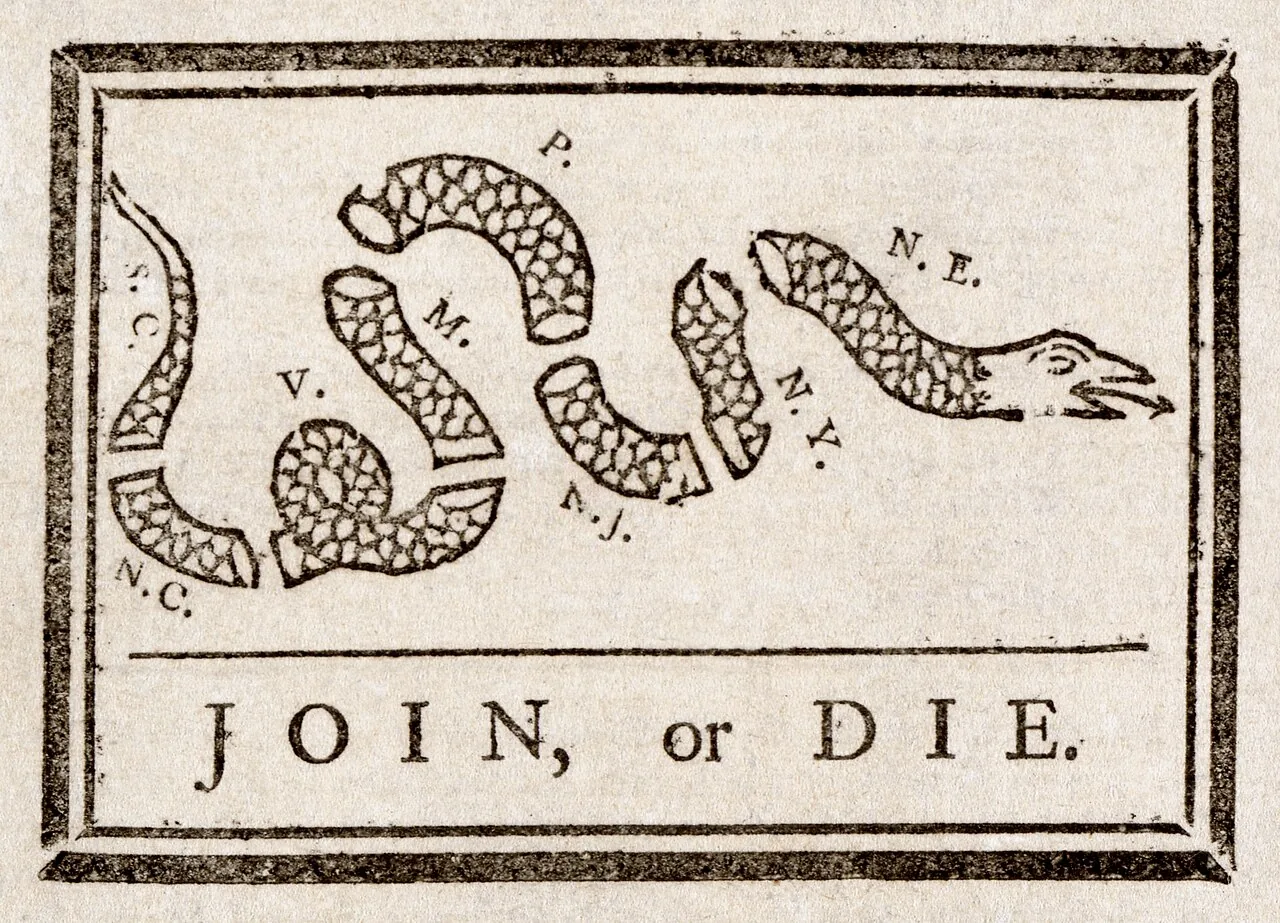
The fourth great war between Britain and France began in the Ohio Valley, where both claimed land and Native peoples had their own interests. In 1754 a young Virginia officer named George Washington lost at Fort Necessity. Delegates to the Albany Congress failed to agree on a union of the colonies. However, Benjamin Franklin’s “Join, or Die” cartoon showed a new sense of common interest.
The war, which became part of the global Seven Years’ War, went badly for Britain until William Pitt, the prime minister, committed large resources. British forces took Louisbourg in 1758, Quebec in 1759, and Montreal in 1760. In the Treaty of Paris of 1763 France gave up Canada and its claims east of the Mississippi River. Spain, an ally of France, handed Florida to Britain and received Louisiana west of the river.
Victory had costs. Britain had nearly doubled its national debt, and it kept an army in North America. Native peoples lost the French as allies and as a counterweight to the British. In 1763 the Ottawa leader Pontiac led a pan-Indian uprising around the Great Lakes. To prevent further wars and to control land policy, the king issued the Proclamation of 1763. It forbade colonists to settle west of the Appalachian crest. The colonists, many of whom had fought for the lands beyond the mountains, were angry.
Document 1 – The Proclamation of 1763
And whereas it is just and reasonable, and essential to our Interest, and the Security of our Colonies, that the several Nations or Tribes of Indians with whom We are connected, and who live under our Protection, should not be molested or disturbed in the Possession of such Parts of Our Dominions and Territories as, not having been ceded to or purchased by Us, are reserved to them. or any of them, as their Hunting Grounds.
Source: The Royal Proclamation of October 7, 1763, issued by King George III; the Avalon Project, Yale Law School.
*Hunting Grounds: lands Native peoples used for hunting and other purposes.
Commentary. The king declares it “just and reasonable” that Native nations not be disturbed in lands that had not been ceded or purchased. The motive was partly to avoid costly frontier wars. Colonists took it as a restraint on their expansion, and speculators who held western claims, including Washington, were affected.
Definition: Proclamation of 1763
a royal order that closed the lands west of the Appalachian Mountains to colonial settlement and reserved them for Native peoples. It aimed to prevent frontier wars but angered colonists and land speculators.
Taxes, representation, and resistance
The British government now wanted the colonies to share the cost of the empire. The Sugar Act (1764) tightened the collection of duties. The Stamp Act (1765) taxed printed material of all kinds, such as newspapers, legal documents, and playing cards. It was the first direct internal tax Parliament had laid on the colonies. Colonists answered that they were Englishmen, and that Englishmen could be taxed only with the consent of their representatives.
People often summed up this principle as “no taxation without representation.” British leaders replied that Parliament represented all subjects of the Crown, including those who could not vote. They called this doctrine “virtual representation.” Colonists organized boycotts. Also, a secret network of protest groups, the Sons of Liberty, intimidated stamp distributors, sometimes with violence. Delegates from nine colonies met in the Stamp Act Congress in 1765.
Document 2 – The Stamp Act Congress, 1765
That it is inseparably essential to the freedom of a people, and the undoubted right of Englishmen, that no taxes be imposed on them, but with their own consent, given personally, or by their representatives. That the people of these colonies are not, and from their local circumstances cannot be, represented in the House of Commons in Great-Britain. That the only representatives of the people of these colonies, are persons chosen therein by themselves, and that no taxes ever have been, or can be constitutionally imposed on them, but by their respective legislatures.
Source: Resolutions of the Stamp Act Congress, New York, October 19, 1765; the Avalon Project, Yale Law School.
*Inseparably essential: inseparable from liberty.
Commentary. The resolution does not deny the king’s authority. It claims a right the colonists thought they had always had: no taxes except those voted by representatives of their own choosing. Parliament repealed the Stamp Act in 1766 but passed the Declaratory Act the same day, asserting its power to make laws for the colonies “in all cases whatsoever.”
Boston and the Coercive Acts
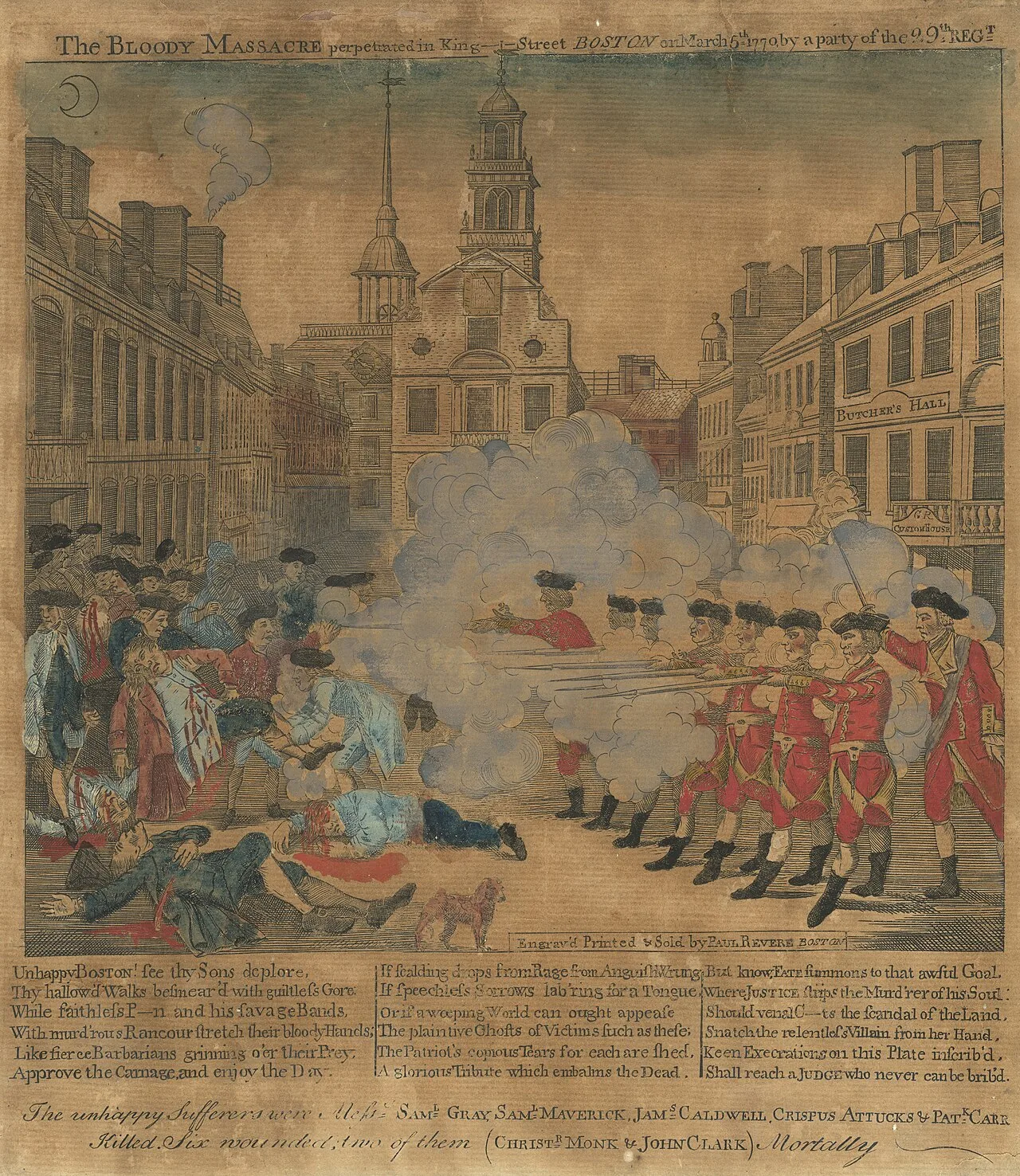
The Townshend Acts (1767) put duties on imports such as glass, lead, paper, and tea, and set off new boycotts. Troops sent to Boston to enforce the law became targets of hostility. On March 5, 1770, soldiers fired into a crowd and killed five people. Samuel Adams and Paul Revere publicized the event as the “Boston Massacre.” John Adams defended the soldiers in court, and most were acquitted. After Parliament repealed most Townshend duties, the tax on tea remained.
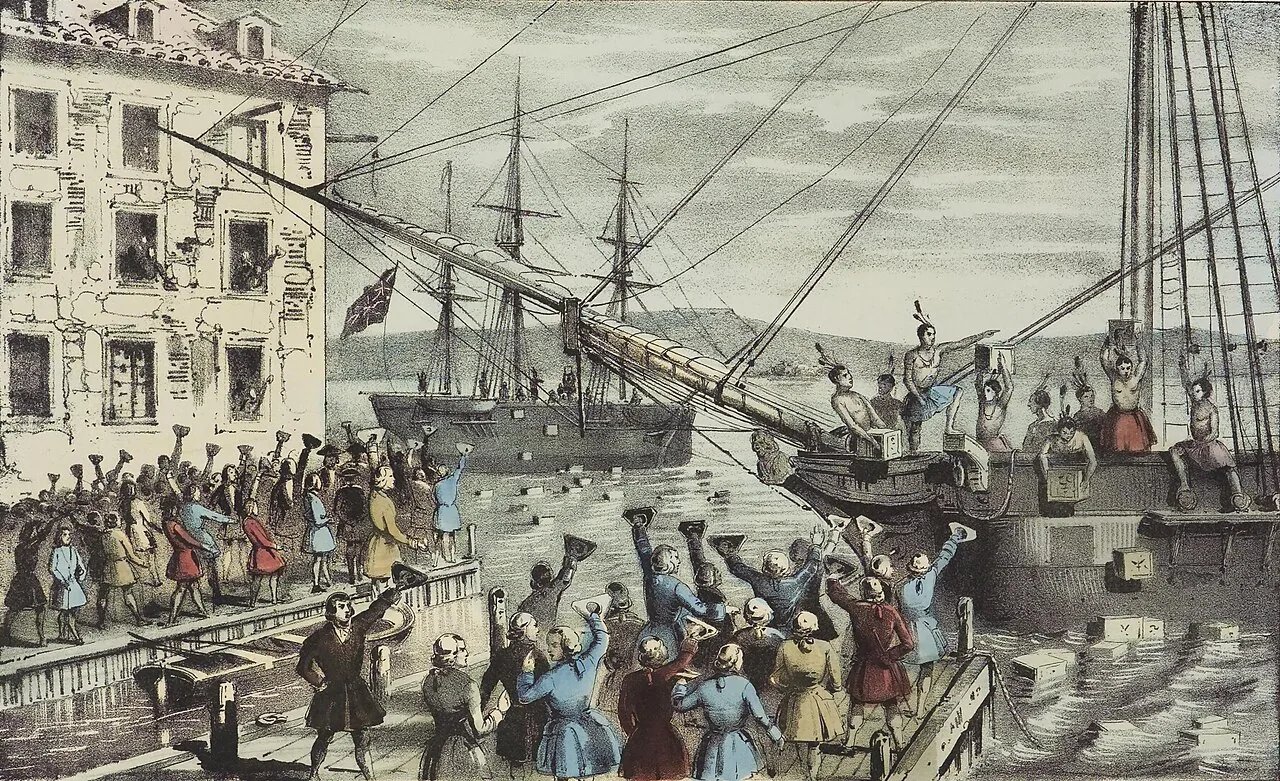
In 1773 the Tea Act gave the East India Company a near monopoly on the colonial tea trade. Radicals in Boston saw it as a trick to make colonists accept Parliament’s right to tax. They dumped 342 chests of tea into the harbor on December 16, 1773. Parliament answered with the Coercive Acts of 1774 (the colonists called them the Intolerable Acts). These laws closed Boston’s port, reduced the powers of Massachusetts’s elected government, and let troops move into private buildings. The other colonies saw the measures as a threat to all of them.
2. Independence and war, 1774-1783
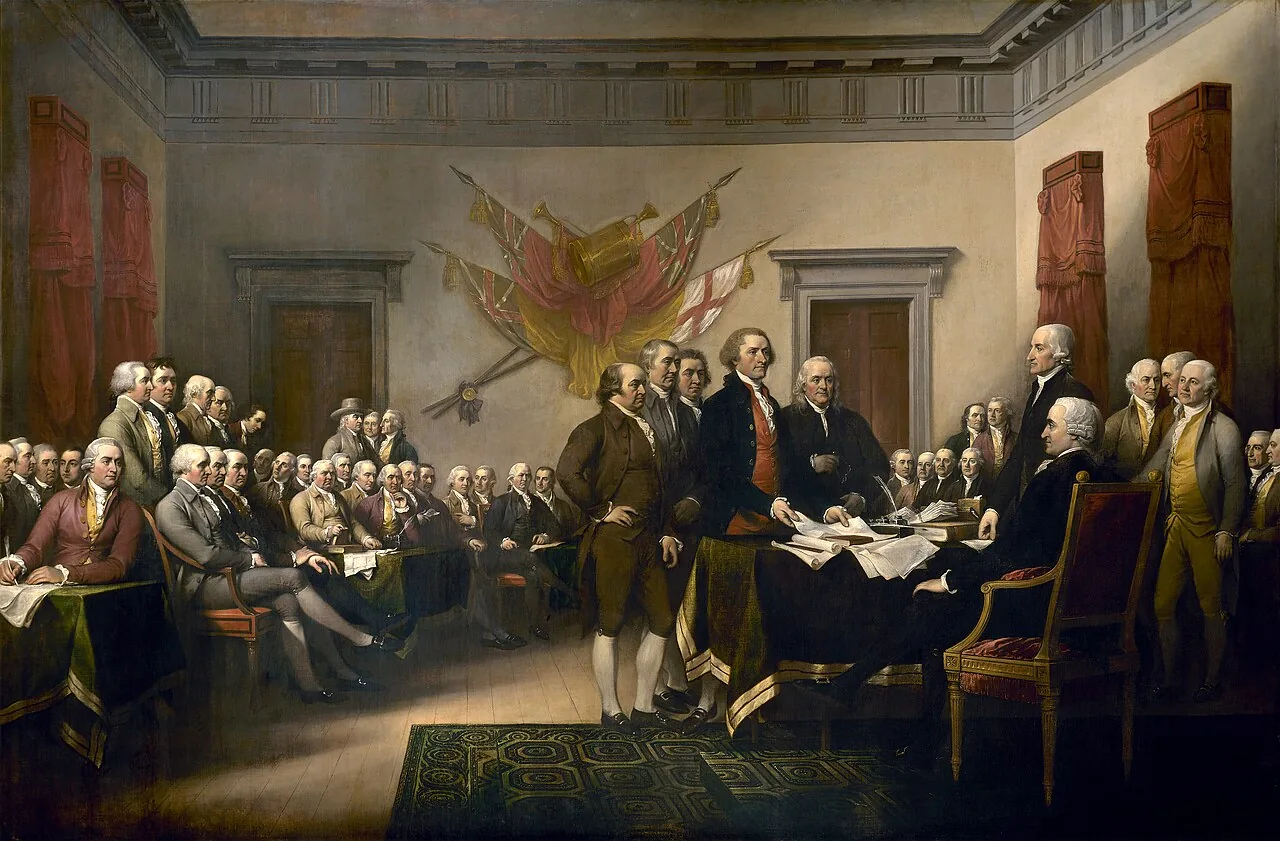
In September 1774 delegates from twelve colonies met as the First Continental Congress in Philadelphia. They organized a boycott of British goods and affirmed colonial rights. On April 19, 1775, British soldiers marching to seize military supplies clashed with militia at Lexington and Concord. The Second Continental Congress created a Continental Army under George Washington, but many colonists still hoped for reconciliation with the king. That hope faded after Thomas Paine’s pamphlet Common Sense (January 1776). The pamphlet argued in plain language that monarchy was absurd and that America should be independent. Printers in several cities issued editions, and it was read aloud in taverns and meetings.
Document 3 – The Declaration of Independence, 1776
We hold these truths to be self-evident: That all men are created equal; that they are endowed by their Creator with certain unalienable rights; that among these are life, liberty, and the pursuit of happiness; that, to secure these rights, governments are instituted among men, deriving their just powers from the consent of the governed; that whenever any form of government becomes destructive of these ends, it is the right of the people to alter or to abolish it, and to institute new government, laying its foundation on such principles, and organizing its powers in such form, as to them shall seem most likely to effect their safety and happiness.
Source: The Declaration of Independence, July 4, 1776; the Avalon Project, Yale Law School.
*Endowed: provided with. *Unalienable: that cannot be taken away. *Instituted: created.
Commentary. The Declaration, drafted largely by Thomas Jefferson and adopted by Congress on July 4, 1776, draws on the philosophy of John Locke. Governments exist to protect natural rights and rest on the consent of the governed, and the people may change a government that violates these ends. The phrase “all men are created equal” has been argued about ever since. Slaveholders wrote it, and it did not include enslaved people, women, or Native Americans. Abolitionists, suffragists, and civil rights leaders would later quote it against the nation’s practices.
The course of the war
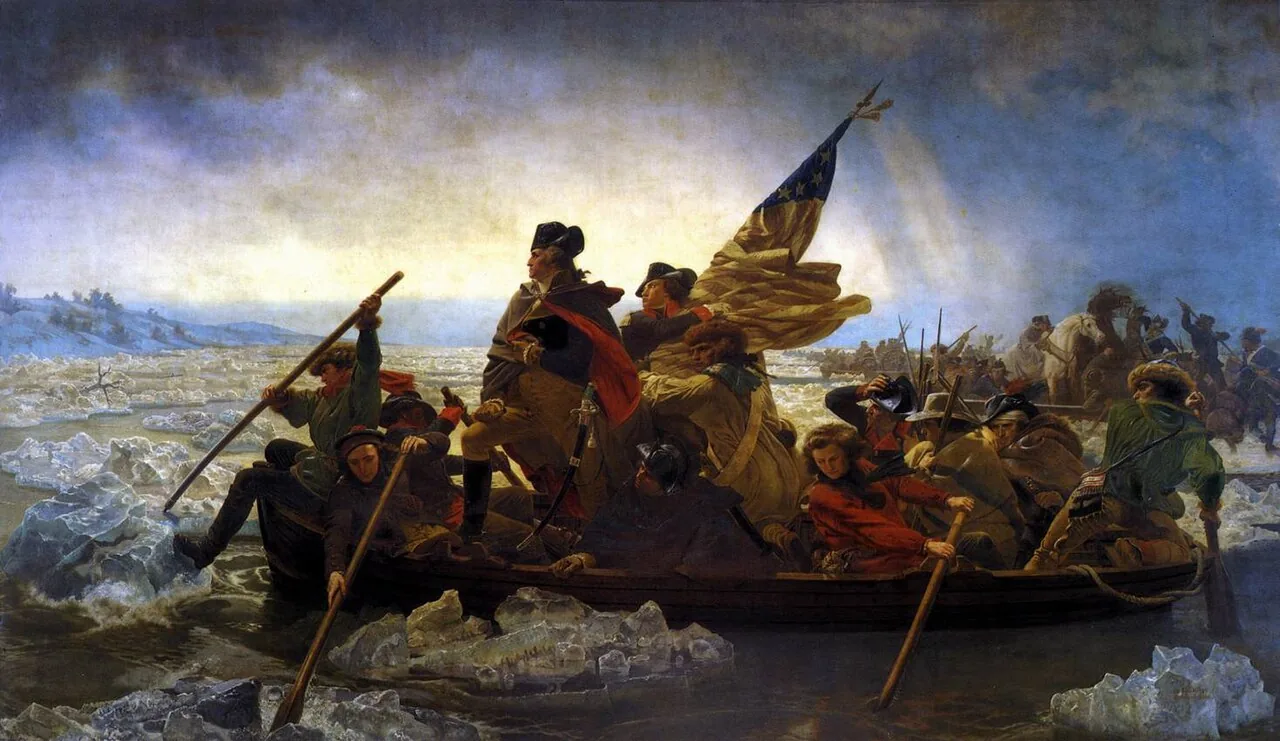
The war began poorly. The British took New York in 1776, and Washington saved his army by retreating and then scoring surprise victories at Trenton (December 1776) and Princeton (January 1777). The decisive moment was the American victory at Saratoga, New York, in October 1777. It convinced France to enter the war openly in 1778 with money, supplies, and a navy. The winter at Valley Forge (1777-1778), where Baron von Steuben drilled the army, turned the Continental Army into a more professional force.
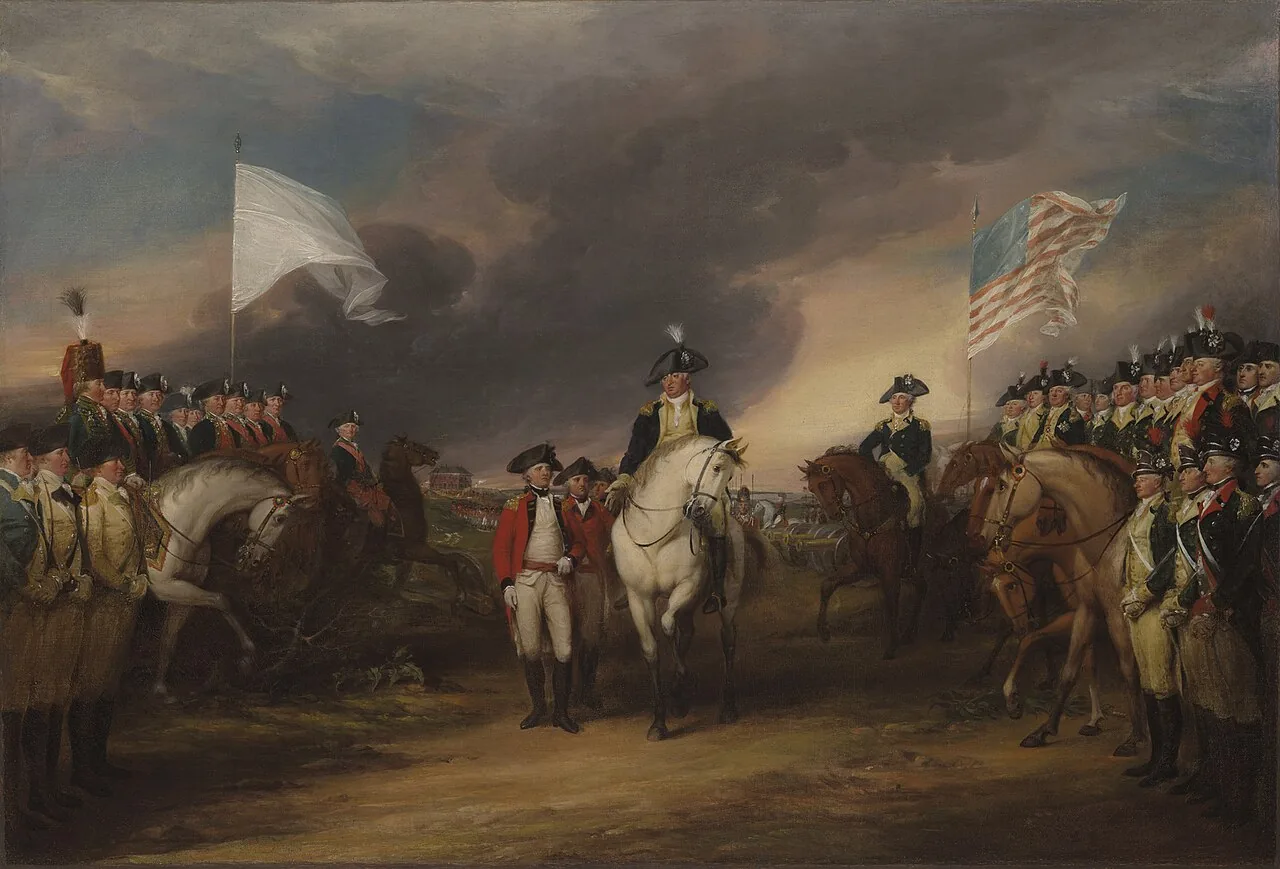
After 1778 the British shifted to the South, hoping to rally Loyalists. They took Charleston in 1780 but were bled by guerrilla warfare and by defeats at Kings Mountain and Cowpens. General Cornwallis marched into Virginia, where a combined American and French army and a French fleet trapped him at Yorktown. He surrendered on October 19, 1781. The Treaty of Paris (1783) recognized American independence and gave the new nation land west to the Mississippi River.
A social upheaval
The Revolution was also a social upheaval. About a fifth of the colonists, the Loyalists, remained loyal to the Crown, and many fled to Canada or Britain. Native peoples divided. Most of the Haudenosaunee sided with Britain. After the war the United States claimed that they had lost their land by defeat. Enslaved people used the war to seek freedom. Lord Dunmore, Virginia’s royal governor, offered freedom to those who joined the British in 1775, and thousands escaped.
Some Black men also fought in the Continental Army. The Revolution’s language of liberty began to erode slavery in the North, where Pennsylvania passed a gradual abolition law in 1780 and Massachusetts courts ended slavery by 1783. However, it left slavery strong in the South. Women ran farms and businesses, boycotted British goods, and, as Abigail Adams reminded her husband in 1776, hoped that new laws would “remember the ladies.”
3. A new government: Confederation and Constitution, 1776-1789
The states wrote constitutions that limited the power of governors and increased the role of legislatures. The first national government, the Articles of Confederation (written in 1777, ratified in 1781), reflected fear of centralized power. It had a single-house Congress in which each state had one vote and no power to tax or regulate trade. Major laws required nine of thirteen states, and amendments required unanimity. Congress did make a lasting contribution in the western lands. The Land Ordinance of 1785 provided for the survey of the Northwest Territory into townships and set aside land for schools. The Northwest Ordinance of 1787 provided a path to statehood and banned slavery north of the Ohio River.
Document 4 – The Northwest Ordinance, 1787
Religion, morality, and knowledge, being necessary to good government and the happiness of mankind, schools and the means of education shall forever be encouraged. […] The utmost good faith shall always be observed towards the Indians; their lands and property shall never be taken from them without their consent; and, in their property, rights, and liberty, they shall never be invaded or disturbed, unless in just and lawful wars authorized by Congress; but laws founded in justice and humanity, shall from time to time be made for preventing wrongs being done to them, and for preserving peace and friendship with them.
Source: The Northwest Ordinance, July 13, 1787; the Avalon Project, Yale Law School.
*Territory: the lands northwest of the Ohio River. *Utmost good faith: complete honesty.
Commentary. The ordinance links education and religion to good government, and it promises fair dealing with Native peoples. In practice, the United States soon went to war for Native land in the Ohio Valley. The ordinance is nevertheless an important statement of the idea that new territories should become equal states.
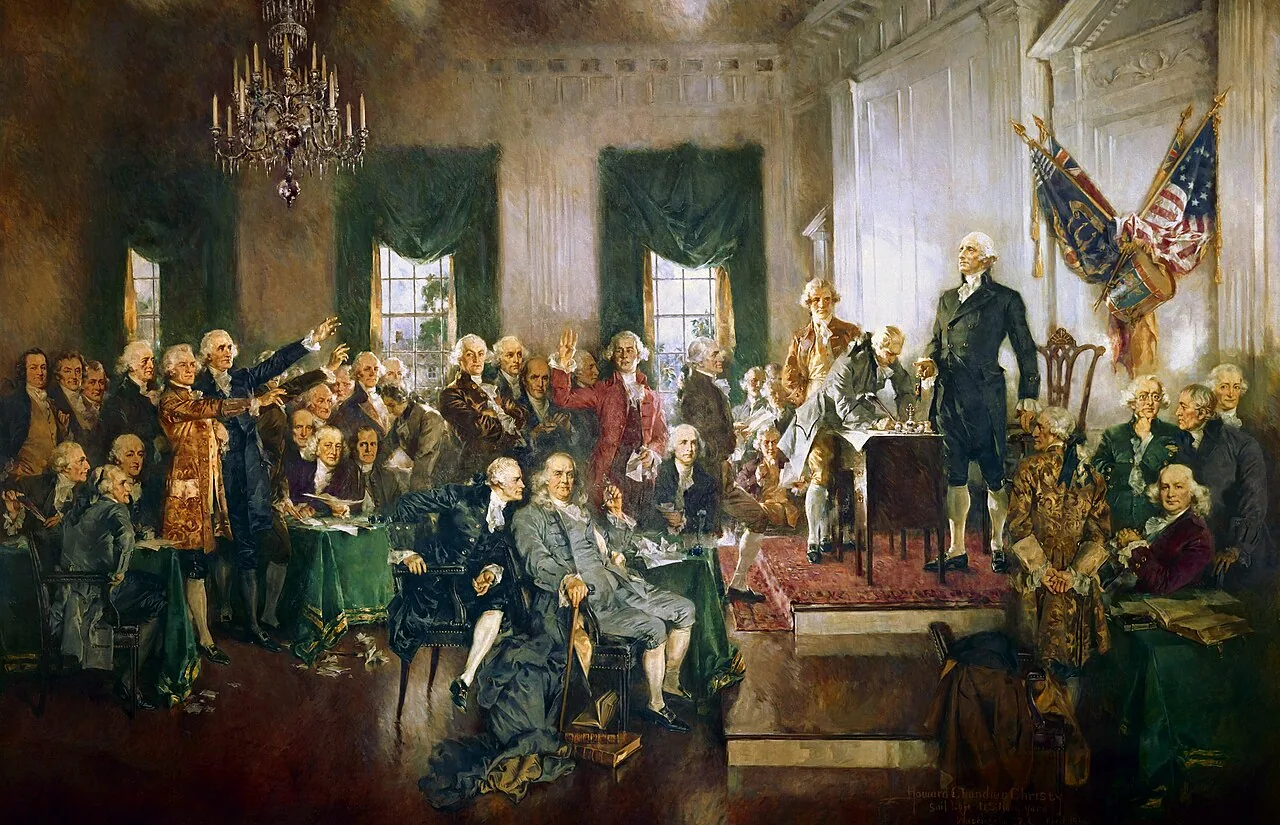
The weaknesses of the Articles became clear. The government could not pay its debts or make states respect the Treaty of Paris. It also could not respond to an uprising of indebted farmers in western Massachusetts. Daniel Shays led this uprising in 1786-1787, and it frightened property owners. In May 1787 delegates from twelve states (Rhode Island did not send any) met in Philadelphia. Instead of revising the Articles, they wrote a new Constitution.
The Great Compromise created a Congress with a House of Representatives apportioned by population and a Senate with two members per state. The Three-Fifths Compromise counted three-fifths of the enslaved population for representation and taxation. This gave slaveholding states more power in the House. The convention also agreed not to ban the Atlantic slave trade before 1808. The Constitution also created a separate executive and judiciary, and checks and balances among the three branches. Federalism divided power between the national government and the states.
Ratification and the Bill of Rights
The proposed Constitution had to be approved by special conventions in nine states. Supporters called themselves Federalists. Alexander Hamilton, James Madison, and John Jay defended the Constitution in a series of essays, The Federalist. Madison argued in No. 10 that a large republic would protect liberty by making it harder for any single faction to dominate. Opponents, the Anti-Federalists, feared a distant national government, a standing army, and the absence of a bill of rights. The compromise was to ratify and then amend. The Bill of Rights, ten amendments protecting freedom of religion, speech, the press, and assembly and procedural rights, took effect in 1791.
Document 5 – Federalist No. 10, 1787
A republic, by which I mean a government in which the scheme of representation takes place, opens a different prospect, and promises the cure for which we are seeking. Let us examine the points in which it varies from pure democracy, and we shall comprehend both the nature of the cure and the efficacy which it must derive from the Union. […] The two great points of difference between a democracy and a republic are: first, the delegation of the government, in the latter, to a small number of citizens elected by the rest; secondly, the greater number of citizens, and greater sphere of country, over which the latter may be extended.
Source: James Madison, The Federalist No. 10, November 22, 1787; the Avalon Project, Yale Law School.
*Faction: a group united by a common interest that is against the rights of others or the good of the community.
Commentary. Madison contrasts a small democracy with a large republic in which elected representatives filter the opinions of the people. His argument that size and diversity protect liberty was an answer to the fear that majorities would trample minorities.
Definition: Federalism
the division of power between a national government and state governments, each with its own sphere of authority. It was a key compromise of the Constitution.
Definition: Republicanism
the belief that government should rest on the consent of the people and be conducted by their elected representatives, with citizens who put the public good above private interest. It was the ideal of the revolutionary generation.
4. The early republic, 1789-1800
George Washington became the first president in 1789. Alexander Hamilton, the secretary of the treasury, proposed three measures. The federal government would take over state war debts (assumption), create a national bank, and encourage manufacturing. Thomas Jefferson and Madison objected that the Constitution did not authorize the bank and that it favored the commercial North over the agricultural South. Their disagreement hardened into the first party system. Federalists favored a strong national government, commercial development, and good relations with Britain.
Democratic-Republicans defended states’ rights, farmers, and sympathy for France. When the government laid an excise tax on whiskey, farmers in western Pennsylvania rebelled in 1794. Washington sent militia to put down the Whiskey Rebellion, showing that the new government could enforce its laws. The Jay Treaty (1794) settled disputes with Britain but angered Republicans. Finally, Washington’s Farewell Address of 1796 warned against political factions and permanent alliances with foreign nations.
Under President John Adams, relations with France collapsed in the XYZ Affair (1797), when French agents demanded bribes from American diplomats. An undeclared naval war, the Quasi-War, followed. The Federalist majority in Congress passed the Alien and Sedition Acts in 1798. The Sedition Act made it a crime to publish false or malicious writing against the government, and Federalist prosecutors targeted Republican newspaper editors. Jefferson and Madison drafted the Kentucky and Virginia Resolutions, which argued that states could judge the constitutionality of federal laws. Supporters of nullification would use this theory again in the 1830s. The election of 1800 brought Jefferson to the presidency and the first peaceful transfer of power between opposing parties. Jefferson later called it a “revolution.”
Document 6 – The Sedition Act, 1798
That if any person shall write, print, utter or publish, or shall cause or procure to be written, printed, uttered or published, or shall knowingly and willingly assist or aid in writing, printing, uttering or publishing any false, scandalous and malicious writing or writings against the government of the United States, or either house of the Congress of the United States, or the President of the United States, with intent to defame the said government, or either house of the said Congress, or the said President, or to bring them, or either of them, into contempt or disrepute; or to excite against them, or either or any of them, the hatred of the good people of the United States,
Source: The Sedition Act, July 14, 1798; the Avalon Project, Yale Law School.
*Utter: say. *Contempt or disrepute: loss of respect.
Commentary. The act criminalizes criticism of the government, the Congress, and the president. It conflicts with the First Amendment and with the idea of a free press, and Republicans argued that it was used to punish political opposition. The Federalist defense was that false statements threatened public order in a time of danger.
- 1754 French and Indian War begins; Albany Congress
- 1763 Treaty of Paris; Proclamation of 1763
- 1765 Stamp Act and Stamp Act Congress
- 1770 Boston Massacre
- 1773 Boston Tea Party
- 1774 Coercive Acts; First Continental Congress
- 1775 Lexington and Concord
- 1776 Common Sense; Declaration of Independence
- 1777 Saratoga; Articles of Confederation drafted
- 1781 Yorktown; Articles ratified
- 1783 Treaty of Paris recognizes independence
- 1787 Constitutional Convention; Northwest Ordinance
- 1791 Bill of Rights
- 1798 Alien and Sedition Acts
- 1800 Election of Jefferson
5. Thinking like a historian: causes of the Revolution
The exam often asks about the causes of the Revolution. Use two categories. Political and ideological causes: the argument about representation, the influence of the Enlightenment and the English tradition of rights, and the fear that Parliament threatened liberty. Economic and social causes: the debt after the French and Indian War, the Proclamation of 1763, the taxes and trade regulations, and colonial habits of self-government after a long period of salutary neglect. A strong argument shows how the categories interact: the taxes were small, but they raised the principle of consent. Also note continuity and change: the Revolution changed political ideas and institutions, but it did little at first for enslaved people, women, or Native Americans.
For the Constitution, learn the compromise that settled each problem: large and small states (Great Compromise) and slavery and representation (Three-Fifths Compromise). Also learn how the fear of centralized power led to federalism, checks and balances, and the Bill of Rights. When a question asks you to evaluate an argument such as Madison’s in Federalist No. 10 or the Anti-Federalists’ objections, state the claim in your own words. Then point to a historical result that supports or challenges it.
Key takeaways
- The French and Indian War left Britain with a huge debt and new territory, and led to the Proclamation of 1763 and new taxes.
- Colonists resisted the Stamp Act and Townshend duties by arguing that taxation required representation; the Coercive Acts pushed the colonies toward unity.
- The Declaration of Independence applied Enlightenment ideas of natural rights and consent, though it left slavery untouched.
- The Articles of Confederation created a weak government; the Constitution created a stronger federal system with separated powers and compromises over representation and slavery.
- Federalists and Anti-Federalists debated the Constitution; the Bill of Rights was the price of ratification.
- The 1790s saw the first party system (Federalists vs. Democratic-Republicans), the Whiskey Rebellion, the Jay Treaty, and the Alien and Sedition Acts.

Quick review: flashcards
Tap a card to see the answer.