


This worksheet on APUSH Period 4: 1800-1848 belongs to the AP US History course. Its questions use primary sources, maps and timelines, and they move from basic recall to short writing tasks. Before you start, review the lesson; afterward, try the true or false quiz.
Exercise 1 : Vocabulary of the early republic
Define each term and use it in a sentence about 1800-1848.
- market revolution
- impressment
- spoils system
- nullification
- Manifest Destiny
- gag rule
Exercise 2 : The Monroe Doctrine
Document.
We owe it, therefore, to candor and to the amicable relations existing between the United States and those powers to declare that we should consider any attempt on their part to extend their system to any portion of this hemisphere as dangerous to our peace and safety. […] But with the Governments who have declared their independence and maintain it, and whose independence we have, on great consideration and on just principles, acknowledged, we could not view any interposition for the purpose of oppressing them, or controlling in any other manner their destiny, by any European power in any other light than as the manifestation of an unfriendly disposition toward the United States.
Source: James Monroe, Seventh Annual Message to Congress, December 2, 1823 (the Monroe Doctrine); the Avalon Project, Yale Law School.
*Candor: honesty.
- Present the document (author, date, context).
- State the two parts of the policy.
- Explain why the United States could not enforce it in 1823.
Exercise 3 : Nullification: two views
Read both documents.
Document A – South Carolina, 1832
We, therefore, the people of the State of South Carolina, in convention assembled, do declare and ordain and it is hereby declared and ordained, that the several acts and parts of acts of the Congress of the United States, purporting to be laws for the imposing of duties and imposts on the importation of foreign commodities, […] affirmance thereof, are and shall be held utterly null and void. […] it shall not be lawful for any of the constituted authorities, whether of this State or of the United States, to enforce the payment of duties imposed by the said acts within the limits of this State;
Source: South Carolina Ordinance of Nullification, November 24, 1832; the Avalon Project, Yale Law School.
Document B – Jackson, 1832
I consider, then, the power to annul a law of the United States, assumed by one State, incompatible with the existence of the Union, contradicted expressly by the letter of the Constitution, unauthorized by its spirit, inconsistent with every principle on which It was founded, and destructive of the great object for which it was formed.
Source: Andrew Jackson, Proclamation to the People of South Carolina, December 10, 1832; the Avalon Project, Yale Law School.
- Summarize the argument of each.
- Identify the view of the Union each reflects.
- Explain how the crisis was resolved.
Exercise 4 : The Bank veto
Document.
It is to be regretted that the rich and powerful too often bend the acts of government to their selfish purposes. […] but when the laws undertake to add to these natural and just advantages artificial distinctions, to grant titles, gratuities, and exclusive privileges, to make the rich richer and the potent more powerful, the humble members of society-the farmers, mechanics, and laborers-who have neither the time nor the means of securing like favors to themselves,
Source: Andrew Jackson, Veto Message Regarding the Bank of the United States, July 10, 1832; the Avalon Project, Yale Law School.
*Gratuities: gifts.
- Present the document.
- Identify Jackson’s argument about wealth and government.
- Explain how supporters and opponents of Jackson might have viewed this message.
Exercise 5 : Declarations compared
Compare the two declarations.
Document A – 1776
We hold these truths to be self-evident: That all men are created equal; that they are endowed by their Creator with certain unalienable rights; that among these are life, liberty, and the pursuit of happiness; that, to secure these rights, governments are instituted among men, deriving their just powers from the consent of the governed; that whenever any form of government becomes destructive of these ends, it is the right of the people to alter or to abolish it, and to institute new government, laying its foundation on such principles, and organizing its powers in such form, as to them shall seem most likely to effect their safety and happiness.
Source: The Declaration of Independence, July 4, 1776 (second paragraph); the Avalon Project, Yale Law School.
Document B – 1848
We hold these truths to be self-evident: that all men and women are created equal; that they are endowed by their Creator with certain inalienable rights; that among these are life, liberty, and the pursuit of happiness; that to secure these rights governments are instituted, deriving their just powers from the consent of the governed. […] The history of mankind is a history of repeated injuries and usurpations on the part of man toward woman, having in direct object the establishment of an absolute tyranny over her.
Source: Declaration of Sentiments, adopted at the Woman’s Rights Convention, Seneca Falls, New York, July 19-20, 1848; text from the Internet History Sourcebooks (Fordham University).
- Identify two phrases that the second text copies or adapts.
- Explain what the authors of Document B gain by modeling it on A.
- Why was the demand for the vote controversial?
Exercise 6 : Learning to read
Document.
A city slave is almost a freeman, compared with a slave on the plantation. He is much better fed and clothed, and enjoys privileges altogether unknown to the slave on the plantation. There is a vestige of decency, a sense of shame, that does much to curb and check those outbreaks of atrocious cruelty so commonly enacted upon the plantation. He is a desperate slaveholder, who will shock the humanity of his non-slaveholding neighbors with the cries of his lacerated slave. Few are willing to incur the odium attaching to the reputation of being a cruel master;
Source: Frederick Douglass, Narrative of the Life of Frederick Douglass, an American Slave, 1845, chapter 7 (life in Baltimore); Project Gutenberg.
*Odium: public hatred. *Vestige: trace.
- Present the author and the nature of the document.
- Describe the differences between city and plantation slavery that he notes.
- Explain why a narrative published in 1845 had political power.
Exercise 7 : Resistance and memory
Compare a text and an image.
Document A – Douglass
This battle with Mr. Covey was the turning-point in my career as a slave. It rekindled the few expiring embers of freedom, and revived within me a sense of my own manhood. It recalled the departed self-confidence, and inspired me again with a determination to be free. The gratification afforded by the triumph was a full compensation for whatever else might follow, even death itself. He only can understand the deep satisfaction which I experienced, who has himself repelled by force the bloody arm of slavery. I felt as I never felt before. It was a glorious resurrection, from the tomb of slavery, to the heaven of freedom. My long-crushed spirit rose, cowardice departed, bold defiance took its place; and I now resolved that, however long I might remain a slave in form, the day had passed forever when I could be a slave in fact.
Source: Frederick Douglass, Narrative of the Life of Frederick Douglass, an American Slave, 1845, chapter 10 (the fight with Edward Covey); Project Gutenberg.
Document B – Nat Turner
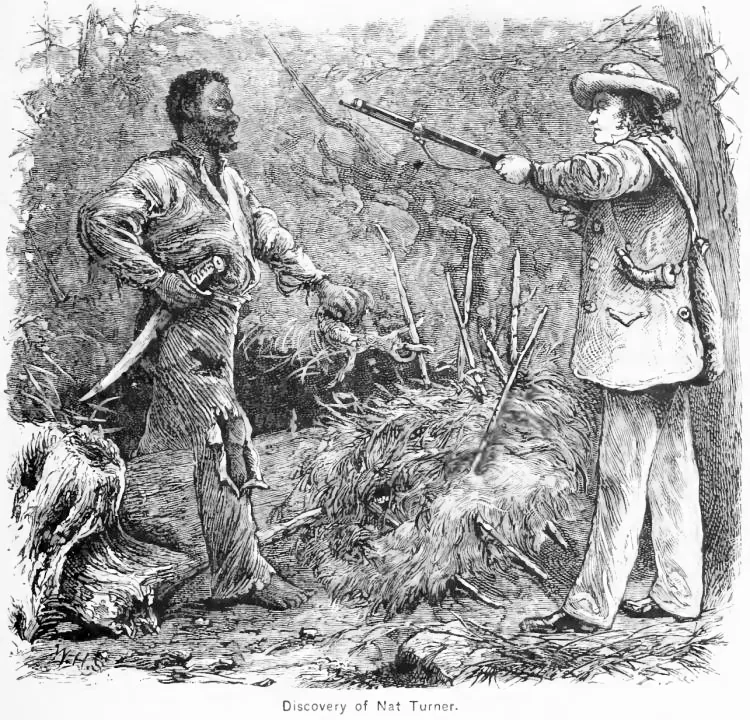
- Present each document.
- Describe two forms of resistance to slavery that they show.
- Explain one difference in point of view.
Exercise 8 : A president and his image
Study the portrait.
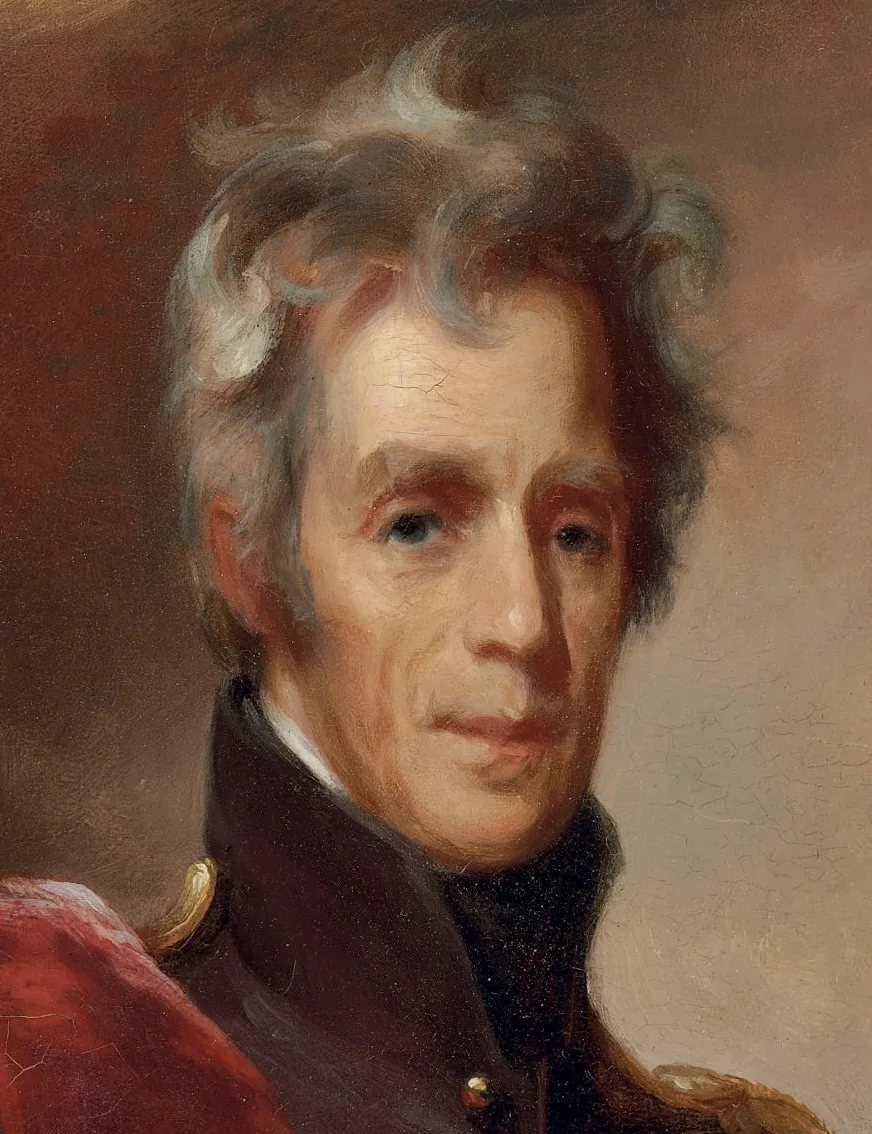
- Present the document.
- Describe how the painter presents Jackson.
- Explain what the image can and cannot tell us about Jacksonian democracy.
Exercise 9 : A machine that changed the South
Study the drawing.
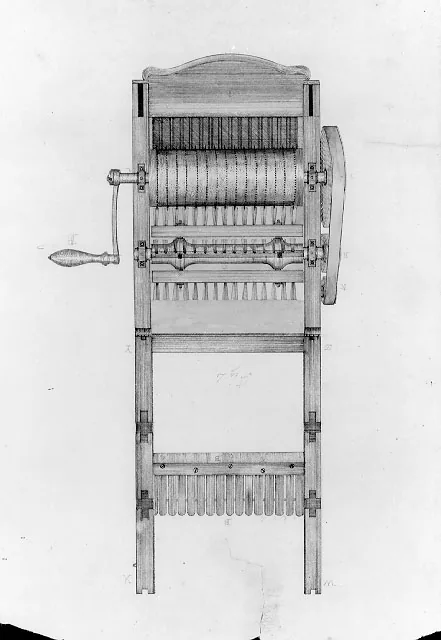
- Present the document.
- Describe how the machine works.
- Explain two effects on slavery and the Southern economy.
Exercise 10 : Writing and sovereignty
Study the portrait.
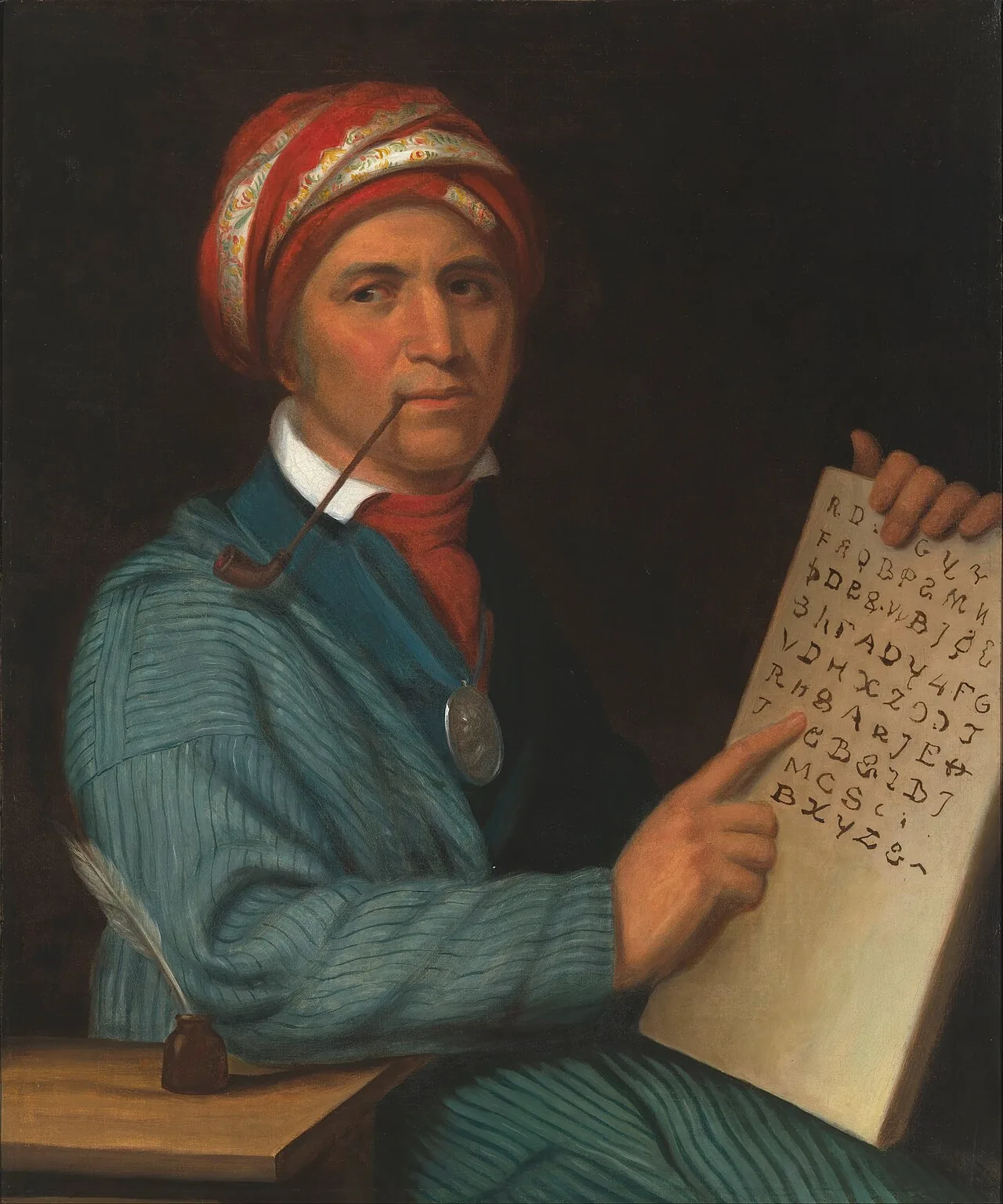
- Present the document.
- Explain the significance of the object Sequoyah holds.
- How did the Cherokee use writing and law to resist removal?
Exercise 11 : Exploring the West
Study the painting.
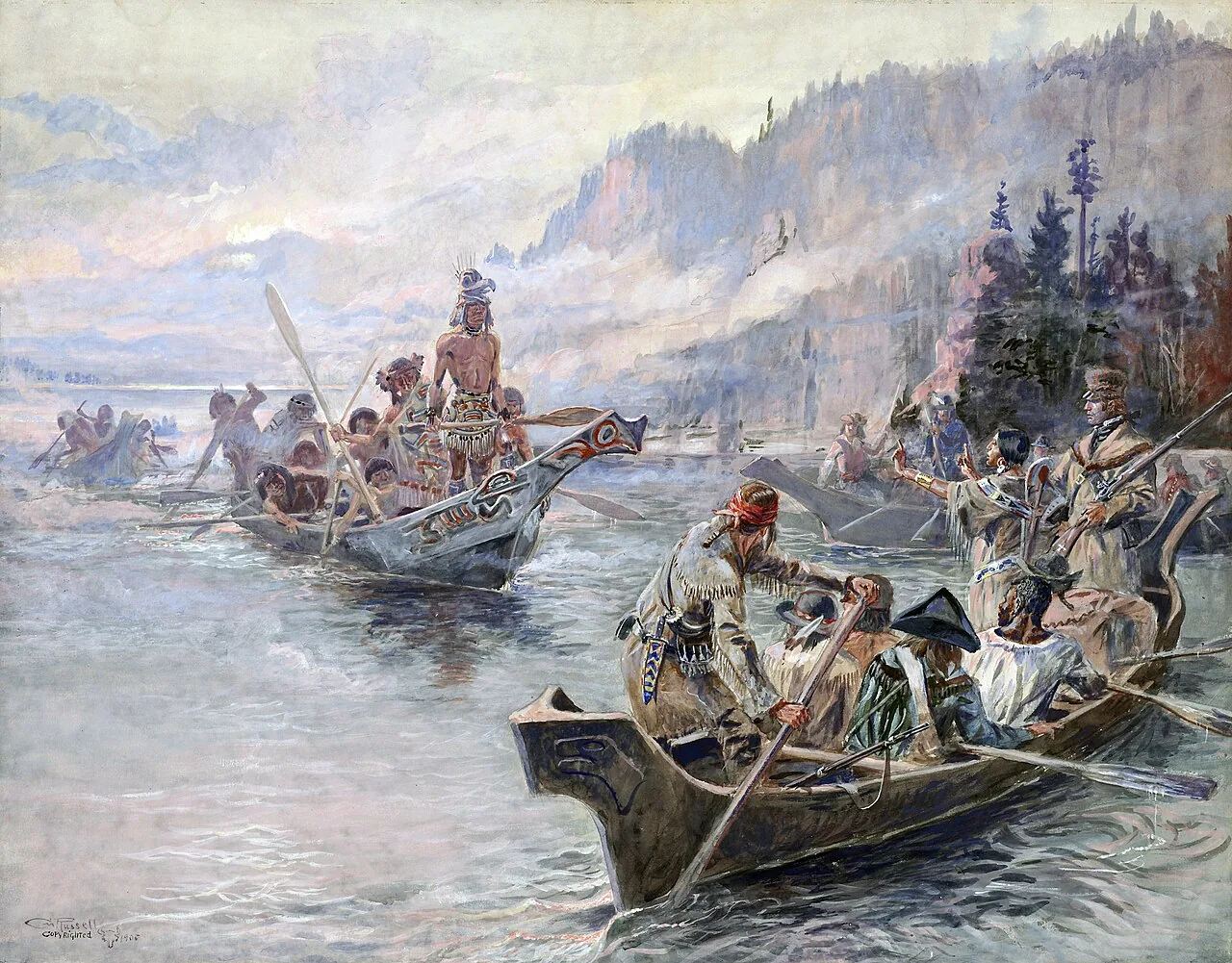
- Present the document.
- Describe the scene.
- Explain why this painting should not be used as direct evidence of the expedition.
Exercise 12 : Slavery by the numbers
Use the table.
| Year | Enslaved people | Total U.S. population | Enslaved share |
|---|---|---|---|
| 1800 | 893,602 | 5,308,483 | about 17% |
| 1820 | 1,538,022 | 9,638,453 | about 16% |
| 1840 | 2,487,355 | 17,069,453 | about 15% |
Source: U.S. Census Bureau, decennial censuses, as reported in the articles “Slavery in the United States” and “United States census” (Wikipedia, consulted November 2026). Shares are calculated here.
- By how much did the enslaved population grow from 1800 to 1840?
- Why did the enslaved share of the population fall slightly even though the number grew?
- Give two causes of the growth in numbers.
Exercise 13 : Map reading: expansion
Use the numbered map.
- Name places 1 to 6 (St. Louis, New Orleans, Fort Mandan, Fort Clatsop, Albany, Buffalo).
- Which two are connected by the Erie Canal?
- Why was New Orleans so important to Jefferson?
Exercise 14 : Map reading: removal
Use Map 2.
- Name the three peoples whose routes are shown.
- Where did they go?
- Explain one legal event that led to the Cherokee removal.
Exercise 15 : Chronology: from Louisiana to Seneca Falls
Order these events and find the span: Erie Canal opens; Louisiana Purchase; Indian Removal Act; Seneca Falls; War of 1812 begins; Nullification Crisis.
Exercise 16 : SAQ: the Nullification Crisis
Answer in complete sentences. (a) Identify one cause of the Nullification Crisis. (b) Explain one argument made by South Carolina. (c) Explain one way in which the crisis was resolved.
Exercise 17 : Stimulus-based multiple choice (Monroe)
Use the document.
We owe it, therefore, to candor and to the amicable relations existing between the United States and those powers to declare that we should consider any attempt on their part to extend their system to any portion of this hemisphere as dangerous to our peace and safety. […] But with the Governments who have declared their independence and maintain it, and whose independence we have, on great consideration and on just principles, acknowledged, we could not view any interposition for the purpose of oppressing them, or controlling in any other manner their destiny, by any European power in any other light than as the manifestation of an unfriendly disposition toward the United States.
Source: James Monroe, Seventh Annual Message to Congress, December 2, 1823 (the Monroe Doctrine); the Avalon Project, Yale Law School.
- The passage most directly reflects (A) economic expansion; (B) a claim of American leadership in the hemisphere; (C) Federalist ideas; (D) support for the Holy Alliance.
- The policy was a response to (A) the Embargo Act; (B) the independence of Latin American nations and European threats; (C) the Mexican War; (D) the Nullification Crisis.
- This policy was later cited to justify (A) the Louisiana Purchase; (B) American intervention in the Western Hemisphere; (C) Indian removal; (D) the Missouri Compromise.
Exercise 18 : Guided research: the Erie Canal
Mini-investigation. Search for: “Erie Canal 1825 history” and “market revolution.” Reliable sites: New York State Canal Corporation (canals.ny.gov), Library of Congress, Smithsonian. Fill in: (1) dates of construction; (2) its length and the cities it linked; (3) two effects on the economy; (4) one effect on settlement.
Exercise 19 : LEQ planning: the market revolution
AP LEQ prompt: “Evaluate the extent to which the market revolution changed the lives of Americans between 1800 and 1848.” Write a thesis and outline two paragraphs.
Exercise 20 : DBQ practice: federal authority
DBQ prompt: “Evaluate the extent to which the Nullification Crisis revealed disagreements over federal power in the 1830s.” Use Documents A and B and add one piece of outside evidence.
Document A – South Carolina
We, therefore, the people of the State of South Carolina, in convention assembled, do declare and ordain and it is hereby declared and ordained, that the several acts and parts of acts of the Congress of the United States, purporting to be laws for the imposing of duties and imposts on the importation of foreign commodities, […] affirmance thereof, are and shall be held utterly null and void. […] it shall not be lawful for any of the constituted authorities, whether of this State or of the United States, to enforce the payment of duties imposed by the said acts within the limits of this State;
Source: South Carolina Ordinance of Nullification, November 24, 1832; the Avalon Project, Yale Law School.
Document B – Jackson
I consider, then, the power to annul a law of the United States, assumed by one State, incompatible with the existence of the Union, contradicted expressly by the letter of the Constitution, unauthorized by its spirit, inconsistent with every principle on which It was founded, and destructive of the great object for which it was formed.
Source: Andrew Jackson, Proclamation to the People of South Carolina, December 10, 1832; the Avalon Project, Yale Law School.


Quick review: flashcards
Tap a card to see the answer.