


This worksheet on APUSH Period 5: 1844-1877 belongs to the AP US History course. Its questions use primary sources, maps and timelines, and they move from basic recall to short writing tasks. Before you start, review the lesson; afterward, try the true or false quiz.
Exercise 1 : Vocabulary of the sectional crisis
Define each term and use it in a sentence about 1844-1877.
- popular sovereignty
- Fugitive Slave Act
- secession
- Emancipation Proclamation
- Black Codes
- sharecropping
Exercise 2 : Guadalupe Hidalgo
Document.
Mexicans now established in territories previously belonging to Mexico, and which remain for the future within the limits of the United States, as defined by the present treaty, shall be free to continue where they now reside, or to remove at any time to the Mexican Republic, retaining the property which they possess in the said territories, or disposing thereof, and removing the proceeds wherever they please, without their being subjected, on this account, to any contribution, tax, or charge whatever. […] Those who shall prefer to remain in the said territories may either retain the title and rights of Mexican citizens, or acquire those of citizens of the United States.
Source: Treaty of Guadalupe Hidalgo, February 2, 1848, Article VIII; the Avalon Project, Yale Law School.
*Contribution: tax.
- Present the document (nature, parties, date, context).
- What choice does it give Mexicans in the ceded land?
- Explain why the promises were not fully kept.
Exercise 3 : The Dred Scott decision
Document.
They had for more than a century before been regarded as beings of an inferior order, and altogether unfit to associate with the white race, either in social or political relations; and so far inferior, that they had no rights which the white man was bound to respect; and that the negro might justly and lawfully be reduced to slavery for his benefit. He was bought and sold, and treated as an ordinary article of merchandise and traffic, whenever a profit could be made by it. This opinion was at that time fixed and universal in the civilized portion of the white race. It was regarded as an axiom in morals as well as in politics, which no one thought of disputing, or supposed to be open to dispute;
Source: Chief Justice Roger B. Taney, opinion of the Court, Dred Scott v. Sandford, 60 U.S. 393 (1857); Legal Information Institute, Cornell Law School.
*Axiom: accepted truth.
- Present the document and the case.
- Identify the claim Taney makes about Black people.
- Explain why the decision pushed the nation closer to war.
Exercise 4 : A martyr or a murderer?
Read both documents.
Document A – Taney (1857)
They had for more than a century before been regarded as beings of an inferior order, and altogether unfit to associate with the white race, either in social or political relations; and so far inferior, that they had no rights which the white man was bound to respect; and that the negro might justly and lawfully be reduced to slavery for his benefit. He was bought and sold, and treated as an ordinary article of merchandise and traffic, whenever a profit could be made by it. This opinion was at that time fixed and universal in the civilized portion of the white race. It was regarded as an axiom in morals as well as in politics, which no one thought of disputing, or supposed to be open to dispute;
Source: Chief Justice Roger B. Taney, opinion of the Court, Dred Scott v. Sandford, 60 U.S. 393 (1857); Legal Information Institute, Cornell Law School.
Document B – John Brown (1859)
Now, if it is deemed necessary that I should forfeit my life for the furtherance of the ends of justice, and mingle my blood farther with the blood of my children and with the blood of millions in this slave country whose rights are disregarded by wicked, cruel, and unjust enactments, I say let it be done.
Source: John Brown, address to the court at his sentencing, Charles Town, Virginia, November 2, 1859; the Avalon Project, Yale Law School.
- Summarize the view of slavery in each.
- Identify the audience for each.
- Explain how the two texts show the failure of political solutions.
Exercise 5 : Why Mississippi seceded
Document.
Our position is thoroughly identified with the institution of slavery– the greatest material interest of the world. Its labor supplies the product which constitutes by far the largest and most important portions of commerce of the earth. These products are peculiar to the climate verging on the tropical regions, and by an imperious law of nature, none but the black race can bear exposure to the tropical sun. These products have become necessities of the world, and a blow at slavery is a blow at commerce and civilization.
Source: A Declaration of the Immediate Causes which Induce and Justify the Secession of the State of Mississippi from the Federal Union, January 1861; the Avalon Project, Yale Law School.
- Present the document.
- What reason does the text give for secession?
- Evaluate the claim that the South seceded only for states’ rights.
Exercise 6 : Two views of the war’s cause
Compare the two documents.
Document A – Mississippi (1861)
Our position is thoroughly identified with the institution of slavery– the greatest material interest of the world. Its labor supplies the product which constitutes by far the largest and most important portions of commerce of the earth. These products are peculiar to the climate verging on the tropical regions, and by an imperious law of nature, none but the black race can bear exposure to the tropical sun. These products have become necessities of the world, and a blow at slavery is a blow at commerce and civilization.
Source: A Declaration of the Immediate Causes which Induce and Justify the Secession of the State of Mississippi from the Federal Union, January 1861; the Avalon Project, Yale Law School.
Document B – Lincoln (1865)
One-eighth of the whole population were colored slaves, not distributed generally over the Union, but localized in the southern part of it. These slaves constituted a peculiar and powerful interest. All knew that this interest was somehow the cause of the war. To strengthen, perpetuate, and extend this interest was the object for which the insurgents would rend the Union even by war, […] Fondly do we hope, fervently do we pray, that this mighty scourge of war may speedily pass away. Yet, if God wills that it continue until all the wealth piled by the bondsman’s two hundred and fifty years of unrequited toil shall be sunk, and until every drop of blood drawn with the lash shall be paid by another drawn with the sword, as was said three thousand years ago, so still it must be said “the judgments of the Lord are true and righteous altogether.”
Source: Abraham Lincoln, Second Inaugural Address, March 4, 1865; the Avalon Project, Yale Law School.
- Summarize each author’s explanation of the cause of the war.
- Identify the shared agreement and the difference.
- Explain how each text uses religion or morality.
Exercise 7 : The Emancipation Proclamation
Document.
That on the first day of January, in the year of our Lord one thousand eight hundred and sixty-three, all persons held as slaves within any State or designated part of a State, the people whereof shall then be in rebellion against the United States, shall be then, thenceforward, and forever free;
Source: Abraham Lincoln, Emancipation Proclamation, January 1, 1863 (quoting the preliminary proclamation of September 22, 1862); the Avalon Project, Yale Law School.
- Present the document.
- Identify the people and places covered.
- Evaluate its limits and its importance.
Exercise 8 : Lincoln’s new birth of freedom
Document.
Now we are engaged in a great civil war, testing whether that nation or any nation so conceived and so dedicated can long endure. We are met on a great battlefield of that war. We have come to dedicate a portion of that field as a final resting-place for those who here gave their lives that that nation might live. […] The world will little note nor long remember what we say here, but it can never forget what they did here. It is for us the living rather to be dedicated here to the unfinished work which they who fought here have thus far so nobly advanced. It is rather for us to be here dedicated to the great task remaining before us–that from these honored dead we take increased devotion to that cause for which they gave the last full measure of devotion
Source: Abraham Lincoln, Gettysburg Address, November 19, 1863 (Bliss copy); the Avalon Project, Yale Law School.
- Present the document and its occasion.
- Explain how Lincoln defines the purpose of the war.
- Identify one idea he draws from the Declaration of Independence.
Exercise 9 : Freedom, citizenship, and the Constitution
Compare the two texts.
Document A – Taney (1857)
They had for more than a century before been regarded as beings of an inferior order, and altogether unfit to associate with the white race, either in social or political relations; and so far inferior, that they had no rights which the white man was bound to respect; and that the negro might justly and lawfully be reduced to slavery for his benefit. He was bought and sold, and treated as an ordinary article of merchandise and traffic, whenever a profit could be made by it. This opinion was at that time fixed and universal in the civilized portion of the white race. It was regarded as an axiom in morals as well as in politics, which no one thought of disputing, or supposed to be open to dispute;
Source: Chief Justice Roger B. Taney, opinion of the Court, Dred Scott v. Sandford, 60 U.S. 393 (1857); Legal Information Institute, Cornell Law School.
Document B – Fourteenth Amendment (1868)
Section 1. All persons born or naturalized in the United States, and subject to the jurisdiction thereof, are citizens of the United States and of the State wherein they reside. No State shall make or enforce any law which shall abridge the privileges or immunities of citizens of the United States; nor shall any State deprive any person of life, liberty, or property, without due process of law; nor deny to any person within its jurisdiction the equal protection of the laws.
Source: The Fourteenth Amendment, Section 1, ratified July 9, 1868; the National Archives.
- State the position on citizenship in each.
- Explain how B responds to A.
- Why did the amendment shift power between states and the national government?
Exercise 10 : Land for settlers
Document.
That any person who is the head of a family, or who has arrived at the age of twenty-one years, and is a citizen of the United States, or who shall have filed his declaration of intention to become such, as required by the naturalization laws of the United States, and who has never borne arms against the United States Government or given aid and comfort to its enemies, shall, from and after the first January, eighteen hundred and sixty-three, be entitled to enter one quarter section or a less quantity of unappropriated public lands
Source: The Homestead Act, May 20, 1862, Section 1; the Avalon Project, Yale Law School.
*Quarter section: 160 acres.
- Present the document.
- Who could receive land?
- Explain why the act was passed in 1862 and who lost out.
Exercise 11 : The cost of war
Study the photograph.
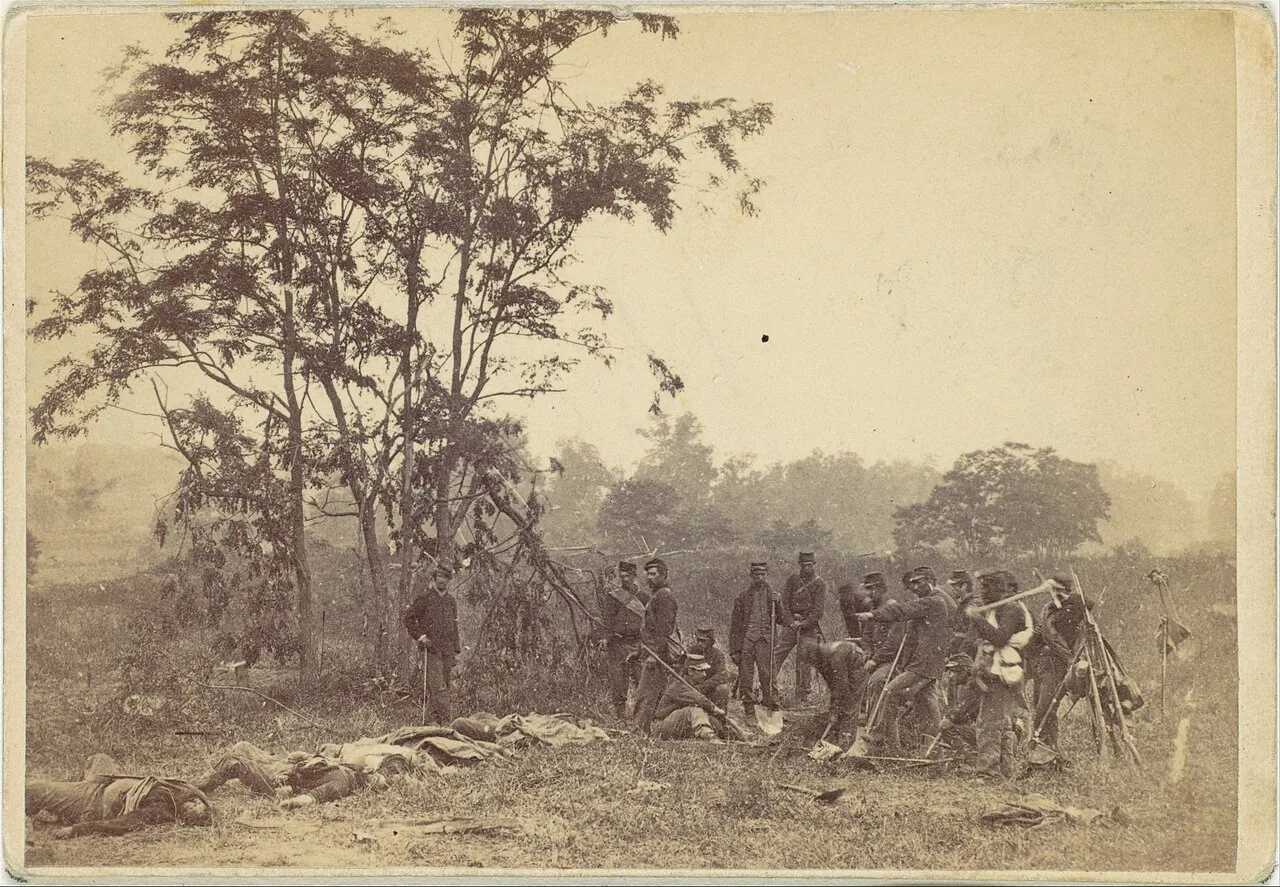
- Present the document.
- Describe what the photograph shows.
- Explain why photographs like this one changed how civilians saw the war.
Exercise 12 : Lincoln’s portrait
Study the photograph.
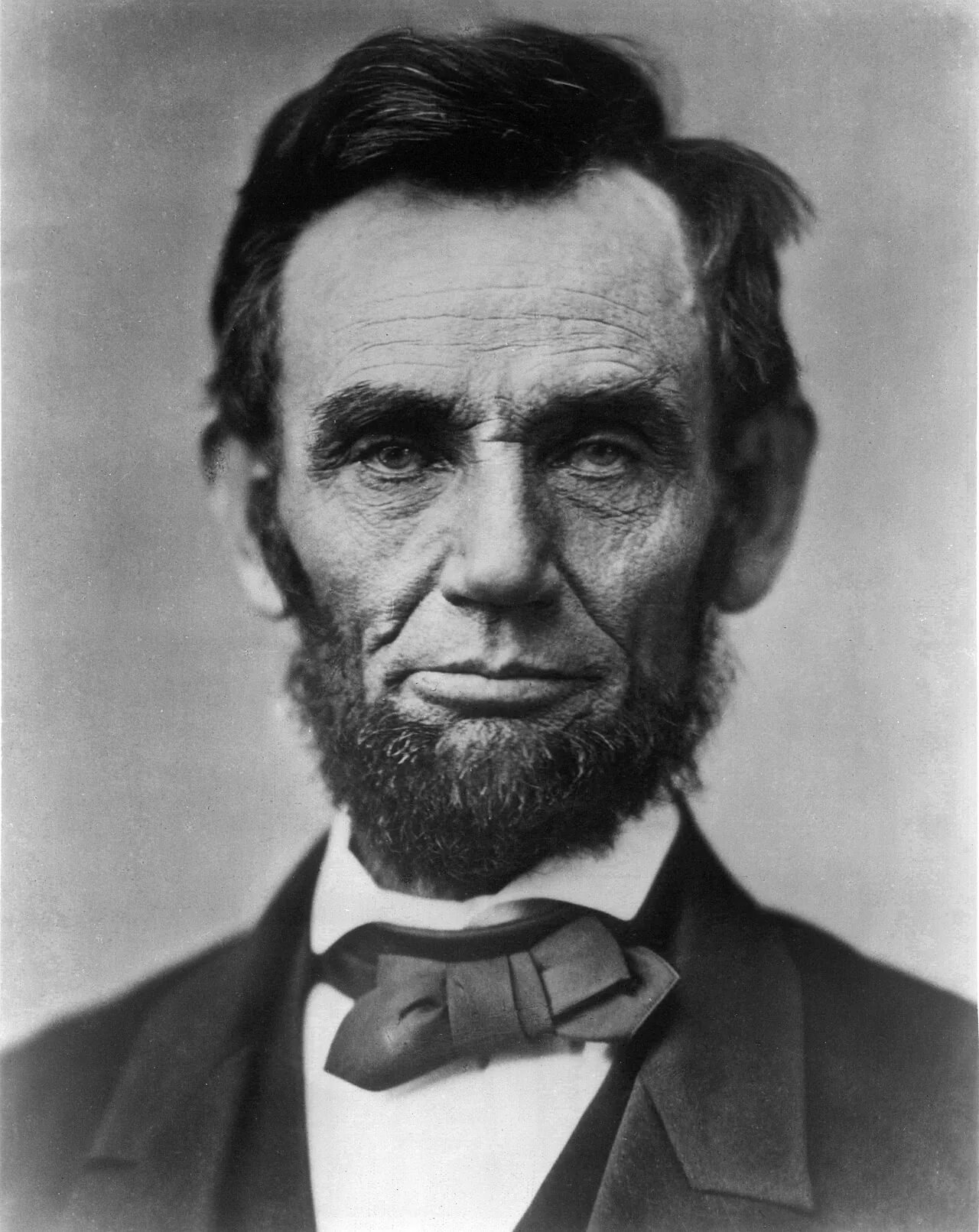
- Present the document.
- Describe Lincoln’s appearance.
- Explain what the photograph can and cannot tell a historian.
Exercise 13 : Terror in the South
Study the cartoon.
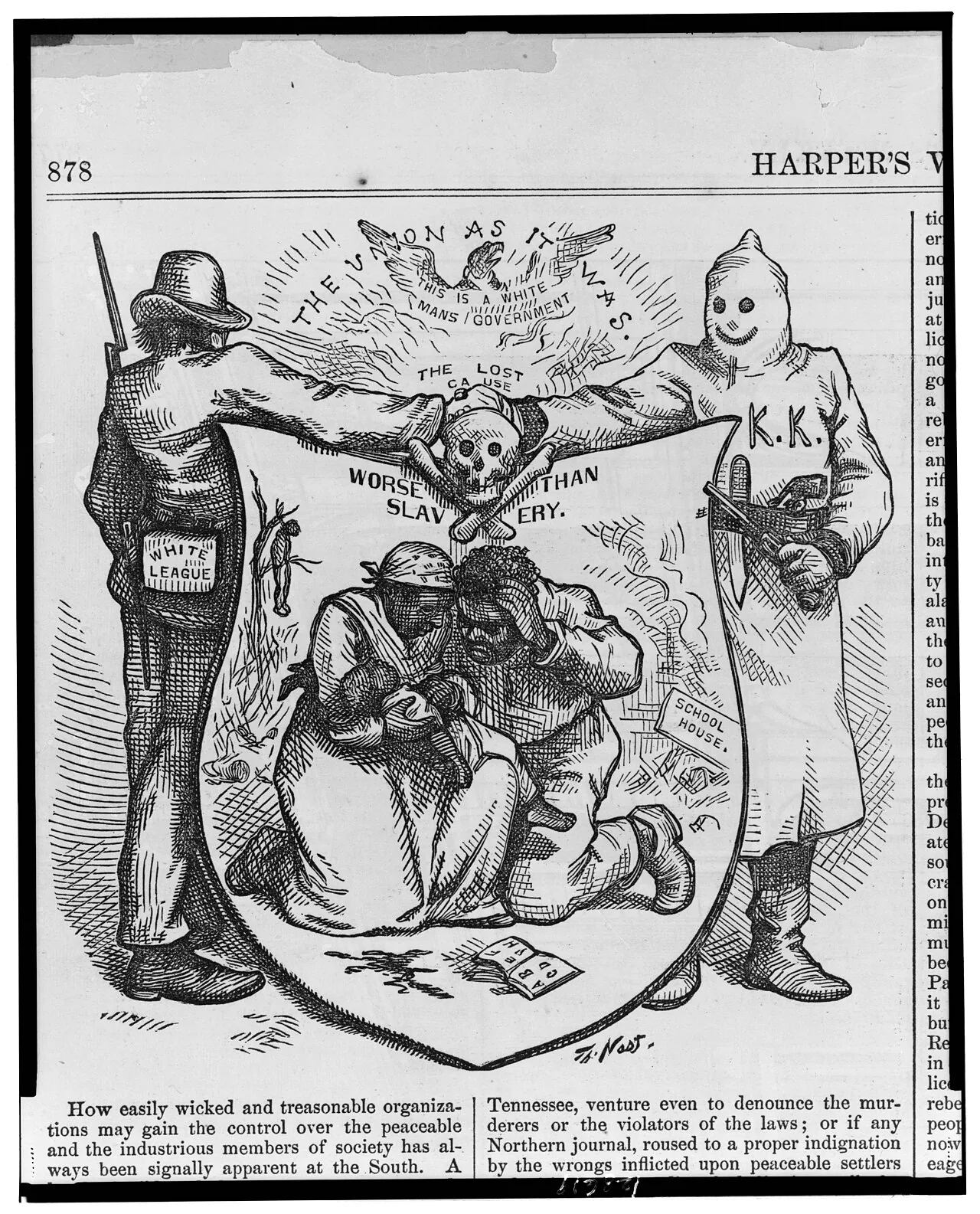
- Present the document and its date.
- Describe the figures and the symbols.
- Explain the cartoonist’s argument.
Exercise 14 : Emancipation: text and image
Compare the two documents.
Document A
That on the first day of January, in the year of our Lord one thousand eight hundred and sixty-three, all persons held as slaves within any State or designated part of a State, the people whereof shall then be in rebellion against the United States, shall be then, thenceforward, and forever free;
Source: Abraham Lincoln, Emancipation Proclamation, January 1, 1863 (quoting the preliminary proclamation of September 22, 1862); the Avalon Project, Yale Law School.
Document B
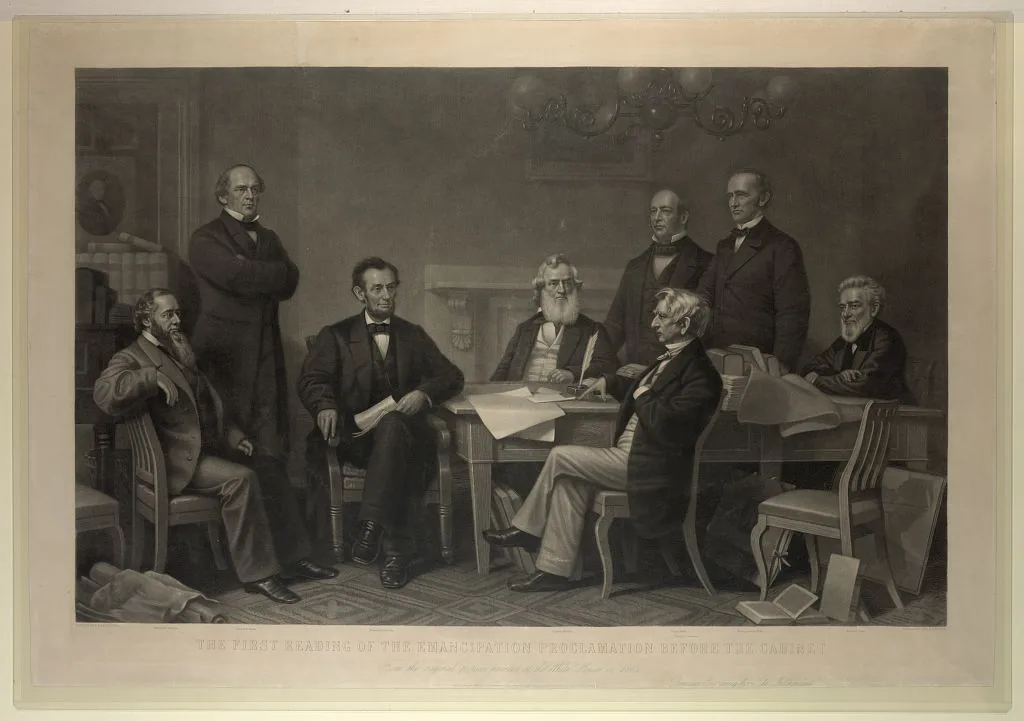
- Present each document.
- Describe what each tells us about the decision.
- Explain a limit of the print as evidence.
Exercise 15 : Slavery and the nation in 1850 and 1860
Use the table.
| Year | Enslaved people | Free Black people | Total U.S. population |
|---|---|---|---|
| 1850 | 3,204,313 | 434,495 | 23,191,876 |
| 1860 | 3,953,760 | 488,070 | 31,443,321 |
Source: U.S. Census Bureau, decennial censuses, as reported in the article “Slavery in the United States” (Wikipedia, consulted November 2026).
- By how many people did the enslaved population grow between 1850 and 1860?
- What share of the nation’s people was enslaved in 1860 (to the nearest percent)?
- Explain why the number mattered to Southern leaders in 1860.
Exercise 16 : Map reading: expansion and compromise
Use the numbered map.
- Name places 1 to 3 (San Francisco, San Antonio, St. Louis).
- What does the dashed line mark?
- Why did the Mexican Cession reopen the slavery debate?
Exercise 17 : Map reading: the Civil War
Use Map 2.
- Where was the war’s first shot fired?
- Which battles gave the Union control of the Mississippi and stopped Lee’s invasion of the North?
- What was the purpose of Sherman’s march?
Exercise 18 : Chronology: from Mexico to Hayes
Order these events and compute the span: Fort Sumter; Treaty of Guadalupe Hidalgo; Dred Scott decision; Compromise of 1877; Emancipation Proclamation; Kansas-Nebraska Act.
Exercise 19 : SAQ: Reconstruction
Answer in complete sentences. (a) Identify one change Reconstruction brought to the South. (b) Identify one way in which Reconstruction failed to secure equality. (c) Explain one reason Reconstruction ended.
Exercise 20 : Guided research: the Freedmen’s Bureau
Mini-investigation. Search for: “Freedmen’s Bureau 1865” and “Hiram Revels Senate 1870.” Reliable sites: National Archives (archives.gov), Library of Congress, U.S. Senate (senate.gov). Fill in: (1) the creation date and purpose of the Bureau; (2) two services it provided; (3) why white Southerners and President Johnson opposed it; (4) one fact about Revels.
Exercise 21 : LEQ planning: causes of the Civil War
AP LEQ prompt: “Evaluate the extent to which the debate over the expansion of slavery into the territories caused the Civil War.” Write a thesis and outline two paragraphs.
Exercise 22 : DBQ practice: Reconstruction and rights
DBQ prompt: “Evaluate the extent to which the Civil War and Reconstruction changed the meaning of citizenship.” Use Documents A and B and one piece of outside evidence.
Document A – Dred Scott (1857)
They had for more than a century before been regarded as beings of an inferior order, and altogether unfit to associate with the white race, either in social or political relations; and so far inferior, that they had no rights which the white man was bound to respect; and that the negro might justly and lawfully be reduced to slavery for his benefit. He was bought and sold, and treated as an ordinary article of merchandise and traffic, whenever a profit could be made by it. This opinion was at that time fixed and universal in the civilized portion of the white race. It was regarded as an axiom in morals as well as in politics, which no one thought of disputing, or supposed to be open to dispute;
Source: Chief Justice Roger B. Taney, opinion of the Court, Dred Scott v. Sandford, 60 U.S. 393 (1857); Legal Information Institute, Cornell Law School.
Document B – Fourteenth Amendment (1868)
Section 1. All persons born or naturalized in the United States, and subject to the jurisdiction thereof, are citizens of the United States and of the State wherein they reside. No State shall make or enforce any law which shall abridge the privileges or immunities of citizens of the United States; nor shall any State deprive any person of life, liberty, or property, without due process of law; nor deny to any person within its jurisdiction the equal protection of the laws.
Source: The Fourteenth Amendment, Section 1, ratified July 9, 1868; the National Archives.


Quick review: flashcards
Tap a card to see the answer.