



This Grade 6 Ancient Civilizations lesson covers Early Humans and the Paleolithic Era, part of the unit “Early humans.” First, read the full lesson with its primary sources, maps and key terms. Then practice with the worksheet, check yourself with the quiz and get ready with the test.
Imagine a world with no cities, no farms, no writing, and no shops. Every meal has to be hunted, caught, or picked, and every night you need a safe place to sleep. For more than 99 percent of the time that humans have existed, this was the only way of life. Historians call this immense period the Paleolithic Era, or Old Stone Age. It begins with the first stone tools, about 3.3 million years ago, and ends roughly 12,000 years ago. During those long ages, our ancestors changed physically and mentally, invented tools and fire, created art, and spread from Africa to nearly every part of the world.
Guiding question: How did early humans survive, adapt, and spread across the world during the Paleolithic Era?
1. How do we know about people who left no writing?
Early humans did not write anything down, so we cannot read their words. Instead, scientists study the objects and remains they left behind. Archaeologists dig carefully at ancient sites and record exactly where each object lies. Paleoanthropologists study fossil bones to learn how the bodies of our ancestors looked and moved. Together, they act like detectives who piece together a story from small clues: a tooth, a stone blade, the ashes of a fire, a painted wall.
Definition: prehistory
The time before people invented writing. Because there are no written records, our knowledge of prehistory comes from archaeology, fossils, and scientific dating methods.
Definition: Paleolithic Era
From the Greek words for “old” and “stone.” The Old Stone Age, the first and longest part of human history, when people made tools of chipped stone, wood, and bone and lived by hunting and gathering.
Dating the past
Dating is a major challenge. Scientists use several methods. Radiocarbon dating measures a form of carbon in once-living material such as charcoal or bone and works for objects up to about 50,000 years old. For older finds, specialists measure radioactive elements in volcanic ash layers or use methods such as thermoluminescence, which estimates when flint or sand was last heated. Each method has a margin of error, which is why you often see dates written like “315 plus or minus 34 thousand years.” New discoveries can also change the story, so historians always say “the evidence suggests” rather than “we know for certain.”
The Paleolithic is usually divided into three stages: the Lower Paleolithic (from the first tools to about 300,000 years ago), the Middle Paleolithic (about 300,000 to 50,000 years ago), and the Upper Paleolithic (about 50,000 years ago to the end of the Ice Age). These labels help us organize a very long past.
Even before there were fossils to dig up, thinkers wondered where humans came from. In 1871, the English naturalist Charles Darwin published a bold guess, based on the animals he knew. Read it as a historian: Darwin had very few fossils to work with.
Document 1 – Darwin guesses where humans began
In each great region of the world the living mammals are closely related to the extinct species of the same region. It is therefore probable that Africa was formerly inhabited by extinct apes closely allied to the gorilla and chimpanzee; and as these two species are now man’s nearest allies, it is somewhat more probable that our early progenitors lived on the African continent than elsewhere.
Source: Charles Darwin, The Descent of Man, and Selection in Relation to Sex, Part I, chapter 6, London, 1871 (English, text of Wikisource).
Commentary. Darwin reasoned that humans are most closely related to the gorilla and chimpanzee, which live only in Africa. So the first humans probably lived there too. At the time, almost no early human fossils had been found in Africa, so this was a hypothesis, not a proven fact. Nearly 150 years of discoveries have supported his idea, as the next sections show.
2. From Lucy to Homo sapiens
The first upright walkers
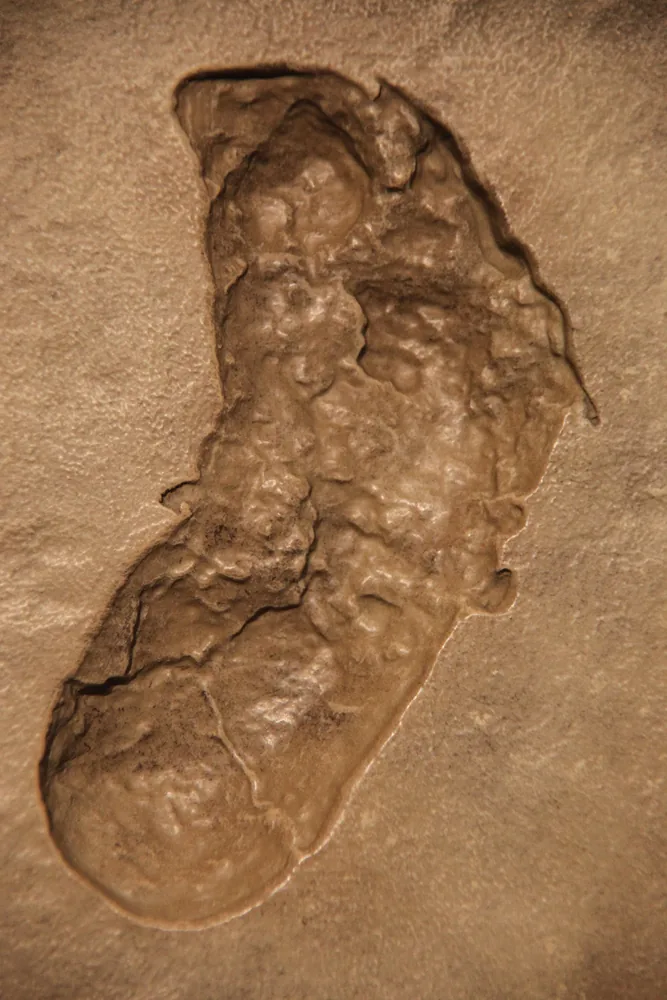
The human family tree includes many species, which scientists call hominins. The earliest well-known group walked upright on two legs but still had small brains and climbed trees. In 1978, a team led by the archaeologist Mary Leakey found a trail of footprints about 88 feet (27 meters) long at Laetoli, Tanzania, pressed into volcanic ash about 3.66 million years ago. The prints were made by a hominin walking on two feet.
In 1974, in Hadar, Ethiopia, Donald Johanson and his team discovered the bones of a young adult female about 3.2 million years old. They nicknamed her “Lucy.” She belonged to the species Australopithecus afarensis, stood about 3 feet 7 inches tall, and walked upright. About 40 percent of her skeleton was found, an unusually complete set for such an old fossil.
Definition: hominin
A member of the human family tree: modern humans and the extinct species more closely related to us than to chimpanzees. Lucy and Homo erectus were hominins.
Tool makers and fire users
The first stone tools are among the oldest signs of human technology. Sharp flakes struck from pebbles are called Oldowan tools, after Olduvai Gorge in Tanzania; the oldest known examples are about 2.6 million years old. They were used to cut meat and scrape bones. Homo habilis, whose name means “handy person,” lived in eastern and southern Africa between about 2.4 and 1.4 million years ago.
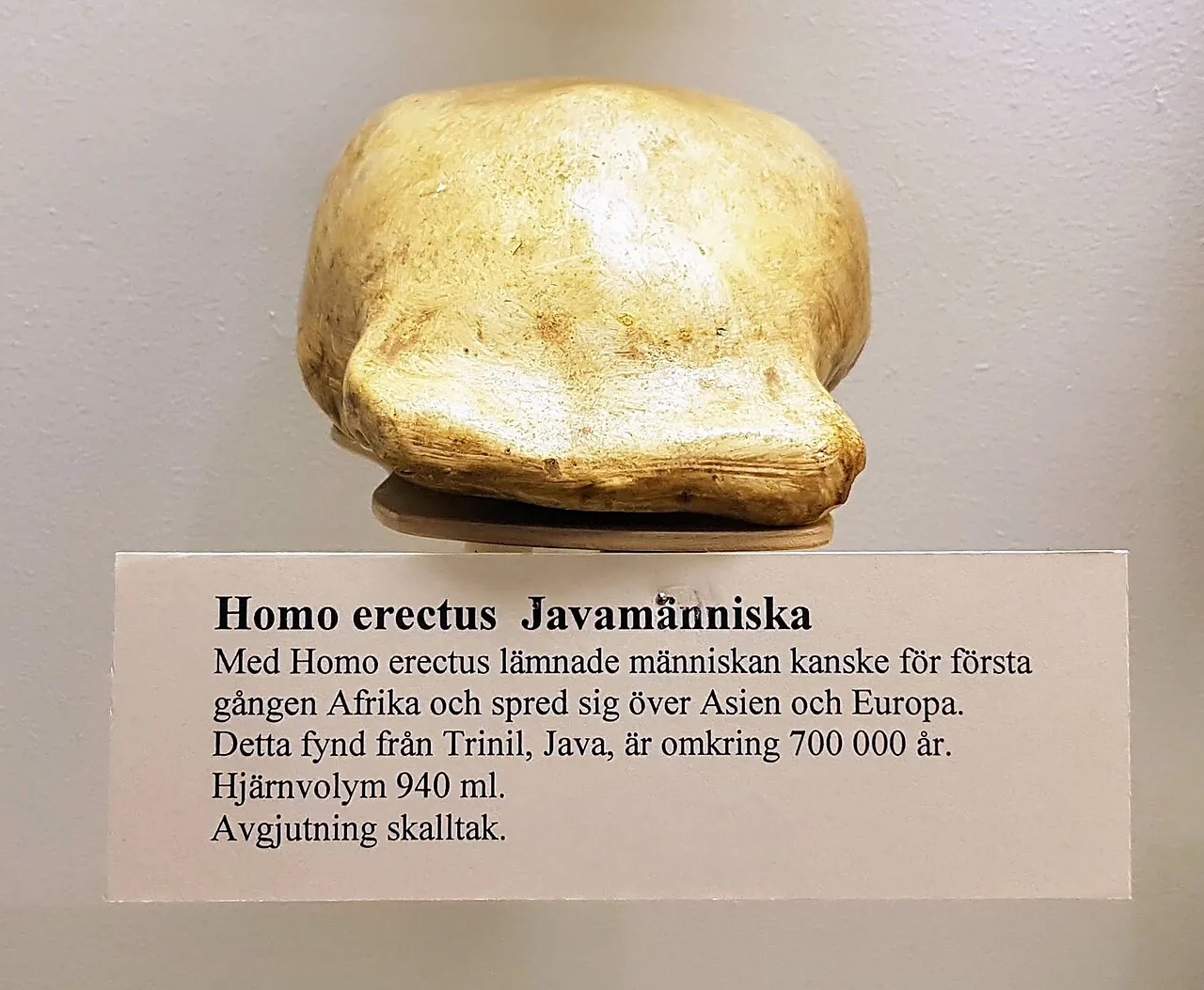
About 1.9 million years ago, Homo erectus (“upright man”) appeared. This species was taller and had a larger brain. It was the first to leave Africa and settle in western and eastern Asia; fossils have been found in Georgia, China, and Indonesia. In 1891, the Dutch doctor Eugène Dubois found a skullcap of Homo erectus at Trinil on the island of Java.
Homo erectus also made a better tool, the handaxe, a teardrop-shaped stone worked on both sides, first found at Saint-Acheul in France. Handaxes remained in use for well over a million years. According to the Smithsonian’s Human Origins program, the earliest evidence of hearths, or campfires, appears during the time range of Homo erectus. Fire kept people warm, scared off predators, lit the dark, and made food safer and easier to chew.
Definition: artifact
An object made or used by humans, such as a stone tool, a spear, or a painted bowl. Artifacts are key evidence for archaeologists.
Neanderthals and our own species
Between about 400,000 and 40,000 years ago, Neanderthals lived in Europe and parts of western and central Asia. They had short, strong bodies suited to cold climates, made sophisticated tools, hunted large animals, and buried some of their dead. Scientists named them after the Neander Valley in Germany, where bones were found in 1856. DNA research shows that people living outside Africa today still carry a small amount of Neanderthal DNA, about 1 to 2 percent, because the two groups sometimes had children together.
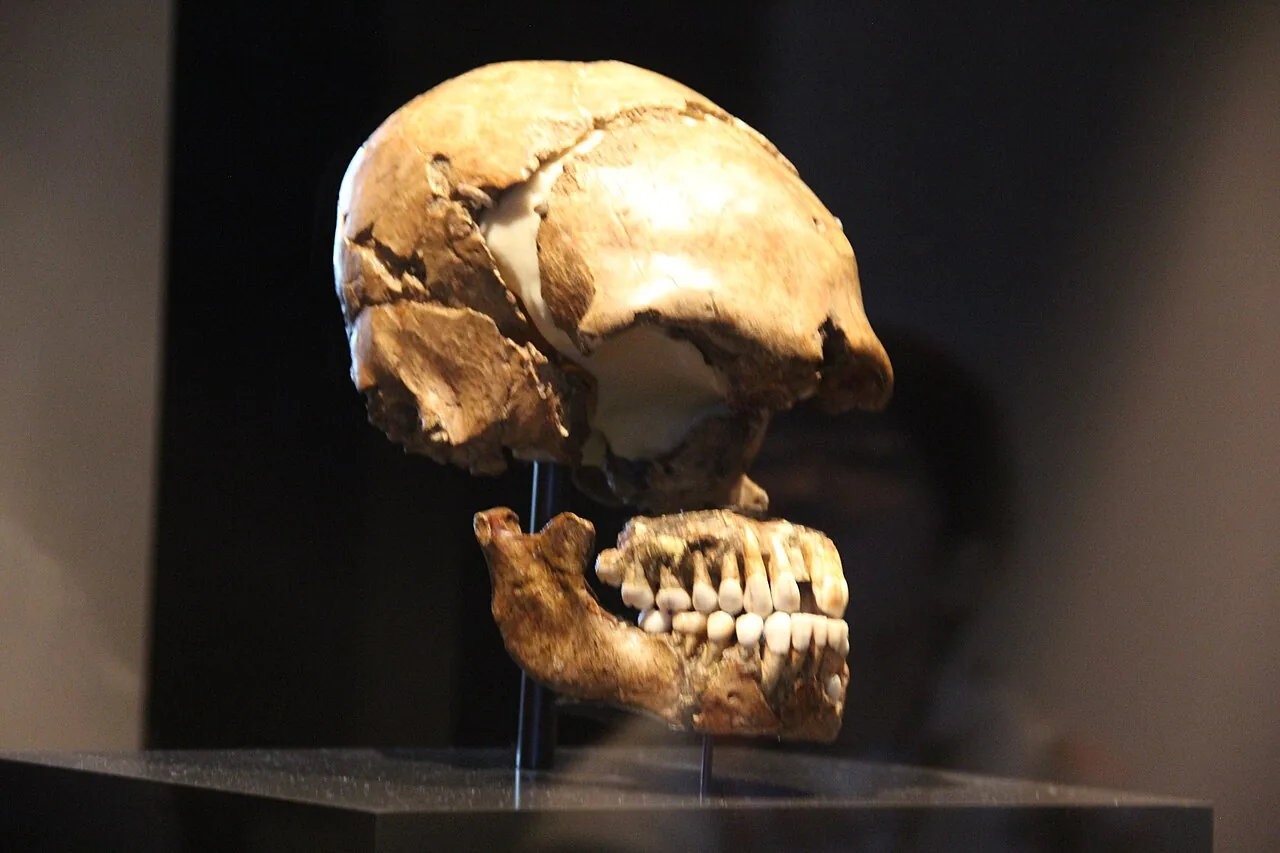
Our own species, Homo sapiens, appeared in Africa about 300,000 years ago. In 2017, an international team led by Jean-Jacques Hublin reported fossils from Jebel Irhoud in Morocco, dated to about 315,000 years ago, which pushed back the known age of our species and suggested that it emerged across the African continent, not only in one corner of it.
Document 2 – The oldest Homo sapiens fossils
Here we report newly discovered human fossils from Jebel Irhoud, Morocco, and interpret the affinities of the hominins from this site with other archaic and recent human groups. […] In combination with an age of 315 ± 34 thousand years (as determined by thermoluminescence dating), this evidence makes Jebel Irhoud the oldest and richest African Middle Stone Age hominin site that documents early stages of the H. sapiens clade […]. Furthermore, it shows that the evolutionary processes behind the emergence of H. sapiens involved the whole African continent.
Source: Jean-Jacques Hublin and colleagues, “New fossils from Jebel Irhoud, Morocco and the pan-African origin of Homo sapiens,” Nature 546 (June 8, 2017), pp. 289-292, abstract (doi:10.1038/nature22336).
Commentary. This is the abstract of a scientific article, the short summary placed at the top. It explains what the team found (fossils), how it dated them (thermoluminescence), and what it concludes. The authors write “hominins” for early humans and “Middle Stone Age” for the African period roughly equal to the Middle Paleolithic. The margin of error (plus or minus 34 thousand years) reminds us that dates are estimates.
Document 3 – Five species of early humans
| Species | Where it lived | When it lived | Height |
|---|---|---|---|
| Australopithecus afarensis | Eastern Africa (Ethiopia, Kenya, Tanzania) | between about 3.85 and 2.95 million years ago | males about 4 ft 11 in (151 cm); females about 3 ft 5 in (105 cm) |
| Homo habilis | Eastern and Southern Africa | 2.4 million to 1.4 million years ago | about 3 ft 4 in to 4 ft 5 in (100-135 cm) |
| Homo erectus | Africa, western Asia (Dmanisi, Georgia), East Asia (China and Indonesia) | between about 1.89 million and 110,000 years ago | 4 ft 9 in to 6 ft 1 in (145-185 cm) |
| Homo neanderthalensis | Europe and southwestern to central Asia | about 400,000 to 40,000 years ago | males about 5 ft 5 in (164 cm); females about 5 ft 1 in (155 cm) |
| Homo sapiens | evolved in Africa, now worldwide | about 300,000 years ago to the present | not given |
Source: Smithsonian National Museum of Natural History, Human Origins program, species pages (humanorigins.si.edu), data summarized in one table.
Commentary. The table shows that several kinds of early humans lived at the same time. For example, Neanderthals and Homo sapiens overlapped for about 260,000 years, from 300,000 to 40,000 years ago. Human evolution was not a straight ladder but more like a branching bush.
3. Life as a hunter-gatherer
For almost all of the Paleolithic, people lived as hunter-gatherers. They moved with the seasons to follow herds of animals and ripening plants. Because they never stayed long in one place, we call them nomads.
Definition: hunter-gatherer
A person who gets food by hunting animals, fishing, and gathering wild plants, nuts, eggs, and insects, rather than by growing crops or raising animals.
Definition: nomad
A person who moves from place to place to find food and water instead of living in one permanent home.
Bands, tools, and shelter
People lived in small groups called bands of a few dozen people, usually relatives. Cooperation was essential. Hunters worked together to track and surround animals, while others gathered fruits, seeds, roots, and shellfish, and everyone shared the food. Children learned by watching adults. Historians and archaeologists debate exactly who did which jobs, because the evidence is thin, and many scholars think tasks varied from band to band.
Tools were made of stone, wood, bone, and antler. At Schöningen in Germany, archaeologists found wooden spears about 300,000 years old, carefully shaped to fly like javelins. Later, people invented spear-throwers, harpoons, and bone needles used to sew animal skins into clothing. The Roman poet Lucretius, writing about 55 BCE, tried to imagine this distant past. He had no archaeology to help him, so his poem is a valuable view of what Romans thought about their ancestors, not evidence for what truly happened.
Document 4 – A Roman poet imagines early fire
’Twas lightning brought primevally to earth
The fire for mortals, and from thence hath spread
O’er all the lands the flames of heat. […]
Next, food to cook and soften in the flame
The sun instructed, since so oft they saw
How objects mellowed, when subdued by warmth.
Source: Lucretius, On the Nature of Things, Book V, about 55 BCE (translation by William Ellery Leonard, 1916).
Commentary. Lucretius suggests that humans first got fire from a lightning strike and then learned to cook by watching how heat softens food. Modern science also thinks early humans first used fires started naturally, by lightning, before learning to make and keep them. But Lucretius could not know the dates or the species involved. His text shows that ancient Romans were already curious about prehistory.
Shelter ranged from caves and rock overhangs to huts built of branches, hides, and even mammoth bones in the colder parts of Europe. Because people moved so often, they owned few things and carried them easily.
Language, belief, and art
Language let people plan hunts, teach skills, and pass on stories. We cannot know exactly when speech began, but Upper Paleolithic people certainly used rich language. Burials, in which bodies were laid in graves with ornaments or tools, suggest beliefs about death. And around 40,000 years ago people began to create wonderful art. In the Chauvet Cave in France, paintings are about 36,000 years old. The Lascaux Cave in the Dordogne, discovered in 1940 by four teenagers, contains hundreds of painted animals made about 17,000 years ago.
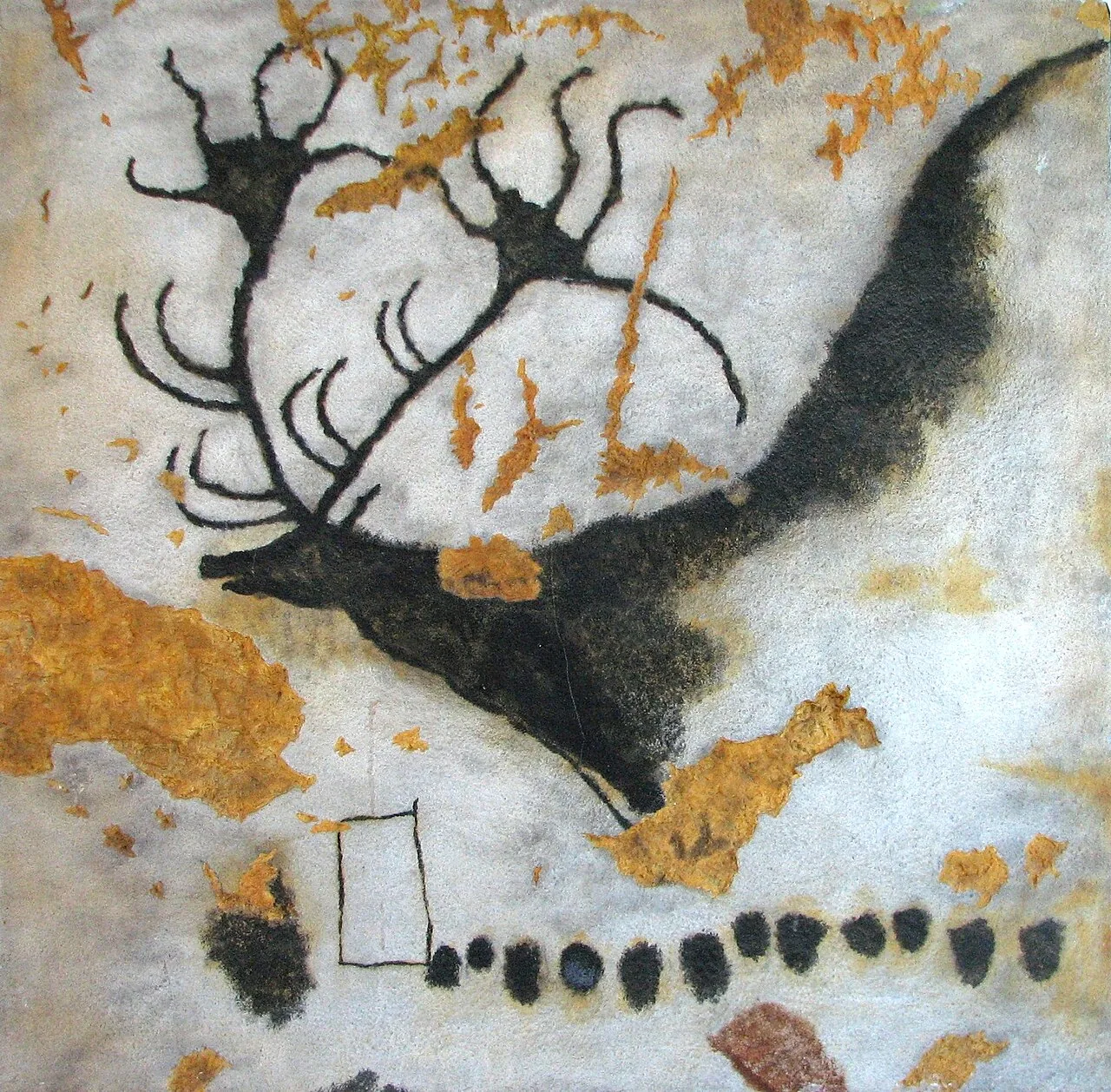
This painting shows a giant deer with enormous antlers. The artist used black outlines and a lighter pigment for the body, and the animal seems to run across the wall. We do not know why people painted such scenes. Some scholars think they were part of ceremonies, others that they honored the animals people depended on. People also carved small figurines, such as the Venus of Willendorf, a limestone statuette of a woman about 4.4 inches tall found in Austria.

4. Spreading across the planet
A migration is the movement of people from one region to another. Homo erectus was the first to leave Africa, and later groups of Homo sapiens followed, probably in several waves, starting more than 60,000 years ago. They moved slowly, over many generations, as bands looked for better hunting grounds. No one set out to “discover” a continent.
Definition: migration
The movement of people from one place to another to live. Early human migrations took place over thousands of years.
Climate shaped these journeys. During the last Ice Age, which reached its coldest point about 20,000 years ago, huge sheets of ice locked up so much water that sea levels dropped by more than 300 feet (about 100 meters). Land appeared where there is now sea. People crossed from Asia to Australia using short boat trips between islands at least 50,000 years ago. Others walked across the land bridge of Beringia, where the Bering Strait lies today, and entered the Americas by at least 15,000 years ago. Scientists still argue about the exact dates and routes, and new discoveries keep changing the picture.
Adapting to new environments
Humans adapted to nearly every environment: tropical forests, deserts, grasslands, mountains, and the icy edge of glaciers. They wore fur clothes in the cold, used fire, and learned the seasons of local plants and animals. By about 12,000 years ago the last Ice Age was ending, the climate was warming, and many big animals such as mammoths were disappearing. These changes opened the way to a very different way of life, farming, which is the subject of the next unit.
- About 3.66 million years ago Footprints are made at Laetoli, Tanzania.
- About 3.2 million years ago Lucy lives at Hadar, Ethiopia.
- About 2.6 million years ago Oldest known Oldowan stone tools.
- About 1.9 million years ago Homo erectus appears; later it leaves Africa.
- About 300,000 years ago Homo sapiens appears in Africa (Jebel Irhoud: about 315,000).
- About 40,000 years ago Neanderthals disappear; Upper Paleolithic art flourishes.
- About 17,000 years ago Painters decorate Lascaux Cave.
- About 12,000 years ago The Ice Age ends and the Paleolithic comes to a close.
Key takeaways
- The Paleolithic lasted from about 3.3 million years ago to about 12,000 years ago and is known only through archaeology, fossils, and scientific dating.
- Human ancestors evolved in Africa: Lucy, Homo habilis, Homo erectus, then Homo sapiens about 300,000 years ago. Several human species lived at the same time.
- Hunter-gatherers lived in small nomadic bands, made tools of stone, wood, and bone, used fire, and developed language, burials, and art.
- Humans spread from Africa to Asia, Europe, Australia, and the Americas, adapting to many climates.
- Historians use evidence carefully: Darwin offered an early hypothesis, while modern teams date fossils and publish results that other scientists can check.

Quick review: flashcards
Tap a card to see the answer.