


This Grade 6 Ancient Civilizations test covers Early Humans and the Paleolithic Era. Like a classroom assessment, it includes documents to analyze, knowledge questions and a short writing task. To prepare, review the lesson first, then practice with the worksheet.
Time : 50 min
The test has three parts: knowledge (28 points), documents (42 points), and a written argument (30 points). Answer in complete sentences and cite the documents.
Document 1 – Early human sites and migration routes
Schematic map prepared for this unit.
Document 2 – A painted wall
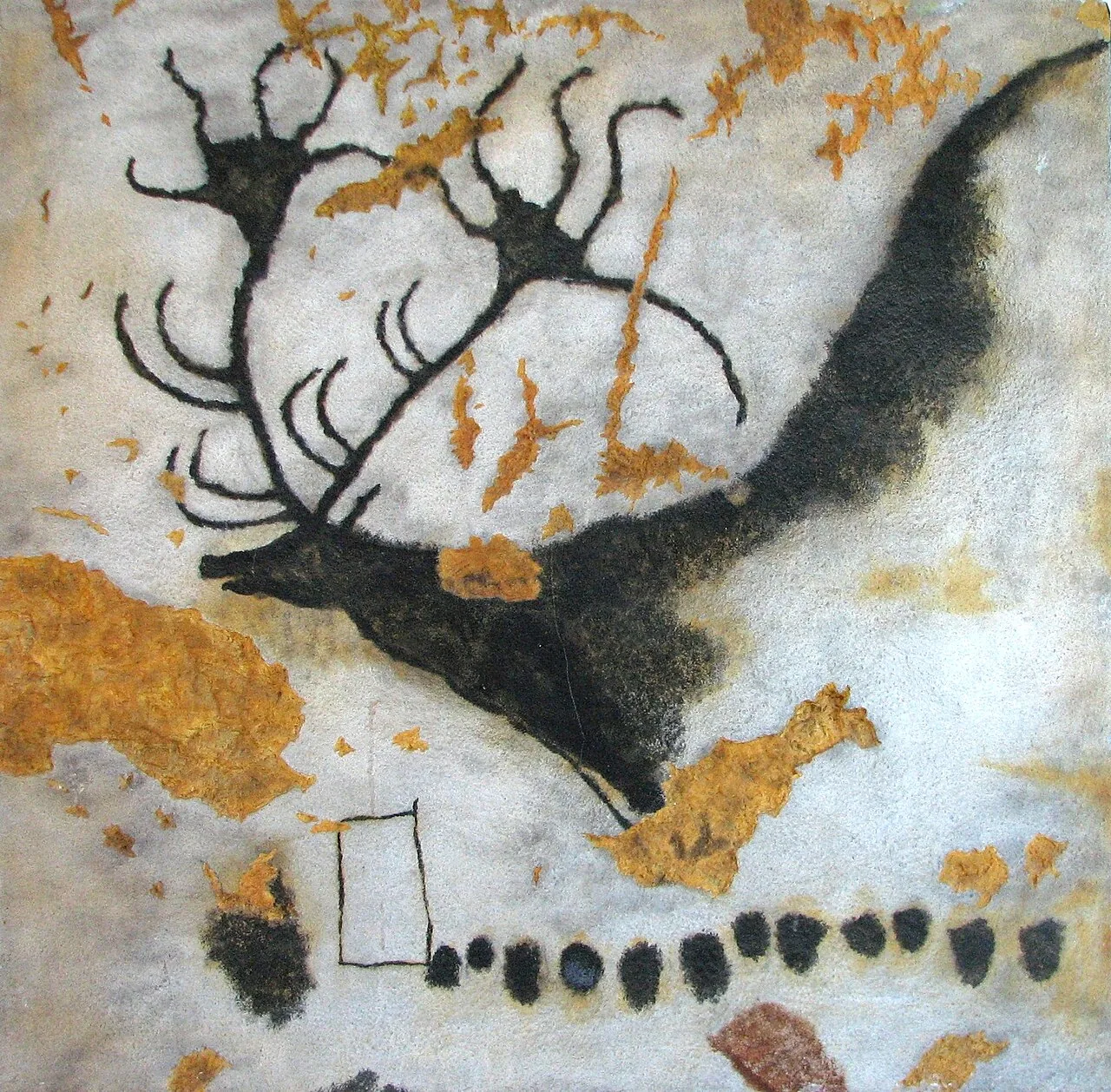
Wikimedia Commons, Lascaux Cave, Dordogne, France.
Document 3 – The oldest Homo sapiens fossils
Here we report newly discovered human fossils from Jebel Irhoud, Morocco, and interpret the affinities of the hominins from this site with other archaic and recent human groups. […] In combination with an age of 315 ± 34 thousand years (as determined by thermoluminescence dating), this evidence makes Jebel Irhoud the oldest and richest African Middle Stone Age hominin site that documents early stages of the H. sapiens clade […]. Furthermore, it shows that the evolutionary processes behind the emergence of H. sapiens involved the whole African continent.
Jean-Jacques Hublin and colleagues, “New fossils from Jebel Irhoud, Morocco and the pan-African origin of <em>Homo sapiens</em>,” <em>Nature</em> 546 (June 8, 2017), pp. 289-292, abstract (doi:10.1038/nature22336).
Document 4 – Five species of early humans
| Species | Where it lived | When it lived | Height |
|---|---|---|---|
| Australopithecus afarensis | Eastern Africa (Ethiopia, Kenya, Tanzania) | between about 3.85 and 2.95 million years ago | males about 4 ft 11 in (151 cm); females about 3 ft 5 in (105 cm) |
| Homo habilis | Eastern and Southern Africa | 2.4 million to 1.4 million years ago | about 3 ft 4 in to 4 ft 5 in (100-135 cm) |
| Homo erectus | Africa, western Asia (Dmanisi, Georgia), East Asia (China and Indonesia) | between about 1.89 million and 110,000 years ago | 4 ft 9 in to 6 ft 1 in (145-185 cm) |
| Homo neanderthalensis | Europe and southwestern to central Asia | about 400,000 to 40,000 years ago | males about 5 ft 5 in (164 cm); females about 5 ft 1 in (155 cm) |
| Homo sapiens | evolved in Africa, now worldwide | about 300,000 years ago to the present | not given |
Smithsonian National Museum of Natural History, <em>Human Origins</em> program, species pages (humanorigins.si.edu), data summarized in one table.
Questions
- Part 1 – Knowledge. Define Paleolithic Era and hunter-gatherer. (10 pts)
- Part 1. Document 1: name the continent where humans first evolved and name two other continents reached by early humans. Explain what Beringia was. (10 pts)
- Part 1. Document 4: which species lived in Europe, and for how many years did it overlap with Homo sapiens? (8 pts)
- Part 2 – Documents. Document 2: present the document, describe what you see, and explain what it tells us about people of the Upper Paleolithic. (10 pts)
- Part 2. Document 3: present the document (nature, authors, date), state the authors’ main claim, and explain what the margin of error means. (12 pts)
- Part 2. Using Documents 1, 3, and 4, explain how the evidence supports the idea that Homo sapiens evolved in Africa. (10 pts)
- Part 2. Explain how the last Ice Age made some migrations possible. (10 pts)
- Part 3 – Written argument. Was the control of fire the most important development of the Paleolithic Era? Write a paragraph or two that makes a claim, uses at least two pieces of evidence from the documents or the lesson, and explains your reasoning. (30 pts)


Quick review: flashcards
Tap a card to see the answer.