


This Grade 6 Ancient Civilizations test covers The Neolithic Revolution and Early Farming. Like a classroom assessment, it includes documents to analyze, knowledge questions and a short writing task. To prepare, review the lesson first, then practice with the worksheet.
Time : 50 min
The test has three parts: knowledge (28 points), documents (42 points), and a written argument (30 points). Answer in complete sentences and cite the documents.
Document 1 – The Fertile Crescent
Schematic map prepared for this unit.
Document 2 – A stone tower
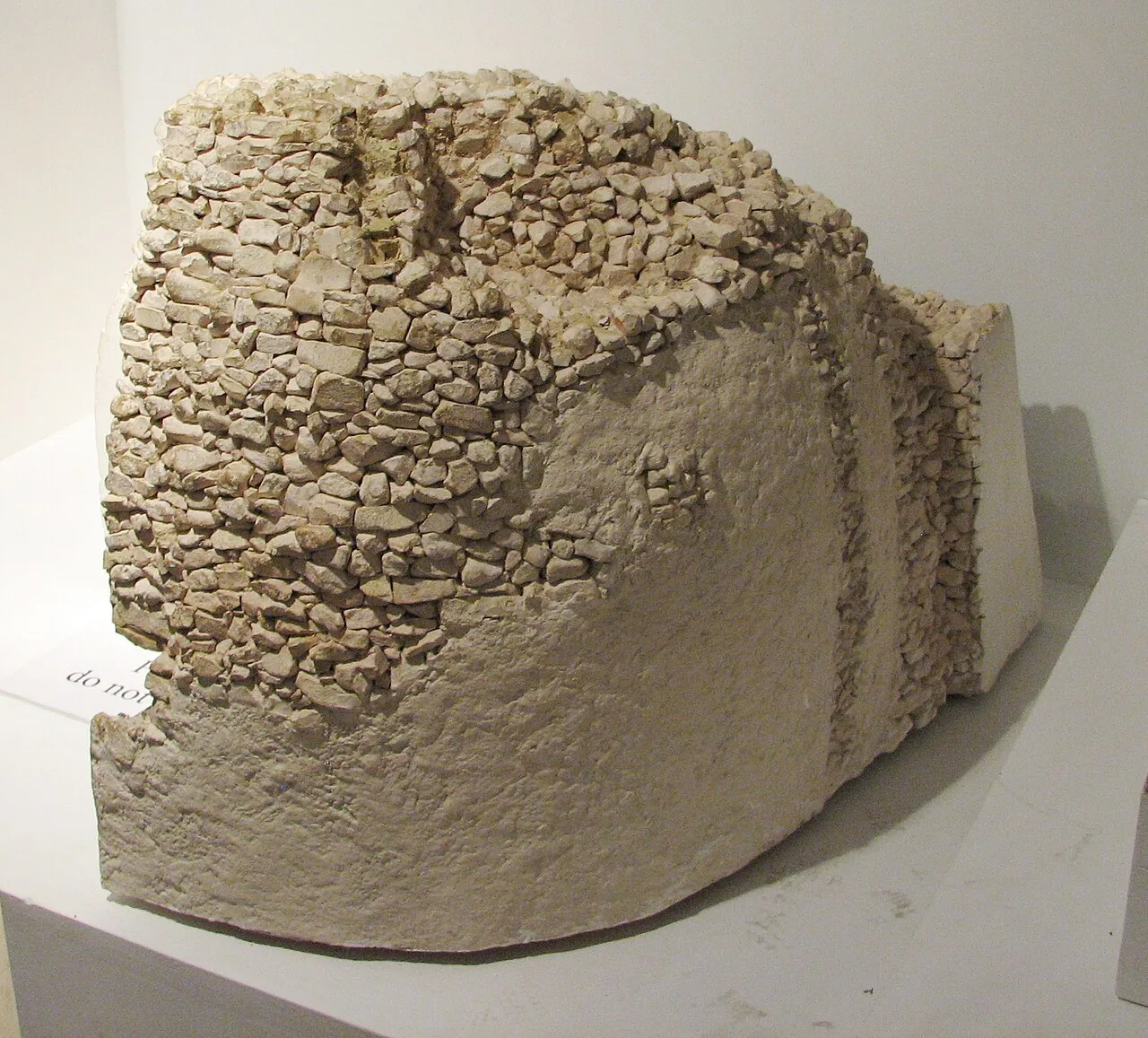
Wikimedia Commons, model of the tower of Jericho.
Document 3 – A Roman poet on planting
But Nature herself,
Mother of things, was the first seed-sower
And primal grafter; since the berries and acorns,
Dropping from off the trees, would there beneath
Put forth in season swarms of little shoots;
Hence too men’s fondness for ingrafting slips
Upon the boughs and setting out in holes
The young shrubs o’er the fields. Then would they try
Ever new modes of tilling their loved crofts,
And mark they would how earth improved the taste
Of the wild fruits by fond and fostering care.
*graft: to attach a cutting from one plant to another plant. *croft: a small field. *tilling: preparing and working the soil.
Lucretius, <em>On the Nature of Things</em>, Book V, about 55 BCE (verse translation by William Ellery Leonard, 1916).
Document 4 – Farming advice by the stars
When the Pleiades, daughters of Atlas, are rising, begin your harvest, and your ploughing when they are going to set. Forty nights and days they are hidden and appear again as the year moves round, when first you sharpen your sickle. […] strip to sow and strip to plough and strip to reap, if you wish to get in all Demeter’s fruits in due season, and that each kind may grow in its season.
*Pleiades: a cluster of stars, whose rising and setting in the sky Greek farmers used as a calendar. *Demeter: the Greek goddess of grain.
Hesiod, <em>Works and Days</em>, about 700 BCE, lines 383-392 (translation by Hugh G. Evelyn-White, 1914).
Document 5 – Pay and fines in Hammurabi’s laws
| Law | Job or crime | Pay or penalty |
|---|---|---|
| 257 | Hiring a field laborer | 8 gur of corn per year |
| 258 | Hiring an ox-driver | 6 gur of corn per year |
| 261 | Hiring a herdsman for cattle or sheep | 8 gur of corn per year |
| 259 | Stealing a water-wheel from a field | fine of 5 shekels of silver |
| 260 | Stealing a shadduf (a device to draw water) or a plow | fine of 3 shekels of silver |
Code of Hammurabi, laws 257-261 (translation by L. W. King, 1910); table prepared for this unit.
Questions
- Part 1 – Knowledge. Define Neolithic Revolution and domestication. (10 pts)
- Part 1. Document 1: name the two rivers of the eastern Fertile Crescent and give two reasons why this region was good for early farming. (10 pts)
- Part 1. Name three crops or animals that were domesticated in the Fertile Crescent and one other region where farming began independently. (8 pts)
- Part 2 – Documents. Document 2: present the document, describe the tower, and explain what it shows about a Neolithic village. (12 pts)
- Part 2. Document 3: present the document, explain how Lucretius thinks planting began, and explain why historians must be careful with this source. (12 pts)
- Part 2. Documents 4 and 5: explain how each shows that farming required planning and rules. Use one detail from each. (18 pts)
- Part 3 – Written argument. Did the Neolithic Revolution make life better for early humans? Write a paragraph or two that makes a claim, uses at least two pieces of evidence from the documents or the lesson, and explains your reasoning. (30 pts)


Quick review: flashcards
Tap a card to see the answer.