


This Grade 6 Ancient Civilizations test covers Mesopotamia and the Fertile Crescent. Like a classroom assessment, it includes documents to analyze, knowledge questions and a short writing task. To prepare, review the lesson first, then practice with the worksheet.
Time : 50 min
The test has three parts: knowledge (28 points), documents (42 points), and a written argument (30 points). Answer in complete sentences and cite the documents.
Document 1 – Map of Mesopotamia
Schematic map prepared for this unit.
Document 2 – The Code of Hammurabi
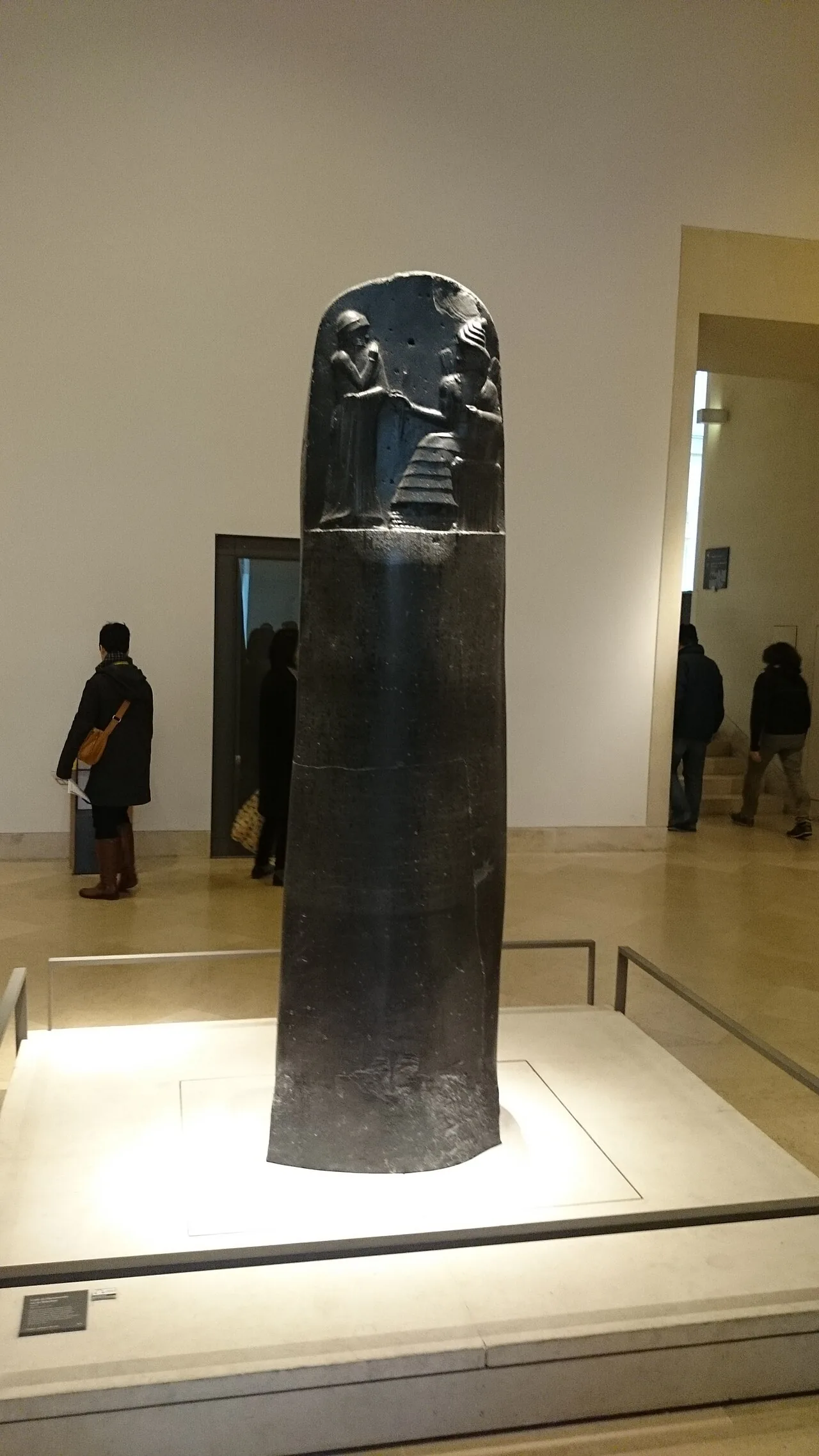
Wikimedia Commons, Louvre Museum, Paris.
Document 3 – Laws 196-200
196. If a man put out the eye of another man, his eye shall be put out.
197. If he break another man’s bone, his bone shall be broken.
198. If he put out the eye of a freed man, or break the bone of a freed man, he shall pay one gold mina.
199. If he put out the eye of a man’s slave, or break the bone of a man’s slave, he shall pay one-half of its value.
200. If a man knock out the teeth of his equal, his teeth shall be knocked out.
*freed man: a person who is not a slave but has lower status than a full citizen in this code. *mina: a unit of weight for silver or gold, about one pound. *equal: a person of the same rank.
Code of Hammurabi, laws 196-200, Babylon, about 1754 BCE (translation by L. W. King, 1910).
Document 4 – Herodotus on farming in Babylonia
But little rain falls in Assyria, enough, however, to make the corn begin to sprout, after which the plant is nourished and the ears formed by means of irrigation from the river. For the river does not, as in Egypt, overflow the corn-lands of its own accord, but is spread over them by the hand, or by the help of engines. The whole of Babylonia is, like Egypt, intersected with canals. […] Of all the countries that we know there is none which is so fruitful in grain.
*corn: here, grain such as wheat and barley. *engines: machines for lifting water. *Assyria: the northern part of Mesopotamia; Herodotus uses it for the whole region.
Herodotus, <em>Histories</em>, Book I, chapter 193, about 430 BCE (translation by George Rawlinson, 1858-1860).
Document 5 – Penalties by status
| Law | Victim of the injury | Penalty for the person who caused it |
|---|---|---|
| 196 | another man (an equal) | his own eye is put out |
| 197 | another man (an equal) | his own bone is broken |
| 198 | a freed man | pays one gold mina |
| 199 | a man’s slave | pays one-half of the slave’s value |
| 200 | an equal (teeth knocked out) | his own teeth are knocked out |
Code of Hammurabi, laws 196-200 (translation by L. W. King, 1910); table prepared for this unit.
Questions
- Part 1 – Knowledge. Define civilization and city-state. (10 pts)
- Part 1. Document 1: name the two rivers, name the body of water at the southeast, and explain why farmers needed irrigation. (10 pts)
- Part 1. Explain what cuneiform is, who used it, and why it was invented. (8 pts)
- Part 2 – Documents. Document 2: present the document, describe what you see, and explain why the king had the laws carved in public. (12 pts)
- Part 2. Documents 3 and 5: explain how the penalty depends on the victim’s class. Give two examples. (12 pts)
- Part 2. Document 4: present the document, explain how Babylonian farmers watered their fields, and explain why we must be careful with this source. (10 pts)
- Part 2. Using Documents 1 and 4, explain how geography shaped Mesopotamian farming and government. (8 pts)
- Part 3 – Written argument. Which was the most important achievement of Mesopotamian civilization: irrigation, writing, or written law? Write a paragraph or two that makes a claim, uses at least two pieces of evidence from the documents or the lesson, and explains your reasoning. (30 pts)


Quick review: flashcards
Tap a card to see the answer.