


This Grade 6 Ancient Civilizations test covers Ancient Egypt. Like a classroom assessment, it includes documents to analyze, knowledge questions and a short writing task. To prepare, review the lesson first, then practice with the worksheet.
Time : 50 min
The test has three parts: knowledge (28 points), documents (52 points), and a written argument (20 points). Answer in complete sentences and cite the documents.
Document 1 – Map of ancient Egypt
Schematic map prepared for this unit.
Document 2 – Judgment of the dead
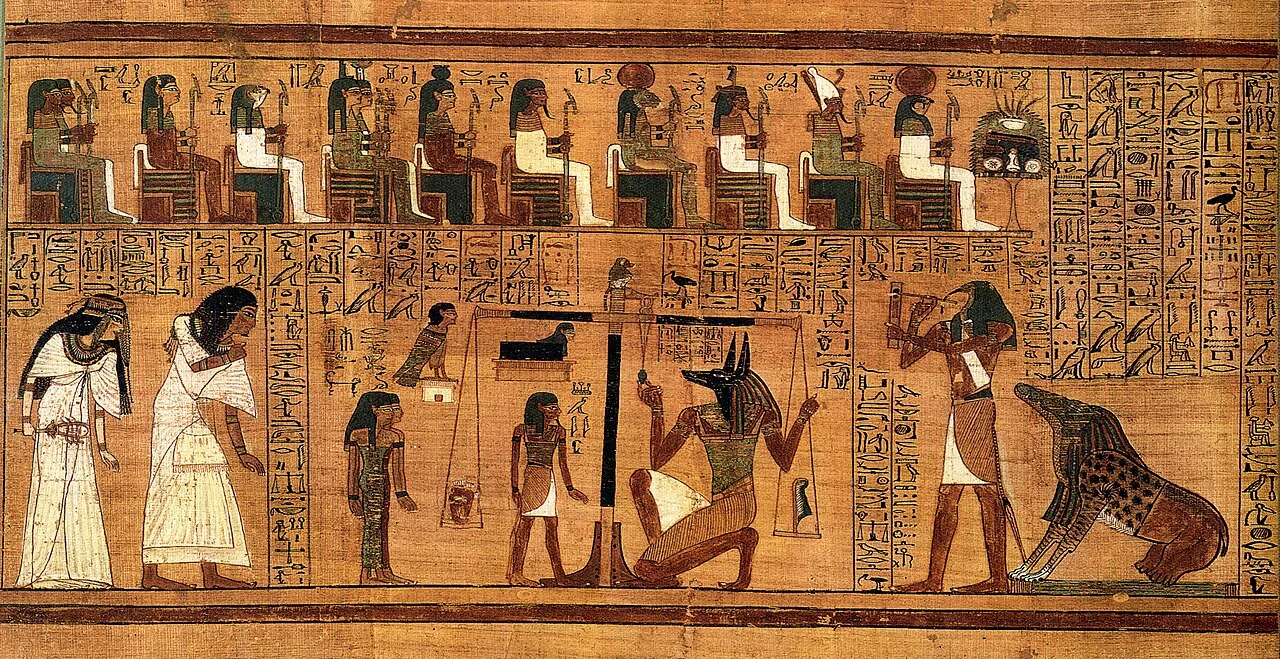
Wikimedia Commons, British Museum, London.
Document 3 – Hymn to the Nile
Hail to thee, O Nile! Who manifests thyself over this land, and comes to give life to Egypt! […] If you cease your toil and your work, then all that exists is in anguish. […] If He shines, the earth is joyous, every stomach is full of rejoicing, every spine is happy, every jaw-bone crushes. […] He spreads himself over Egypt, filling the granaries, renewing the marts, watching over the goods of the unhappy.
*marts: markets. *the goods of the unhappy: the property of the poor.
<em>Hymn to the Nile</em>, Middle Kingdom, about 2100 BCE (anonymous translation, 1907, published on Wikisource).
Document 4 – Herodotus on the Great Pyramid
Some were required to drag blocks of stone down to the Nile from the quarries in the Arabian range of hills; others received the blocks after they had been conveyed in boats across the river, and drew them to the range of hills called the Libyan. A hundred thousand men laboured constantly, and were relieved every three months by a fresh lot. It took ten years’ oppression of the people to make the causeway for the conveyance of the stones […]. The pyramid itself was twenty years in building.
*Arabian range, Libyan range: the hills east and west of the Nile. *causeway: a raised road. *Herodotus is describing King Cheops, the Greek name for Khufu.
Herodotus, <em>Histories</em>, Book II, chapter 124, about 430 BCE (translation by George Rawlinson, 1858-1860).
Document 5 – The pyramids of Giza
| Pyramid | King | Built about | Original height |
|---|---|---|---|
| Great Pyramid | Khufu | 2560 BCE | about 481 feet |
| Second pyramid | Khafre | 2530 BCE | about 471 feet |
| Third pyramid | Menkaure | 2500 BCE | about 215 feet |
Mark Lehner, <em>The Complete Pyramids</em> (1997), approximate figures; table prepared for this unit.
Questions
- Part 1 – Knowledge. Define pharaoh and delta, and explain why Egyptians called their land the “Black Land.” (10 pts)
- Part 1. Document 1: name the river and the two seas shown, say in which direction the river flows, and explain the difference between Upper and Lower Egypt. (12 pts)
- Part 1. Explain what the Rosetta Stone is and why it was important for historians. (6 pts)
- Part 2 – Documents. Document 2: present the document, describe the scene, and explain what it shows about Egyptian ideas of the afterlife. (14 pts)
- Part 2. Document 3: present the document and explain how it shows that Egyptians depended on the Nile. (12 pts)
- Part 2. Document 4: present the document, explain how, according to Herodotus, the Great Pyramid was built, and explain why a historian must be careful with this source. Use Document 5 to show how big the Great Pyramid was compared with the third pyramid. (16 pts)
- Part 2. Using Documents 1 and 3, explain how geography shaped Egyptian farming and religion. (10 pts)
- Part 3 – Written argument. Which was more important to ancient Egypt: the Nile or the pharaoh? Write a paragraph or two with a claim, at least two pieces of evidence from the documents or the lesson, and your reasoning. (20 pts)


Quick review: flashcards
Tap a card to see the answer.