


This worksheet on Ancient Egypt belongs to the Grade 6 Ancient Civilizations course. Its questions use primary sources, maps and timelines, and they move from basic recall to short writing tasks. Before you start, review the lesson; afterward, try the true or false quiz.
Exercise 1 : Vocabulary of ancient Egypt
Define each word, then use it in a sentence.
- Nile
- delta
- silt
- pharaoh
- scribe
- mummification
- hieroglyphs
Hint: use the definition boxes and the lesson.
Exercise 2 : The gift of the river
Document 1 – Herodotus on Egypt and the Nile
For any one who sees Egypt, without having heard a word about it before, must perceive, if he has only common powers of observation, that the Egypt to which the Greeks go in their ships is an acquired country, the gift of the river. […] In the first place, on approaching it by sea, when you are still a day’s sail from the land, if you let down a sounding-line you will bring up mud, and find yourself in eleven fathoms’ water, which shows that the soil washed down by the stream extends to that distance.
Source: Herodotus, Histories, Book II, chapter 5, about 430 BCE (translation by George Rawlinson, 1858-1860).
*acquired country: land that was formed over time, here by mud left by the river. *fathom: a unit of depth, about six feet.
- Present the document (nature, author, date, context).
- What does Herodotus mean by “an acquired country, the gift of the river”?
- What evidence does he give to support his claim?
- Explain how the Nile helped Egyptian farmers.
- Herodotus was a Greek visitor. Why should a historian check his claims against other evidence?
Hint: look for the part of the text about mud and the sounding-line.
Exercise 3 : A hymn to the river
Document 1 – Hymn to the Nile
Hail to thee, O Nile! Who manifests thyself over this land, and comes to give life to Egypt! […] If you cease your toil and your work, then all that exists is in anguish. […] If He shines, the earth is joyous, every stomach is full of rejoicing, every spine is happy, every jaw-bone crushes. […] He spreads himself over Egypt, filling the granaries, renewing the marts, watching over the goods of the unhappy.
Source: Hymn to the Nile, Middle Kingdom, about 2100 BCE (anonymous translation, 1907, published on Wikisource).
*marts: markets. *the goods of the unhappy: the property of the poor.
- Present the document.
- List two things the hymn says the Nile gives to Egypt.
- According to the hymn, what happens if the Nile stops its work?
- Explain why Egyptians would write a hymn to a river.
- Compare the tone of this hymn with that of Herodotus in the other documents of this unit.
Exercise 4 : Advice for a young man
Document 1 – Advice from the vizier Ptahhotep: be humble
Be not proud because thou art learned; but discourse with the ignorant man, as with the sage. For no limit can be set to skill, neither is there any craftsman that possesseth full advantages. Fair speech is more rare than the emerald that is found by slave-maidens on the pebbles.
Source: The Instruction of Ptah-hotep, maxim 1, attributed to a vizier of the Old Kingdom, about 2400 BCE (translation by Battiscombe Gunn, 1906).
*vizier: the pharaoh’s chief minister. *sage: a wise person. *emerald: a green gemstone.
- Present the document (nature, author, date).
- What does Ptahhotep tell his reader not to be?
- Why does he say that no one has “full advantages”?
- What does this text tell us about the values of Egyptian officials?
- Which value in this text would still be useful in a classroom today? Explain.
Exercise 5 : Herodotus and the Great Pyramid
Document 1 – Herodotus on the building of the Great Pyramid
Some were required to drag blocks of stone down to the Nile from the quarries in the Arabian range of hills; others received the blocks after they had been conveyed in boats across the river, and drew them to the range of hills called the Libyan. A hundred thousand men laboured constantly, and were relieved every three months by a fresh lot. It took ten years’ oppression of the people to make the causeway for the conveyance of the stones […]. The pyramid itself was twenty years in building.
Source: Herodotus, Histories, Book II, chapter 124, about 430 BCE (translation by George Rawlinson, 1858-1860).
*Arabian range, Libyan range: the hills east and west of the Nile. *causeway: a raised road. *Herodotus is describing King Cheops, the Greek name for Khufu.
Document 2 – The pyramids of Giza today
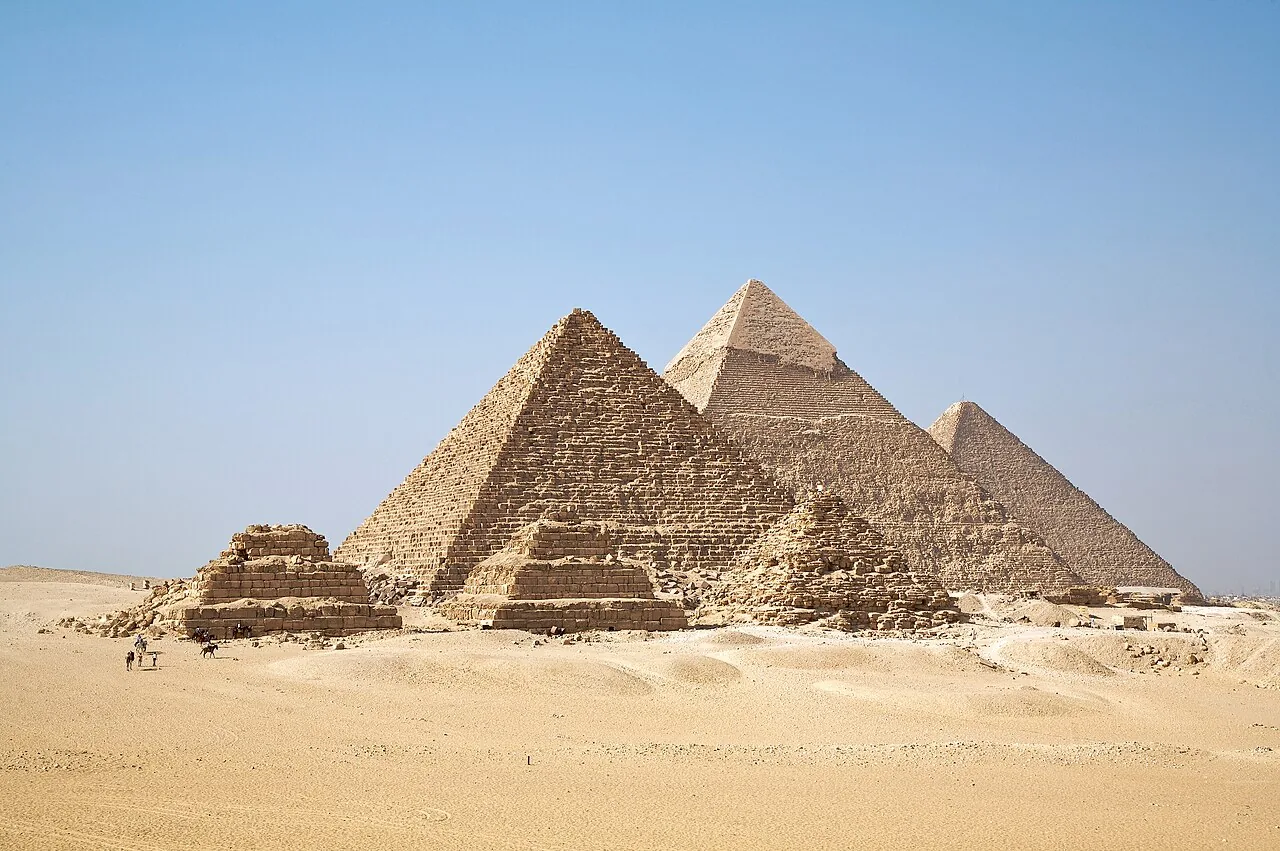
- Present both documents.
- According to Herodotus, how many people worked on the Great Pyramid, and for how long?
- Describe the monuments in Document 2.
- Archaeologists have found that the builders were paid, fed workers, not mainly slaves. Explain what this changes in our reading of Document 1.
- Why do historians need both written sources and archaeology?
Exercise 6 : Two views of the Nile
Document 1 – Herodotus on Egypt and the Nile
For any one who sees Egypt, without having heard a word about it before, must perceive, if he has only common powers of observation, that the Egypt to which the Greeks go in their ships is an acquired country, the gift of the river. […] In the first place, on approaching it by sea, when you are still a day’s sail from the land, if you let down a sounding-line you will bring up mud, and find yourself in eleven fathoms’ water, which shows that the soil washed down by the stream extends to that distance.
Source: Herodotus, Histories, Book II, chapter 5, about 430 BCE (translation by George Rawlinson, 1858-1860).
*acquired country: land that was formed over time, here by mud left by the river. *fathom: a unit of depth, about six feet.
Document 2 – Hymn to the Nile
Hail to thee, O Nile! Who manifests thyself over this land, and comes to give life to Egypt! […] If you cease your toil and your work, then all that exists is in anguish. […] If He shines, the earth is joyous, every stomach is full of rejoicing, every spine is happy, every jaw-bone crushes. […] He spreads himself over Egypt, filling the granaries, renewing the marts, watching over the goods of the unhappy.
Source: Hymn to the Nile, Middle Kingdom, about 2100 BCE (anonymous translation, 1907, published on Wikisource).
*marts: markets. *the goods of the unhappy: the property of the poor.
- Present each document.
- What does each author say about the importance of the river?
- What is the main difference between the two authors’ points of view?
- Which source would a scientist use to study how the delta formed? Which one tells us more about Egyptian beliefs?
- Write a sentence that uses both documents to answer: Why was the Nile so important?
Exercise 7 : What did leaders owe their people?
Document 1 – Advice from the vizier Ptahhotep: be a good leader
If thou be a leader, as one directing the conduct of the multitude, endeavour always to be gracious, that thine own conduct be without defect. Great is Truth, appointing a straight path; never hath it been overthrown since the reign of Osiris. One that oversteppeth the laws shall be punished.
Source: The Instruction of Ptah-hotep, maxim 5, attributed to a vizier of the Old Kingdom, about 2400 BCE (translation by Battiscombe Gunn, 1906).
*gracious: kind and fair. *Osiris: the god of the dead, thought of as the first king of Egypt.
Document 2 – Herodotus on the building of the Great Pyramid
Some were required to drag blocks of stone down to the Nile from the quarries in the Arabian range of hills; others received the blocks after they had been conveyed in boats across the river, and drew them to the range of hills called the Libyan. A hundred thousand men laboured constantly, and were relieved every three months by a fresh lot. It took ten years’ oppression of the people to make the causeway for the conveyance of the stones […]. The pyramid itself was twenty years in building.
Source: Herodotus, Histories, Book II, chapter 124, about 430 BCE (translation by George Rawlinson, 1858-1860).
*Arabian range, Libyan range: the hills east and west of the Nile. *causeway: a raised road. *Herodotus is describing King Cheops, the Greek name for Khufu.
- Present each document.
- What does Ptahhotep say a leader should be like?
- How does Herodotus describe the way King Khufu treated his people?
- Compare the two documents: do they agree about leadership? Explain.
- Why should we be careful about relying on either source alone?
Exercise 8 : A Greek traveler on customs
Document 1 – Herodotus on Egyptian customs
The women attend the markets and trade, while the men sit at home at the loom; and here, while the rest of the world works the woof up the warp, the Egyptians work it down; the women likewise carry burthens upon their shoulders, while the men carry them upon their heads. […] A woman cannot serve the priestly office, either for god or goddess, but men are priests to both; sons need not support their parents unless they choose, but daughters must, whether they choose or no.
Source: Herodotus, Histories, Book II, chapter 35, about 430 BCE (translation by George Rawlinson, 1858-1860).
*woof, warp: the crosswise and lengthwise threads in weaving. *burthens: burdens.
- Present the document.
- List two differences that Herodotus describes between men’s and women’s tasks.
- What does the text say about who could be a priest?
- Why might Herodotus emphasize how different Egypt was from Greece?
- Other sources show that Egyptian women could own property and go to court. How does this evidence support or challenge Herodotus?
Exercise 9 : The Narmer Palette
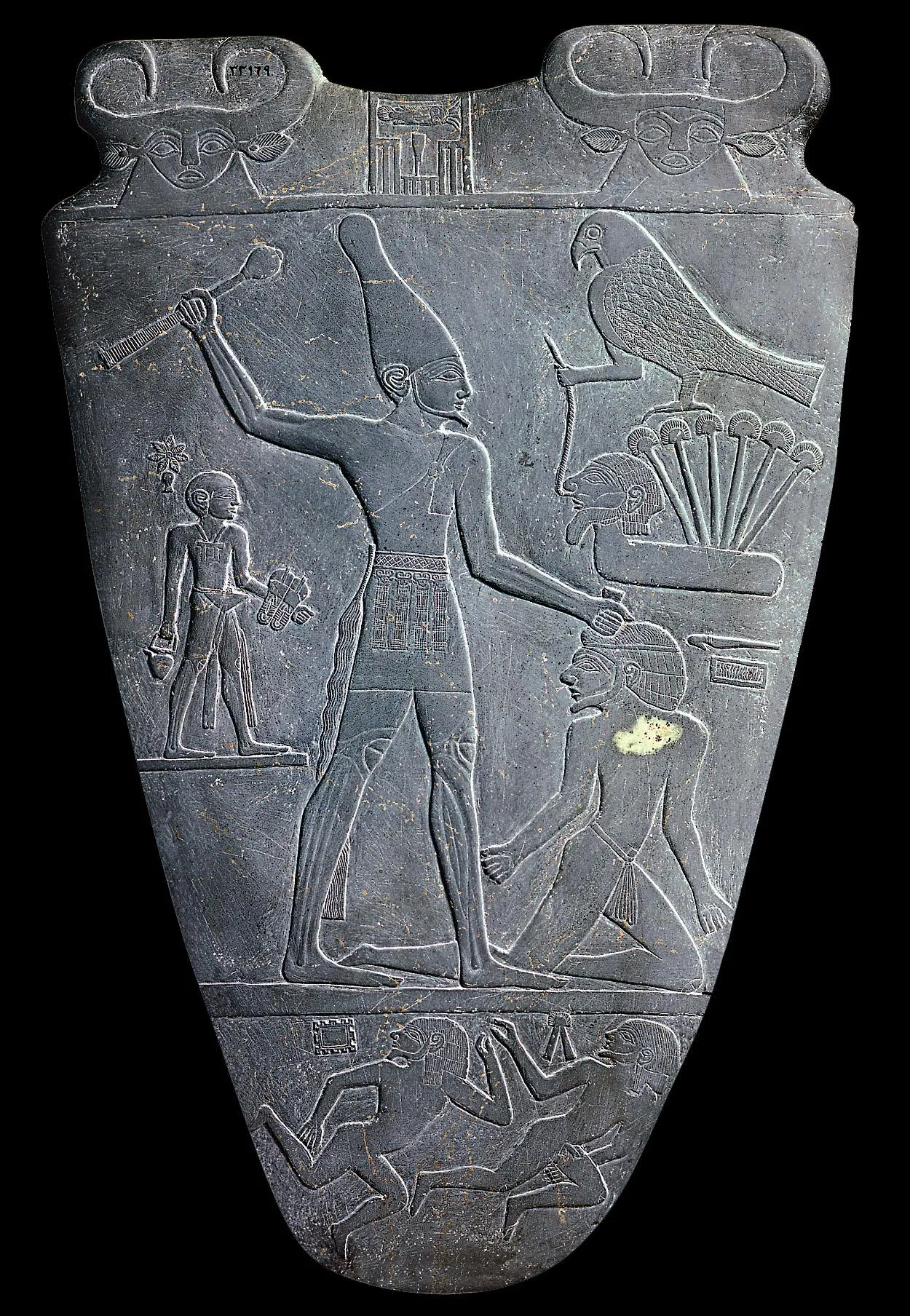
- Present the document (nature, date, place).
- Describe the main figure and what he is doing.
- What does the crown he wears tell you about the king’s region?
- Why would a king have a scene like this carved on a ceremonial object?
- Why do historians treat the palette as evidence about the unification of Egypt, although it is not a written story?
Exercise 10 : The Step Pyramid
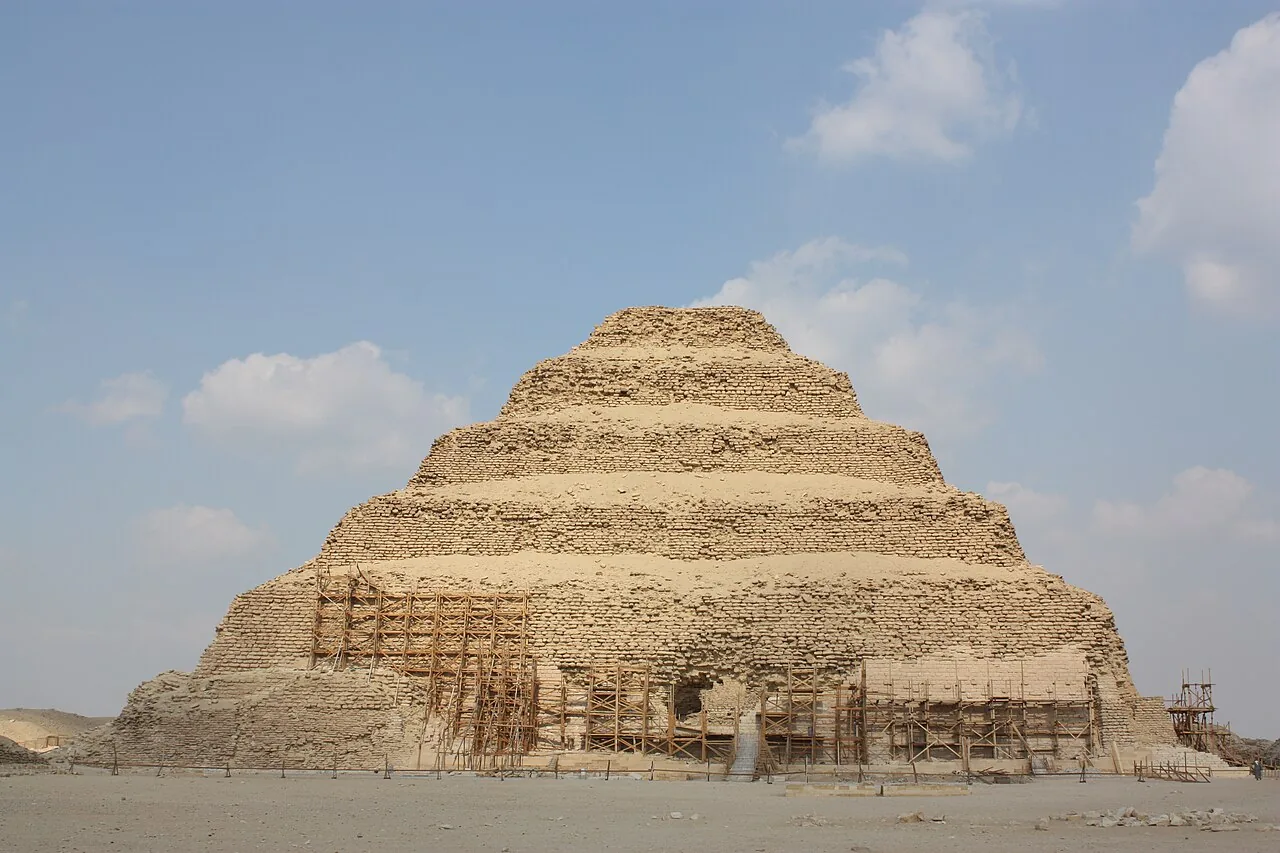
- Present the document.
- Describe the shape of the pyramid. How many levels do you see?
- How does it differ from the pyramids in the Giza photograph?
- Why was a project like this possible only for a strong government?
- What can we learn about Egyptian beliefs from the existence of a tomb this large?
Exercise 11 : Weighing the heart
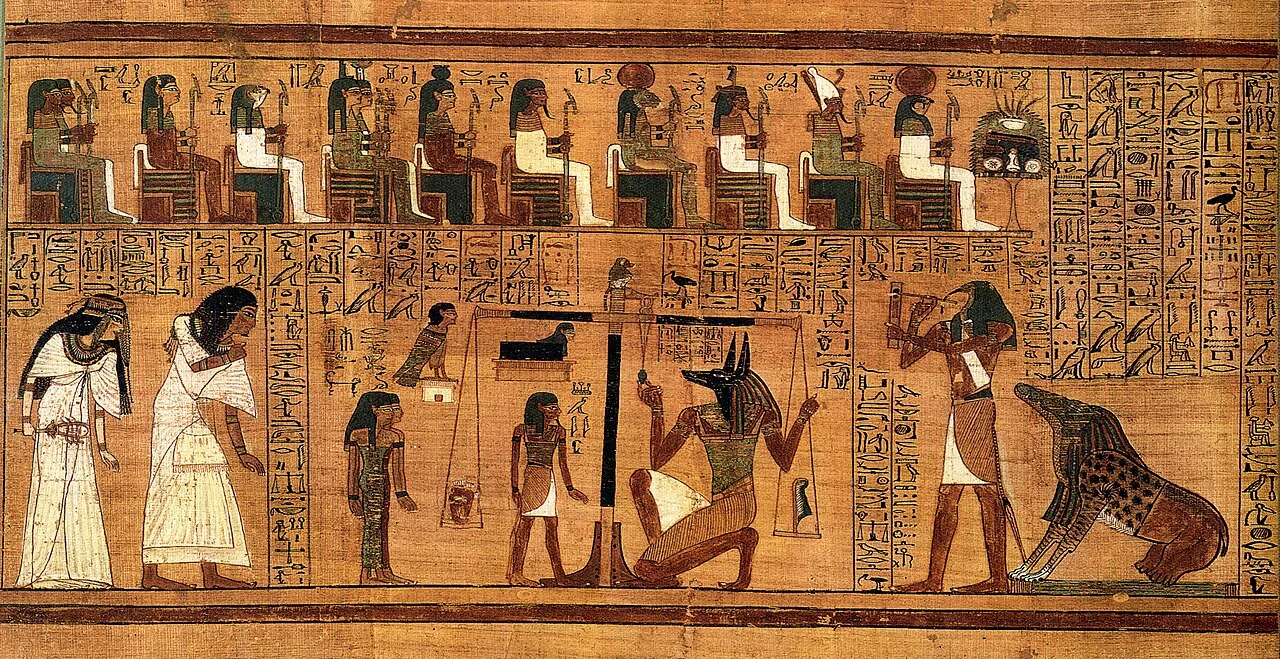
- Present the document.
- Describe the central scene: who is standing near the scale, and what is on each side?
- What is the monster at the right waiting to do?
- What does this image show about Egyptian ideas of right and wrong?
- Why can this painting be used as evidence about daily behavior, although it shows a religious scene?
Exercise 12 : The Rosetta Stone
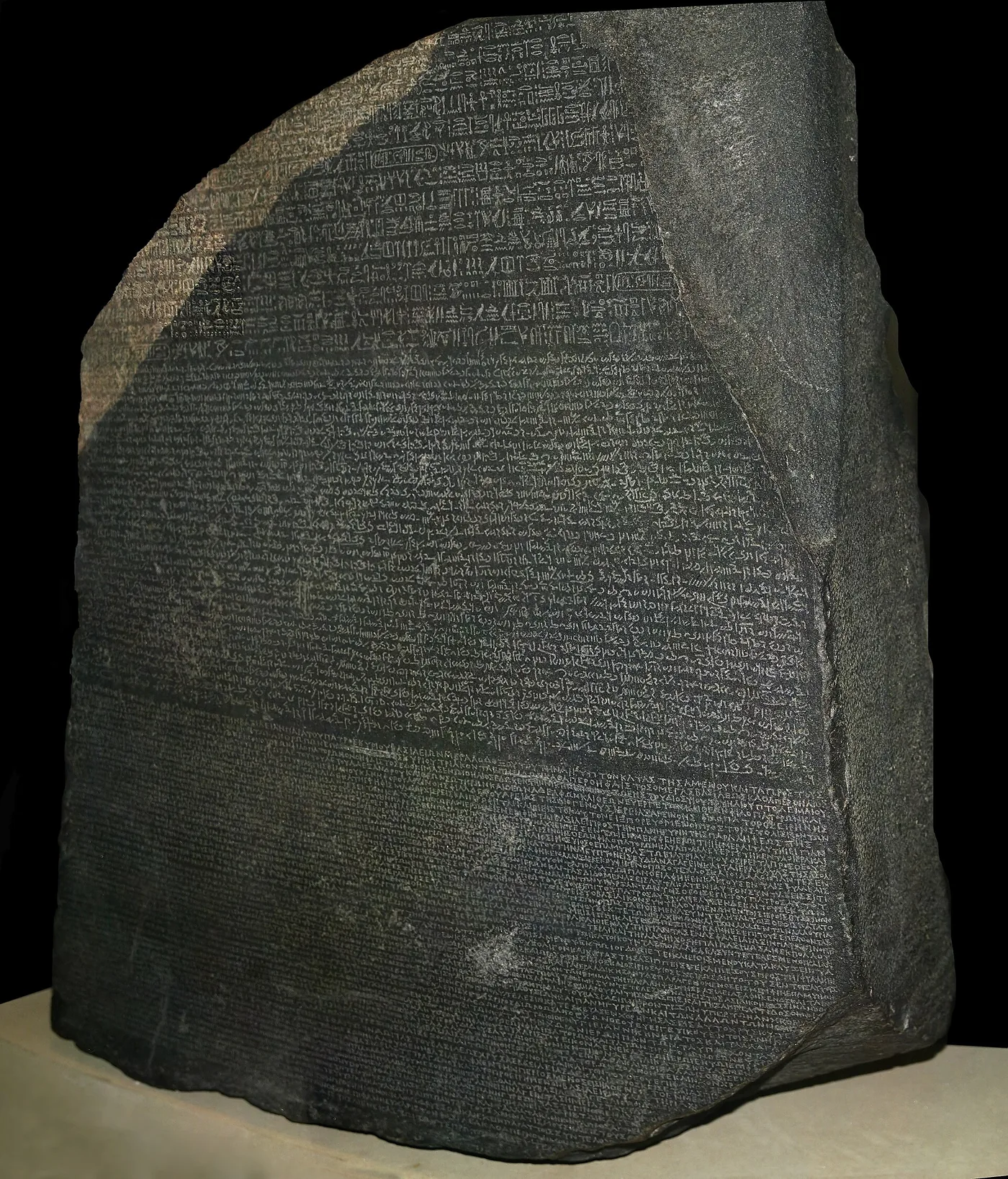
- Present the document.
- How many kinds of writing are on the stone? Name them.
- Why was it possible to read the Egyptian parts?
- Who deciphered hieroglyphs, and when?
- Explain how this stone changed the study of Egyptian history.
Exercise 13 : A pharaoh's mask
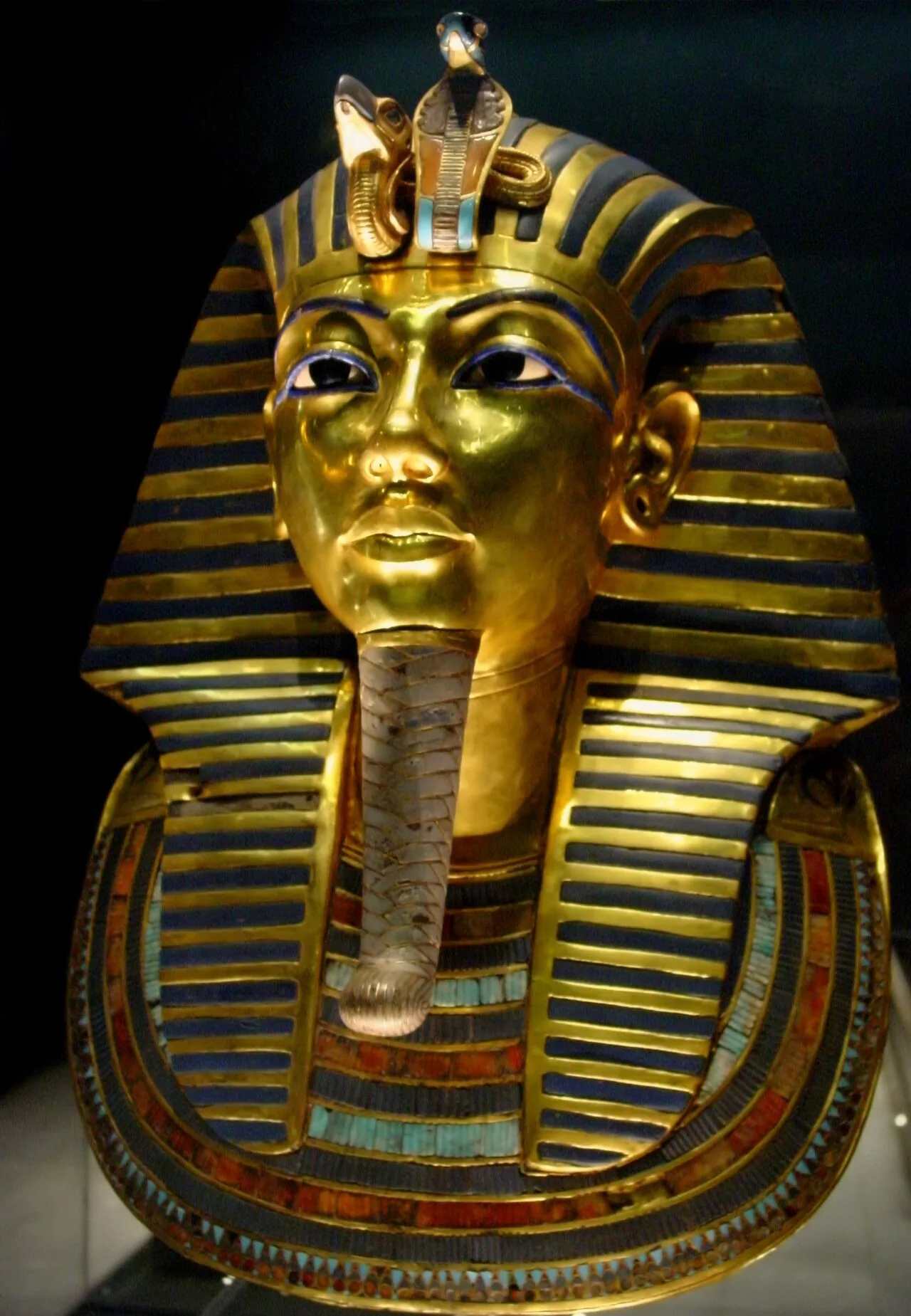
- Present the document.
- Describe the materials, colors, and symbols on the mask.
- What do the cobra and vulture on the forehead suggest?
- Why were such objects placed in a tomb?
- Why is Tutankhamun’s tomb so valuable to historians?
Exercise 14 : Farming along the Nile
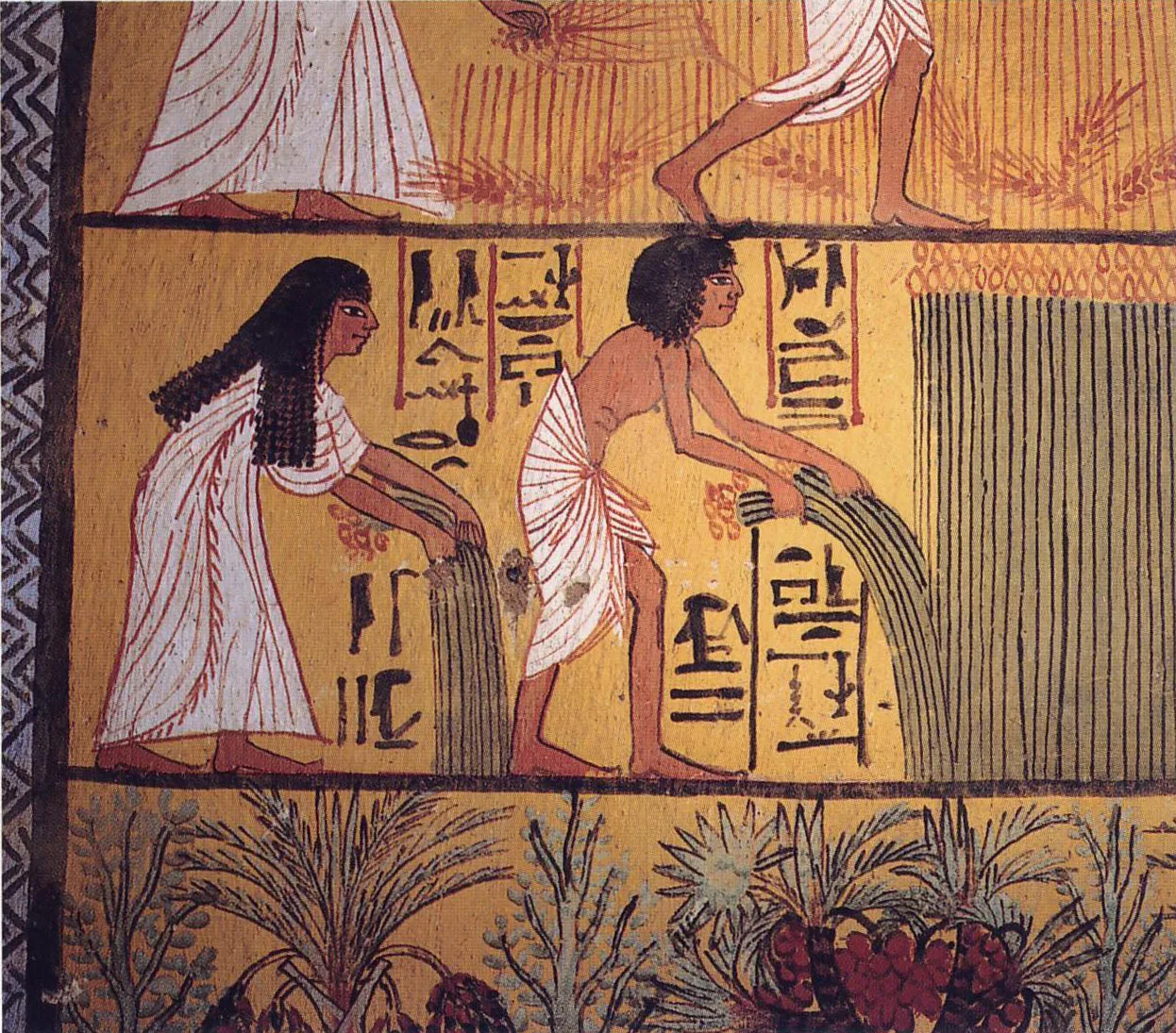
- Present the document.
- Describe the two people and what they are doing.
- What crop do they seem to be harvesting?
- Why was a scene of farm work painted inside a tomb?
- How does this image support what Herodotus says about the Nile’s gift?
Exercise 15 : The pyramids of Giza by the numbers
Document 1 – The three main pyramids of Giza
| Pyramid | King | Built about | Original height |
|---|---|---|---|
| Great Pyramid | Khufu | 2560 BCE | about 481 feet |
| Second pyramid | Khafre | 2530 BCE | about 471 feet |
| Third pyramid | Menkaure | 2500 BCE | about 215 feet |
Source: Mark Lehner, The Complete Pyramids (Thames & Hudson, 1997); heights and dates are approximate; table prepared for this unit.
- Which pyramid was the tallest? By how many feet was it taller than the third pyramid?
- How many years passed between the building of Khufu’s pyramid and Menkaure’s?
- What does the decreasing size suggest about the later kings?
- Why is this table useful but not complete evidence about Egyptian power?
Exercise 16 : Locate Egyptian sites
- In what direction does the Nile flow?
- Name the sea at the north and the sea at the east.
- Which numbered site is closest to the Mediterranean? Which is farthest south?
- Explain why Upper Egypt is in the south and Lower Egypt in the north.
Exercise 17 : Complete the map of Egypt
- Name the sites A to E using this list: Alexandria, Memphis, Thebes, Aswan, Abu Simbel.
- Which letter marks a site in the Delta region?
- Why did most Egyptians live within a few miles of the river?
- Explain how the deserts helped protect Egypt.
Hint: find the delta first, then go upriver.
Exercise 18 : Order the events
Put these events in order from the oldest to the most recent.
- Cleopatra VII dies.
- Narmer unites Egypt.
- Ramses II becomes pharaoh.
- Djoser’s Step Pyramid is built.
- Persia conquers Egypt.
- The Great Pyramid is built for Khufu.
Exercise 19 : How long between events?
Calculate each time span. Remember that BCE years count down toward zero.
- From Narmer (3100 BCE) to the Great Pyramid (2560 BCE).
- From the Great Pyramid (2560 BCE) to Ramses II (1279 BCE).
- From Cleopatra’s death (30 BCE) to 2026.
- Was Cleopatra closer in time to the building of the Great Pyramid or to the moon landing (1969 CE)?
Exercise 20 : Guided research: a pharaoh
Choose one pharaoh: Hatshepsut, Akhenaten, Tutankhamun, or Ramses II. Research on at least two reliable sites, such as the British Museum, the Metropolitan Museum of Art, or Britannica Kids. Suggested keywords: [name] pharaoh British Museum, [name] Metropolitan Museum.
- When did the pharaoh rule?
- Name two achievements or events from the reign.
- Find one artifact or building connected to the pharaoh and describe it.
- Which website did you use, and why is it reliable?
Hint: museum and university sites are usually more reliable than personal blogs; compare two sources.
Exercise 21 : CER paragraph: Was the Nile a blessing?
Write a Claim, Evidence, Reasoning paragraph that answers: Was the Nile the most important reason for the success of ancient Egyptian civilization?
- Claim: state your position.
- Evidence: use at least two details from Herodotus, the Hymn to the Nile, or the lesson.
- Reasoning: explain how the evidence supports your claim.
Hint: you may argue that the river mattered most but not alone.
Exercise 22 : SAQ: Pharaohs and pyramids
Answer in complete sentences.
- Identify two jobs of an Egyptian pharaoh.
- Explain one reason why the Egyptians built pyramids.
- Explain one way the Nile’s flood affected the building of the pyramids.
Exercise 23 : True or false? Justify
Decide whether each statement is true or false, and justify your answer.
- The Nile flows from north to south.
- Hieroglyphs were deciphered thanks to the Rosetta Stone.
- Egyptian women could not own property.
- All pyramids were built during the New Kingdom.
Exercise 24 : Causes and consequences: flood and government
Complete the chain and explain each link.
- Cause: the Nile floods every year. Effect: ______.
- Effect on food and population: ______.
- Effect on government and records: ______.
- Effect on beliefs: ______.


Quick review: flashcards
Tap a card to see the answer.