


This worksheet on Mesopotamia and the Fertile Crescent belongs to the Grade 6 Ancient Civilizations course. Its questions use primary sources, maps and timelines, and they move from basic recall to short writing tasks. Before you start, review the lesson; afterward, try the true or false quiz.
Exercise 1 : Vocabulary of Mesopotamia
Define each word, then use it in a sentence.
- Mesopotamia
- irrigation
- city-state
- ziggurat
- cuneiform
- scribe
- civilization
Hint: use the definition boxes.
Exercise 2 : How Babylonians farmed
Document 1 – Herodotus on Babylonian farming
But little rain falls in Assyria, enough, however, to make the corn begin to sprout, after which the plant is nourished and the ears formed by means of irrigation from the river. For the river does not, as in Egypt, overflow the corn-lands of its own accord, but is spread over them by the hand, or by the help of engines. The whole of Babylonia is, like Egypt, intersected with canals. […] Of all the countries that we know there is none which is so fruitful in grain.
Source: Herodotus, Histories, Book I, chapter 193, about 430 BCE (translation by George Rawlinson, 1858-1860).
*corn: here, grain such as wheat and barley. *engines: machines for lifting water. *Assyria: the northern part of Mesopotamia; Herodotus uses it for the whole region.
- Present the document (nature, author, date).
- According to Herodotus, how is farming in Babylonia different from farming in Egypt?
- Explain how Babylonian farmers got water to their fields.
- Herodotus was Greek and wrote about 1,300 years after Hammurabi. Why should a historian be careful with his claims?
- Which claim by Herodotus seems exaggerated, and why?
Hint: look at the last sentence of the passage.
Exercise 3 : The king’s explanation
Document 1 – Prologue of the Code of Hammurabi
[…] Anu and Bel called by name me, Hammurabi, the exalted prince, who feared God, to bring about the rule of righteousness in the land, to destroy the wicked and the evil-doers; so that the strong should not harm the weak; so that I should rule over the black-headed people like Shamash, and enlighten the land, to further the well-being of mankind.
Source: Code of Hammurabi, prologue, Babylon, about 1754 BCE (translation by L. W. King, 1910).
*Anu and Bel: two great Mesopotamian gods (Bel is another name for Enlil). *Shamash: the sun god, who was also the god of justice. *the black-headed people: a Mesopotamian term for the people of the land.
- Present the document (nature, author, date).
- According to Hammurabi, who chose him to be king?
- List three goals he says his laws will achieve.
- Explain why a king would say that the gods chose him.
- What do you think the phrase “the strong should not harm the weak” means?
Exercise 4 : Study the laws
Document 1 – Laws 196-200
196. If a man put out the eye of another man, his eye shall be put out.
197. If he break another man’s bone, his bone shall be broken.
198. If he put out the eye of a freed man, or break the bone of a freed man, he shall pay one gold mina.
199. If he put out the eye of a man’s slave, or break the bone of a man’s slave, he shall pay one-half of its value.
200. If a man knock out the teeth of his equal, his teeth shall be knocked out.
Source: Code of Hammurabi, laws 196-200, Babylon, about 1754 BCE (translation by L. W. King, 1910).
*freed man: a person who is not a slave but has lower status than a full citizen in this code. *mina: a unit of weight for silver or gold, about one pound. *equal: a person of the same rank.
- Present the document.
- What is the punishment for a man who puts out the eye of an equal?
- What happens if the victim is a freed man? A slave?
- Explain what these laws show about social classes in Babylon.
- Do you think these laws were fair? Give one reason for your opinion.
Exercise 5 : The promise and the practice
Document 1 – The prologue
[…] Anu and Bel called by name me, Hammurabi, the exalted prince, who feared God, to bring about the rule of righteousness in the land, to destroy the wicked and the evil-doers; so that the strong should not harm the weak; so that I should rule over the black-headed people like Shamash, and enlighten the land, to further the well-being of mankind.
Source: Code of Hammurabi, prologue, Babylon, about 1754 BCE (translation by L. W. King, 1910).
*Anu and Bel: two great Mesopotamian gods (Bel is another name for Enlil). *Shamash: the sun god, who was also the god of justice. *the black-headed people: a Mesopotamian term for the people of the land.
Document 2 – Laws 229-230
229. If a builder build a house for some one, and does not construct it properly, and the house which he built fall in and kill its owner, then that builder shall be put to death.
230. If it kill the son of the owner the son of that builder shall be put to death.
Source: Code of Hammurabi, laws 229-230, Babylon, about 1754 BCE (translation by L. W. King, 1910).
- Present each document.
- What is Hammurabi’s goal in Document 1?
- What problem do the laws in Document 2 deal with, and what is the penalty?
- Explain how Document 2 puts Hammurabi’s goal into practice.
- Do you think the penalty in law 230 is fair? Explain.
Exercise 6 : Bricks in two texts
Document 1 – Herodotus on Babylon’s walls
As fast as they dug the moat the soil which they got from the cutting was made into bricks, and when a sufficient number were completed they baked the bricks in kilns. Then they set to building, and began with bricking the borders of the moat, after which they proceeded to construct the wall itself, using throughout for their cement hot bitumen, and interposing a layer of wattled reeds at every thirtieth course of the bricks.
Source: Herodotus, Histories, Book I, chapter 179, about 430 BCE (translation by George Rawlinson, 1858-1860).
*bitumen: a natural black tar used like glue. *wattled: woven. *course: a horizontal row of bricks.
Document 2 – Genesis 11:3-4
And they said one to another, Go to, let us make brick, and burn them thoroughly. And they had brick for stone, and slime had they for morter. And they said, Go to, let us build us a city and a tower, whose top may reach unto heaven; and let us make us a name, lest we be scattered abroad upon the face of the whole earth.
Source: Hebrew Bible (Old Testament), Genesis 11:3-4, King James Version (1611), used here as a historical source; the story is set in “the land of Shinar,” the Hebrew name for Mesopotamia.
*slime: here, bitumen. *morter: mortar. *Go to: an old way of saying “come, let us.”
- Present each document.
- Name the building materials mentioned in both documents.
- What do the texts tell us about how buildings were made in Mesopotamia?
- Compare the purpose of the building in each text.
- Why does the lack of stone in Mesopotamia explain the use of brick?
Exercise 7 : The tower of Babylon
Document 1 – Herodotus on the tower of Babylon
In the middle of the precinct there was a tower of solid masonry, a furlong in length and breadth, upon which was raised a second tower, and on that a third, and so on up to eight. The ascent to the top is on the outside, by a path which winds round all the towers.
Source: Herodotus, Histories, Book I, chapter 181, about 430 BCE (translation by George Rawlinson, 1858-1860).
*precinct: the sacred enclosure around a temple. *furlong: about 200 meters (660 feet). *masonry: stone or brick construction.
Document 2 – A ziggurat today
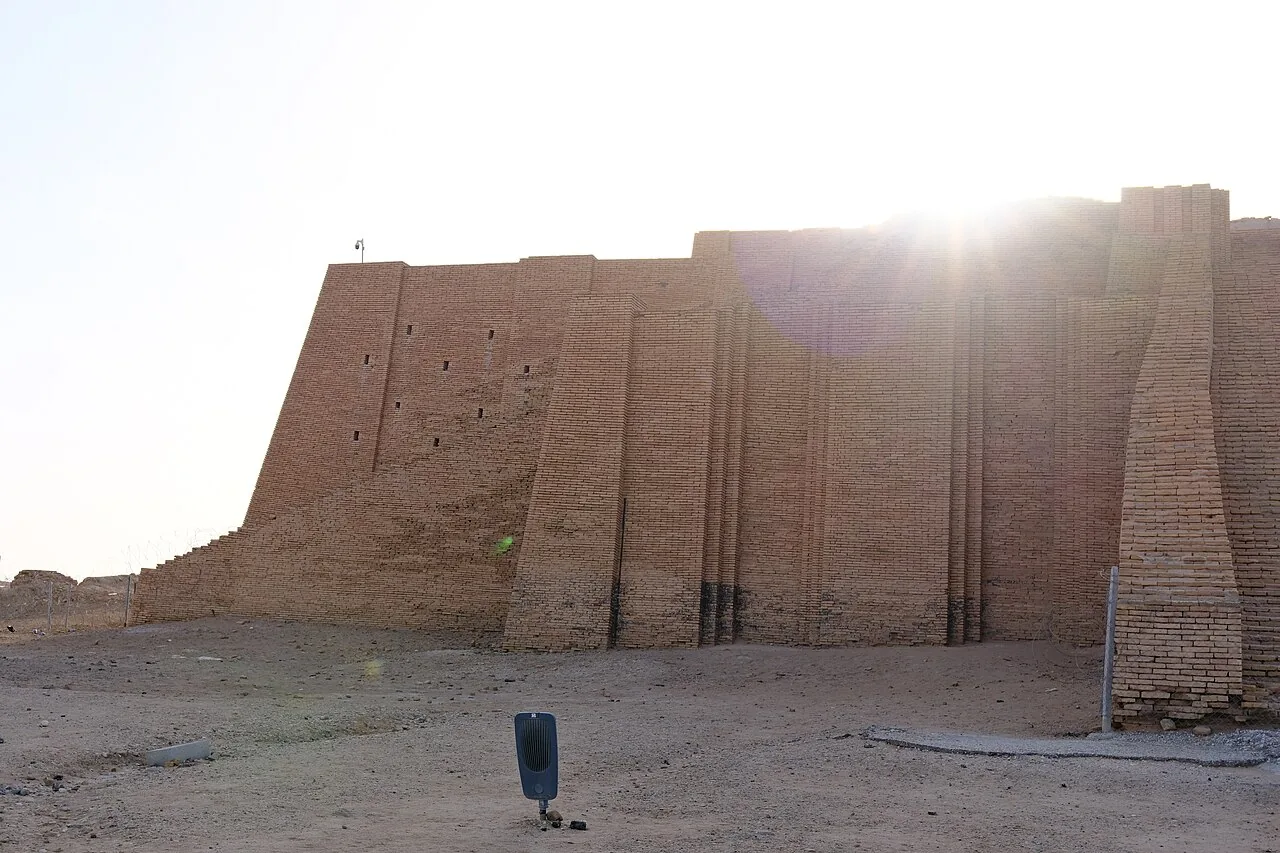
- Present both documents.
- Describe the tower according to Herodotus.
- Describe the ziggurat in Document 2.
- Compare the two documents: what do they have in common?
- Explain why the ziggurat was the center of a Mesopotamian city.
Exercise 8 : The stele of Hammurabi
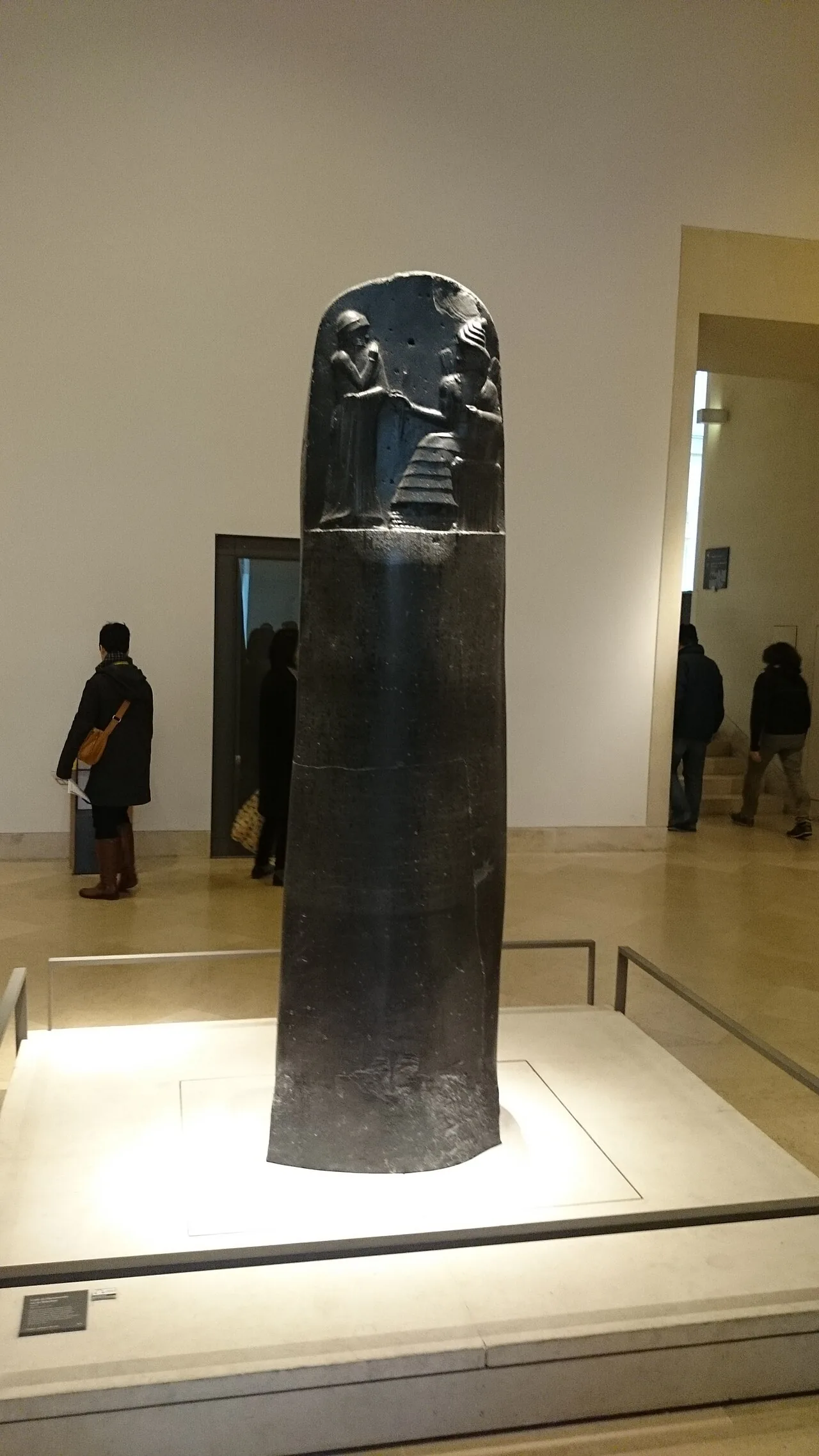
- Present the document.
- Describe what you see and what the object is made of.
- Why was the stele placed where everyone could see it?
- Why is it important that laws are written down?
Exercise 9 : The Standard of Ur: peace
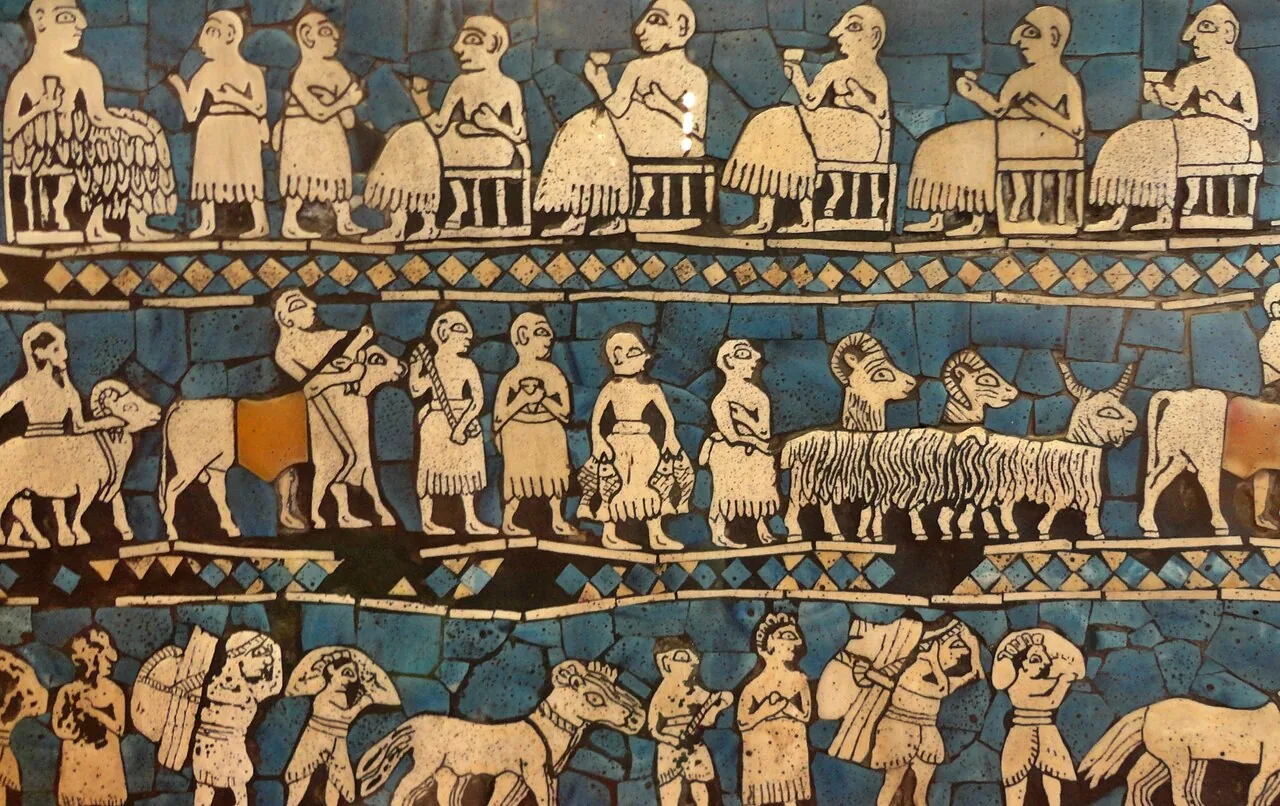
- Present the document.
- Describe the top row. What are the people doing?
- Describe the lower rows. What are the people carrying or leading?
- What does this panel tell us about the economy of Ur?
- Which materials came from far away, and what does that show?
Hint: lapis lazuli came from Afghanistan.
Exercise 10 : The Standard of Ur: war
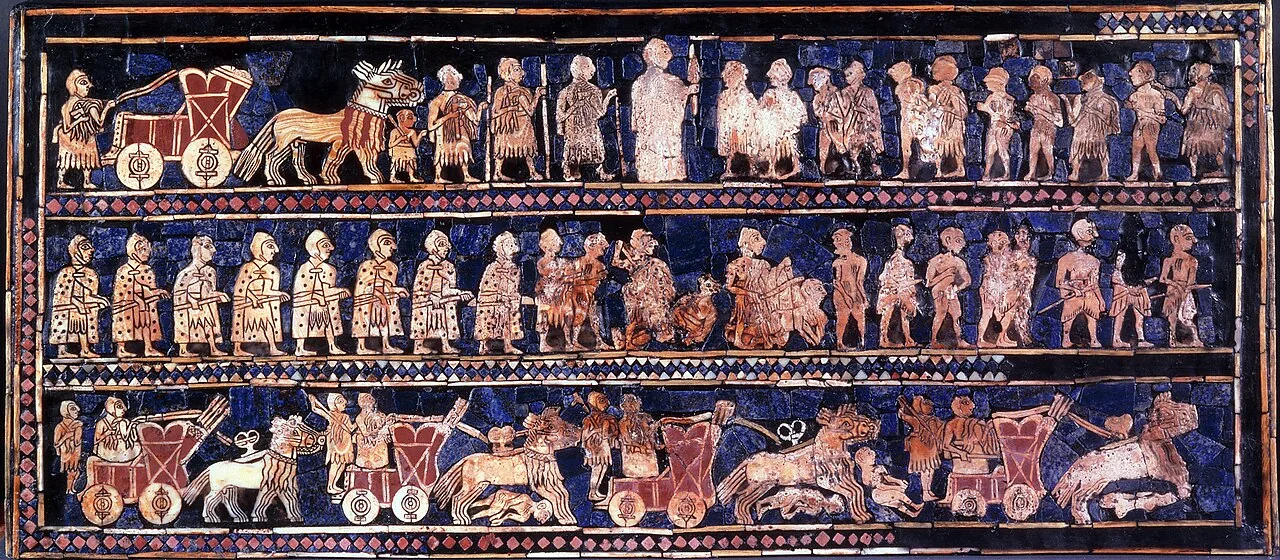
- Present the document.
- Describe the bottom row.
- Describe the middle and top rows.
- What does this panel tell us about warfare in Sumer?
- Compare it with the peace panel: what do the two sides show together?
Exercise 11 : The Warka Vase
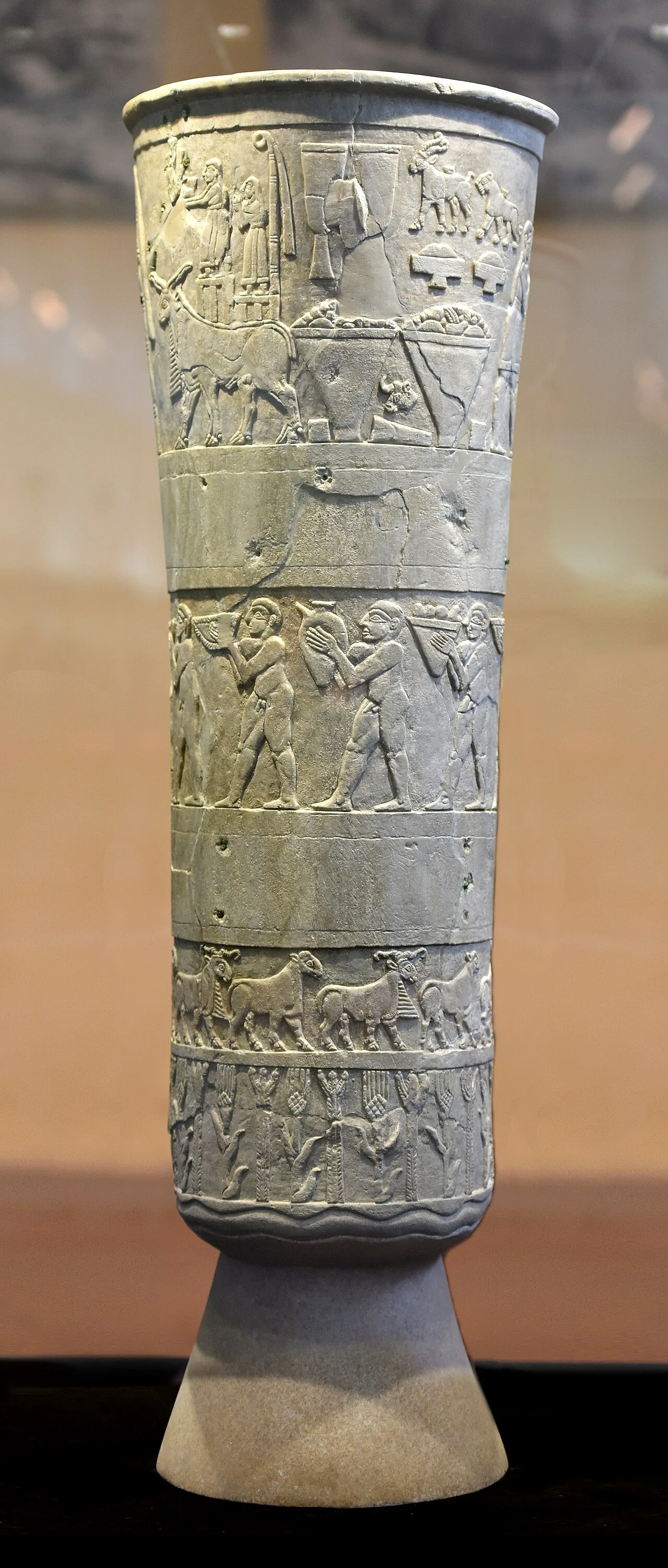
- Present the document.
- Describe the vase: shape, material, and decoration.
- What does it suggest about the role of temples?
- Why do archaeologists treat this object as a source even though it has no readable story?
Exercise 12 : An early clay tablet
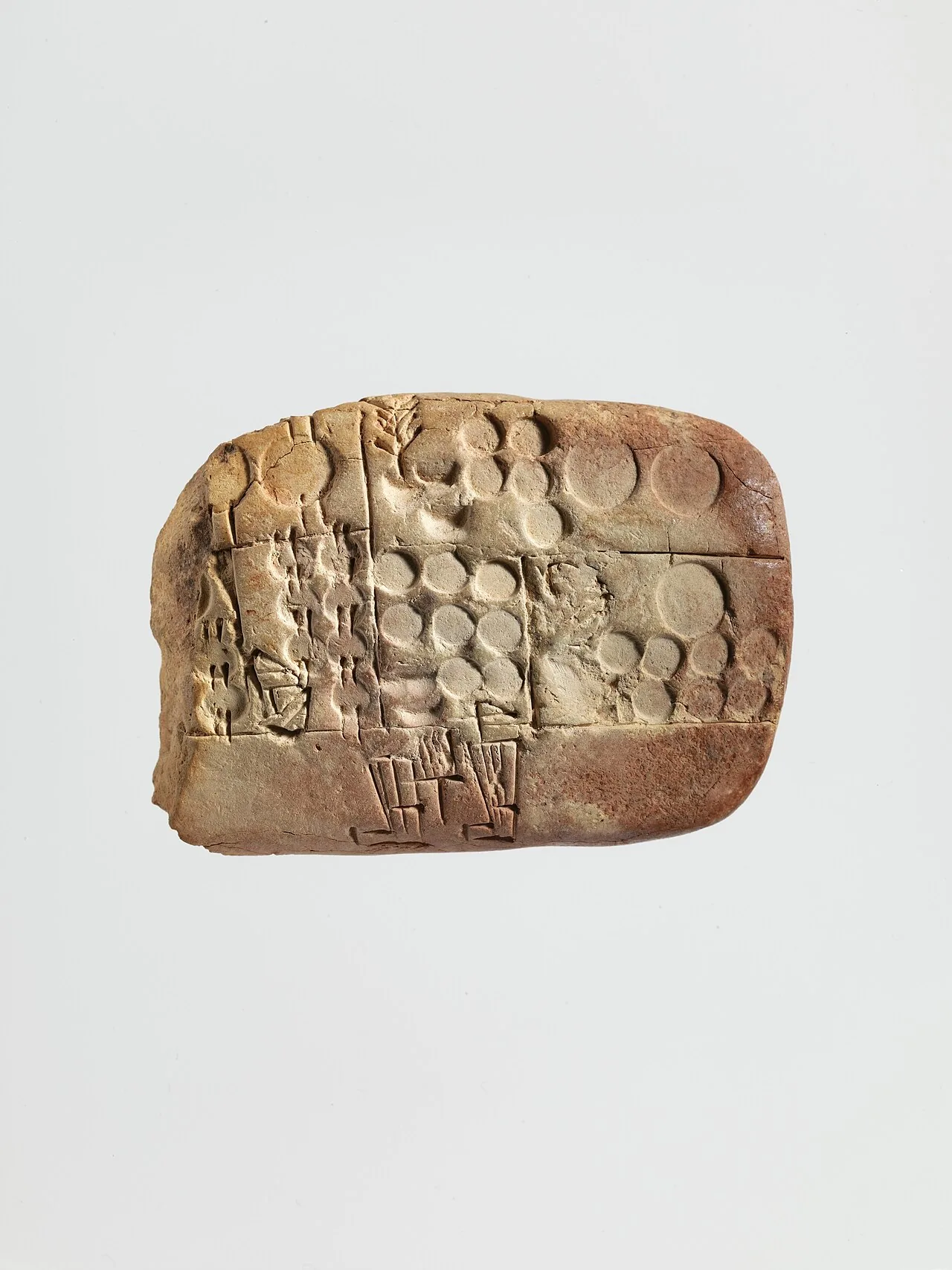
- Present the document.
- Describe the object and its signs.
- What was this kind of tablet used for?
- Why was clay a good material for writing in Mesopotamia?
Exercise 13 : The Ishtar Gate
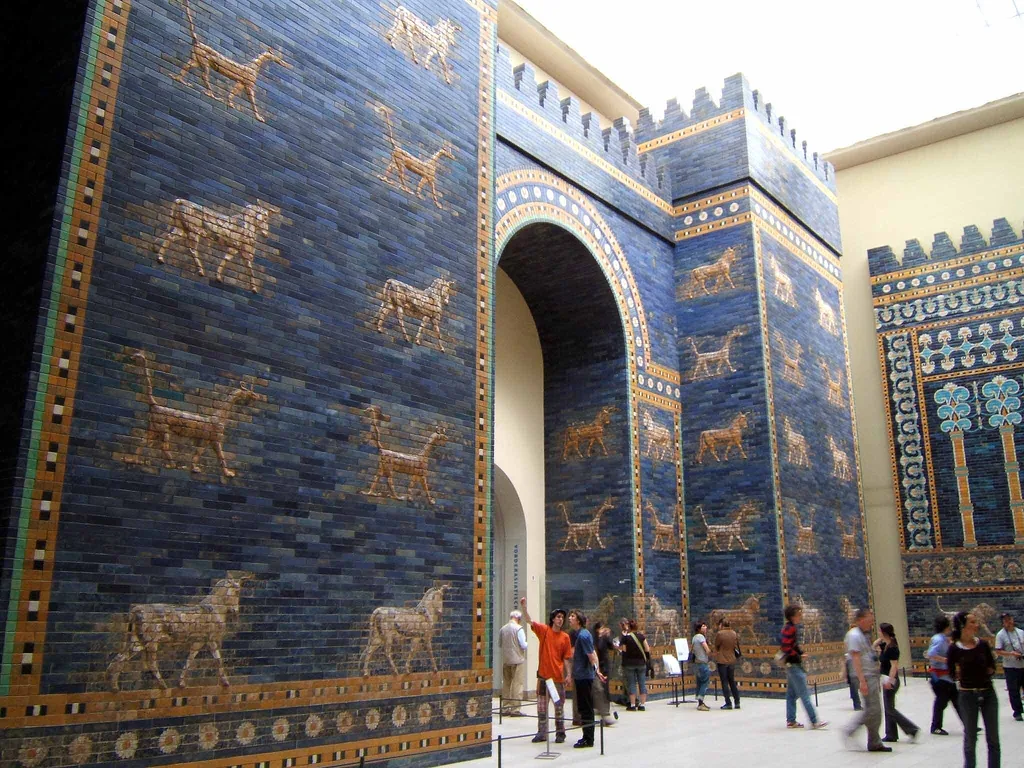
- Present the document.
- Describe the colors and the animals shown.
- What does the gate tell us about Babylon in the time of Nebuchadnezzar II?
- Explain why this is a reconstruction.
Exercise 14 : Reading a table of penalties
Document 1 – Penalties by status in the Code of Hammurabi
| Law | Victim of the injury | Penalty for the person who caused it |
|---|---|---|
| 196 | another man (an equal) | his own eye is put out |
| 197 | another man (an equal) | his own bone is broken |
| 198 | a freed man | pays one gold mina |
| 199 | a man’s slave | pays one-half of the slave’s value |
| 200 | an equal (teeth knocked out) | his own teeth are knocked out |
Source: Code of Hammurabi, laws 196-200 (translation by L. W. King, 1910); table prepared for this unit.
- Which victims receive the punishment of “an eye for an eye”?
- What happens when the victim is a freed man?
- How is the penalty for a slave different?
- What conclusion can you draw about the treatment of different classes?
- Why is a table a good way to present this information?
Exercise 15 : Locate the cities
- Name the two rivers shown on the map.
- Which numbered city is farthest north? Which is closest to the Persian Gulf?
- Where is Babylon in relation to the rivers?
- Explain why most early cities were built near rivers.
Exercise 16 : Complete the map
- Name the cities A to H using the list: Nineveh, Ashur, Babylon, Nippur, Uruk, Lagash, Ur, Eridu.
- Which letters are in Sumer?
- Which letter marks Nineveh, the capital of Assyria?
- Explain why the north of Mesopotamia needed less irrigation than the south.
Hint: start with the cities on the rivers.
Exercise 17 : Order the events
Order these events from the oldest to the most recent.
- Cyrus conquers Babylon.
- Writing appears in Uruk.
- Hammurabi has his code carved.
- Sargon creates the first empire.
- The Ishtar Gate is built.
- Ur-Nammu builds the ziggurat of Ur.
Exercise 18 : How long between events?
Calculate the time between these events. Remember that BCE years count backward.
- From writing at Uruk (3300 BCE) to Hammurabi’s code (1754 BCE).
- From Hammurabi’s code (1754 BCE) to the conquest of Babylon by Cyrus (539 BCE).
- From Sargon (2334 BCE) to Ur-Nammu’s ziggurat (2100 BCE).
- Is the time from Hammurabi to Cyrus longer or shorter than the time from Cyrus to today (2026)?
Exercise 19 : Guided research: Standard of Ur
Investigate an object from ancient Mesopotamia and fill in a fact sheet.
- Choose the Standard of Ur, the Code of Hammurabi, the Ishtar Gate, or a cuneiform tablet.
- Keywords: Standard of Ur British Museum, Code of Hammurabi Louvre, Ishtar Gate Pergamon, cuneiform tablet Metropolitan Museum.
- Reliable sites: the British Museum, the Louvre, the Metropolitan Museum of Art, the Smithsonian, Encyclopaedia Britannica, or Wikipedia (check its sources).
- Fact sheet: name, date, where found and by whom, materials, what it shows, where it is today, and your sources.
Hint: compare at least two sources.
Exercise 20 : CER paragraph: Was the Code fair?
Write a Claim, Evidence, Reasoning paragraph answering: Was the Code of Hammurabi a fair system of justice?
- Claim: state your position.
- Evidence: use at least two details from the laws or the prologue.
- Reasoning: explain how the evidence supports your claim.
Hint: you may argue that it was fair in some ways and unfair in others.
Exercise 21 : SAQ: Why Mesopotamia?
Answer in complete sentences.
- Describe one advantage of the Tigris and Euphrates rivers.
- Explain one problem the rivers caused for farmers.
- Explain how irrigation helped lead to governments.
Exercise 22 : True or false? Justify
Decide whether each statement is true or false, and justify your answer.
- Mesopotamia means “land of the pharaohs.”
- Cuneiform was written by pressing a reed into clay.
- Hammurabi ruled Babylon about 1754 BCE.
- All people were punished in the same way under the Code of Hammurabi.
Exercise 23 : Causes and consequences: rivers and cities
Complete the chain and explain each link.
- Cause: rivers deposit fertile silt. Effect: ______.
- Effect on farming and population: ______.
- Effect on organization and government: ______.
- Effect on writing: ______.


Quick review: flashcards
Tap a card to see the answer.