


This worksheet on The Neolithic Revolution and Early Farming belongs to the Grade 6 Ancient Civilizations course. Its questions use primary sources, maps and timelines, and they move from basic recall to short writing tasks. Before you start, review the lesson; afterward, try the true or false quiz.
Exercise 1 : Neolithic vocabulary
Define each word, then use it in a sentence.
- Neolithic Revolution
- Fertile Crescent
- domestication
- surplus
- specialization
- irrigation
Hint: use the definition boxes and the lesson.
Exercise 2 : How did planting begin?
Document 1 – Lucretius on the start of planting
But Nature herself,
Mother of things, was the first seed-sower
And primal grafter; since the berries and acorns,
Dropping from off the trees, would there beneath
Put forth in season swarms of little shoots;
Hence too men’s fondness for ingrafting slips
Upon the boughs and setting out in holes
The young shrubs o’er the fields. Then would they try
Ever new modes of tilling their loved crofts,
And mark they would how earth improved the taste
Of the wild fruits by fond and fostering care.
Source: Lucretius, On the Nature of Things, Book V, about 55 BCE (verse translation by William Ellery Leonard, 1916).
*graft: to attach a cutting from one plant to another plant. *croft: a small field. *tilling: preparing and working the soil.
- Present the document (nature, author, date).
- According to Lucretius, who or what was the “first seed-sower”?
- Explain how people learned to plant, according to the poem.
- Lucretius lived thousands of years after farming began. Explain what this tells you about the reliability of his account.
- Which fact in the lesson shows that farming developed over a long time?
Hint: think about whether Lucretius could have witnessed what he describes.
Exercise 3 : Two views of farming
Document 1 – Genesis 3:17-19
[…] cursed is the ground for thy sake; in sorrow shalt thou eat of it all the days of thy life; Thorns also and thistles shall it bring forth to thee; and thou shalt eat the herb of the field; In the sweat of thy face shalt thou eat bread, till thou return unto the ground […].
Source: Hebrew Bible (Old Testament), Genesis 3:17-19, King James Version (1611), used here as a historical source on how an ancient people remembered the hard work of farming.
Document 2 – Lucretius on early farmers
But Nature herself,
Mother of things, was the first seed-sower
And primal grafter; since the berries and acorns,
Dropping from off the trees, would there beneath
Put forth in season swarms of little shoots;
Hence too men’s fondness for ingrafting slips
Upon the boughs and setting out in holes
The young shrubs o’er the fields. Then would they try
Ever new modes of tilling their loved crofts,
And mark they would how earth improved the taste
Of the wild fruits by fond and fostering care.
Source: Lucretius, On the Nature of Things, Book V, about 55 BCE (verse translation by William Ellery Leonard, 1916).
- Present each document.
- How does Document 1 describe farm work?
- How does Document 2 describe the early work of planting?
- Compare the two views: what is similar and what is different?
- Explain why historians need both kinds of sources, but must not treat them as exact records of the Neolithic.
Exercise 4 : Farming by the stars
Document 1 – Hesiod, Works and Days
When the Pleiades, daughters of Atlas, are rising, begin your harvest, and your ploughing when they are going to set. Forty nights and days they are hidden and appear again as the year moves round, when first you sharpen your sickle. […] strip to sow and strip to plough and strip to reap, if you wish to get in all Demeter’s fruits in due season, and that each kind may grow in its season.
Source: Hesiod, Works and Days, about 700 BCE, lines 383-392 (translation by Hugh G. Evelyn-White, 1914).
*Pleiades: a cluster of stars, whose rising and setting in the sky Greek farmers used as a calendar. *Demeter: the Greek goddess of grain.
- Present the document.
- When does Hesiod say the farmer should begin the harvest? When should he plow?
- What happens, he warns, if a farmer does not work in season?
- Explain how this text shows that farming required planning.
- Why does a farmer in 700 BCE use stars as a calendar?
Exercise 5 : Water rules in Babylon
Document 1 – Laws 53-55 of the Code of Hammurabi
53. If any one be too lazy to keep his dam in proper condition, and does not so keep it; if then the dam break and all the fields be flooded, then shall he in whose dam the break occurred be sold for money, and the money shall replace the corn which he has caused to be ruined.
54. If he be not able to replace the corn, then he and his possessions shall be divided among the farmers whose corn he has flooded.
55. If any one open his ditches to water his crop, but is careless, and the water flood the field of his neighbor, then he shall pay his neighbor corn for his loss.
Source: Code of Hammurabi, laws 53-55, Babylon, about 1754 BCE (translation by L. W. King, 1910).
*corn: here, grain such as barley or wheat. *dam: a bank of earth that holds water in a canal or field.
- Present the document.
- Identify the problem that each of the three laws tries to prevent.
- What penalty does law 53 give? Why is it so severe?
- Explain why farming societies need laws about water.
- How do these laws show that governments grew along with farming?
Exercise 6 : From bronze to iron sickles
Document 1 – Lucretius on metals and tilling
With copper men to work the soil began […]
Then by slow degrees
The sword of iron succeeded, and the shape
Of brazen sickle into scorn was turned:
With iron to cleave the soil of earth they ’gan.
Source: Lucretius, On the Nature of Things, Book V, about 55 BCE (verse translation by William Ellery Leonard, 1916).
*brazen: made of bronze or brass.
Document 2 – A Neolithic flint sickle
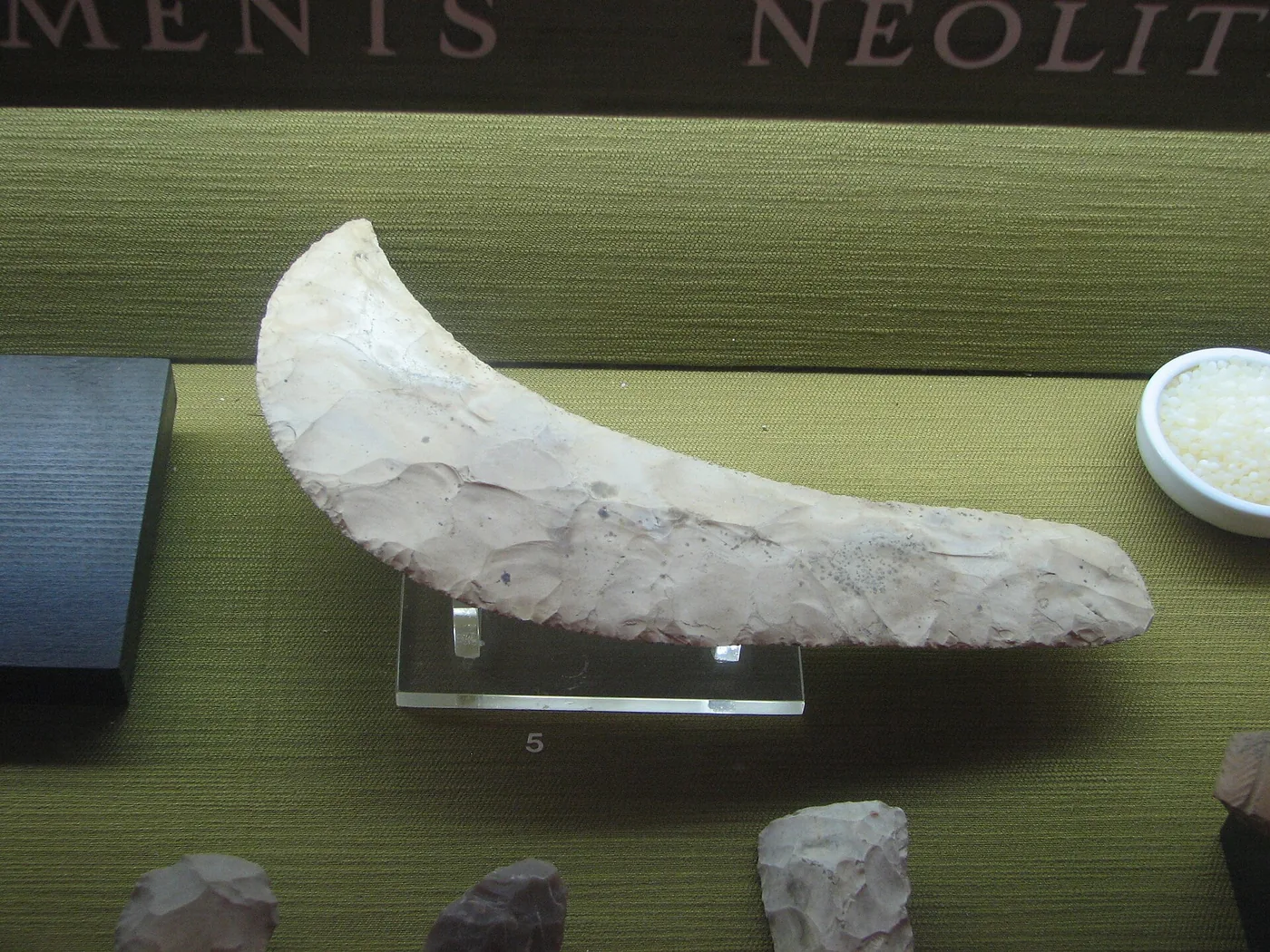
- Present both documents.
- Describe the tool in Document 2 (shape, material).
- What does Lucretius say about the tools of farmers as time passed?
- Compare the tool in Document 2 with the tools in Document 1.
- Explain why farming tools improved over time.
Hint: a sickle is for cutting grain.
Exercise 7 : The shepherd and the farmer
Document 1 – Genesis 4:2-3
And Abel was a keeper of sheep, but Cain was a tiller of the ground. And in process of time it came to pass, that Cain brought of the fruit of the ground an offering unto the Lord.
Source: Hebrew Bible (Old Testament), Genesis 4:2-3, King James Version (1611), used here as a historical source.
- Present the document.
- Name the two ways of life described.
- Explain how a shepherd’s life differs from a farmer’s life in the Neolithic world.
- Why might historians use this verse as evidence about early societies?
Exercise 8 : Pillars at Göbekli Tepe
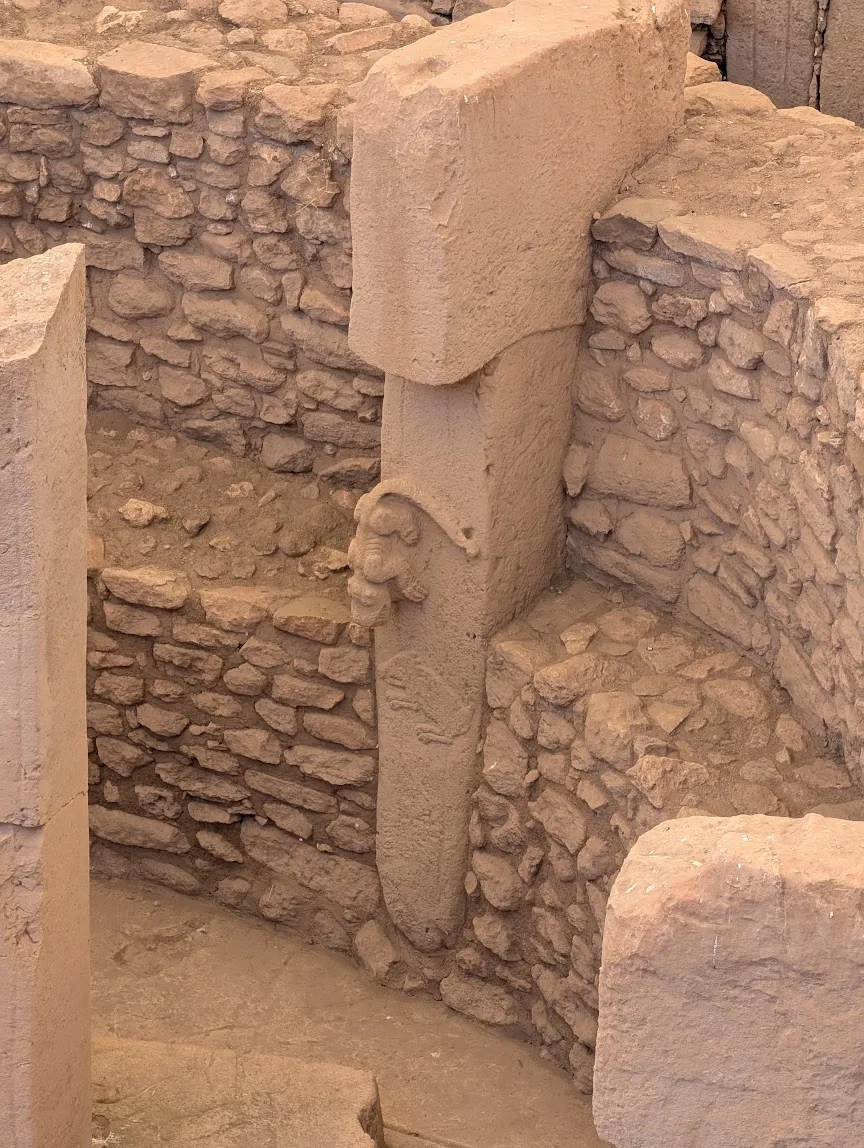
- Present the document.
- Describe the carvings on the pillar.
- Who built Göbekli Tepe, and what is surprising about that?
- Give one reason why historians cannot be sure what the monument was used for.
Exercise 9 : The tower of Jericho
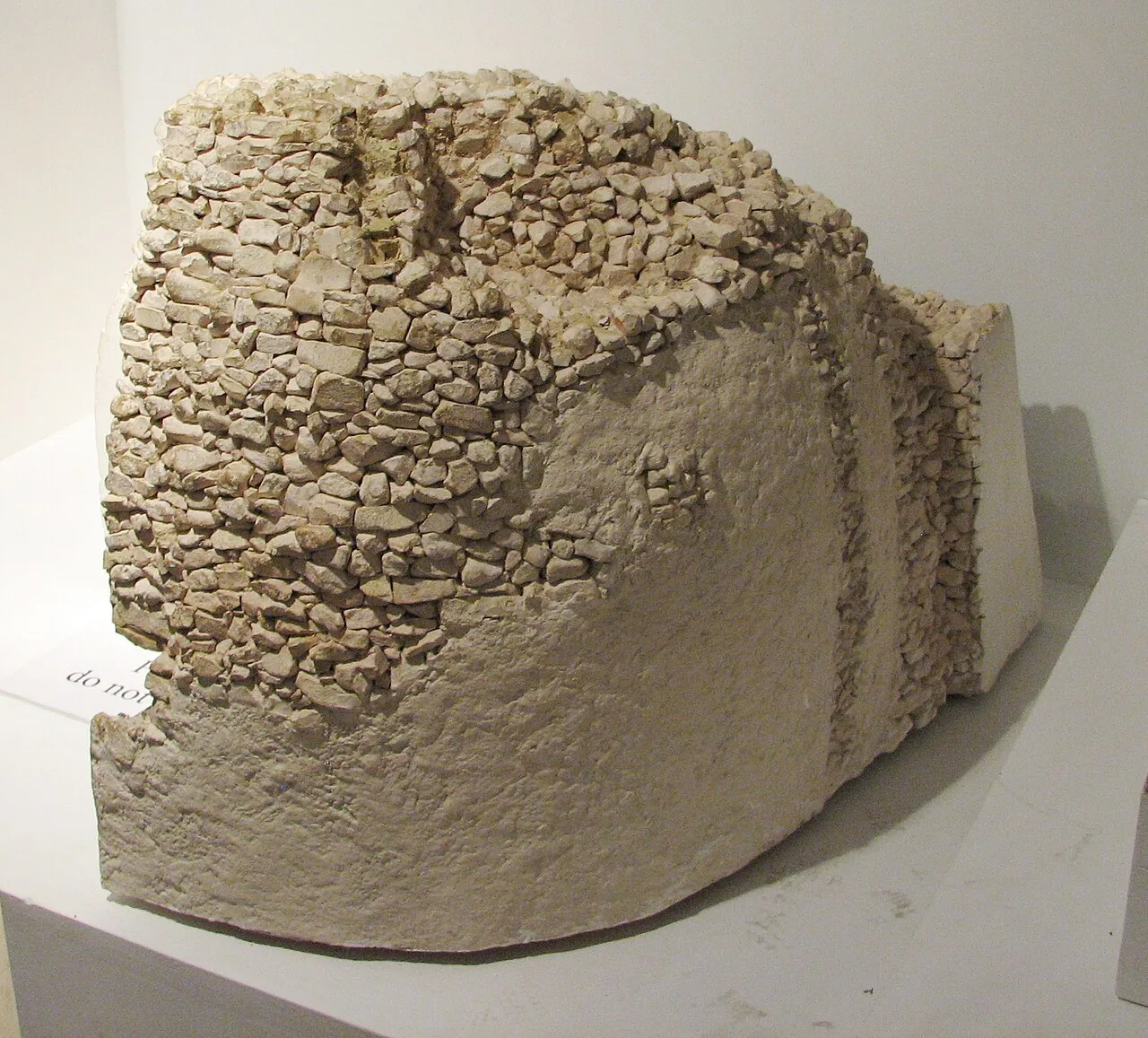
- Present the document.
- Describe the tower: shape, material, and any inside feature.
- Why would villagers build a tower and a wall?
- What does the tower tell us about life in a Neolithic village?
Exercise 10 : A statue from Ain Ghazal
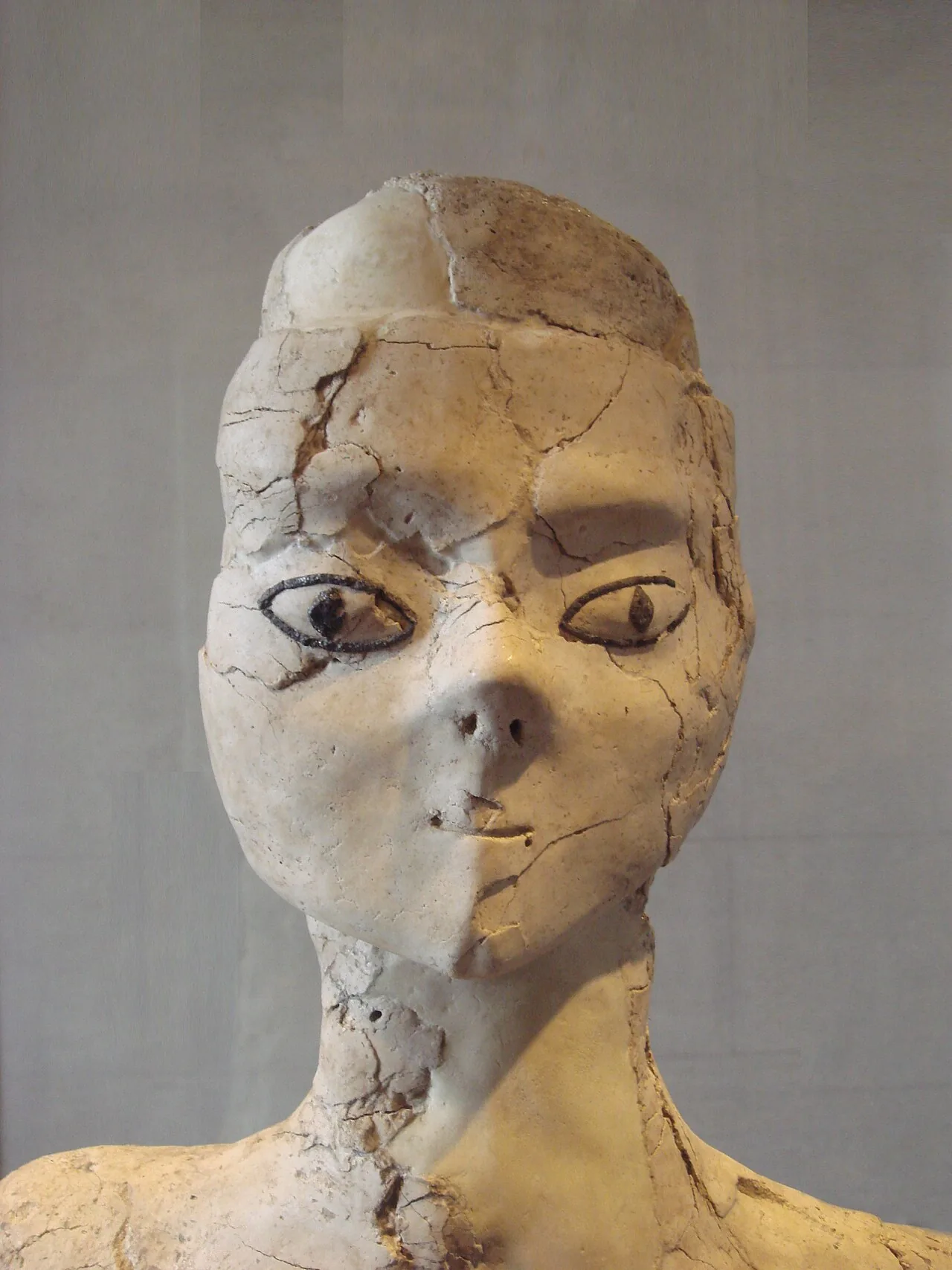
- Present the document.
- Describe the face and the material.
- What does the statue suggest about the beliefs of Neolithic villagers?
- Why is it difficult to be sure about what the statue meant?
Exercise 11 : Wheat in the field
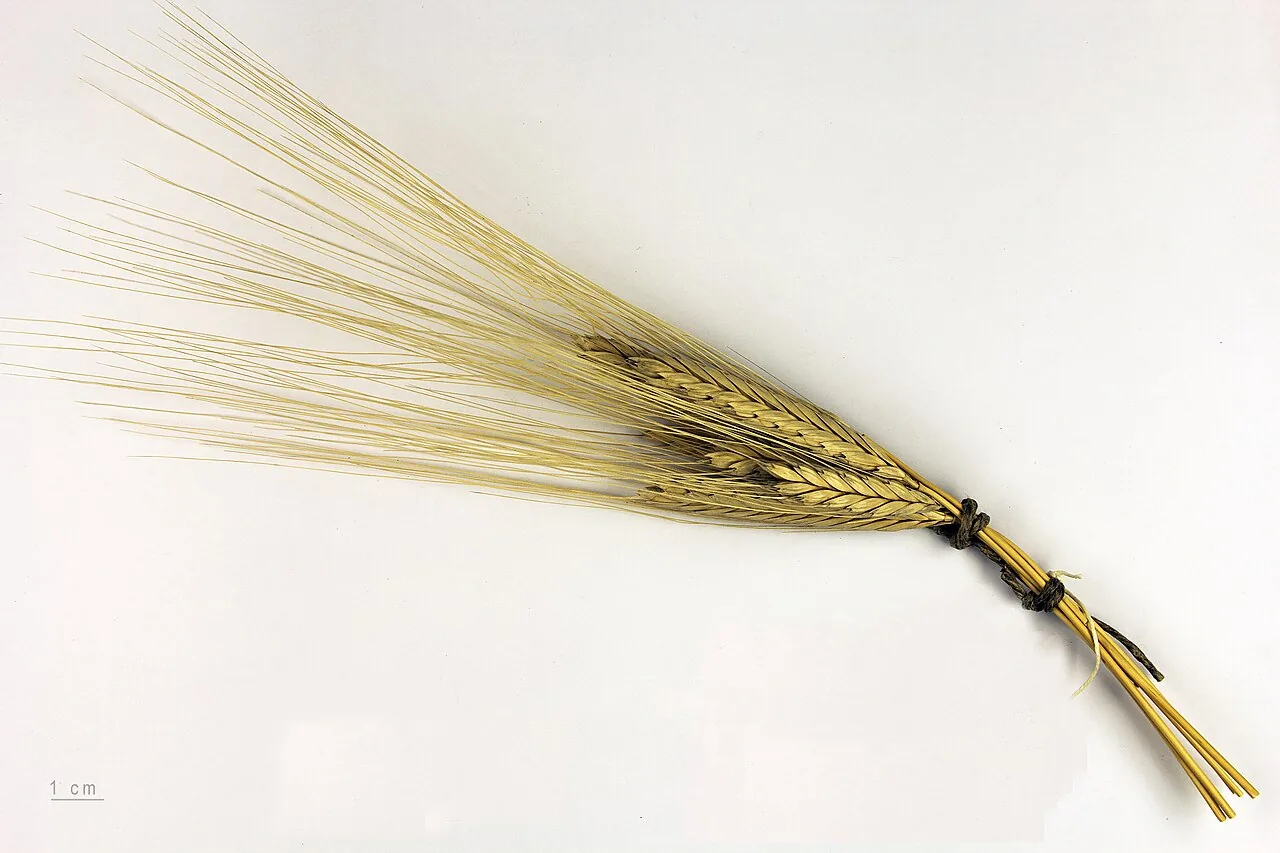
- Present the document.
- Describe the plant in the picture.
- Why did early farmers prefer wheat plants whose grain stayed on the stalk?
- Explain what domestication did to wild wheat.
Hint: think about harvesting.
Exercise 12 : Grinding grain
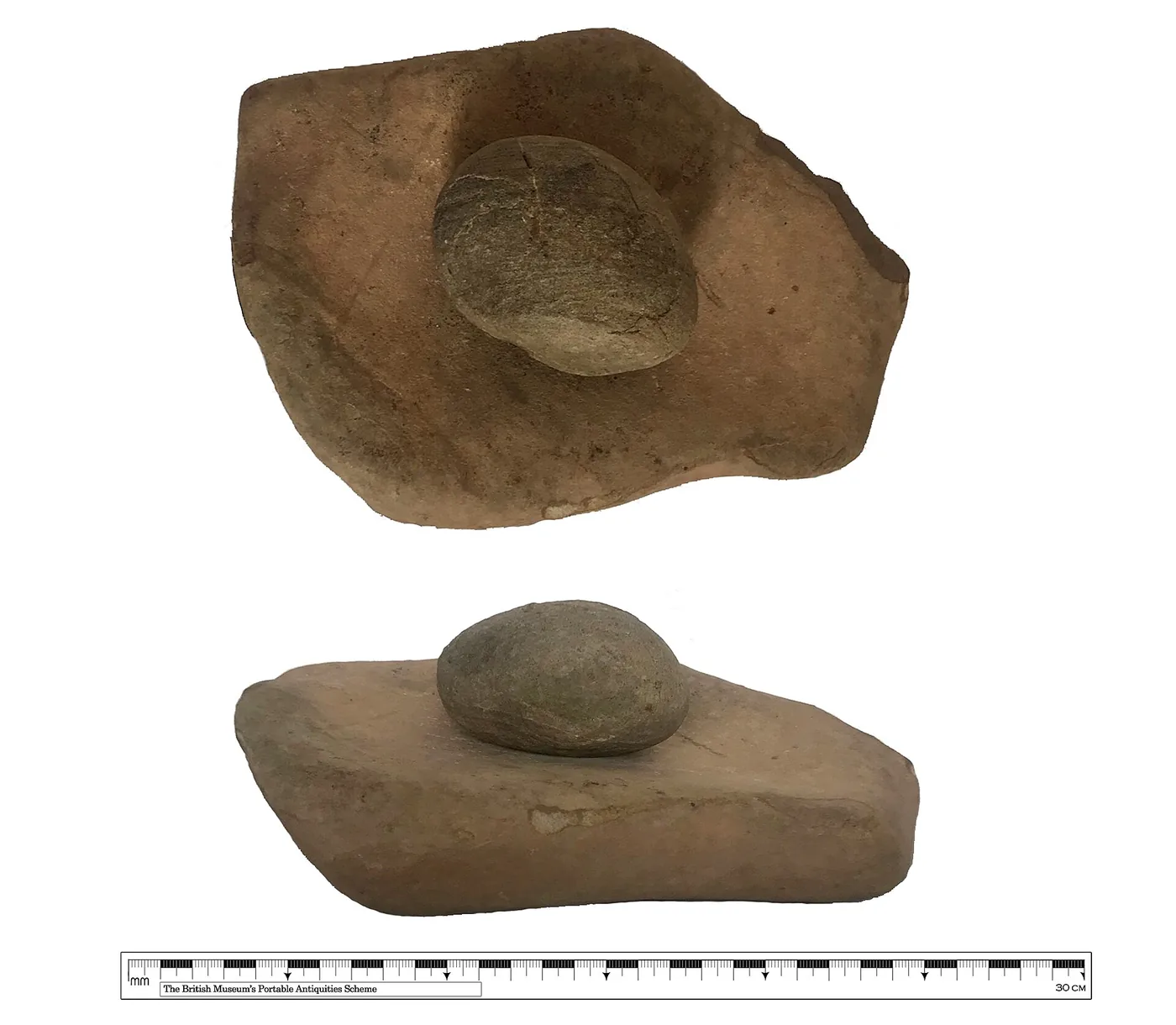
- Present the document.
- Describe the two parts of the tool.
- Explain how the tool was used.
- Why did farmers need such a tool?
Exercise 13 : Reading a table of farm work
Document 1 – Wages and fines in Hammurabi’s laws
| Law | Job or crime | Pay or penalty |
|---|---|---|
| 257 | Hiring a field laborer | 8 gur of corn per year |
| 258 | Hiring an ox-driver | 6 gur of corn per year |
| 261 | Hiring a herdsman for cattle or sheep | 8 gur of corn per year |
| 259 | Stealing a water-wheel from a field | fine of 5 shekels of silver |
| 260 | Stealing a shadduf (a device to draw water) or a plow | fine of 3 shekels of silver |
Source: Code of Hammurabi, laws 257-261 (translation by L. W. King, 1910); table prepared for this unit.
- Which farm worker earned the least?
- How much more per year did a field laborer earn than an ox-driver?
- Which theft carried the larger fine, a water-wheel or a plow? How much more?
- Explain what the table shows about farm life in Babylonia.
- Compare: the herdsman and the field laborer earn the same. What might that suggest about the importance of animals?
Exercise 14 : Locate the first farming sites
- Which rivers define the eastern part of the Fertile Crescent?
- Identify the site that is in present-day Turkey and was built by hunter-gatherers.
- Which site is farthest south?
- Explain why the Fertile Crescent was a good place for the first farms.
Exercise 15 : Farming around the world
- Name three regions where farming began independently.
- Name a crop that was first farmed in the Andes.
- Why do scholars say farming began independently in several places?
- What natural conditions do the regions share?
Hint: look at the legend.
Exercise 16 : Put events in order
Order these events from the oldest to the most recent and calculate the gaps.
- Jericho builds a stone tower (about 8000 BCE).
- Göbekli Tepe is built (about 9500 BCE).
- Çatalhöyük is founded (about 7400 BCE).
- Hammurabi issues his laws (about 1754 BCE).
- Wheat and barley are farmed in the Fertile Crescent (by about 9000 BCE).
Hint: with BCE, the larger number is older.
Exercise 17 : How long ago?
Use the year 2026 and remember that BCE years are counted backward.
- How many years ago was Çatalhöyük founded (7400 BCE)?
- How many years ago was the Jericho tower built (8000 BCE)?
- The Paleolithic lasted about 3.3 million years and farming has lasted about 12,000 years. About how many times longer was the Paleolithic?
- Explain why this comparison shows that farming is a recent change.
Exercise 18 : Guided research: Catalhoyuk
Research one early village and complete a fact sheet.
- Choose Çatalhöyük, Jericho, or Ain Ghazal.
- Keywords: Catalhoyuk UNESCO, Jericho Tell es-Sultan tower, Ain Ghazal statues.
- Reliable sites: UNESCO World Heritage (whc.unesco.org), the British Museum, the Smithsonian, Encyclopaedia Britannica, and Wikipedia (check its sources).
- Fact sheet: name, country today, approximate dates, what crops and animals were found, one unusual feature, and your sources.
Hint: compare at least two sources.
Exercise 19 : CER paragraph: Was farming progress?
Write a Claim, Evidence, Reasoning paragraph answering: Did farming improve people’s lives?
- Claim: take a position.
- Evidence: give at least two facts from the lesson.
- Reasoning: explain how the facts support the claim.
Hint: you can argue that it was a mixed result.
Exercise 20 : SAQ: Surplus and society
Answer in complete sentences.
- Describe what a surplus is.
- Explain one way a surplus changed society.
- Explain one problem that farming villages faced.
Exercise 21 : True or false? Justify
Decide whether each statement is true or false and justify your answer.
- The Neolithic Revolution happened in a single year.
- Farming began in only one place in the world.
- Göbekli Tepe was built by farmers.
- Farmers needed to stay near their fields.
Exercise 22 : Causes and consequences of farming
Complete the chain and explain each link.
- Cause: the Ice Age ends. Effect on climate and plants: ______.
- Effect on food supply: ______.
- Effect on where people live: ______.
- Effect on jobs and wealth: ______.


Quick review: flashcards
Tap a card to see the answer.