


This worksheet on Early Humans and the Paleolithic Era belongs to the Grade 6 Ancient Civilizations course. Its questions use primary sources, maps and timelines, and they move from basic recall to short writing tasks. Before you start, review the lesson; afterward, try the true or false quiz.
Exercise 1 : Vocabulary of the Paleolithic
Define each word in one sentence, then use it in a sentence about early humans.
- Paleolithic
- hominin
- hunter-gatherer
- nomad
- artifact
- migration
Hint: reread the definition boxes in the lesson and add an example.
Exercise 2 : Darwin’s hypothesis
Document 1 – Darwin on the birthplace of humans
In each great region of the world the living mammals are closely related to the extinct species of the same region. It is therefore probable that Africa was formerly inhabited by extinct apes closely allied to the gorilla and chimpanzee; and as these two species are now man’s nearest allies, it is somewhat more probable that our early progenitors lived on the African continent than elsewhere.
Source: Charles Darwin, The Descent of Man, and Selection in Relation to Sex, Part I, chapter 6, London, 1871 (English, text of Wikisource).
- Present the document (nature, author, date, context).
- Identify the continent Darwin names as the likely birthplace of humans.
- Explain the two pieces of reasoning he uses to reach that conclusion.
- Darwin writes “somewhat more probable.” What does this wording tell you about how sure he was?
Hint: look at which animals he mentions and where they live.
Exercise 3 : Evidence from Jebel Irhoud
Document 1 – Oldest Homo sapiens fossils
Here we report newly discovered human fossils from Jebel Irhoud, Morocco, and interpret the affinities of the hominins from this site with other archaic and recent human groups. […] In combination with an age of 315 ± 34 thousand years (as determined by thermoluminescence dating), this evidence makes Jebel Irhoud the oldest and richest African Middle Stone Age hominin site that documents early stages of the H. sapiens clade […]. Furthermore, it shows that the evolutionary processes behind the emergence of H. sapiens involved the whole African continent.
Source: Jean-Jacques Hublin and colleagues, “New fossils from Jebel Irhoud, Morocco and the pan-African origin of Homo sapiens,” Nature 546 (June 8, 2017), pp. 289-292, abstract (doi:10.1038/nature22336).
- Present the document (nature, authors, date, context).
- Where were the fossils found, and how old are they?
- Which dating method did the scientists use?
- Identify the main claim the authors make in their last sentence.
- Why do the authors give an age with the sign “±” (plus or minus)?
Hint: a margin of error shows how precise a measurement is.
Exercise 4 : A guess and a discovery
Document 1 – Charles Darwin, 1871
In each great region of the world the living mammals are closely related to the extinct species of the same region. It is therefore probable that Africa was formerly inhabited by extinct apes closely allied to the gorilla and chimpanzee; and as these two species are now man’s nearest allies, it is somewhat more probable that our early progenitors lived on the African continent than elsewhere.
Source: Charles Darwin, The Descent of Man, and Selection in Relation to Sex, Part I, chapter 6, London, 1871 (English, text of Wikisource).
Document 2 – Jean-Jacques Hublin and colleagues, 2017
Here we report newly discovered human fossils from Jebel Irhoud, Morocco, and interpret the affinities of the hominins from this site with other archaic and recent human groups. […] In combination with an age of 315 ± 34 thousand years (as determined by thermoluminescence dating), this evidence makes Jebel Irhoud the oldest and richest African Middle Stone Age hominin site that documents early stages of the H. sapiens clade […]. Furthermore, it shows that the evolutionary processes behind the emergence of H. sapiens involved the whole African continent.
Source: Jean-Jacques Hublin and colleagues, “New fossils from Jebel Irhoud, Morocco and the pan-African origin of Homo sapiens,” Nature 546 (June 8, 2017), pp. 289-292, abstract (doi:10.1038/nature22336).
- Compare the two documents: what do they have in common?
- Explain the main difference between them in terms of evidence.
- How does Document 2 support Document 1?
- Write two sentences explaining why historians and scientists keep re-examining old ideas.
Exercise 5 : Can a Roman poet be a source?
Document 1 – Lucretius on early humans
And whilst so many lustrums of the sun
Rolled on across the sky, men led a life
After the roving habit of wild beasts.
[…]
What sun and rains
To them had given, what earth of own accord
Created then, was boon enough to glad
Their simple hearts.
Source: Lucretius, On the Nature of Things, Book V, about 55 BCE (verse translation by William Ellery Leonard, 1916).
*lustrum (plural lustrums): a period of five years in ancient Rome. *glad: to make glad.
- Present the document (nature, author, date).
- Describe how Lucretius imagines the life of the first humans.
- Lucretius wrote about 55 BCE, thousands of years after the Paleolithic ended. Explain why we cannot treat his poem as proof of how Paleolithic people lived.
- Name one thing in the poem that archaeology has confirmed (see the lesson).
Hint: compare what the poem says about food with what you learned about hunter-gatherers.
Exercise 6 : Weapons: a poet and a stone tool
Document 1 – The first weapons, according to Lucretius
Man’s ancient arms
Were hands, and nails and teeth, stones too and boughs–
Breakage of forest trees– and flame and fire,
As soon as known. Thereafter force of iron
And copper discovered was.
Source: Lucretius, On the Nature of Things, Book V, about 55 BCE (translation by William Ellery Leonard, 1916).
Document 2 – An Acheulean handaxe
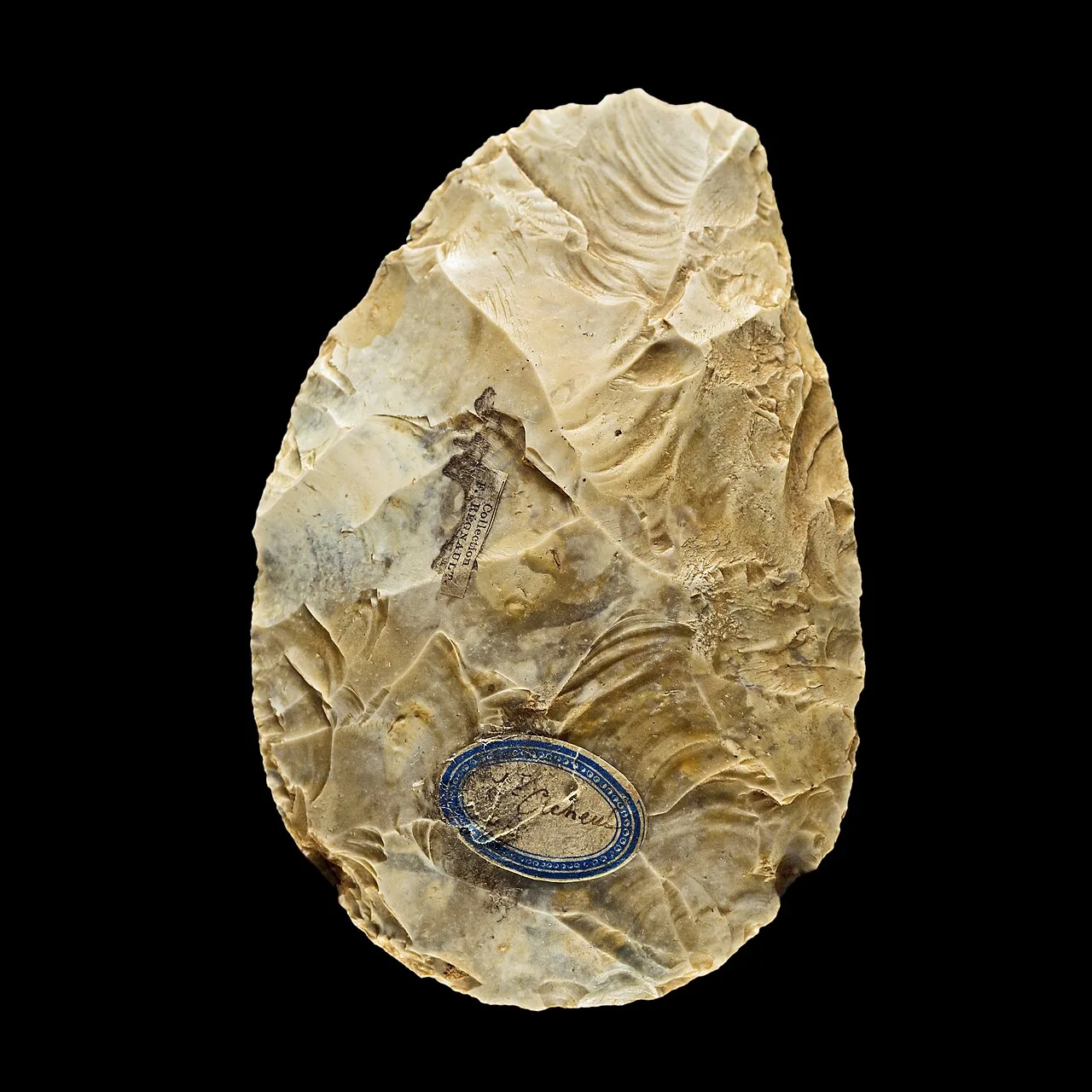
- Identify the weapons Lucretius lists as the earliest.
- Describe the object in Document 2 (material, shape, how it was made).
- Compare the two documents: what does the real object add that the poem does not tell us?
- Explain why a handaxe is useful evidence for archaeologists.
Hint: think about skill: someone had to shape this stone.
Exercise 7 : Fire in the Roman imagination
Document 1 – Lucretius on fire
’Twas lightning brought primevally to earth
The fire for mortals, and from thence hath spread
O’er all the lands the flames of heat. […]
Next, food to cook and soften in the flame
The sun instructed, since so oft they saw
How objects mellowed, when subdued by warmth.
Source: Lucretius, On the Nature of Things, Book V, about 55 BCE (translation by William Ellery Leonard, 1916).
- Present the document.
- According to the poem, how did humans first get fire?
- What did early people learn about food from heat?
- List three ways fire changed life for early humans (use the lesson).
- Explain why fire is called one of the most important discoveries in human history.
Exercise 8 : Lucy’s skeleton
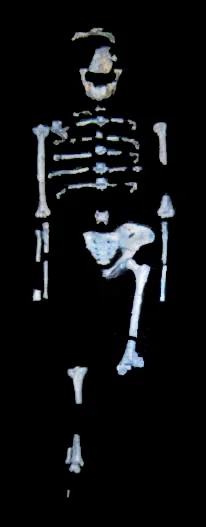
- Present the document (what it shows, date, place of discovery).
- Describe what you see. Which parts of the skeleton are present?
- Lucy was found in 1974 at Hadar, Ethiopia. Why was her find so important?
- Explain why it is a cast and not the original bones.
Hint: look at the pelvis and the leg bones; they show how she moved.
Exercise 9 : Footprints in volcanic ash
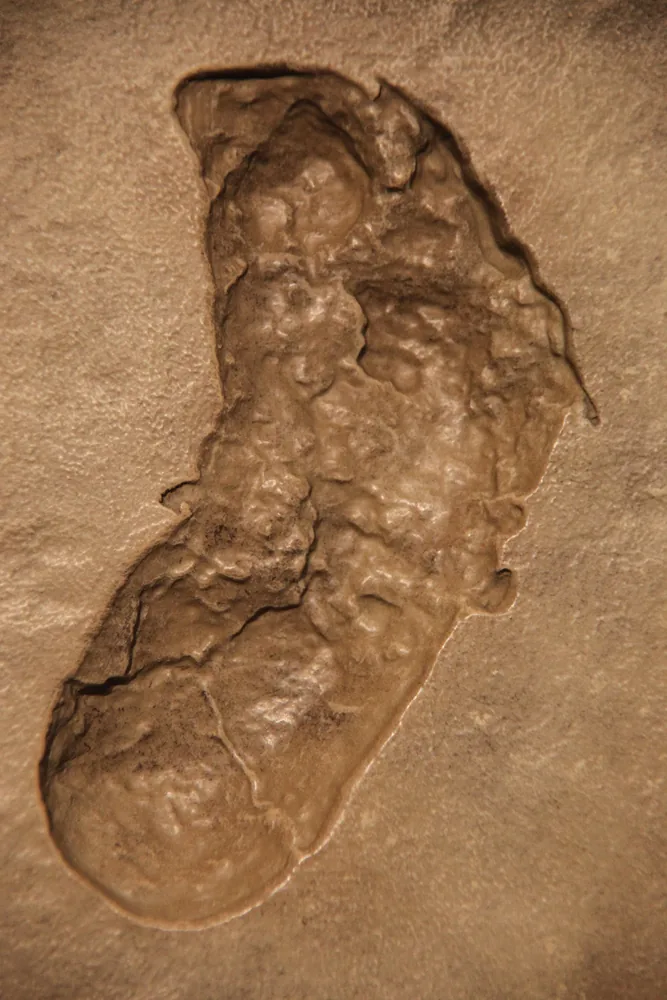
- Present the document.
- Describe the shape of the print. Which part of the foot can you identify?
- Explain what a trail of footprints can tell us about how a hominin moved.
- Why is it lucky that this trail survived for 3.66 million years?
Hint: a trail shows steps in a row.
Exercise 10 : Java Man
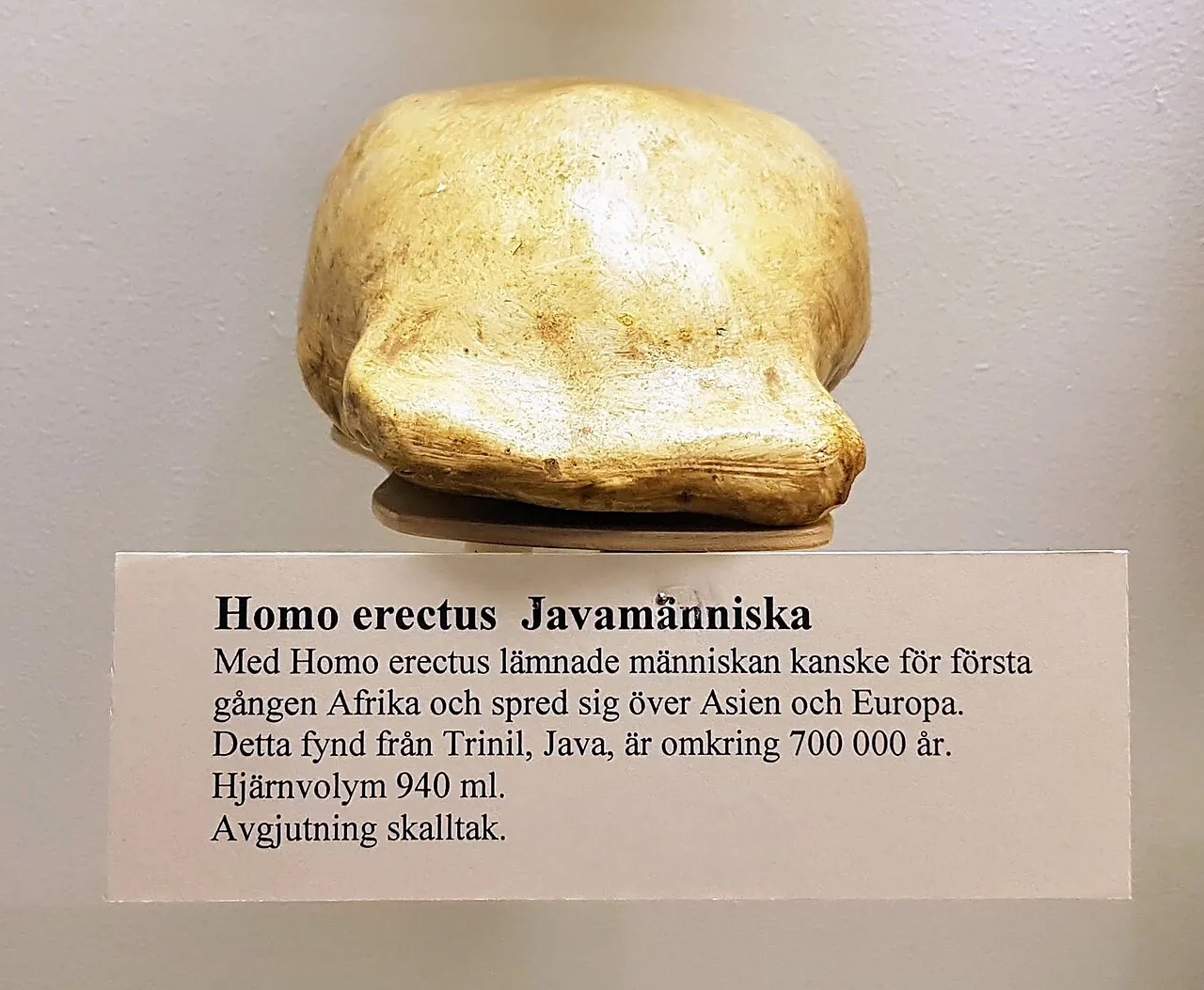
- Present the document.
- Describe the object. What part of the head survives?
- Who found it, when, and where?
- Why was this fossil important for the idea that early humans left Africa?
Exercise 11 : The painted wall at Lascaux
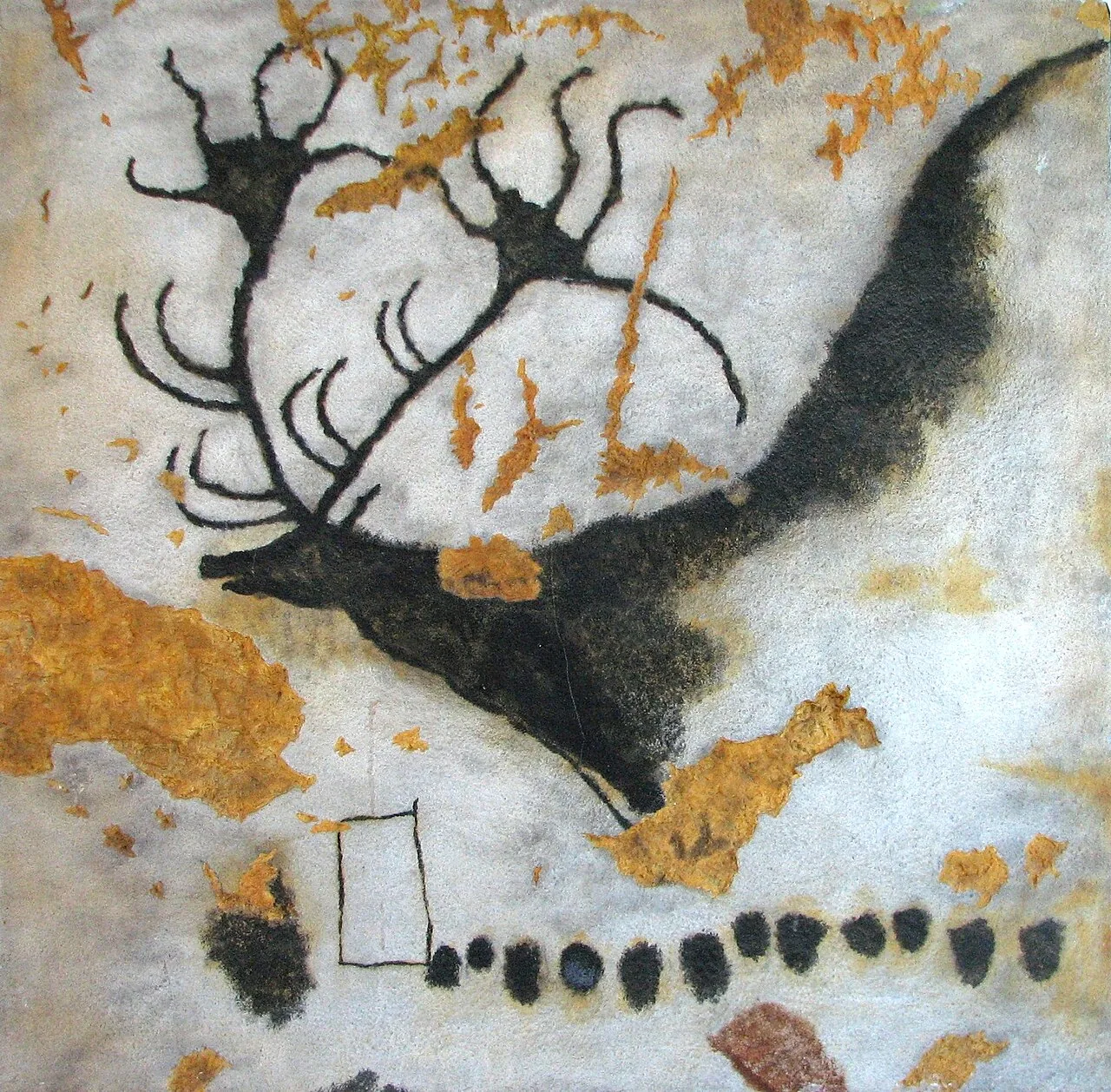
- Present the document.
- Describe what the artist painted and the colors used.
- Give two possible explanations for why people painted such scenes.
- What does this painting tell us about the people who made it besides their skill?
Hint: think about what the people needed from this animal.
Exercise 12 : A figurine from the Ice Age
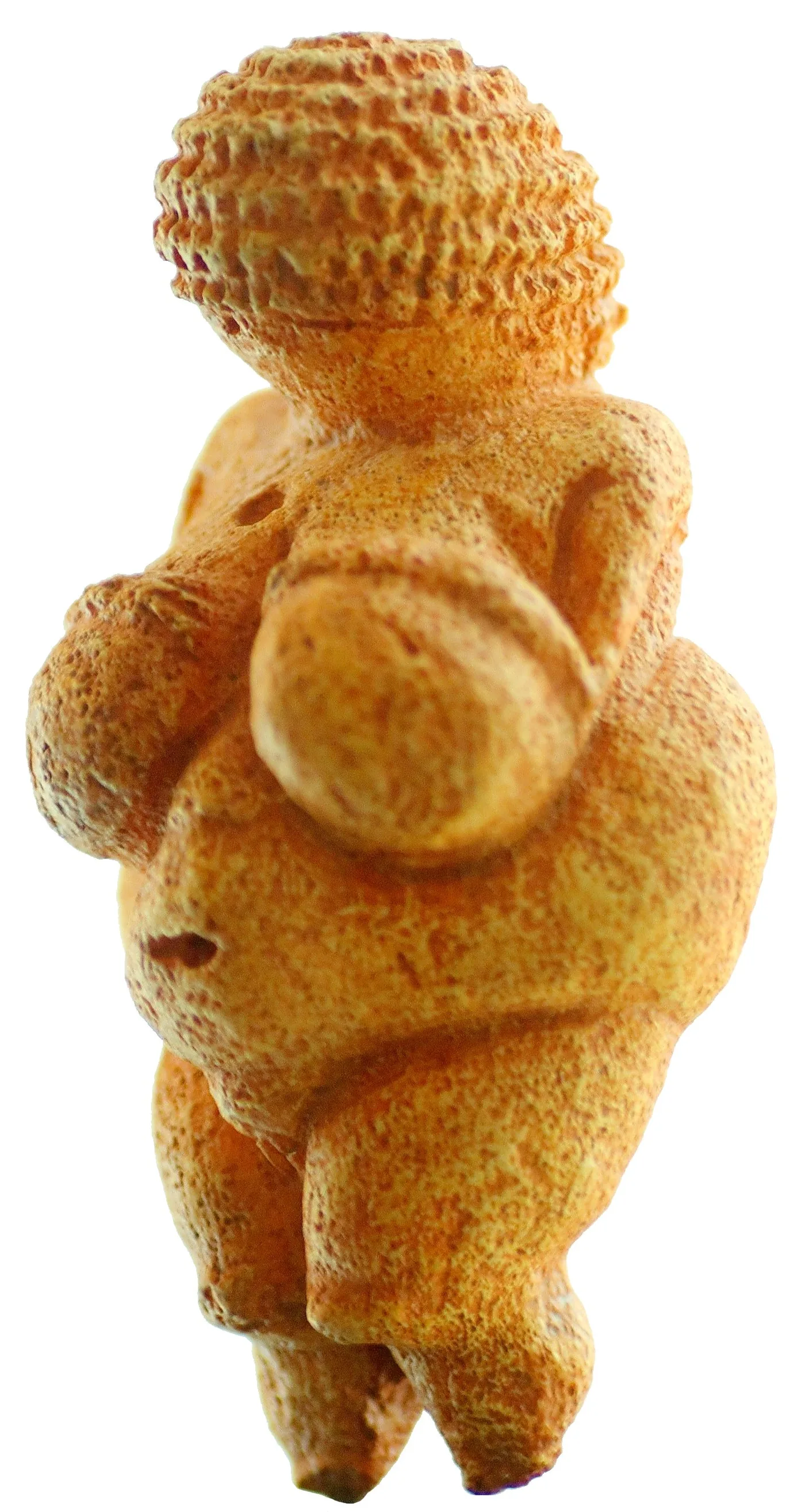
- Present the document.
- Describe the object: material, size, shape, features.
- What does the figurine show about the skills of Upper Paleolithic people?
- Why do archaeologists avoid saying for certain what the figurine meant?
Exercise 13 : Reading a table of early humans
Document 1 – Five species of early humans
| Species | Where it lived | When it lived | Height |
|---|---|---|---|
| Australopithecus afarensis | Eastern Africa (Ethiopia, Kenya, Tanzania) | between about 3.85 and 2.95 million years ago | males about 4 ft 11 in (151 cm); females about 3 ft 5 in (105 cm) |
| Homo habilis | Eastern and Southern Africa | 2.4 million to 1.4 million years ago | about 3 ft 4 in to 4 ft 5 in (100-135 cm) |
| Homo erectus | Africa, western Asia (Dmanisi, Georgia), East Asia (China and Indonesia) | between about 1.89 million and 110,000 years ago | 4 ft 9 in to 6 ft 1 in (145-185 cm) |
| Homo neanderthalensis | Europe and southwestern to central Asia | about 400,000 to 40,000 years ago | males about 5 ft 5 in (164 cm); females about 5 ft 1 in (155 cm) |
| Homo sapiens | evolved in Africa, now worldwide | about 300,000 years ago to the present | not given |
Source: Smithsonian National Museum of Natural History, Human Origins program, species pages (humanorigins.si.edu), data summarized in one table.
- Which species lived in Europe?
- Which species lived the longest, in years? Calculate roughly.
- How long did Neanderthals and Homo sapiens overlap?
- Which species lived in the widest range of regions, and what does that suggest?
- Write one conclusion about human evolution based on the table.
Exercise 14 : Locate the sites
- Name the continent where sites 1 and 2 are located.
- Which numbered site is in France? Which is in China?
- Identify the continents that the arrows reach.
- Explain why the sites of the earliest hominins are all in the same part of the world.
Exercise 15 : Complete the migration map
- Name the region marked X where the journeys begin.
- Match each letter to a destination: Europe, East Asia, Australia, the Americas.
- Which route needed a land bridge during the Ice Age? Explain.
- Which route required crossing sea between islands?
Hint: the dashed arrow leaves the map at the right edge.
Exercise 16 : Order the events
Put these events in order from the oldest to the most recent. Then match each to a stage of the Paleolithic.
- Painters decorate Lascaux Cave.
- Lucy lives at Hadar.
- Homo sapiens appears in Africa.
- Homo erectus leaves Africa.
- Footprints are made at Laetoli.
- The Ice Age ends.
Hint: use the timeline in the lesson.
Exercise 17 : How long is the Paleolithic?
Writing was invented about 5,200 years ago. Homo sapiens has existed for about 300,000 years. The first stone tools are about 3.3 million years old.
- How many years of Homo sapiens history happened before writing? (300,000 minus 5,200)
- About what percent of Homo sapiens history is recorded in writing? (5,200 divided by 300,000)
- How many times longer than the history of writing is the Paleolithic? (3,300,000 divided by 5,200)
- Explain why the Paleolithic is hard to study.
Exercise 18 : Guided research: a Paleolithic site
Investigate one Paleolithic site and fill in a fact sheet.
- Choose Lascaux, Chauvet, Olduvai Gorge, or Schöningen.
- Keywords to type: Lascaux cave painting age, Chauvet Cave, Olduvai Gorge Leakey, Schöningen spears.
- Reliable sites: the Smithsonian Human Origins website (humanorigins.si.edu), the British Museum, the UNESCO World Heritage website, Encyclopaedia Britannica, or Wikipedia (check its sources at the bottom).
- Fact sheet: name of the site, country, date of the finds, who found it and when, what was found, what it tells us.
Hint: compare at least two sources and note any difference in dates.
Exercise 19 : CER paragraph: the importance of fire
Write a paragraph using the Claim, Evidence, Reasoning model to answer: Why was the control of fire important for early humans?
- Claim: state your answer in one sentence.
- Evidence: give two facts from the lesson or the documents.
- Reasoning: explain how the facts support your claim.
Hint: use words such as because, for example, and this shows that.
Exercise 20 : SAQ: Why did hunter-gatherers move?
Answer in three parts, in complete sentences.
- Describe one way a hunter-gatherer band got its food.
- Explain one reason bands had to move from place to place.
- Describe one way that nomadic life affected what people owned.
Exercise 21 : True or false? Justify
Decide whether each statement is true or false and justify your answer with a fact.
- Lucy was a member of the species Homo sapiens.
- Homo erectus was the first human species to leave Africa.
- Neanderthals and Homo sapiens never lived at the same time.
- Paleolithic people grew crops in fields.
Exercise 22 : Causes and consequences: the Ice Age
Complete the chain and explain each link.
- Cause: huge ice sheets lock up water. Effect on sea level: ______.
- Effect on the land: ______.
- Effect on human travel: ______.
- Explain one risk early migrants faced.
Hint: think about Beringia and Australia.


Quick review: flashcards
Tap a card to see the answer.