


This Grade 6 Ancient Civilizations lesson covers Mesopotamia and the Fertile Crescent, part of the unit “River valley civilizations.” First, read the full lesson with its primary sources, maps and key terms. Then practice with the worksheet, check yourself with the quiz and get ready with the test.
If you flew over southern Iraq today, you would see a flat brown plain crossed by two rivers. About 6,000 years ago, this plain held something new: crowded cities with temples that towered over the houses, officials who counted grain on clay tablets, and kings who made laws. This was Mesopotamia, a Greek word meaning “the land between the rivers.” The people who lived here built one of the world’s first civilizations and invented ideas we still use, from the wheel to the 60-minute hour.
Guiding question: How did geography and new inventions help the first civilizations grow in Mesopotamia?
1. The land between two rivers
Mesopotamia lies in the eastern part of the Fertile Crescent, the arc of rich land you studied in the last unit. Today it is mostly in Iraq, with parts in Syria, Turkey, and Iran. Two rivers define it: the Tigris and the Euphrates. Both begin in the mountains of what is now Turkey and flow southeast across the plain to the Persian Gulf.
Definition: Mesopotamia
A region of southwest Asia between the Tigris and Euphrates rivers, in present-day Iraq and neighboring countries, where some of the world’s first cities appeared. The name comes from Greek and means “between the rivers.”
Geography gave Mesopotamia great advantages and serious problems. Each spring, melting snow in the mountains made the rivers rise and deposit silt, a fine, fertile soil, over the plain. The soil was perfect for growing barley and wheat. However, there was almost no rain in the south, and the floods were unpredictable. Some years the rivers overflowed and destroyed crops. In other years the water came late. There were few trees, stone, or metals, so people had to trade for them and to build with the one thing everywhere: mud.
The farmers’ answer was irrigation: digging canals to carry river water to the fields, building dams and dikes to hold it, and storing it in reservoirs. Irrigation required many people to work together, to agree on rules, and to repair the system every year. Historians think that this need for cooperation encouraged the growth of leaders and governments. The Greek historian Herodotus, who lived about 484 to 425 BCE, described the farming of Babylonia in his Histories.
Document 1 – Herodotus describes farming in Babylonia
But little rain falls in Assyria, enough, however, to make the corn begin to sprout, after which the plant is nourished and the ears formed by means of irrigation from the river. For the river does not, as in Egypt, overflow the corn-lands of its own accord, but is spread over them by the hand, or by the help of engines. The whole of Babylonia is, like Egypt, intersected with canals. […] Of all the countries that we know there is none which is so fruitful in grain.
Source: Herodotus, Histories, Book I, chapter 193, about 430 BCE (translation by George Rawlinson, 1858-1860).
*corn: here, grain such as wheat and barley. *engines: machines for lifting water. *Assyria: the northern part of Mesopotamia; Herodotus uses it for the whole region.
Commentary. Herodotus was a Greek traveler and writer, living about 1,300 years after the age of Hammurabi, so he describes a much later Babylon. He explains that the rivers do not flood on their own, as the Nile does, but that farmers must spread the water by hand or with machines. His claim that the land is the most fruitful in grain is probably exaggerated, since other parts of his account give extremely high yields, but his description of canals matches what archaeologists have found.
Definition: irrigation
A system of canals, ditches, and dams that brings water from a river to farm fields.
2. The first cities of Sumer
By about 4000 BCE, villages in southern Mesopotamia were growing into towns. The southern region is called Sumer, and its people are the Sumerians. Their language was not related to any language we know today. Around 3200 BCE the city of Uruk had grown large, with tens of thousands of people, and it is often called one of the first true cities. Other early cities include Ur, Lagash, Kish, Nippur, and Eridu.
Each Sumerian city was an independent state with its own ruler, army, and patron god. Historians call these cities city-states. They often fought over land, water, and borders, so cities built walls. A city might control the villages and fields around it for several miles.
Definition: city-state
A city that governs itself and the land around it as an independent state, with its own ruler, laws, and army.
Temples and gods
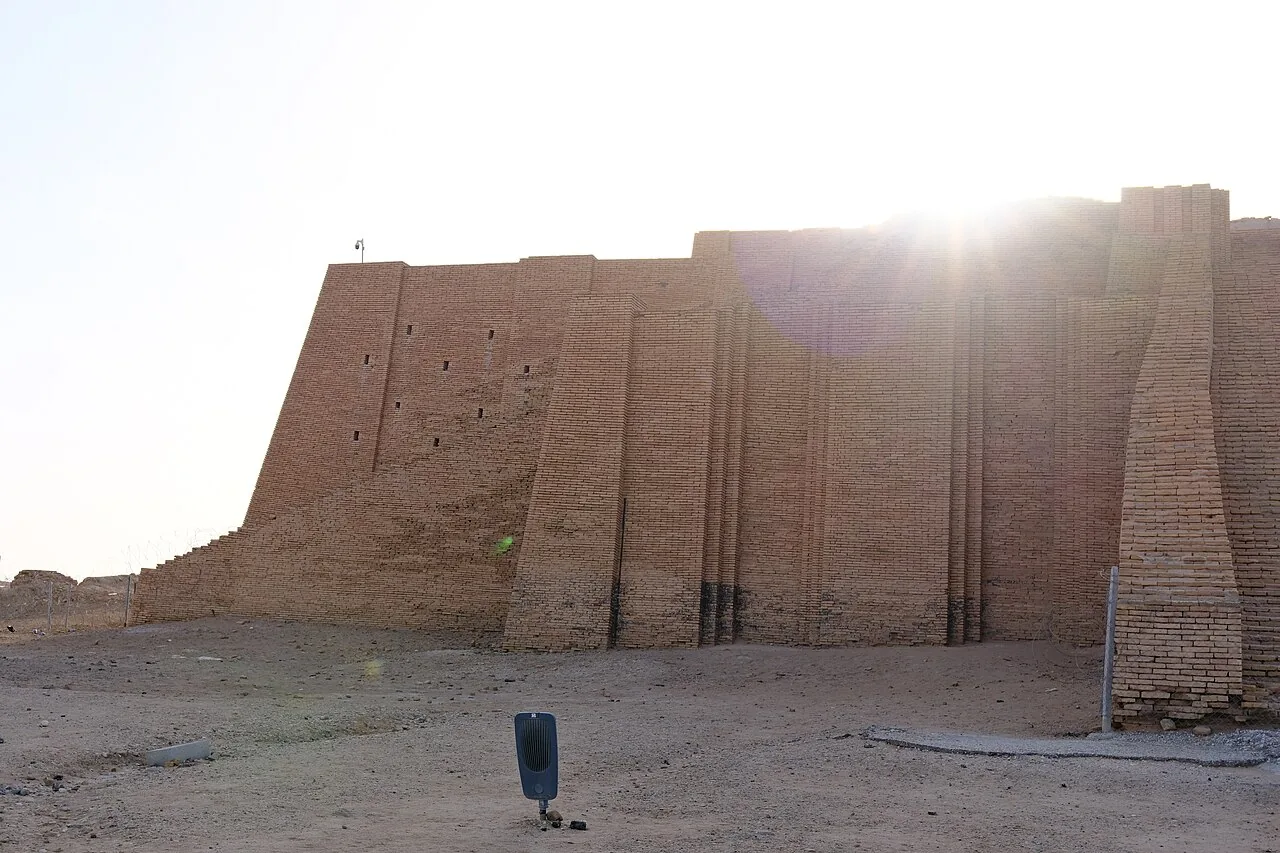
The temple stood at the center of the city. The Sumerians believed in many gods (polytheism), each tied to a natural force or to a city. Inanna was goddess of Uruk, and Nanna, the moon god, protected Ur. People thought the gods owned the city and that the king ruled for them. To honor the gods, Sumerians built a stepped tower of mudbrick called a ziggurat, topped with a small temple. The best preserved is the Great Ziggurat of Ur, built about 2100 BCE by King Ur-Nammu.
Definition: ziggurat
A massive stepped tower of mudbrick in Mesopotamian cities, with a temple at the top, built to honor a city’s god.
Society and trade
Sumerian society had levels, called social classes. At the top were the king, priests, and officials. Next came wealthy landowners, merchants, and skilled workers such as potters, weavers, and metalworkers. Most people were farmers. At the bottom were slaves, who were often prisoners of war or people who could not pay their debts. Women could own property, run businesses, and become priestesses. For example, Enheduanna, a priestess and the daughter of King Sargon, is the first author in history we know by name, about 2300 BCE.
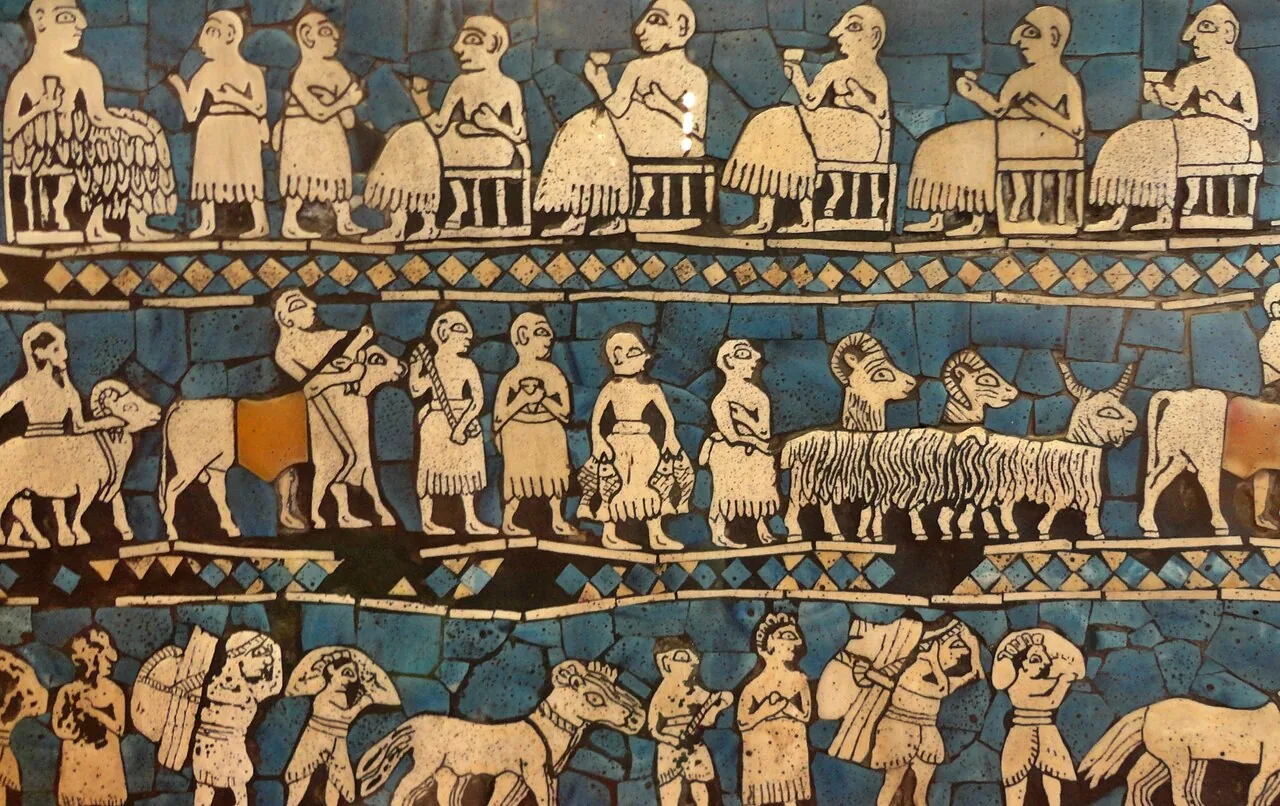
The cities also traded. Sumerians exchanged grain, cloth, and pottery for stone, wood, and metals from distant lands, sailing on rivers and the Gulf and traveling by donkey caravan. Artists made beautiful objects, such as the “Standard of Ur,” a wooden box decorated with shell, limestone, and lapis lazuli found in a royal graveyard at Ur by Leonard Woolley in the 1920s. Its “War” and “Peace” sides show soldiers, chariots, prisoners, a banquet, and people bringing goods.
3. Cuneiform and other inventions
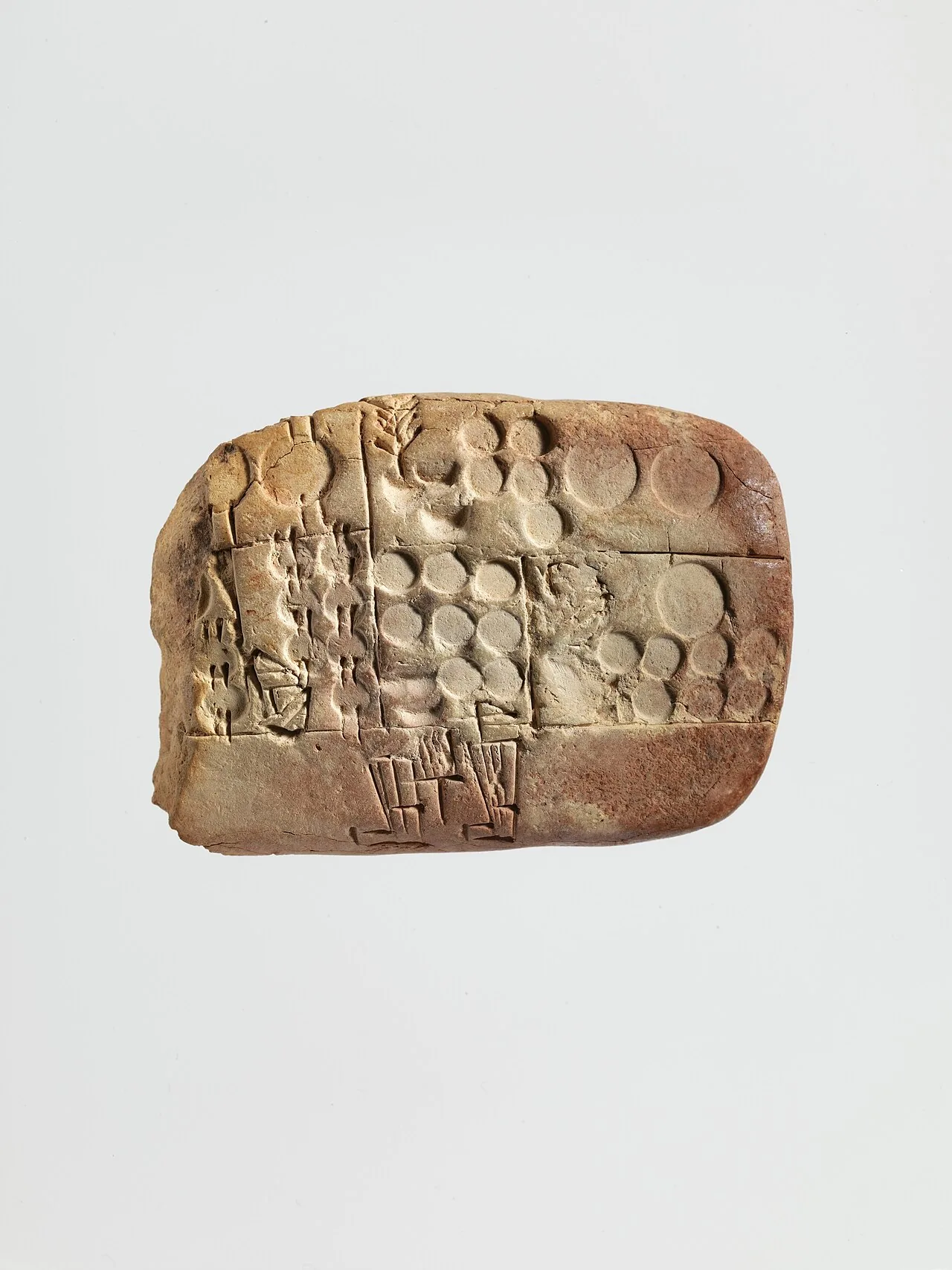
The most important Mesopotamian invention was writing. About 3300 BCE in Uruk, officials began to press signs into soft clay to record how much grain, beer, and livestock the temples collected and gave out. Over time the signs came to stand for sounds and words. Scribes pressed a sharpened reed into wet clay, so the marks look like wedges. The writing is called cuneiform, from the Latin word cuneus, meaning “wedge.” Dried tablets lasted for thousands of years. Scribes used cuneiform for laws, letters, business contracts, prayers, and stories. One of them is the Epic of Gilgamesh, about a king of Uruk and one of the world’s oldest stories.
Definition: cuneiform
The wedge-shaped writing of Mesopotamia, made by pressing a reed stylus into wet clay. It was first used to keep records and later to write many languages.
A scribe was a person trained to read and write. Learning cuneiform took years of study in a school, and boys, and sometimes girls from rich families, copied lists of signs again and again. Scribes held important jobs in temples, palaces, and businesses.
Other advances
The Sumerians and their neighbors made other advances. About 3500 BCE they used the potter’s wheel and soon after the wheeled cart, which made it easier to carry grain. They built plows pulled by oxen, sailboats, and mudbrick buildings with arches. In mathematics they counted in base 60, which is why we have 60 seconds in a minute, 60 minutes in an hour, and 360 degrees in a circle. They watched the moon to create a calendar of twelve lunar months and tracked the stars.
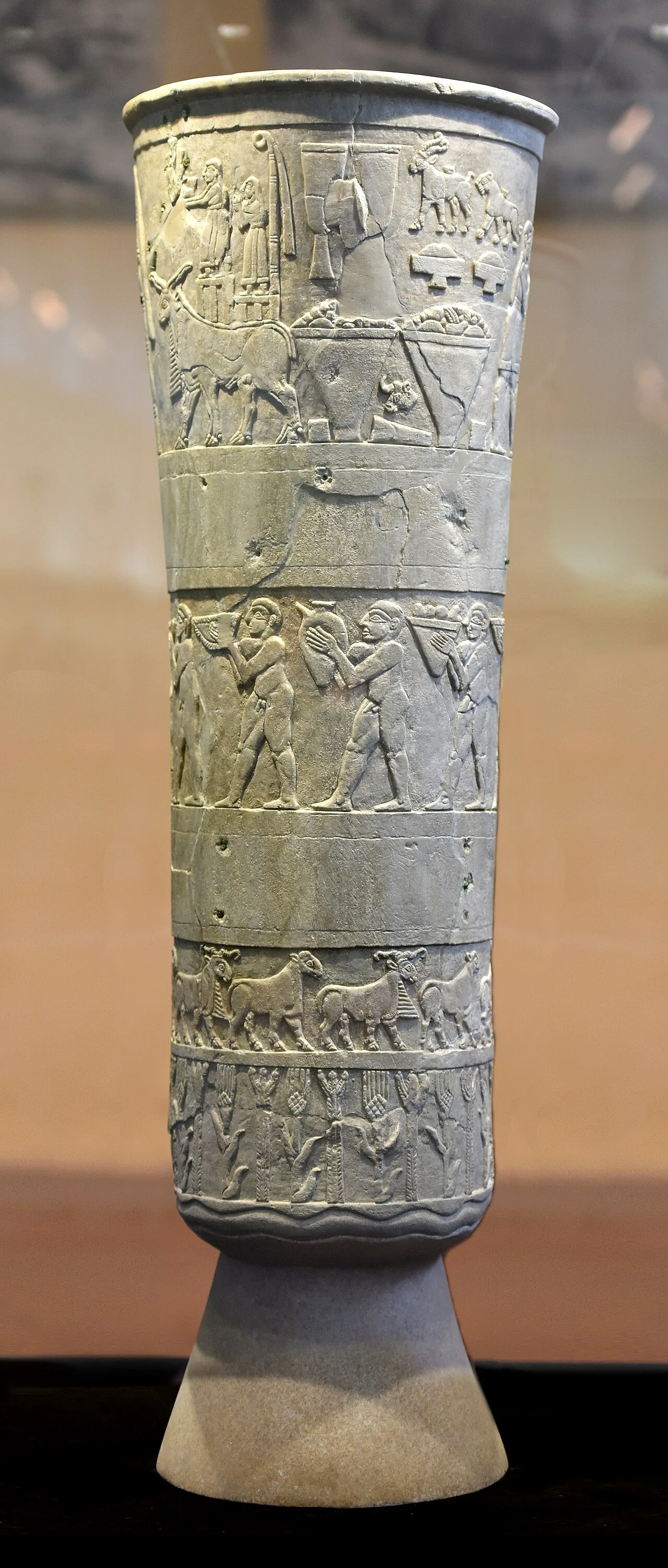
Historians use a list of features to define a civilization: cities, an organized government, a shared religion, social classes, and writing and art. Mesopotamia had all of them, which is why it is called one of the first civilizations.
Definition: civilization
A complex society with cities, a government, a shared religion, social classes, specialized jobs, writing, and art.
4. Empires, laws, and legacy
As cities fought each other, strong rulers began to conquer their neighbors. About 2334 BCE, Sargon of Akkad, who came from the north of Sumer, united the cities of Sumer and Akkad and created what is often called the first empire. Later, King Ur-Nammu of Ur built a new state and the ziggurat of Ur. About 1792 BCE, Hammurabi became king of Babylon, a city on the Euphrates. During his reign of more than forty years, Babylon took over most of Mesopotamia.
Hammurabi is famous for his laws. About 1754 BCE he had them carved on a tall stele of black stone that stood in a public place so that anyone could read them. It contains 282 laws. Archaeologists found it in 1901-1902 at Susa, in present-day Iran, where an enemy king had carried it off as a trophy. It is now in the Louvre Museum in Paris.
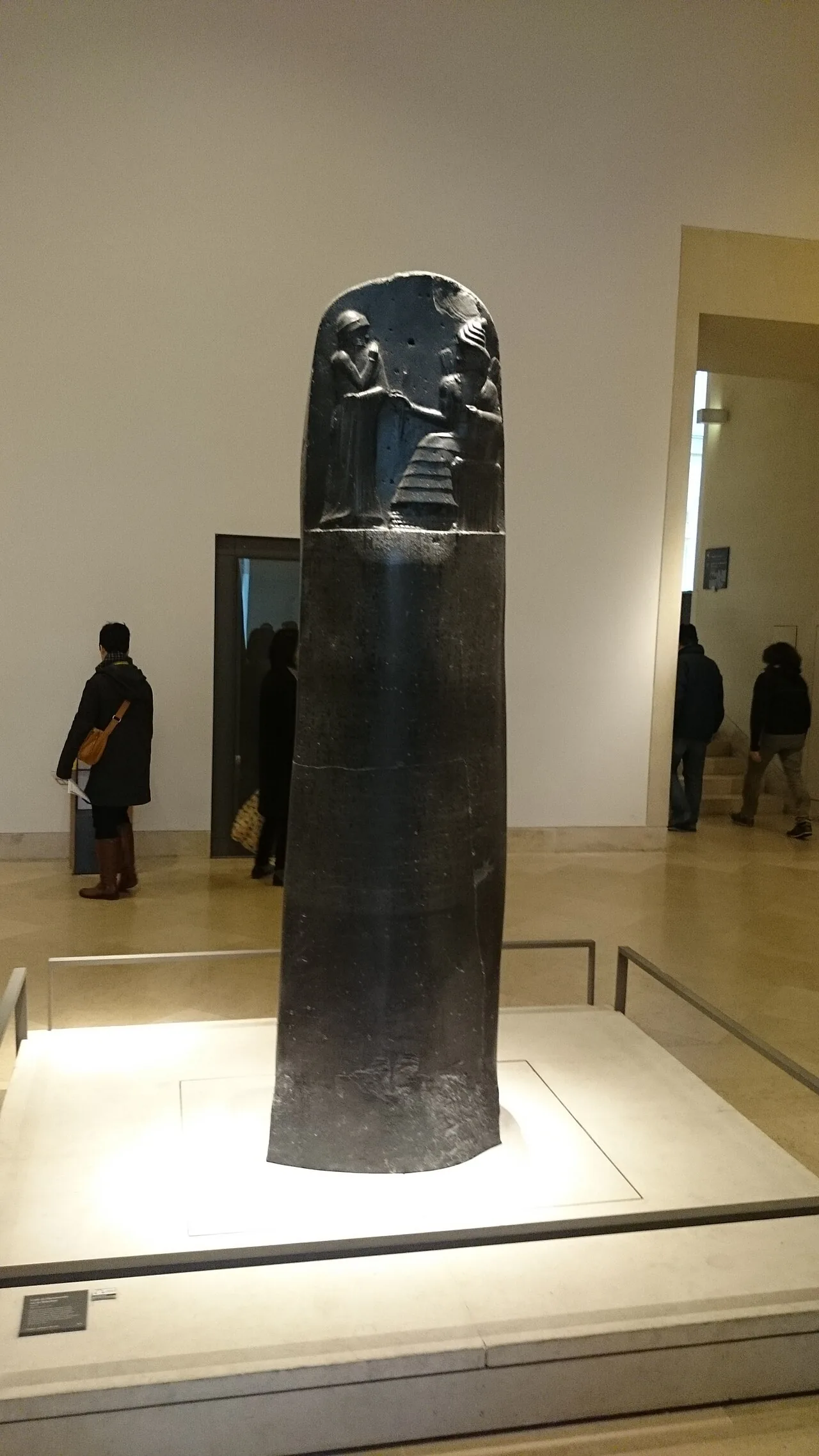
In the prologue, Hammurabi explains why he made the laws.
Document 2 – Why Hammurabi made his laws
[…] Anu and Bel called by name me, Hammurabi, the exalted prince, who feared God, to bring about the rule of righteousness in the land, to destroy the wicked and the evil-doers; so that the strong should not harm the weak; so that I should rule over the black-headed people like Shamash, and enlighten the land, to further the well-being of mankind.
Source: Code of Hammurabi, prologue, Babylon, about 1754 BCE (translation by L. W. King, 1910).
*Anu and Bel: two great Mesopotamian gods (Bel is another name for Enlil). *Shamash: the sun god, who was also the god of justice. *the black-headed people: a Mesopotamian term for the people of the land.
Commentary. The king says that the gods chose him to bring justice, to punish the wicked, and to protect the weak from the strong. This was also a way of claiming that his power came from the gods. The laws themselves show what justice meant: punishments were different for people of different classes.
Document 3 – Eye for an eye, but not for everyone
196. If a man put out the eye of another man, his eye shall be put out.
197. If he break another man’s bone, his bone shall be broken.
198. If he put out the eye of a freed man, or break the bone of a freed man, he shall pay one gold mina.
199. If he put out the eye of a man’s slave, or break the bone of a man’s slave, he shall pay one-half of its value.
200. If a man knock out the teeth of his equal, his teeth shall be knocked out.
Source: Code of Hammurabi, laws 196-200, Babylon, about 1754 BCE (translation by L. W. King, 1910).
*freed man: a person who is not a slave but has lower status than a full citizen in this code. *mina: a unit of weight for silver or gold, about one pound. *equal: a person of the same rank.
Commentary. Laws 196, 197, and 200 follow the rule of equal punishment, often called “an eye for an eye.” But if the victim was a freed man or a slave, the punishment was only a payment, and a smaller one for a slave. The code treated people unequally, according to their class. It also protected the written word: everyone could see the law, even though few could read it.
Later empires
Babylon later declined, and the Assyrians of the north, with a fierce army and iron weapons, built a large empire from about 900 to 612 BCE, with capitals at Ashur and Nineveh. In 612 BCE, Babylonians and Medes destroyed Nineveh. Under King Nebuchadnezzar II (605 to 562 BCE), Babylon again became rich and built the Ishtar Gate and great walls. In 539 BCE, the Persian king Cyrus conquered Babylon.
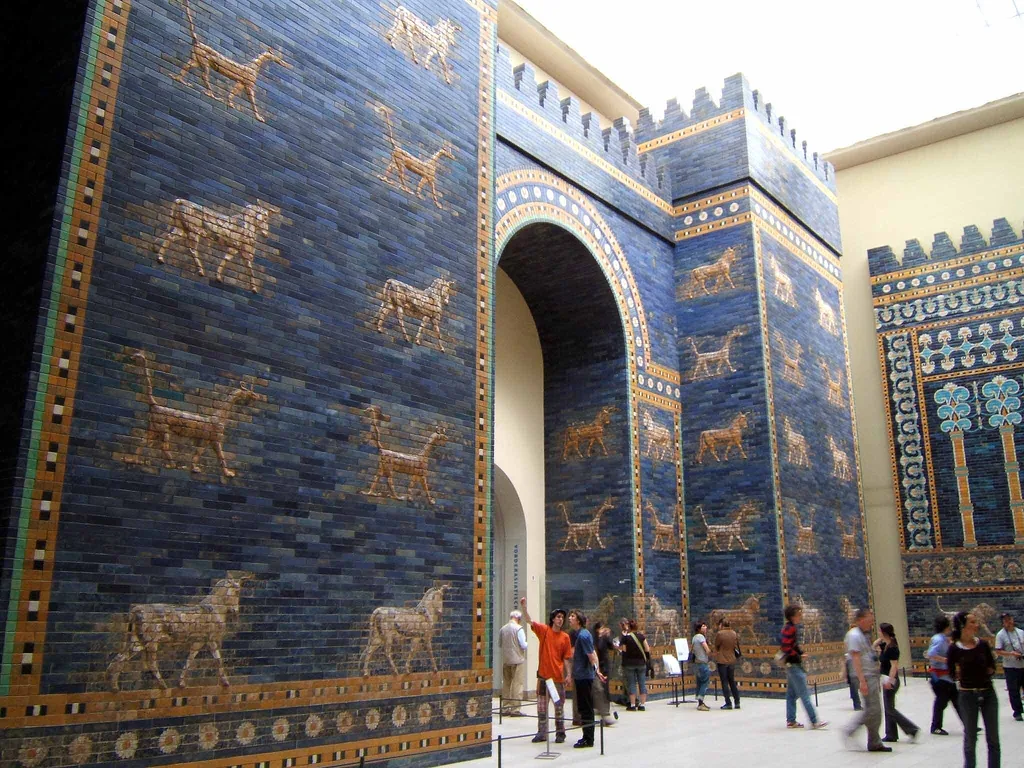
Mesopotamian civilization left a lasting legacy: writing, written law, the wheel, the sailboat, math based on 60, and the idea of the city. These ideas spread to neighboring peoples and influenced later cultures, including the Hebrews, Persians, and Greeks, as the next units show.
- About 4000 BCE Villages and temples grow into towns in southern Mesopotamia.
- About 3300 BCE Uruk is a large city; writing begins on clay tablets.
- About 2600-2400 BCE Royal tombs of Ur hold the Standard of Ur.
- About 2334 BCE Sargon of Akkad creates the first empire.
- About 2100 BCE King Ur-Nammu builds the Great Ziggurat of Ur.
- About 1754 BCE Hammurabi of Babylon has his code of laws carved on a stele.
- 612 BCE Babylonians and Medes destroy Nineveh, capital of Assyria.
- About 575 BCE The Ishtar Gate is built in Babylon under Nebuchadnezzar II.
- 539 BCE Cyrus of Persia conquers Babylon.
Key takeaways
- Mesopotamia means “between the rivers”; the Tigris and Euphrates brought fertile silt but unpredictable floods, so people built irrigation canals.
- Southern Mesopotamia (Sumer) had the first city-states, such as Uruk and Ur, each with a king, a patron god, and a ziggurat.
- Society had classes: kings and priests, merchants and craftworkers, farmers, and slaves.
- Scribes invented cuneiform writing on clay about 3300 BCE; the Mesopotamians also used the wheel, the plow, and a base-60 number system.
- Sargon built the first empire, and Hammurabi of Babylon issued a written code of 282 laws about 1754 BCE, which treated people differently by class.
- Later empires (Assyrian, Neo-Babylonian) ended when Cyrus of Persia conquered Babylon in 539 BCE.

Quick review: flashcards
Tap a card to see the answer.