


This AP World History: Modern lesson covers AP World Unit 6: Consequences of Industrialization, part of the unit “AP World units.” First, read the full lesson with its primary sources, maps and key terms. Then practice with the worksheet, check yourself with the quiz and get ready with the test.
On the morning of September 15, 1830, thousands of people gathered along a new railway between the English port of Liverpool and the cotton city of Manchester. The Liverpool and Manchester Railway was the first line in the world on which steam locomotives pulled passengers and freight on a regular schedule.
The opening day was also a disaster: a member of Parliament, William Huskisson, stepped onto the track and was struck by the locomotive Rocket. He died that evening. The accident showed how strange and powerful the new machines were. Within sixty years, railways, steamships, and telegraph wires would tie together cities, farms, mines, and colonies on every continent. A small number of industrial states would use that power to dominate much of the globe.
Guiding question: How did industrialization change work, society, and politics, and why did it push industrial states to dominate much of the world between 1750 and 1900?
This unit follows the College Board course framework for Unit 6, Consequences of Industrialization, c. 1750 to c. 1900. The key concepts are the rise and spread of industrial production, the new ideas and movements it provoked (capitalism, socialism, nationalism, reform), the imperialism that industrial states practiced, and the migrations that moved millions of people. As you read, practice the historical thinking skills: explain causation (why change happened), comparison (how places differed), and continuity and change over time.
1. The rise and spread of industrialization
Why Britain first
Industrialization means a shift from hand tools and animal or human muscle to machines driven by inanimate power (first water, then steam). It also means a shift from small workshops and home production to factories. It began in Great Britain in the second half of the eighteenth century, especially in the cotton textile industry. Historians point to a combination of causes rather than a single one. Britain had large deposits of coal and iron ore, often close to each other and to the sea.
It had a stable government that protected property and, after 1688, gave Parliament power over taxes and law. Banks and merchants had capital to invest. An agricultural revolution, including enclosure of common fields and new crop rotations, raised food output. It also pushed many rural people to look for wages elsewhere. And Britain’s overseas empire supplied raw cotton (much of it grown by enslaved people in the Americas) and bought finished cloth. As a result, the demand for manufactured goods seemed almost without limit.
Definition: Industrial Revolution
the change from handmade goods to machine-made goods produced in factories, using new sources of power such as steam. It began in Britain around the 1750s to 1780s and spread to other regions during the nineteenth century.
Machines, steam, and factories
A series of inventions made cotton cloth cheaper and faster to produce. The spinning jenny (about 1764), the water frame (patented 1769), and later Samuel Crompton’s mule sped up spinning. Edmund Cartwright’s power loom (patented 1785) did the same for weaving. James Watt’s improvements to the steam engine (a separate condenser, patented 1769) freed factories from the need to stand beside a river. By the early nineteenth century steam powered mills, mines, and ironworks. Coke-fired furnaces produced iron in huge quantities, as the painting below suggests. The Bessemer process (1856) later made steel cheap enough to build rails, ships, and skyscrapers.
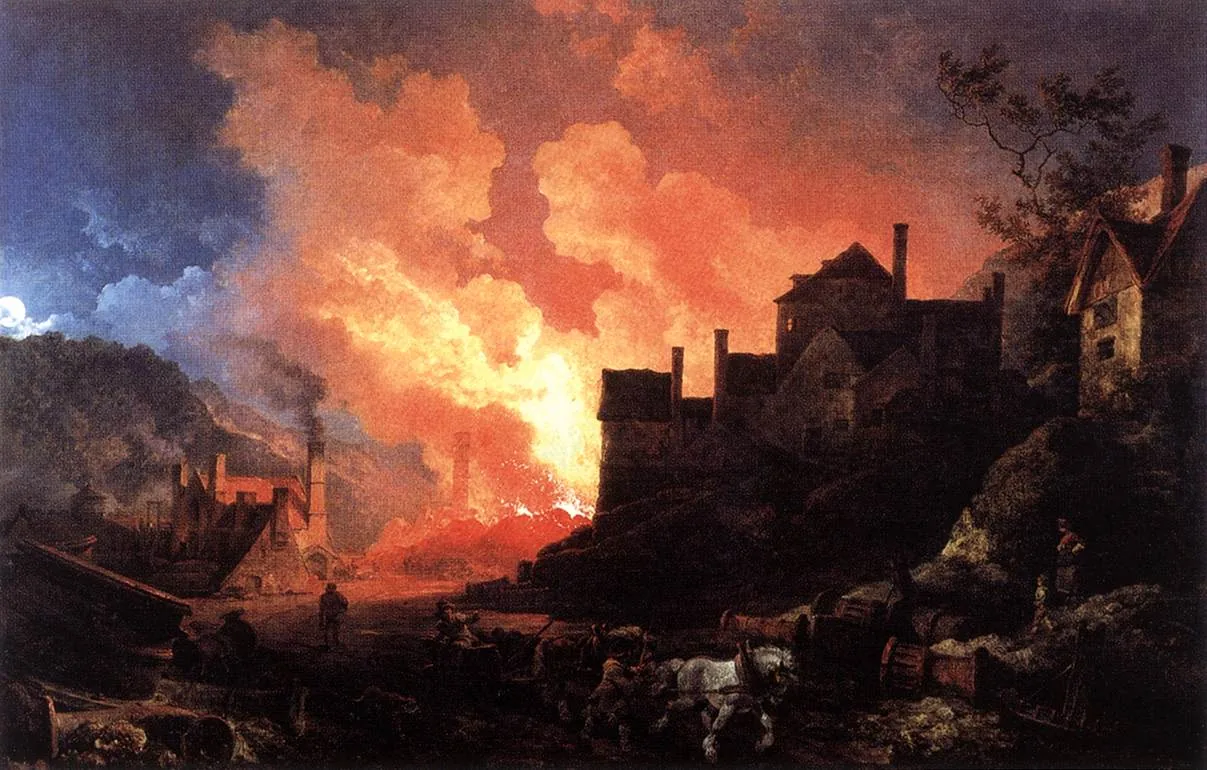
The painting shows the Madeley Wood furnaces at Coalbrookdale, in Shropshire, where the ironmaster Abraham Darby had first smelted iron with coke in 1709. The artist treats the furnaces as both frightening and grand, which is how many visitors felt about the new industry. Notice that it is a view from outside, painted for an audience that did not work there. For the point of view of a person inside an industrial economy, turn to the economist Adam Smith.
Document 1 – The division of labor in a pin factory
One man draws out the wire; another straights it; a third cuts it; a fourth points it; a fifth grinds it at the top for receiving the head; to make the head requires two or three distinct operations; to put it on is a peculiar business; to whiten the pins is another; it is even a trade by itself to put them into the paper; and the important business of making a pin is, in this manner, divided into about eighteen distinct operations
Source: Adam Smith, An Inquiry into the Nature and Causes of the Wealth of Nations, 1776, book 1, chapter 1; Project Gutenberg, ebook 3300.
*Peculiar trade: a separate, specialized occupation. *Straight: to straighten.
Smith published this passage in 1776, a few years before steam-driven mills spread. His argument is about specialization: when each worker does one small task, the whole group produces far more. In the same chapter he reports that ten men in a small pin workshop made about twelve pounds of pins a day, more than 48,000 pins, or about 4,800 per worker. In contrast, one person working alone could not make twenty. The factory system applied this idea to machines and steam. It also changed daily life. Workers had to arrive at fixed hours and follow the pace of the machine, not the rhythm of the seasons.
Spread of industry and new transport
Britain tried to keep its lead by banning the export of machines and skilled workers, but the knowledge crossed borders anyway. Belgium, with its own coal and iron, industrialized in the 1820s and 1830s. In the United States, textile mills appeared in New England from the 1810s and 1820s. Railroads linked the coasts after the completion of the transcontinental line in 1869.
Germany, unified in 1871, built its power on the coal of the Ruhr valley and on chemicals and steel. Russia began large-scale railway building after its defeat in the Crimean War (1853-1856) and the emancipation of the serfs in 1861. The Trans-Siberian Railway began in 1891. Japan is the most striking case outside the Atlantic world, as Section 4 explains.
Transport and communication
New transport and communication technologies shrank distance. Railways cut travel times on land. Steamships, especially after the iron-hulled and screw-propeller designs of the 1840s and 1850s, made ocean crossings faster and more reliable. The telegraph, which carried its first long-distance message in the United States in 1844, and undersea cables, which crossed the Atlantic permanently in 1866, allowed news and orders to travel in minutes. The Suez Canal (1869) cut the sea route between Europe and Asia by thousands of miles. The Panama Canal followed in 1914.
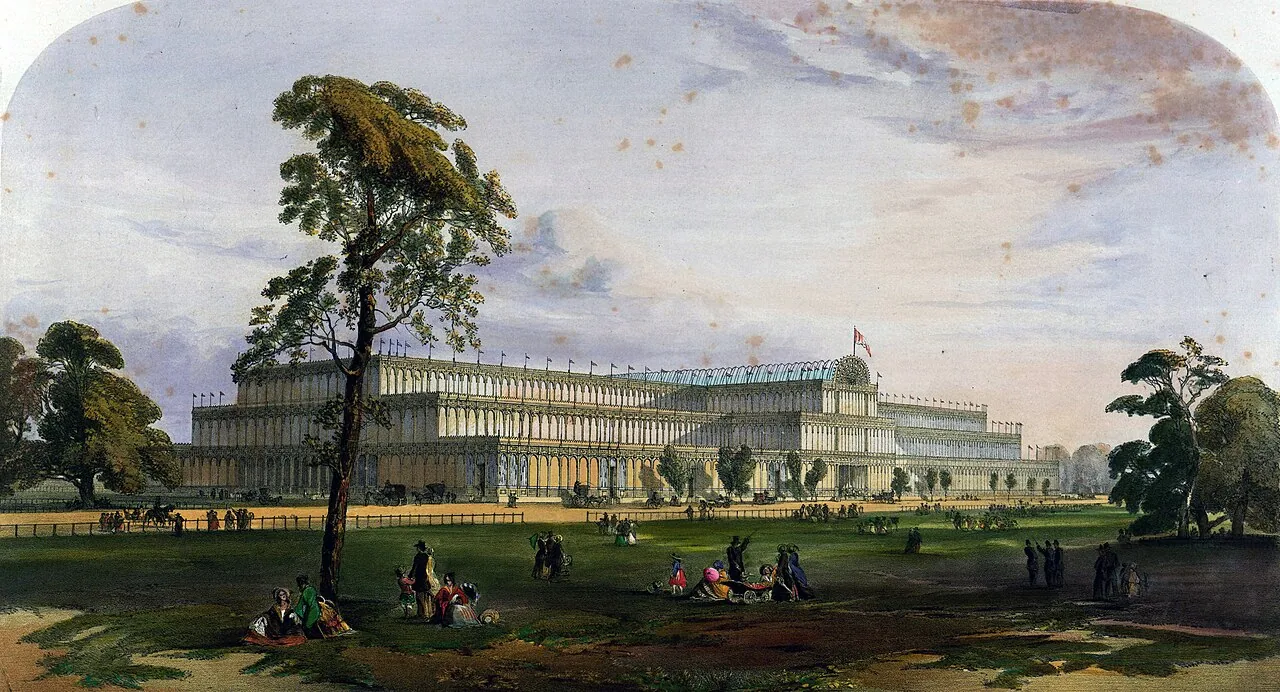
The Great Exhibition of 1851 in London’s Crystal Palace was Britain’s own showcase of confidence. More than six million visits were made to it, and it displayed machines, textiles, and raw materials from around the empire. Its message was that industry meant progress and that Britain stood at the front of the line.
Definition: Capitalism
an economic system in which individuals and companies own the means of production (land, factories, machines) and compete in markets to earn profit. In the nineteenth century, many thinkers defended laissez-faire capitalism, the idea that governments should leave the economy alone.
2. Society and politics in the industrial age
Cities, classes, and the working poor
Industry pulled people toward the mills, and cities grew fast. Manchester, Birmingham, Leeds, and Glasgow expanded from towns into large cities; later Essen, Pittsburgh, and Osaka did the same. Housing was often crowded, with open sewers and polluted water. Cholera epidemics struck industrial cities repeatedly in the 1830s to 1850s. Reformers such as Edwin Chadwick argued that clean water and sewers were a public duty.
Factory owners and merchants formed a prosperous middle class, while wage workers made up a growing working class. Many mills employed women and children, who were paid less than men and could work on small machines. Parliament passed the Factory Act of 1833 to limit the hours of children in textile mills. It passed the Mines Act of 1842 to ban women and young children from underground work. It also passed the Ten Hours Act of 1847 to limit the hours of women and young people in textile factories.
Document 2 – Over London by rail
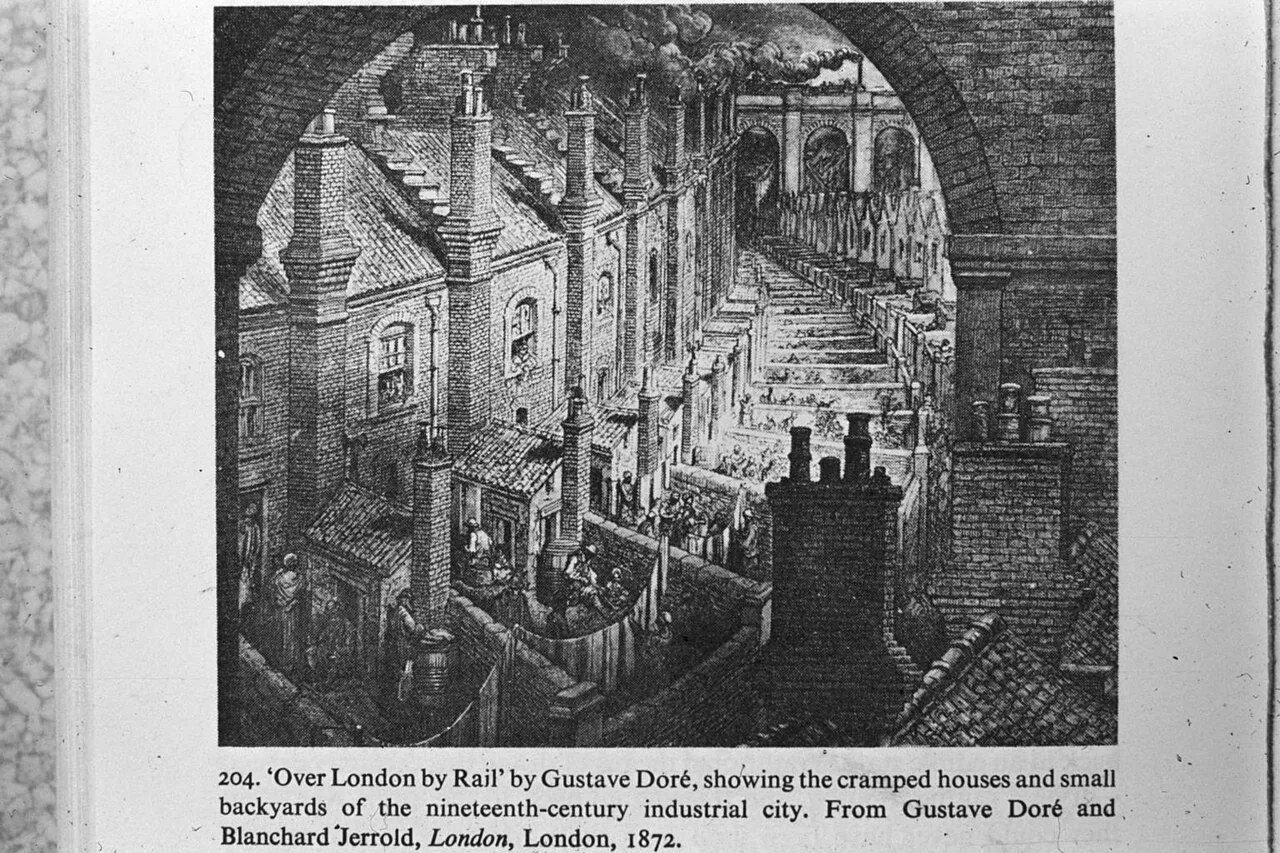
Doré made this engraving for a book on London that appeared in 1872. A railway viaduct looks down on the roofs and tiny yards of working-class houses. The picture shows two sides of industrial change: the railway, a symbol of progress, passes over families who live in cramped, dirty conditions. When you analyze such an image, ask who made it, for whom, and what point of view it takes. Doré and his writing partner were outsiders visiting the poor districts, and their book was meant for middle-class readers.
Reform, unions, and socialism
Workers responded by organizing. In Britain, trade unions were legalized in 1824 and 1825, although strikes remained risky. The Chartists in the late 1830s and 1840s demanded the vote for all adult men. Governments responded with factory laws, public health acts, and, gradually, wider voting rights. Others looked for more radical answers. Socialism arose as a set of ideas that criticized private ownership of factories and called for shared or public ownership.
In 1848, Karl Marx and Friedrich Engels published The Communist Manifesto, which interpreted history as a struggle between classes. It predicted that the industrial workers, or proletariat, would overthrow the owners, the bourgeoisie. The pamphlet drew little attention in 1848. Its ideas spread widely after 1870, when socialist parties and unions grew in Germany, France, Britain, and Russia.
Document 3 – Marx and Engels on history and class
The history of all hitherto existing societies is the history of class struggles. Freeman and slave, patrician and plebeian, lord and serf, guild-master and journeyman, in a word, oppressor and oppressed, stood in constant opposition to one another, carried on an uninterrupted, now hidden, now open fight, a fight that each time ended, either in a revolutionary re-constitution of society at large, or in the common ruin of the contending classes.
Source: Karl Marx and Friedrich Engels, Manifesto of the Communist Party, 1848, part 1, English translation of 1888; Project Gutenberg, ebook 61.
*Patrician: a member of the noble class of ancient Rome. *Journeyman: a worker who had learned a trade and worked for a master.
Definition: Socialism
a political and economic theory that calls for the community, usually through the state, to own the major means of production so that wealth is shared more equally. Communism, in the Marxist sense, was the final stage of a classless society.
Other movements also grew in these years. Many reformers campaigned against slavery, and the British Empire abolished it in 1833 (with an “apprenticeship” period that ended in 1838). Russia freed its serfs in 1861, and the United States ended slavery in 1865. Women activists, many of whom had joined anti-slavery societies, began to demand the vote at meetings such as Seneca Falls, New York, in 1848. Liberals asked for constitutions and elected parliaments, and nationalism, the belief that people who share a language, history, or territory should form their own state, led to the unification of Italy (1861) and Germany (1871).
3. The age of imperialism
Why industrial states expanded
Industrial states needed raw materials such as cotton, rubber, and palm oil, markets for their goods, and places to invest their capital. Governments also wanted naval bases and coaling stations. The new weapons helped: steamships and gunboats could travel up rivers, repeating rifles and the Maxim gun gave small forces enormous advantage. The drug quinine also protected Europeans from malaria in tropical Africa. National pride and rivalry mattered too, as did new racial theories. Social Darwinism bent Charles Darwin’s ideas about biological evolution into a claim that some peoples were naturally fit to rule others. Many Europeans used it to justify empire.
Definition: Imperialism
a policy by which a state extends its power over other territories and peoples, by conquest, treaties, or economic control. The “New Imperialism” refers to the rapid European, American, and Japanese expansion from about 1870 to 1914.
Economic imperialism and the Opium Wars
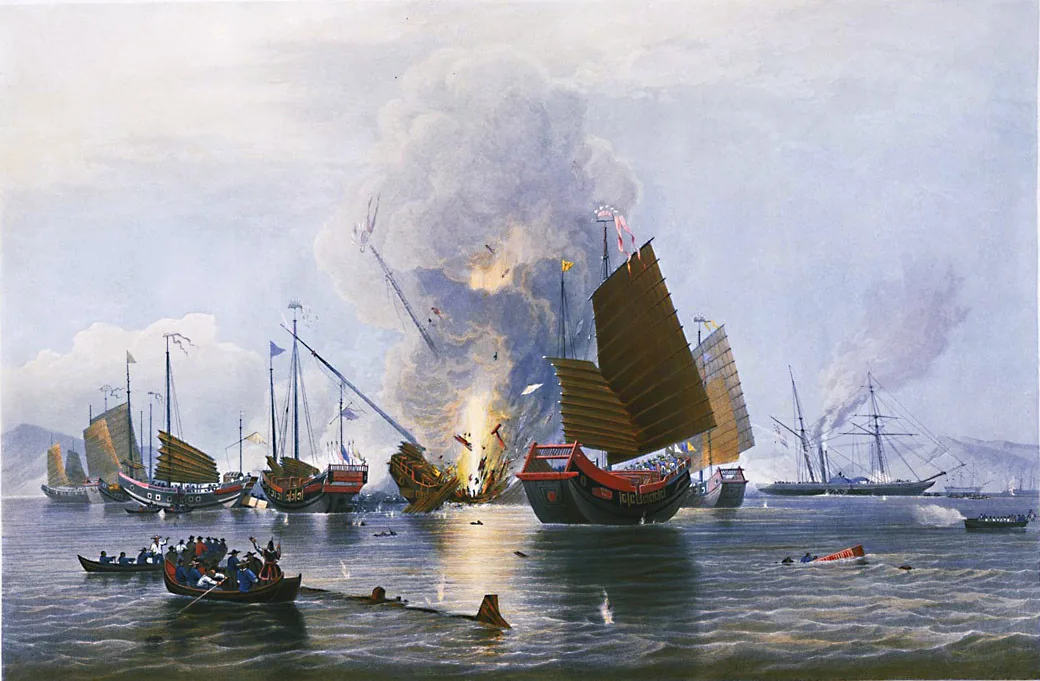
Control did not always mean flags and governors. In China, British merchants paid for tea and silk by selling Indian-grown opium, and by the 1830s millions of Chinese were addicted. In 1839 the imperial commissioner Lin Zexu seized and destroyed about 20,000 chests of opium at Canton. He also wrote an open letter to Queen Victoria. Britain responded with gunboats.
In the First Opium War (1839-1842) the Royal Navy, using steam-powered ships such as the Nemesis, defeated Qing forces. The Treaty of Nanjing (1842) ceded Hong Kong to Britain, opened five “treaty ports,” and set low tariffs on British goods. A second war (1856-1860) opened more ports and legalized the opium trade. Other powers, including France, Russia, Germany, Japan, and the United States, then claimed their own spheres of influence in China.
Document 4 – A Chinese official appeals to Queen Victoria
But, during the commercial intercourse which has existed so long, among the numerous foreign merchants resorting hither, are wheat and tares, good and bad; and of these latter are some, who, by means of introducing opium by stealth, have seduced our Chinese people, and caused every province of the land to overflow with that poison. […] Every native of the Inner Land who sells opium, as also all who smoke it, are alike adjudged to death.
Source: Lin Zexu (Commissioner Lin), open letter to Queen Victoria, 1839, as translated and printed at the time; Fordham University Internet Modern History Sourcebook.
*Tares: weeds that grow among wheat. *Inner Land: China. *Annihilation: complete destruction.
The Scramble for Africa and Asia
In 1800, Europeans controlled only the African coast and a few ports. By 1914, Britain, France, Germany, Belgium, Portugal, Italy, and Spain had divided almost the whole continent; only Ethiopia and Liberia remained independent. The immediate spark was a rivalry in central Africa. King Leopold II of Belgium used the explorer Henry Morton Stanley to claim the Congo basin as his private possession.
He would rule the Congo Free State from 1885 with notorious violence, until international protest led Belgium to take it over in 1908. To avoid war among themselves, fourteen states, including the United States, met at the Berlin Conference (1884-1885). No African ruler was invited. The conference set rules for claiming land. The powers drew borders on maps with little regard for local languages, kingdoms, or trade routes.
In South Asia, the British East India Company had already conquered most of India by the 1850s. After the Sepoy Rebellion of 1857, in which Indian soldiers and many civilians rose against Company rule, Parliament abolished the Company in 1858. It then governed through a viceroy. In Southeast Asia, the French took Indochina, the Dutch ruled the East Indies, and Britain held Burma and Malaya. In the Pacific the United States annexed Hawaii (1898) and took the Philippines from Spain after the Spanish-American War (1898). Empire was justified in many ways, by trade, by strategy, and by claims of a “civilizing mission.”
Document 5 – Imperialism in a French speech
Gentlemen, we must speak more loudly and more honestly! We must say openly that indeed the higher races have a right over the lower races […] I repeat, that the superior races have a right because they have a duty. They have the duty to civilize the inferior races […] In the history of earlier centuries these duties, gentlemen, have often been misunderstood; and certainly when the Spanish soldiers and explorers introduced slavery into Central America, they did not fulfill their duty as men of a higher race
Source: Jules Ferry, speech to the French Chamber of Deputies, July 28, 1885, in the debate on colonial credits; Fordham University Internet Modern History Sourcebook (translation).
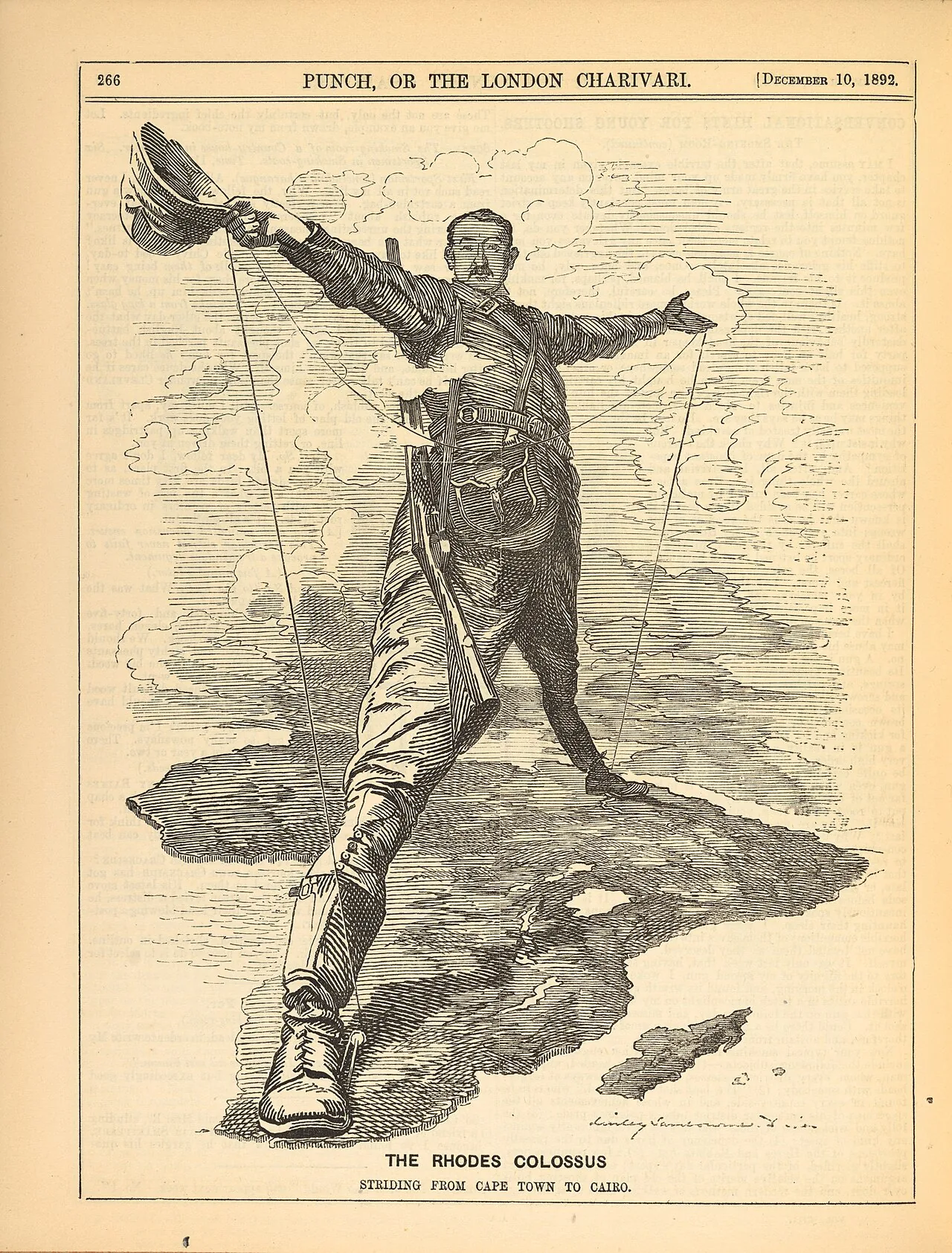
The cartoon shows Cecil Rhodes, founder of the De Beers diamond company and prime minister of the Cape Colony, as a giant bestriding Africa with a telegraph line. Rhodes dreamed of a railway and telegraph from Cape Town to Cairo, all on British territory. The cartoon turns that dream into a picture of power. Anyone using it as evidence must remember that it comes from a British humor magazine and comments on, rather than simply records, imperial ambition.
4. Responses, resistance, and migration
Reform and resistance
People in the colonized or threatened world did not stand still. Some resisted by force. The Sepoy Rebellion (1857) and the Boxer Uprising in China (1899-1901) were attacks on foreign power. A large Taiping Rebellion (1850-1864), led by Hong Xiuquan, shook the Qing dynasty from within and cost millions of lives. In East Africa, the Maji Maji Rebellion (1905-1907) rose against German rule. Ethiopia, under Emperor Menelik II, bought modern rifles and defeated an Italian army at Adwa in March 1896, an exceptional victory that kept the country independent.
Others tried to reform from above in order to compete. Egypt under Muhammad Ali (ruled 1805-1848) built a modern army and promoted cotton. The Ottoman Empire launched the Tanzimat reforms from 1839. Qing officials launched “self-strengthening” programs after the Opium Wars. The most successful response came in Japan. When American Commodore Matthew Perry arrived in Edo Bay in 1853 with steam-powered warships, Japan’s rulers, the Tokugawa shogunate, signed unequal treaties. A group of samurai leaders then overthrew the shogunate in 1868 in the Meiji Restoration and set out to build a strong state.
Document 6 – The Charter Oath of 1868
By this oath we set up as our aim the establishment of the national weal on a broad basis and the framing of a constitution and laws. 1. Deliberative assemblies shall be widely established and all matters decided by public discussion. 2. All classes, high and low, shall unite in vigorously carrying out the administration of affairs of state. 3. The common people, no less than the civil and military officials, shall each be allowed to pursue his own calling so that there may be no discontent. 4. Evil customs of the past shall be broken off and everything based upon the just laws of Nature. 5. Knowledge shall be sought throughout the world so as to strengthen the foundations of imperial rule.
Source: the Charter Oath of the Meiji emperor, April 6, 1868, in Tsunoda, de Bary, and Keene, eds., Sources of Japanese Tradition, vol. 2.
*National weal: the welfare of the nation. *Imperial rule: the government of the emperor.
The Meiji government abolished the old class privileges of the samurai, created a conscript army and a national school system. It also built railways (the first line opened between Tokyo and Yokohama in 1872), and sent officials abroad to study. Japan adopted a constitution in 1889. By the 1890s it had become an industrial and imperial power: it defeated China in 1894-1895 and took Taiwan. It also defeated Russia in 1904-1905.
Global migration
Industry and empire set millions of people in motion. Farm families moved to cities. After Britain ended slavery, planters in the Caribbean, Mauritius, Natal, and Fiji recruited indentured workers from India and China under contracts that were often close to forced labor. Chinese workers went to Southeast Asia, Peru, Cuba, and California, where they helped build railroads. Fear of this labor led the United States to pass the Chinese Exclusion Act in 1882, the first major federal law to restrict immigration by nationality. Australia, Canada, and South Africa also passed similar laws.
Europeans on the move
Europeans left home in even larger numbers, headed for the Americas, Australia, and southern Africa. The Irish came after the potato famine of the 1840s (more than a million died and a million or more emigrated). Later came Italians, Germans, Poles, and Jews fleeing hardship and persecution. Many migrants hoped to return home with savings; many stayed.
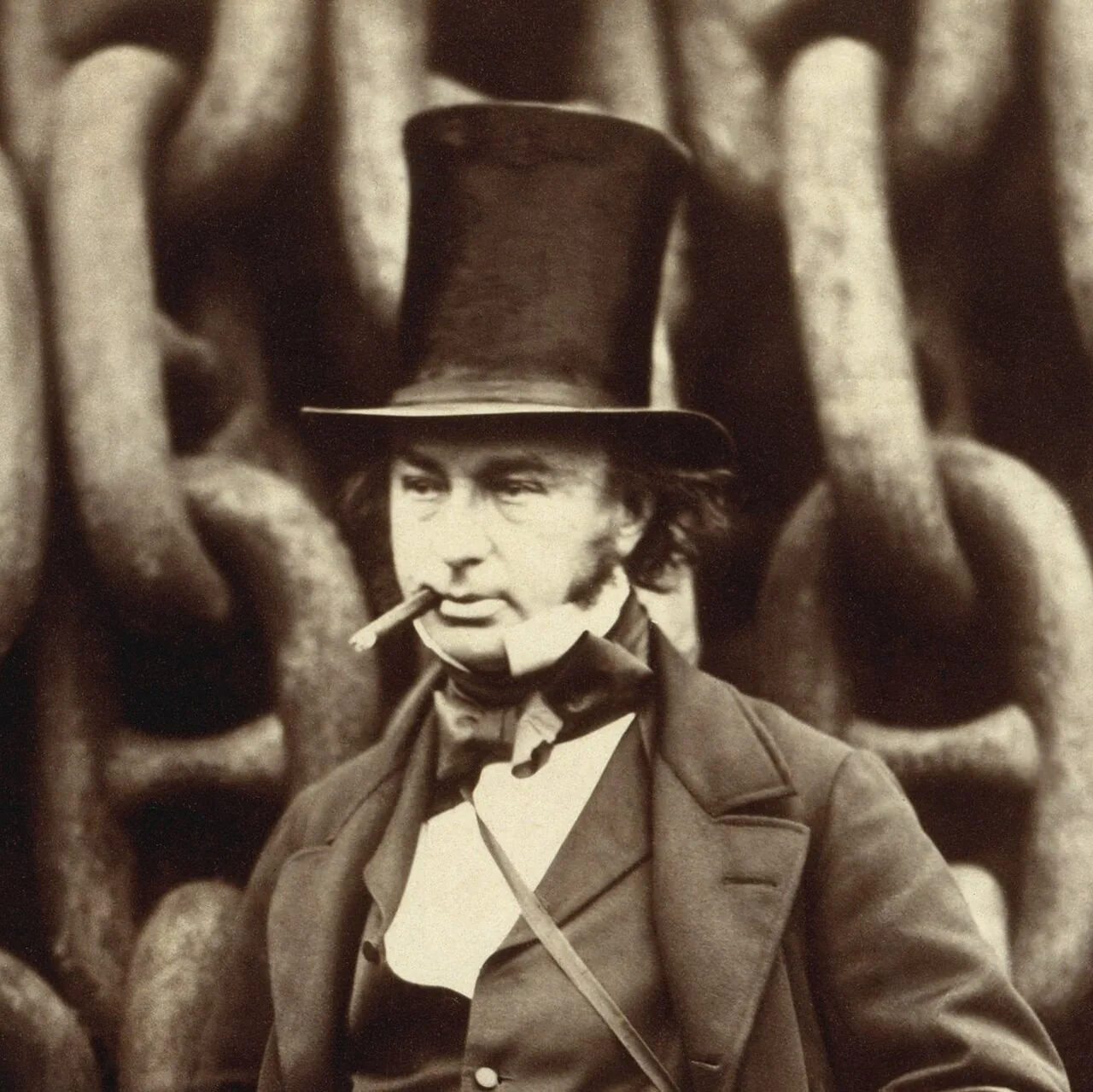
The portrait of Brunel, in front of the huge chains used to launch his steamship Great Eastern in 1857, makes a fitting end. Britain’s engineers, owners, and navy had built a world connected by iron and steam. The consequences, as you have seen, were enormous and uneven: new wealth and new poverty, new freedoms and new forms of control, and a world divided between industrial powers and the places they used as sources of materials, markets, and labor.
- 1764 The spinning jenny, invented by James Hargreaves, speeds up thread making
- 1769 Watt’s steam engine patent; Arkwright’s water frame
- 1830 Liverpool and Manchester Railway opens
- 1833 Britain abolishes slavery in most of its empire; Factory Act
- 1839-1842 First Opium War between Britain and Qing China
- 1848 The Communist Manifesto published
- 1853-1854 Perry opens Japan to American trade
- 1857-1858 Sepoy Rebellion; Crown replaces East India Company in India
- 1868 Meiji Restoration in Japan
- 1869 Suez Canal and U.S. transcontinental railroad open
- 1884-1885 Berlin Conference on Africa
- 1896 Ethiopia defeats Italy at Adwa
Key takeaways
- Industrialization began in Britain in the 1700s because of coal and iron, capital, stable government, empire, and agricultural change, and then spread to Europe, the United States, and Japan.
- Industry brought urban growth, new classes, and new protest: unions, factory laws, and socialism.
- Industrial states pursued empire for raw materials, markets, and prestige, and used steamships, guns, and medicine to win; the Scramble for Africa followed the Berlin Conference (1884-1885).
- Responses varied: rebellion (Sepoy, Taiping, Boxer), resistance (Ethiopia), and reform (Egypt, Ottoman Empire, Meiji Japan).
- Millions migrated, as free workers, indentured laborers, and refugees, and many receiving countries passed laws to restrict newcomers.

Quick review: flashcards
Tap a card to see the answer.