


This AP World History: Modern lesson covers AP World Unit 8: Cold War and Decolonization, part of the unit “AP World units.” First, read the full lesson with its primary sources, maps and key terms. Then practice with the worksheet, check yourself with the quiz and get ready with the test.
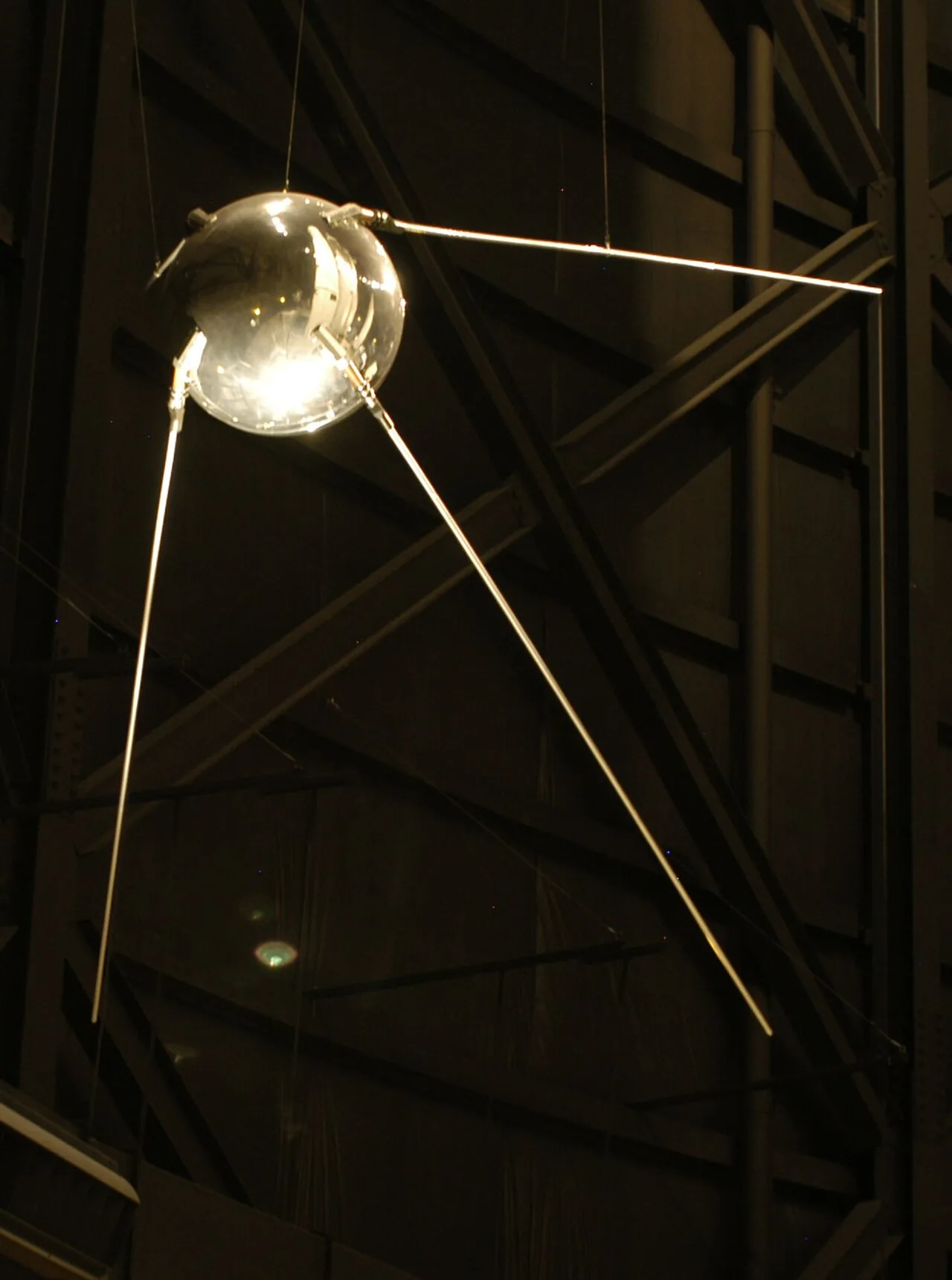
On October 4, 1957, a polished metal sphere about the size of a beach ball began to circle the Earth, sending out a steady beeping radio signal. Sputnik 1 was the first artificial satellite, launched by the Soviet Union. To many Americans, the beeping was the sound of a rival that could also build rockets able to reach their cities. In the Soviet Union it was a triumph. Sputnik captures the spirit of an age in which two superpowers, each armed with nuclear weapons, competed for power in space and on every continent. At that very moment dozens of colonies were becoming independent nations and had to decide which side, if any, to join.
Guiding question: How did the rivalry between two superpowers and the end of European empires reshape the world between 1945 and 1991?
This unit follows the College Board framework for Unit 8, Cold War and Decolonization, c. 1900 to the present. Its key concepts are the ideological, political, and economic competition of the Cold War, the nuclear arms race, proxy wars, the end of colonial empires through both violent and nonviolent movements, and the new challenges that new states faced. Practice the skills of comparison, causation, and contextualization.
1. The origins of the Cold War
Two superpowers, two systems
In 1945, the Second World War left Europe and Asia in ruins. Two states emerged stronger than the rest. These were the United States, with the world’s largest economy and the atomic bomb, and the Soviet Union, whose Red Army controlled eastern Europe and whose armies had borne the heaviest losses of the war. They had been allies against Germany, but their systems were opposed.
The United States was a capitalist democracy that wanted open markets and free elections. The Soviet Union was a one-party communist state with a planned economy. It wanted friendly governments on its western border after being invaded twice in thirty years. Each side feared the other’s intentions. The result was the Cold War, a long contest for influence that never produced a direct war between the two superpowers.
Definition: Cold War
the period of rivalry and tension, from about 1945 to 1991, between the United States and its allies and the Soviet Union and its allies, fought by propaganda, economic aid, alliances, an arms race, and proxy wars rather than by direct battle between the two superpowers.
In eastern Europe, Soviet-backed communist parties took power in Poland, Hungary, Czechoslovakia, Romania, Bulgaria, and East Germany between 1945 and 1948. Winston Churchill described the division of Europe in a 1946 speech as an “iron curtain.” The American diplomat George Kennan argued in 1946-1947 that the United States should adopt a policy of containment, resisting any further spread of communism.
Definition: Containment
the American policy, set out after 1946, of stopping the spread of communism by diplomatic, economic, and military means, without trying to roll it back by direct war.
Containment in practice
The first major test came in Greece and Turkey, where Britain could no longer afford to support the governments. On March 12, 1947, President Truman asked Congress for $400 million in aid to both countries. He set out what became known as the Truman Doctrine.
Document 1 – The Truman Doctrine
At the present moment in world history nearly every nation must choose between alternative ways of life. The choice is too often not a free one. One way of life is based upon the will of the majority, and is distinguished by free institutions, representative government, free elections, guarantees of individual liberty, freedom of speech and religion, and freedom from political oppression. The second way of life is based upon the will of a minority forcibly imposed upon the majority. It relies upon terror and oppression, a controlled press and radio; fixed elections, and the suppression of personal freedoms.
Source: President Harry S. Truman, address to a joint session of Congress, March 12, 1947 (the Truman Doctrine); Avalon Project, Yale Law School.
*Subjugation: bringing under control. *Infiltration: secret entry to take control from inside.
Truman presented the world as a choice between two ways of life. This was a simplification, but it shaped American policy for decades. The next step was economic. In June 1947, Secretary of State George Marshall proposed American help for the recovery of Europe. The European Recovery Program, or Marshall Plan, gave about $13 billion in grants and loans to Western European countries from 1948 to 1952. The Soviet Union refused the aid for itself and forbade its eastern European satellites from taking it.
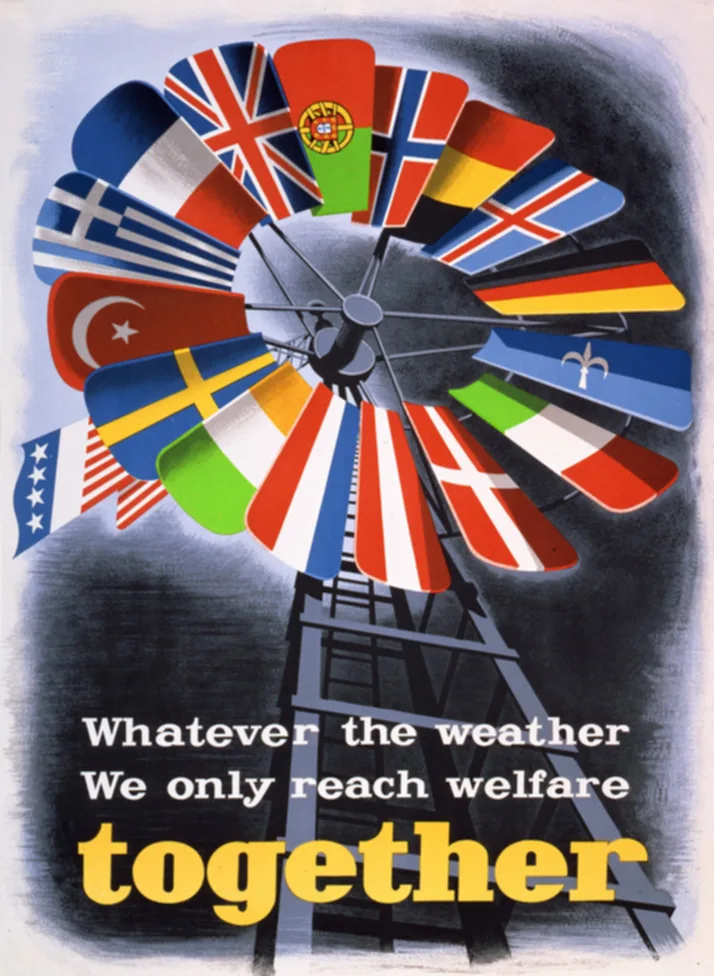
Germany became the center of the struggle. After the war it was divided into four occupation zones, and so was Berlin, deep inside the Soviet zone.
The Berlin crisis
In June 1948, the Soviet Union blockaded the western sectors of Berlin to force the Western powers out. For eleven months, American and British aircraft supplied the city in the Berlin Airlift, until the Soviets lifted the blockade in May 1949. In 1949 two German states were created: the Federal Republic of Germany in the west and the German Democratic Republic in the east. In April 1949 the United States, Canada, and ten Western European states formed the North Atlantic Treaty Organization, or NATO. The Soviet Union and its allies answered with the Warsaw Pact in 1955.
The Cold War turns global
In Asia the contest was just as fierce. Meanwhile, the Soviet Union tested its first atomic bomb in 1949, and the Chinese Communist Party led by Mao Zedong won the civil war and proclaimed the People’s Republic of China on October 1, 1949. The defeated Nationalists fled to Taiwan. In June 1950 North Korea, a Soviet-supported communist state, invaded South Korea. The United States and a United Nations force, mainly American, intervened, and China sent troops in the fall of 1950. After three years of war the armistice of July 1953 left Korea divided near the 38th parallel, as it still is.
2. Arms, proxies, and crises
Nuclear rivalry and the space race
Both sides built nuclear arsenals and, by the late 1950s, rockets able to carry them across oceans. Strategists spoke of mutually assured destruction: neither side could attack without being destroyed in return, which, they argued, made war irrational. The arms race was costly, and each new weapon drove the other side to build more. The race extended to space. After Sputnik, the United States created NASA (1958) and made science education a national priority. The Soviet Union put the first human, Yuri Gagarin, in orbit in April 1961. The United States landed astronauts on the Moon in July 1969.
Document 2 – A warning from a general turned president
We recognize the imperative need for this development. Yet we must not fail to comprehend its grave implications. Our toil, resources and livelihood are all involved; so is the very structure of our society. In the councils of government, we must guard against the acquisition of unwarranted influence, whether sought or unsought, by the military-industrial complex. The potential for the disastrous rise of misplaced power exists and will persist. We must never let the weight of this combination endanger our liberties or democratic processes. We should take nothing for granted. Only an alert and knowledgeable citizenry can compel the proper meshing of the huge industrial and military machinery of defense with our peaceful methods and goals, so that security and liberty may prosper together.
Source: President Dwight D. Eisenhower, farewell address, January 17, 1961; Avalon Project, Yale Law School.
*Councils of government: the bodies that make policy. *Meshing: fitting together.
Eisenhower, who had commanded the Allied armies in Europe, warned in his final speech that a permanent arms industry joined to the armed forces had become a new kind of power in American life. The passage also shows that Cold War rivalry shaped domestic politics, not only foreign policy.
Proxy wars and crises
Because direct war between the nuclear powers was so dangerous, they competed through proxy wars, supporting different sides in conflicts in other countries. Korea (1950-1953) was the first. In Vietnam, the communist Viet Minh under Ho Chi Minh had defeated France at Dien Bien Phu in 1954. The Geneva Accords divided the country at the 17th parallel, and the United States backed the government of South Vietnam.
American combat troops arrived in 1965. The war lasted until the Paris Peace Accords of 1973; North Vietnam took Saigon on April 30, 1975. In Latin America the United States helped overthrow elected or left-leaning governments, as in Guatemala in 1954. In Cuba, Fidel Castro’s revolution took power in 1959 and soon allied the island with the Soviet Union. The failed American-backed invasion at the Bay of Pigs in April 1961 deepened the hostility.
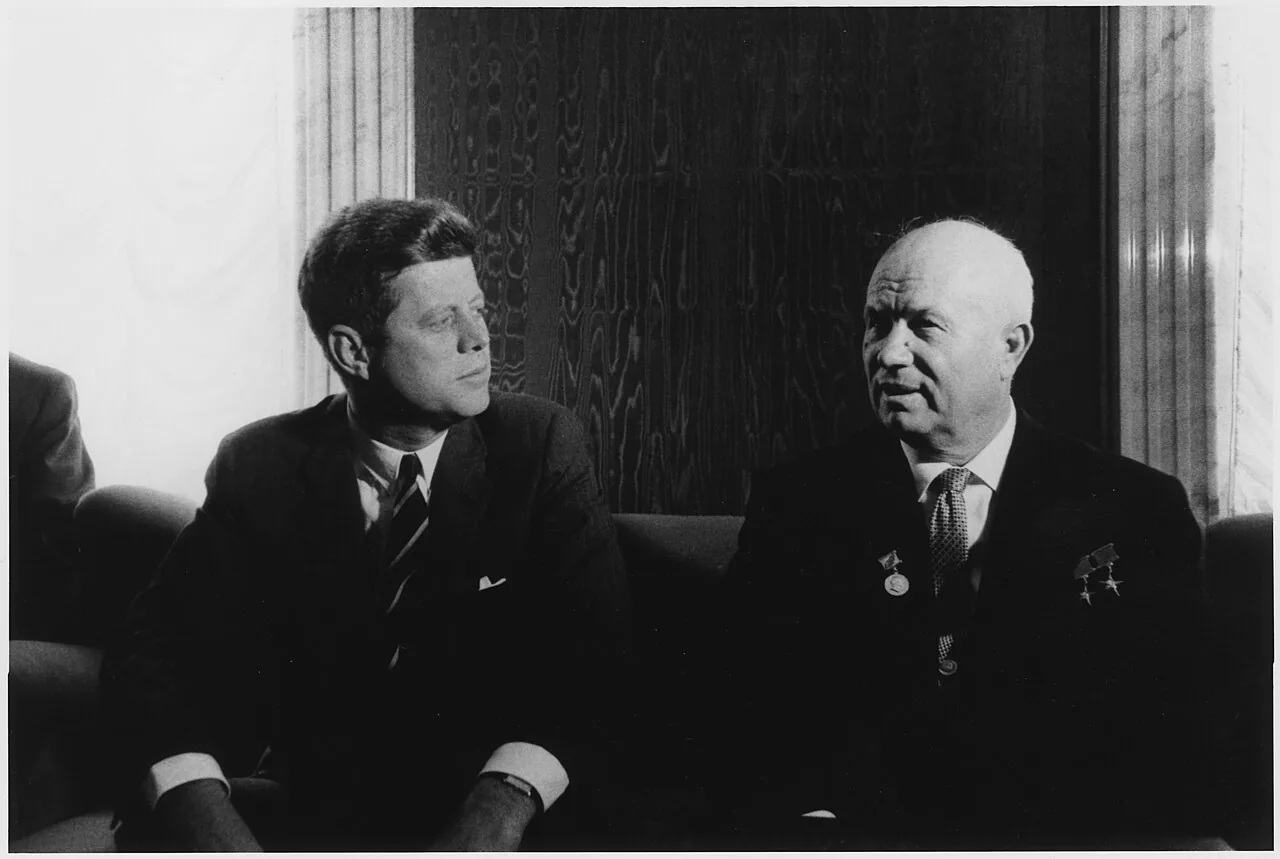
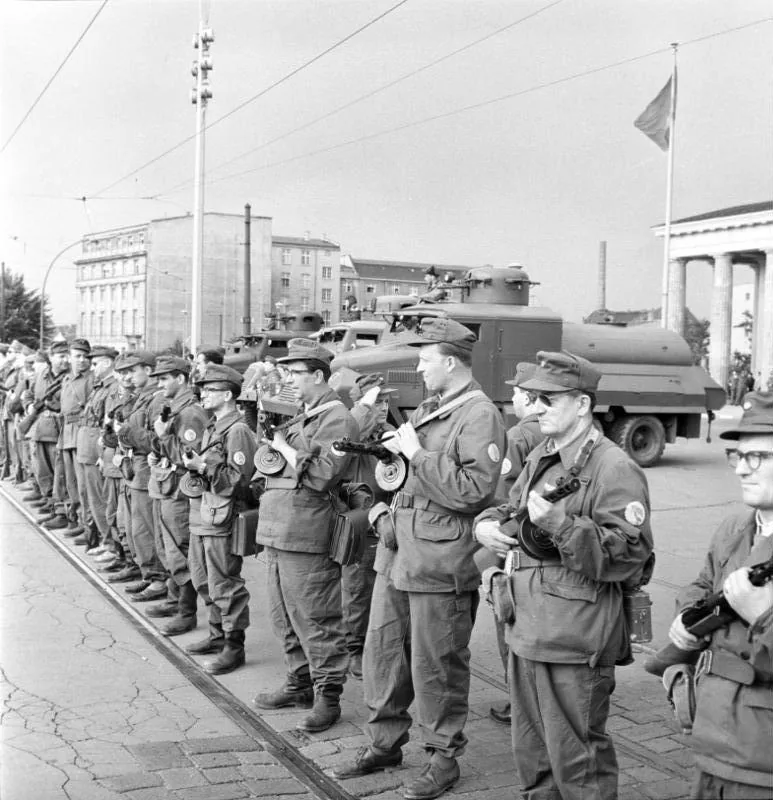
The most dangerous moments came in 1961 and 1962. At Vienna in June 1961, Kennedy and Soviet leader Nikita Khrushchev met and parted without agreement over Berlin.
Berlin and Cuba
Two months later, on August 13, 1961, East Germany began to close the border in Berlin with barbed wire and then a concrete wall. The aim was to stop the flight of its citizens to the West. The Berlin Wall stood until 1989.
Definition: Proxy war
a conflict in which major powers support opposing sides in another country, supplying money, weapons, or advisers, instead of fighting each other directly.
In October 1962, American reconnaissance planes found Soviet nuclear missile sites under construction in Cuba. Kennedy announced a naval “quarantine” of the island in a televised address.
Document 3 – The missile crisis speech
The purpose of these bases can be none other than to provide a nuclear strike capability against the Western Hemisphere. […] Each of these missiles, in short, is capable of striking Washington, D.C., the Panama Canal, Cape Canaveral, Mexico City, or any other city in the southeastern part of the United States, in Central America, or in the Caribbean area. […] It shall be the policy of this Nation to regard any nuclear missile launched from Cuba against any nation in the Western Hemisphere as an attack by the Soviet Union on the United States, requiring a full retaliatory response upon the Soviet Union.
Source: President John F. Kennedy, radio and television address on the Soviet missiles in Cuba, October 22, 1962; text from the Marxists Internet Archive.
*Offensive: for attack. *Retaliatory: in return for an attack.
For about thirteen days the world seemed close to nuclear war. The crisis ended when Khrushchev agreed on October 28 to remove the missiles. In return, the United States pledged not to invade Cuba and, secretly, agreed to remove its missiles from Turkey. Afterward, the two powers set up a telephone “hot line” and signed a treaty limiting nuclear tests (1963).
In the 1970s, a period of détente, they signed the first Strategic Arms Limitation Treaty (SALT I, 1972). President Richard Nixon also visited China in February 1972. Tension returned after the Soviet invasion of Afghanistan in December 1979. It ended only with the reforms of Mikhail Gorbachev after 1985 and the collapse of the Soviet system in 1989-1991, which is the subject of Unit 9.
3. The end of empires
Why decolonization came
The Second World War weakened Britain, France, and the Netherlands, which could no longer afford large empires. Colonial soldiers had fought for freedom in Europe and returned home with new expectations. The Atlantic Charter and the founding of the United Nations (1945) provided a language of self-determination. Both superpowers, for different reasons, opposed old-style colonialism. Nationalist movements in Asia and Africa, many of them led by leaders educated in Europe, organized mass campaigns.
India and South Asia
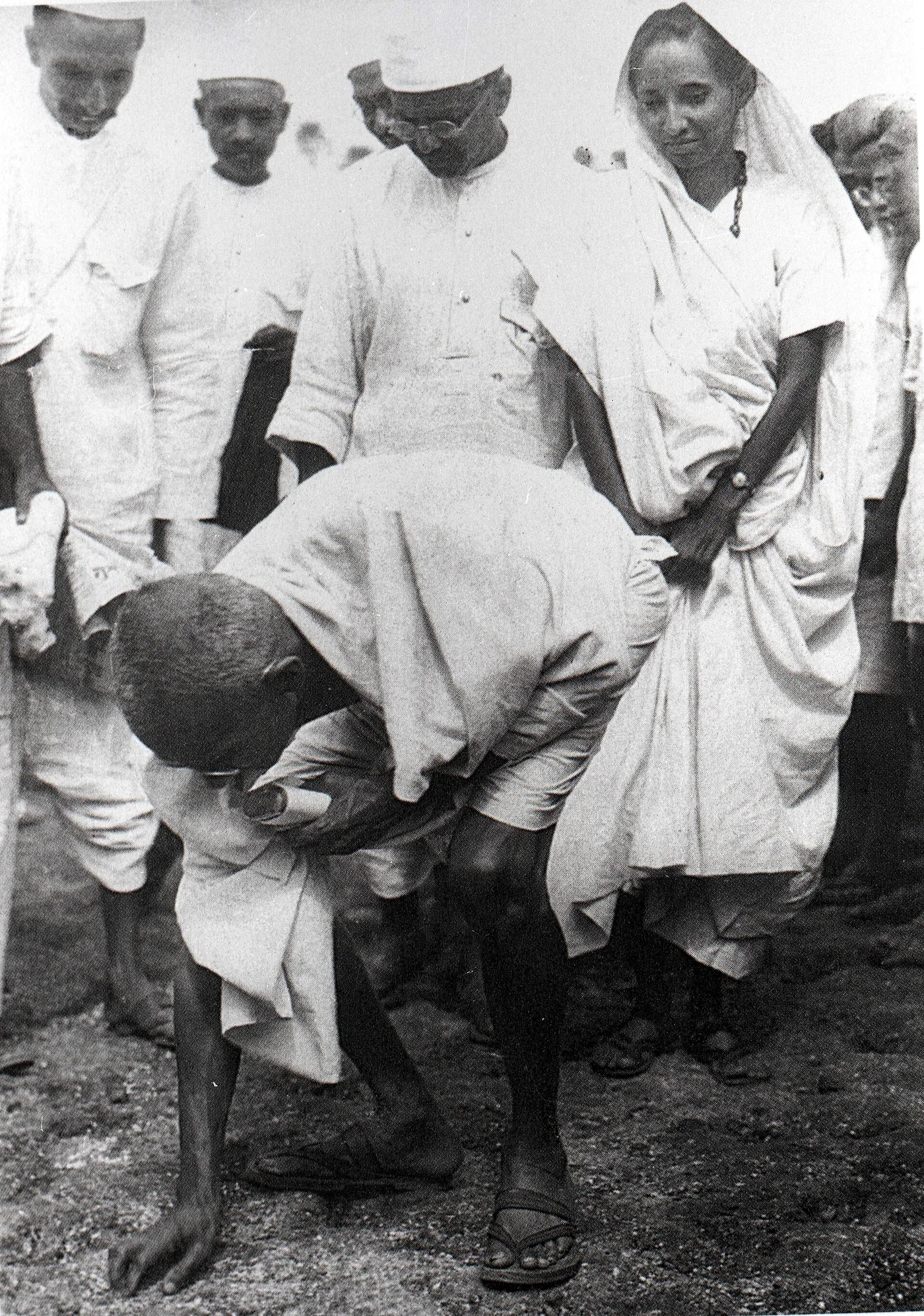
India offers the best-known example of a nonviolent movement. Mohandas Gandhi, who developed his method of satyagraha (insistence on truth) in South Africa, led the Indian National Congress in campaigns of boycott and civil disobedience. In 1930, he led a march of about 240 miles to the sea at Dandi to make salt in defiance of the British monopoly. Thousands followed him to jail.
After the Second World War, Britain agreed to leave. But the Muslim League led by Muhammad Ali Jinnah demanded a separate state for Muslims. In August 1947 Britain divided British India into two independent states, India and Pakistan. Partition caused terrible violence between Hindus, Muslims, and Sikhs and the displacement of millions of people. Gandhi was assassinated in January 1948 by a Hindu nationalist.
Document 4 – “A tryst with destiny”
Long years ago we made a tryst with destiny, and now the time comes when we shall redeem our pledge, not wholly or in full measure, but very substantially. At the stroke of the midnight hour, when the world sleeps, India will awake to life and freedom. A moment comes, which comes but rarely in history, when we step out from the old to the new, when an age ends
Source: Jawaharlal Nehru, speech to the Constituent Assembly of India, August 14, 1947 (“A Tryst with Destiny”); Fordham University Internet Modern History Sourcebook.
*Tryst: an appointment. *Redeem our pledge: fulfill a promise.
Southeast Asia and Africa
Elsewhere independence came through war. In Indonesia, Sukarno proclaimed independence on August 17, 1945; after four years of fighting, the Netherlands recognized it in December 1949. Meanwhile, in Vietnam, Ho Chi Minh declared independence on September 2, 1945, and the war against France followed. In Africa, Ghana, led by Kwame Nkrumah, became the first sub-Saharan colony to win independence on March 6, 1957. By 1960 “the year of Africa,” seventeen colonies became independent.
Kenya won independence in 1963 after the Mau Mau uprising. Algeria won after an eight-year war against France (1954-1962), in which hundreds of thousands died. Portuguese Angola and Mozambique won independence only in 1975, after Portugal’s government fell in 1974. In Southern Rhodesia, a white minority government declared independence in 1965, and Zimbabwe came to majority rule in 1980. South Africa kept its system of racial separation, apartheid, until the 1990s.
Definition: Decolonization
the process by which colonies became independent states, mostly between 1945 and the 1970s, through nonviolent campaigns, armed struggle, or negotiated transfers of power.
4. The new nations in a divided world
The new states faced many problems. Colonial borders had been drawn with little regard for ethnic groups, so many states contained rival peoples. Economies depended on a few export crops or minerals and on foreign firms. Some leaders warned of neocolonialism, the continued economic or political control of new nations by outside powers.
The Congo shows the dangers: it won independence from Belgium on June 30, 1960, but within weeks it was in crisis. The mineral-rich province of Katanga broke away, the United Nations sent troops, and the prime minister Patrice Lumumba was killed in January 1961 in a plot involving Congolese and Belgian forces. The Cold War deepened such conflicts, since the superpowers supplied weapons and money to rival groups.
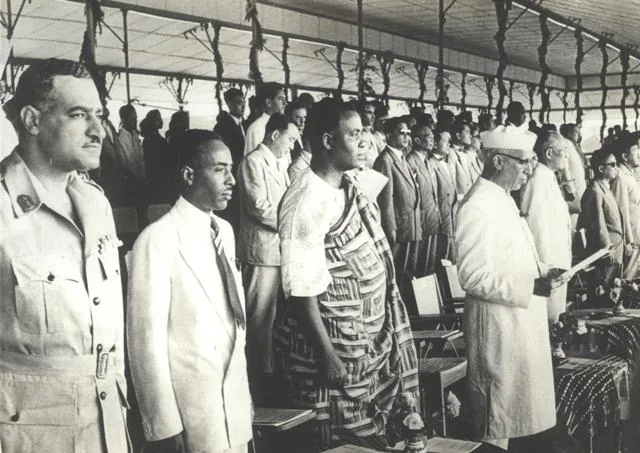
Some leaders refused to choose a side. In April 1955, twenty-nine African and Asian governments met at Bandung, Indonesia. Their final statement supported self-determination, human rights, and the equality of races, and condemned colonialism. In 1961, leaders including Nehru of India, Nasser of Egypt, Tito of Yugoslavia, and Nkrumah created the Non-Aligned Movement at Belgrade. In the Middle East, the Egyptian leader Gamal Abdel Nasser nationalized the Suez Canal in 1956. Britain, France, and Israel attacked, but pressure from the United States and the Soviet Union forced them to withdraw. This was a sign that the old imperial powers no longer decided the world’s fate.
Document 5 – Sukarno at Bandung
We are often told “Colonialism is dead.” Let us not be deceived or even soothed by that. […] How can we say it is dead, so long as vast areas of Asia and Africa are unfree. […] Colonialism has also its modern dress, in the form of economic control, intellectual control, actual physical control by a small but alien community within a nation. It is a skilful and determined enemy, and it appears in many guises. It does not give up its loot easily. Wherever, whenever and however it appears, colonialism is an evil thing, and one which must be eradicated from the earth.
Source: President Sukarno of Indonesia, speech at the opening of the Asian-African Conference, Bandung, April 18, 1955 (excerpts); Fordham University Internet Modern History Sourcebook.
*Eradicated: removed completely. *Guises: appearances.
Communist China, meanwhile, followed its own course. Mao’s Great Leap Forward (1958-1962) tried to speed up industry and agriculture through collectives and caused a famine that killed millions. The Cultural Revolution (from 1966) closed schools and persecuted many officials and intellectuals. After the break between China and the Soviet Union in the early 1960s, the communist world was no longer unified.
- 1947 Truman Doctrine; independence of India and Pakistan
- 1948-1949 Berlin Blockade and Airlift
- 1949 NATO founded; People’s Republic of China proclaimed
- 1950-1953 Korean War
- 1955 Bandung Conference; Warsaw Pact
- 1957 Sputnik; independence of Ghana
- 1961 Berlin Wall built
- 1962 Cuban Missile Crisis; Algerian independence
- 1965-1973 American combat role in Vietnam
- 1972 SALT I; Nixon visits China
- 1975 Fall of Saigon; independence of Angola and Mozambique
Key takeaways
- The Cold War was a contest between the United States and the Soviet Union that used alliances, aid, propaganda, and an arms race, but avoided direct war between them.
- Containment led to the Truman Doctrine, the Marshall Plan, NATO, and wars in Korea and Vietnam. The Berlin Wall and the Cuban Missile Crisis were the most dangerous moments.
- Decolonization came through nonviolent campaigns (India), armed struggle (Indonesia, Vietnam, Algeria), and negotiation, and produced dozens of new states by the 1970s.
- New states faced artificial borders, economic dependence, and Cold War pressure; many sought a middle course through Bandung and the Non-Aligned Movement.

Quick review: flashcards
Tap a card to see the answer.