


This worksheet on AP World Unit 8: Cold War and Decolonization belongs to the AP World History: Modern course. Its questions use primary sources, maps and timelines, and they move from basic recall to short writing tasks. Before you start, review the lesson; afterward, try the true or false quiz.
Exercise 1 : Vocabulary of the Cold War
Match each term to its definition: (a) containment, (b) proxy war, (c) neocolonialism, (d) détente, (e) Non-Aligned Movement, (f) satyagraha.
- A relaxation of tension between the superpowers in the 1970s.
- Gandhi’s method of nonviolent resistance.
- A conflict in which great powers support opposing sides in another country.
- The policy of stopping the spread of communism.
- Continued outside economic or political control of formally independent countries.
- A group of states that refused to join either superpower bloc.
Exercise 2 : The Truman Doctrine
Document 1 – Two ways of life
At the present moment in world history nearly every nation must choose between alternative ways of life. The choice is too often not a free one. One way of life is based upon the will of the majority, and is distinguished by free institutions, representative government, free elections, guarantees of individual liberty, freedom of speech and religion, and freedom from political oppression. The second way of life is based upon the will of a minority forcibly imposed upon the majority. It relies upon terror and oppression, a controlled press and radio; fixed elections, and the suppression of personal freedoms.
Source: President Harry S. Truman, address to a joint session of Congress, March 12, 1947 (the Truman Doctrine); Avalon Project, Yale Law School.
- Present the document (author, date, occasion).
- Describe the two ways of life that Truman contrasts.
- Identify which way of life he associates with the United States and which with its opponents.
- Explain how the speech helps justify aid to Greece and Turkey.
- Explain what the speech leaves out or simplifies.
Exercise 3 : The Truman Doctrine: the policy
Document 2 – The policy of the United States
I believe that it must be the policy of the United States to support free peoples who are resisting attempted subjugation by armed minorities or by outside pressures. I believe that we must assist free peoples to work out their own destinies in their own way. I believe that our help should be primarily through economic and financial aid which is essential to economic stability and orderly political processes.
Source: President Harry S. Truman, address to a joint session of Congress, March 12, 1947 (the Truman Doctrine); Avalon Project, Yale Law School.
*Armed minorities: small groups with weapons.
- Present the document (author, date).
- State the policy Truman declares.
- Identify the kind of help he says should be given.
- Explain how this policy relates to the idea of containment.
- Explain how a critic abroad, such as a leader of a colony, might have read this.
Exercise 4 : Eisenhower’s farewell address
Document 3 – The military-industrial complex
We recognize the imperative need for this development. Yet we must not fail to comprehend its grave implications. Our toil, resources and livelihood are all involved; so is the very structure of our society. In the councils of government, we must guard against the acquisition of unwarranted influence, whether sought or unsought, by the military-industrial complex. The potential for the disastrous rise of misplaced power exists and will persist. We must never let the weight of this combination endanger our liberties or democratic processes. We should take nothing for granted. Only an alert and knowledgeable citizenry can compel the proper meshing of the huge industrial and military machinery of defense with our peaceful methods and goals, so that security and liberty may prosper together.
Source: President Dwight D. Eisenhower, farewell address, January 17, 1961; Avalon Project, Yale Law School.
- Present the document (author, date, occasion).
- State what Eisenhower warns against.
- Explain what “an alert and knowledgeable citizenry” can do.
- Identify two features of the Cold War that explain his concern.
- Explain why this source is especially significant given the author’s own career.
Exercise 5 : Kennedy on the missiles in Cuba
Document 4 – October 22, 1962
The purpose of these bases can be none other than to provide a nuclear strike capability against the Western Hemisphere. […] Each of these missiles, in short, is capable of striking Washington, D.C., the Panama Canal, Cape Canaveral, Mexico City, or any other city in the southeastern part of the United States, in Central America, or in the Caribbean area. […] It shall be the policy of this Nation to regard any nuclear missile launched from Cuba against any nation in the Western Hemisphere as an attack by the Soviet Union on the United States, requiring a full retaliatory response upon the Soviet Union.
Source: President John F. Kennedy, radio and television address on the Soviet missiles in Cuba, October 22, 1962; text from the Marxists Internet Archive.
*Offensive: used for attack. *Hemisphere: half of the world; here, the Americas.
- Present the document (author, date, audience).
- Identify what Kennedy says the missiles can do.
- State the policy he announces toward missiles launched from Cuba.
- Explain why Kennedy chose a televised address.
- Name a limitation of this source for understanding Soviet motives.
Exercise 6 : Nehru and Indian independence
Document 5 – “A Tryst with Destiny”
Long years ago we made a tryst with destiny, and now the time comes when we shall redeem our pledge, not wholly or in full measure, but very substantially. At the stroke of the midnight hour, when the world sleeps, India will awake to life and freedom. A moment comes, which comes but rarely in history, when we step out from the old to the new, when an age ends
Source: Jawaharlal Nehru, speech to the Constituent Assembly of India, August 14, 1947 (“A Tryst with Destiny”); Fordham University Internet Modern History Sourcebook.
*Tryst: appointment. *Redeem a pledge: keep a promise.
- Present the document (author, date, occasion).
- Identify the “pledge” Nehru mentions.
- Describe the moment he says has come “rarely in history.”
- Explain how this speech reflects the aims of the nationalist movement.
- Explain what the speech leaves unsaid about the events of that same month.
Exercise 7 : Sukarno at Bandung
Document 6 – “Colonialism is not yet dead”
We are often told “Colonialism is dead.” Let us not be deceived or even soothed by that. […] How can we say it is dead, so long as vast areas of Asia and Africa are unfree. […] Colonialism has also its modern dress, in the form of economic control, intellectual control, actual physical control by a small but alien community within a nation. It is a skilful and determined enemy, and it appears in many guises. It does not give up its loot easily. Wherever, whenever and however it appears, colonialism is an evil thing, and one which must be eradicated from the earth.
Source: President Sukarno of Indonesia, speech at the opening of the Asian-African Conference, Bandung, April 18, 1955 (excerpts); Fordham University Internet Modern History Sourcebook.
- Present the document (author, date, occasion).
- State what Sukarno says about the claim that colonialism is dead.
- Identify the “modern dress” he gives colonialism.
- Explain the connection between colonialism and Cold War rivalry in the speech’s context.
- Explain how a historian should treat a speech opening a conference.
Exercise 8 : Two worlds, two speeches
Document 7 – Truman (1947)
At the present moment in world history nearly every nation must choose between alternative ways of life. The choice is too often not a free one. One way of life is based upon the will of the majority, and is distinguished by free institutions, representative government, free elections, guarantees of individual liberty, freedom of speech and religion, and freedom from political oppression. The second way of life is based upon the will of a minority forcibly imposed upon the majority. It relies upon terror and oppression, a controlled press and radio; fixed elections, and the suppression of personal freedoms.
Source: President Harry S. Truman, address to a joint session of Congress, March 12, 1947 (the Truman Doctrine); Avalon Project, Yale Law School.
Document 8 – Sukarno (1955)
We are often told “Colonialism is dead.” Let us not be deceived or even soothed by that. […] How can we say it is dead, so long as vast areas of Asia and Africa are unfree. […] Colonialism has also its modern dress, in the form of economic control, intellectual control, actual physical control by a small but alien community within a nation. It is a skilful and determined enemy, and it appears in many guises. It does not give up its loot easily. Wherever, whenever and however it appears, colonialism is an evil thing, and one which must be eradicated from the earth.
Source: President Sukarno of Indonesia, speech at the opening of the Asian-African Conference, Bandung, April 18, 1955 (excerpts); Fordham University Internet Modern History Sourcebook.
- Present each document.
- Identify how each author sees the world: Truman’s two ways of life, Sukarno’s colonialism.
- Compare how each speaker uses the idea of freedom.
- Explain what the contrast shows about the choices facing new nations.
Exercise 9 : Two nationalist voices
Document 9 – Nehru (1947)
Long years ago we made a tryst with destiny, and now the time comes when we shall redeem our pledge, not wholly or in full measure, but very substantially. At the stroke of the midnight hour, when the world sleeps, India will awake to life and freedom. A moment comes, which comes but rarely in history, when we step out from the old to the new, when an age ends
Source: Jawaharlal Nehru, speech to the Constituent Assembly of India, August 14, 1947 (“A Tryst with Destiny”); Fordham University Internet Modern History Sourcebook.
Document 10 – Sukarno (1955)
We are often told “Colonialism is dead.” Let us not be deceived or even soothed by that. […] How can we say it is dead, so long as vast areas of Asia and Africa are unfree. […] Colonialism has also its modern dress, in the form of economic control, intellectual control, actual physical control by a small but alien community within a nation. It is a skilful and determined enemy, and it appears in many guises. It does not give up its loot easily. Wherever, whenever and however it appears, colonialism is an evil thing, and one which must be eradicated from the earth.
Source: President Sukarno of Indonesia, speech at the opening of the Asian-African Conference, Bandung, April 18, 1955 (excerpts); Fordham University Internet Modern History Sourcebook.
- Present each document.
- Compare their tone: hopeful or warning?
- Identify one point of agreement.
- Explain how events between 1947 and 1955 might explain the difference in tone.
Exercise 10 : Gandhi at Dandi
Document 11 – Breaking the salt law
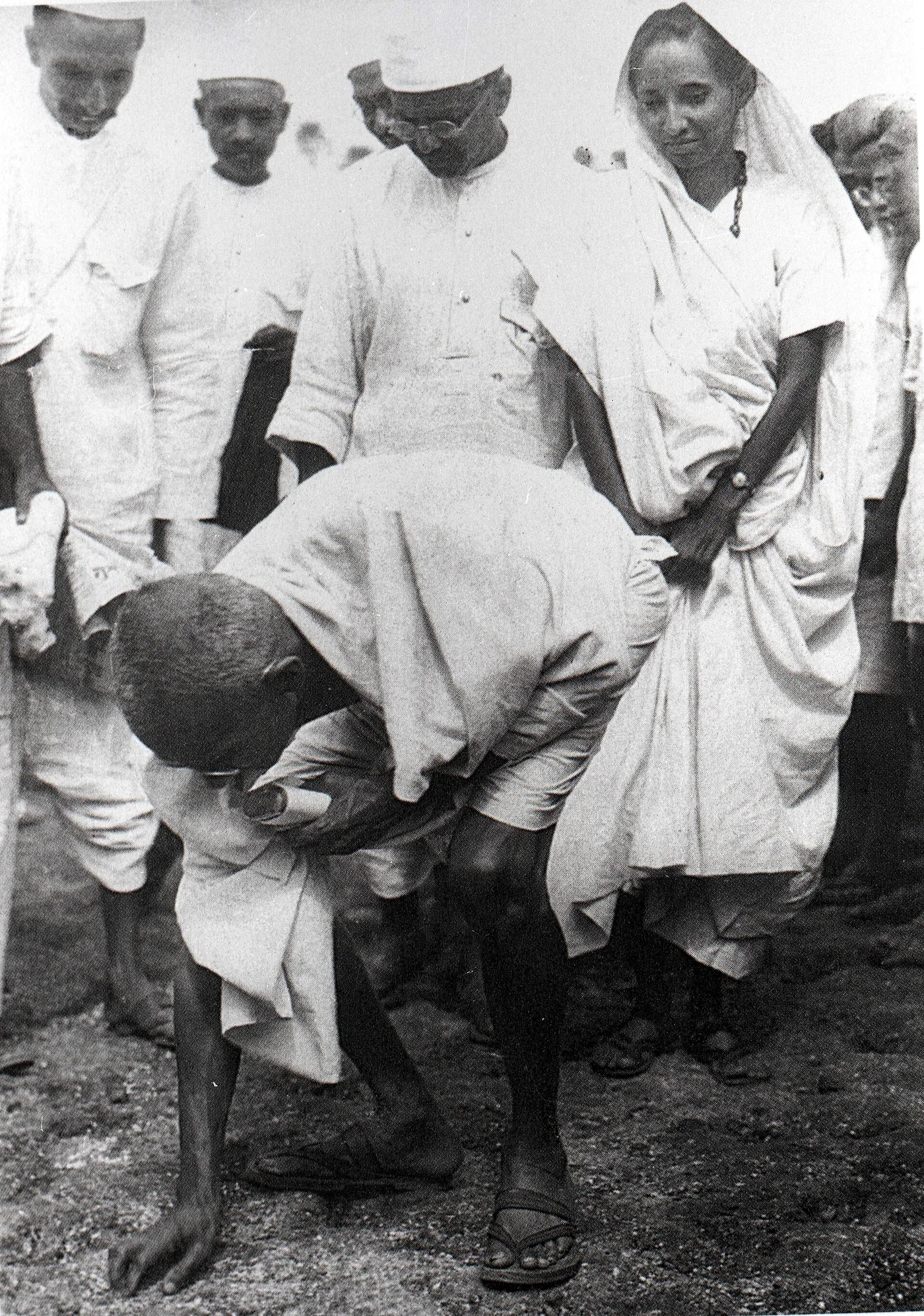
- Present the image (nature, place, date).
- Describe what Gandhi is doing.
- Explain why picking up salt was an act of civil disobedience.
- Explain one limit of the photograph as evidence.
Exercise 11 : The Berlin Wall
Document 12 – Guarding the border, August 1961
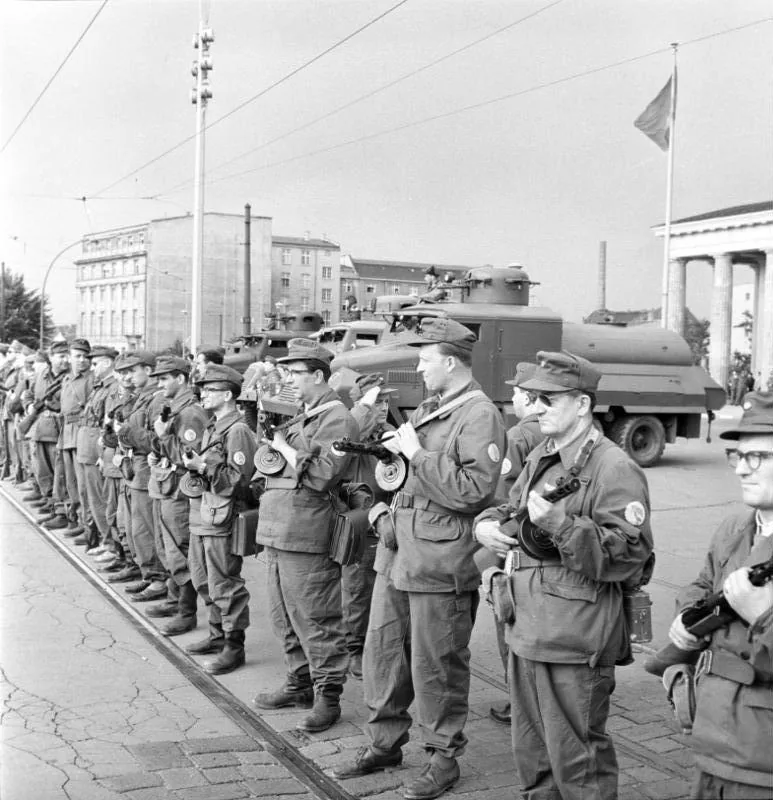
- Present the image (nature, place, date).
- Describe the men and what they carry.
- Explain why East Germany closed the border.
- Explain how the Wall became a symbol of the Cold War.
Exercise 12 : The missile site at San Cristóbal
Document 13 – Evidence from the air
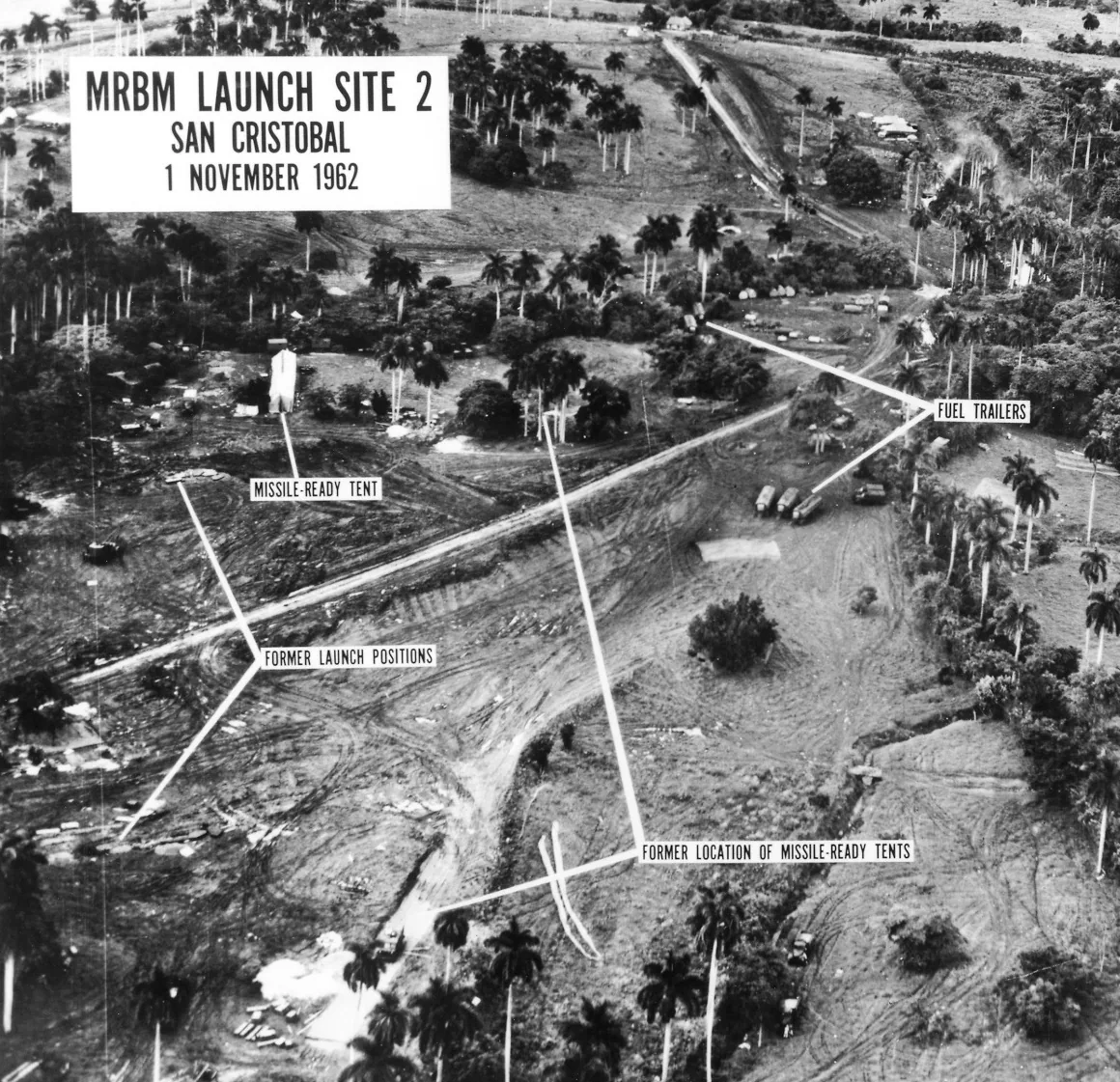
- Present the image (nature, place, date).
- Describe what the labels point to.
- Explain why aerial photographs were important in October 1962.
- Explain one limit of the photograph for a historian.
Exercise 13 : Delegates at Bandung
Document 14 – Asia and Africa meet
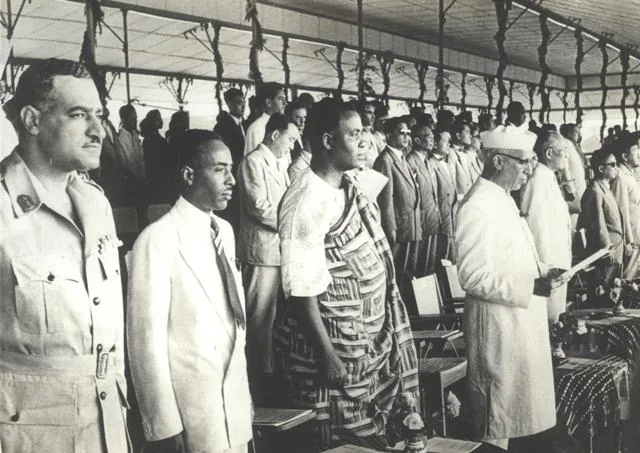
- Present the image (nature, place, date).
- Describe the people shown.
- Explain why the conference mattered for the newly independent nations.
- Explain what the image cannot tell us about the discussions.
Exercise 14 : Poster and speech: selling the Marshall Plan
Document 15 – A poster
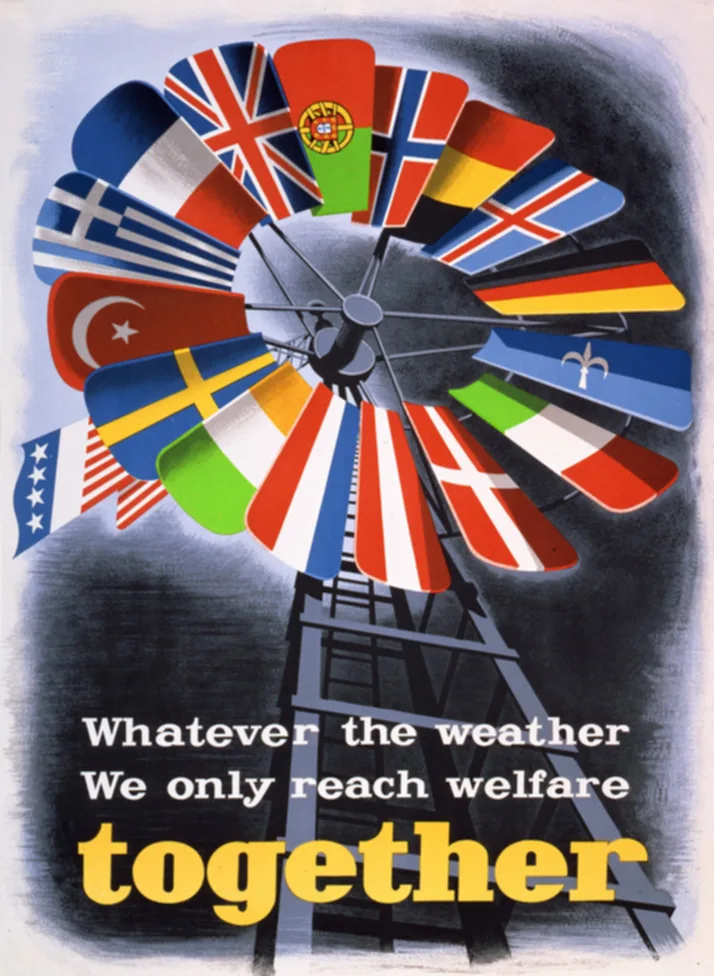
Document 16 – The Truman Doctrine
I believe that it must be the policy of the United States to support free peoples who are resisting attempted subjugation by armed minorities or by outside pressures. I believe that we must assist free peoples to work out their own destinies in their own way. I believe that our help should be primarily through economic and financial aid which is essential to economic stability and orderly political processes.
Source: President Harry S. Truman, address to a joint session of Congress, March 12, 1947 (the Truman Doctrine); Avalon Project, Yale Law School.
- Present each document.
- Identify the message of the poster.
- Explain how both sources promote American aid, in different ways.
- Name one reason why the Soviet Union rejected the Marshall Plan.
Exercise 15 : Dates of the Cold War
Use the table to answer.
| Date | Event |
|---|---|
| March 12, 1947 | Truman Doctrine |
| June 1948 – May 1949 | Berlin Blockade and Airlift |
| April 1949 | NATO founded |
| Oct. 1, 1949 | People’s Republic of China proclaimed |
| June 1950 – July 1953 | Korean War |
| Aug. 13, 1961 | Berlin Wall begins |
| Oct. 1962 | Cuban Missile Crisis |
| April 30, 1975 | Fall of Saigon |
Dates as given in standard reference works.
- Calculate the length of the Korean War in years.
- Which events show Germany as a center of the struggle?
- Calculate the years between the Truman Doctrine and the fall of Saigon.
Exercise 16 : Locate the divided Europe
Use Map 3. The numbers mark six places.
- Identify: 1 Berlin, 2 Moscow, 3 London, 4 Warsaw, 5 Athens, 6 Istanbul.
- Which capital lay inside East Germany?
- Which two states received American aid under the Truman Doctrine? Find them on the map.
- Explain why the position of Berlin made it a flashpoint.
Exercise 17 : Locate the new states
Use Map 4. The numbers mark nine capitals.
- Identify: 1 New Delhi, 2 Jakarta, 3 Accra, 4 Algiers, 5 Nairobi, 6 Kinshasa, 7 Luanda, 8 Harare, 9 Hanoi.
- Which of these capitals belonged to states that won independence after armed struggle against a European power?
- Which came last, in 1975 or 1980?
- Explain why most African states became independent after 1957.
Exercise 18 : Order the events
Put in order: (a) Bandung Conference, (b) independence of India, (c) Cuban Missile Crisis, (d) Truman Doctrine, (e) Berlin Wall, (f) independence of Ghana.
- Write the order with years.
- Which events belong to the period of decolonization in Asia?
- Which events were the most dangerous Cold War crises?
Exercise 19 : Durations
Calculate: (a) from the Marshall Plan speech (1947) to the end of the plan (1952); (b) from the Berlin Blockade (June 1948) to its end (May 1949), in months; (c) from the independence of Ghana (1957) to that of Zimbabwe (1980); (d) from the building of the Berlin Wall (1961) to its fall (1989).
Exercise 20 : Guided research: the Non-Aligned Movement
Mission: find out how the Non-Aligned Movement began.
- Search: Non-Aligned Movement Belgrade 1961 founders. Use an encyclopedia, a university site, or the UN.
- Fill in the card: the year and place of the first summit; the five founding leaders; two principles; one problem the movement faced.
- Explain in two sentences why nonalignment appealed to new states.
Hint: the Bandung Conference of 1955 is the background.
Exercise 21 : SAQ: the Cold War
Short-answer question.
- Identify ONE way the United States tried to contain communism after 1945.
- Identify ONE way the Soviet Union tried to expand its influence.
- Explain ONE way the Cold War affected a country in Africa or Asia.
Exercise 22 : LEQ: decolonization
Prompt. Compare the methods of decolonization in India and in Algeria.
- Write a thesis.
- List one similarity and one difference with evidence.
- Write a paragraph explaining one cause of the difference.
Exercise 23 : DBQ practice: reactions to the Cold War
Prompt. Evaluate the extent to which the documents show different views of the Cold War from 1947 to 1962.
Document A
At the present moment in world history nearly every nation must choose between alternative ways of life. The choice is too often not a free one. One way of life is based upon the will of the majority, and is distinguished by free institutions, representative government, free elections, guarantees of individual liberty, freedom of speech and religion, and freedom from political oppression. The second way of life is based upon the will of a minority forcibly imposed upon the majority. It relies upon terror and oppression, a controlled press and radio; fixed elections, and the suppression of personal freedoms.
Source: President Harry S. Truman, address to a joint session of Congress, March 12, 1947 (the Truman Doctrine); Avalon Project, Yale Law School.
Document B
We are often told “Colonialism is dead.” Let us not be deceived or even soothed by that. […] How can we say it is dead, so long as vast areas of Asia and Africa are unfree. […] Colonialism has also its modern dress, in the form of economic control, intellectual control, actual physical control by a small but alien community within a nation. It is a skilful and determined enemy, and it appears in many guises. It does not give up its loot easily. Wherever, whenever and however it appears, colonialism is an evil thing, and one which must be eradicated from the earth.
Source: President Sukarno of Indonesia, speech at the opening of the Asian-African Conference, Bandung, April 18, 1955 (excerpts); Fordham University Internet Modern History Sourcebook.
Document C
The purpose of these bases can be none other than to provide a nuclear strike capability against the Western Hemisphere. […] Each of these missiles, in short, is capable of striking Washington, D.C., the Panama Canal, Cape Canaveral, Mexico City, or any other city in the southeastern part of the United States, in Central America, or in the Caribbean area. […] It shall be the policy of this Nation to regard any nuclear missile launched from Cuba against any nation in the Western Hemisphere as an attack by the Soviet Union on the United States, requiring a full retaliatory response upon the Soviet Union.
Source: President John F. Kennedy, radio and television address on the Soviet missiles in Cuba, October 22, 1962; text from the Marxists Internet Archive.
- Write a thesis.
- State the point of view of each document.
- Name one additional document you would want.
Exercise 24 : Stimulus-based multiple choice
Stimulus
Long years ago we made a tryst with destiny, and now the time comes when we shall redeem our pledge, not wholly or in full measure, but very substantially. At the stroke of the midnight hour, when the world sleeps, India will awake to life and freedom. A moment comes, which comes but rarely in history, when we step out from the old to the new, when an age ends
Source: Jawaharlal Nehru, speech to the Constituent Assembly of India, August 14, 1947 (“A Tryst with Destiny”); Fordham University Internet Modern History Sourcebook.
*Tryst: appointment.
- The speech best reflects which development? (A) The spread of fascism (B) The end of colonial rule in South Asia (C) The Marshall Plan (D) Soviet expansion
- The speaker’s main purpose was most likely to (A) justify partition (B) mark the beginning of India’s independence (C) declare war (D) oppose the United Nations
- Which movement most directly shaped the speaker’s hopes? (A) The Indian National Congress (B) NATO (C) The Warsaw Pact (D) The League of Nations


Quick review: flashcards
Tap a card to see the answer.